 Ed Neuhaus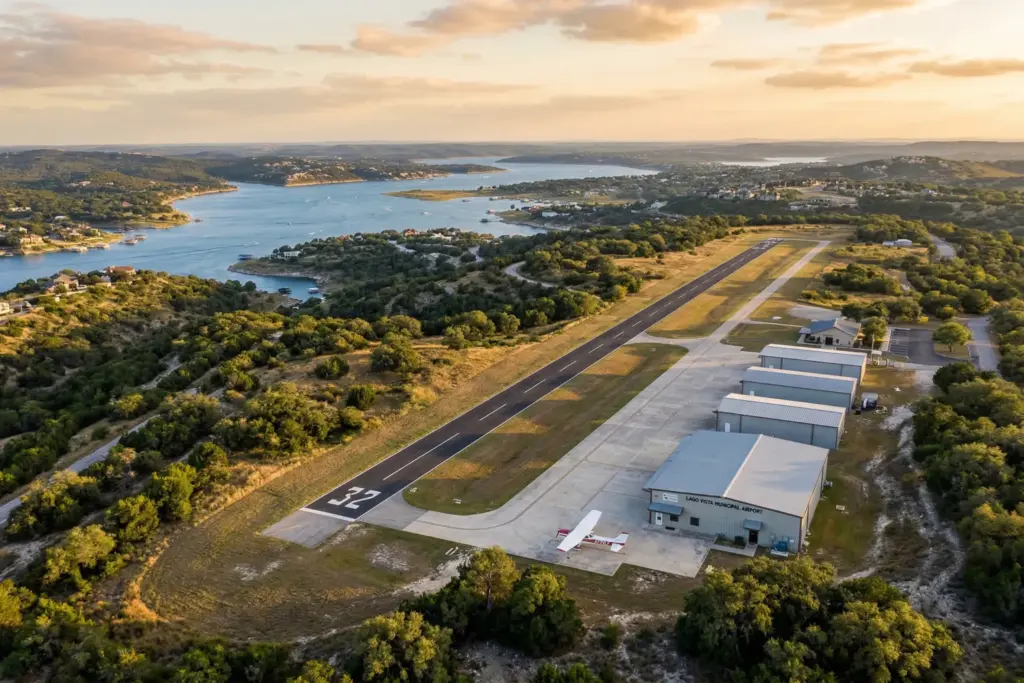
Lago Vista airport homes start in the high $200s with a 3,808-foot paved municipal runway two miles up the road. That’s Rusty Allen Airport (RYW), and for pilots who want Hill Country flying plus Lake Travis lifestyle without spending Lakeway Airpark money, this is the math that actually works. According to AirNav data, 83 aircraft are currently based at RYW, fuel runs $4.75 a gallon for 100LL, and there are zero landing fees. Not bad for a public municipal airport that most Austin pilots don’t even know about.
So lets talk about what you’re actually getting here, because Lago Vista and Rusty Allen are genuinely different from every other aviation community I cover in my fly-in communities guide. This is not a gated airpark. You don’t taxi from your hangar to the runway. But what you DO get is a real town with a real airport, and the gap between what that costs and what a Lakeway Airpark home costs is, well, significant.
A Quick History (Because This Airport Has a Great One)
The airport started life in 1951 as Bar K Airport, a caliche strip built to serve a local dude ranch. A dude ranch. In the Texas Hill Country. With its own airstrip. I love that.
By the early 1970s the runway had been realigned to its current 15/33 heading and paved with asphalt. It got lengthened, got lighting, and started attracting pilots who realized that the Hill Country northwest of Austin was a pretty great place to keep an airplane.
The big change came in 1994 when the City of Lago Vista took ownership. They renamed it after Rusty Allen, the former mayor who had been involved in basically every major airport improvement for over 20 years. And here’s a detail I love: Allen and a guy named George Eeds had co-owned a 1942 Piper L-4 Cub that was used for emergency stretcher evacuation during World War II. When the airport first started there were only 16 aircraft and 10 buildings on the field. Today there are 83 based aircraft. That’s a pretty solid growth story for a small municipal airport.
What Pilots Actually Need to Know About RYW
Ok lets get into the operational stuff because if you’re reading this you probably care about runway numbers more than neighborhood amenities (we’ll get to those).
Runway 15/33 is 3,808 feet by 50 feet of asphalt. That’s enough for most single-engine aircraft and a good number of light twins with room to spare. Both ends have 2-light PAPI visual slope indicators, which is nice for a field this size. The elevation sits at 1,231 feet MSL, so your density altitude calculations in a Texas summer are something you want to pay attention to (ask me how I know).
There’s no control tower. You’re on CTAF 122.725 and there’s an AWOS-3PT on 119.375 if you want to check conditions before you fly. The airport is staffed Monday through Friday, 8am to 6pm.
Fuel: 100LL available on field at $4.75 per gallon. Self-serve. For a municipal airport in the Austin metro that’s competitive.
Landing fees: None. You read that right. Fly in, park, walk to your car, drive home. Zero dollars.
The deer situation: I have to mention this because AirNav flags it and the city confirms it. Deer on and in the vicinity of the airport. This is Hill Country. There are deer everywhere. Just something to be aware of during your approach, especially dawn and dusk. Not a dealbreaker, just a factor.
One thing that sets RYW apart from the private airparks is that AOPA has designated it a destination airport. That means visiting pilots actually seek this place out. Makes sense when you think about it. You’ve got Lake Travis right there, Hill Country scenery on every approach, and no landing fees to worry about.
Lago Vista: The Town, Not Just the Airport
So here’s where the real estate conversation gets interesting. Lago Vista sits on the northern shores of Lake Travis, less than 20 miles from downtown Austin. The town started as a golf resort community (there’s still a municipal golf course), but it has evolved into something much more interesting over the past decade or so.
The population hit about 8,900 in the 2020 census, which was a 47% jump from 2010. That’s meaningful growth, but Lago Vista still feels like a small town. You’ve got POA-owned lakefront parks, a local brewery, a winery, the Hill Country Singers doing Broadway-scale productions (seriously), and enough restaurants that you don’t have to drive to Cedar Park every time you want dinner.
And then there’s the lake. Lake Travis access through the POA is a genuine lifestyle upgrade that you don’t get in most Hill Country communities. Boating, swimming, cliff jumping if that’s your thing. The whole scene.
For families, the area feeds into Lake Travis ISD, which is one of the stronger districts in the Austin metro. That matters if you’re relocating with kids and also happens to be a pilot who needs airport proximity. That’s a fairly specific Venn diagram, but I’ve met more people in it than you’d think.
The Real Estate Math (This Is Where It Gets Good)
Median home prices in Lago Vista are running somewhere between $380,000 and $475,000 depending on which month and which source you look at (the data varies, but the range is consistent). The average skews higher because there are some lakefront properties pushing into the $600s and above, but the median tells the real story.
Now compare that to what’s happening at Lakeway Airpark. If you want a home with an attached hangar and direct taxiway access at 3R9, you’re looking at pricing that starts in the high six figures and goes well north of a million. The Lakeway market overall has a median around $756,000 in early 2026.
So the delta between Lago Vista and Lakeway is roughly $300,000 to $400,000 on median. That’s a lot of avgas right. That’s years of hangar rent at RYW. That’s an engine overhaul fund. However you want to think about it, the savings are real.
But here’s the honest caveat (and I’m always going to give you the caveat). You are NOT getting taxiway-to-your-door at Lago Vista. Rusty Allen is a public municipal airport. You drive to the airport, pull your plane out of a hangar you lease from the city, and go fly. It’s a five minute drive from most homes in town, maybe ten from the far edges. That’s different from rolling your Cirrus out of your attached garage and taxiing to the numbers.
Benjamin Graham wrote about knowing exactly what you’re buying and what you’re paying for it. That applies here perfectly. You’re buying Lago Vista the town, Lake Travis the lifestyle, and RYW the airport as three separate but complementary things. The value is in the combination, not in one feature.
Who This Makes Sense For (And Who It Doesn’t)
Lets be direct about this.
Lago Vista makes a lot of sense if you:
- Fly recreationally and don’t need daily taxiway access
- Want Lake Travis lifestyle at a price point that doesn’t require selling your airplane to afford the house
- Are relocating to the Austin area and want to be near a good airport without living in a gated airpark
- Value a real town with restaurants and community over an HOA-controlled compound
- Fly a single-engine aircraft that’s comfortable on 3,800 feet (which is most of them)
It might NOT be your move if you:
- Need hangar-to-runway taxiway access from your property
- Fly something that wants more than 3,800 feet regularly
- Want the social structure of a dedicated aviation community where every neighbor is a pilot
And that’s fine. Different pilots want different things. I cover all the fly-in options in Central Texas because there genuinely is something for everyone out here.
What I Tell Pilot Buyers About Lago Vista
Here’s the thing I always say when someone calls me about aviation real estate in the Austin area. You have to decide what matters more: the airplane infrastructure or the lifestyle surrounding it. Because right now, in this market, you can optimize for one but you usually can’t maximize both without writing a very large check.
Lakeway Airpark gives you the infrastructure. Taxiway access, attached hangars, a community built around aviation. But you pay for it.
Lago Vista gives you the lifestyle. Lake Travis waterfront access, Hill Country living, a growing small town with character, and oh by the way there’s a perfectly good 3,800-foot runway with cheap fuel and no landing fees right up the road. And you pay considerably less for the whole package.
For most recreational pilots I work with, the Lago Vista equation wins. You fly on weekends, maybe a couple times during the week. You don’t need to taxi from your back yard. You need a good runway, available fuel, and a short drive. RYW checks all those boxes.
I’ve been selling homes in the Austin Hill Country for 19 years and I have my pilot’s license, so this is one of those rare topics where both halves of my brain actually get to work together. If you’re a pilot looking at the Austin area, lets talk. The aviation real estate landscape out here has more options than most people realize, and the right one depends entirely on how you fly and how you live.
Frequently Asked Questions
Ready to Explore Lago Vista?
If you’re a pilot shopping for a home in the Austin area and the Lago Vista equation sounds like it might work for you, give me a call. I fly out of this area, I sell homes in this area, and I can walk you through exactly what’s available near the airport right now. Lets grab coffee and talk airplanes and real estate. Two of my favorite subjects.


