 Ed
Ed 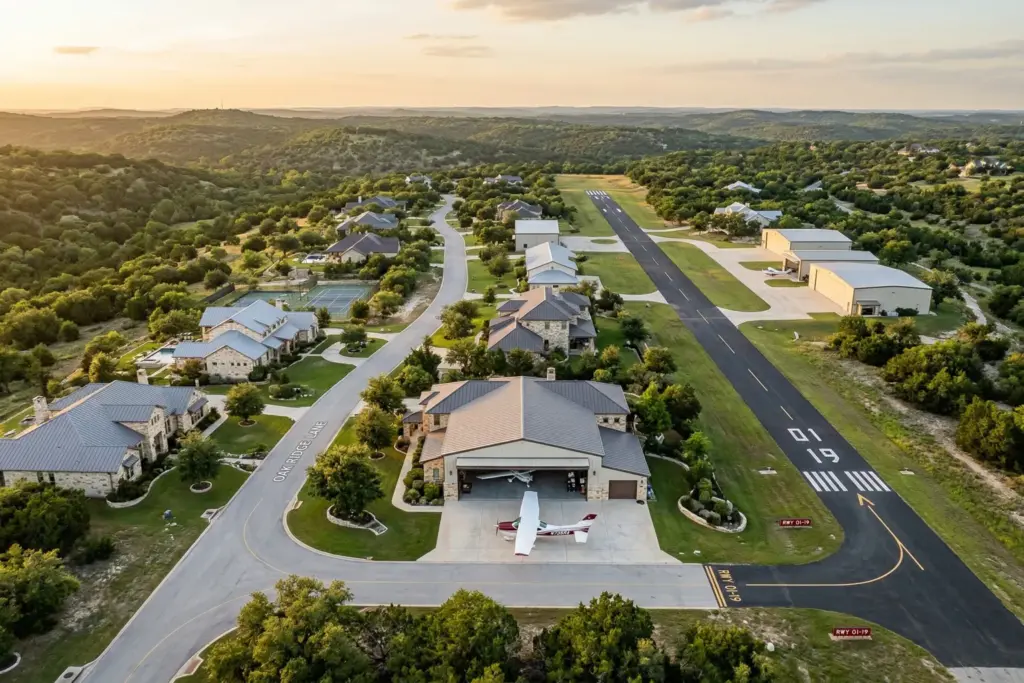
Airpark homes in the United States range from about $200,000 in rural Florida to over $19 million in Scottsdale-adjacent Arizona. According to the Living With Your Plane Association, there are roughly 426 residential airparks spread across the country, with Texas leading at 84 communities and Florida close behind at 79. So yeah, the pricing spread is enormous.
Sounds overwhelming right. But here’s the thing, once you understand the regional patterns, the numbers start making a lot more sense. And as someone who holds both a pilot’s license and a real estate broker’s license, I’ve spent a probably unhealthy amount of time studying this market. Lets break it down state by state.
Texas: The Most Airparks in America (and the Widest Price Range)
Texas has more residential airparks than any other state. 84 at last count. That alone tells you something about the culture here. Pilots in Texas have options, and that competition keeps pricing more accessible than you might expect.
Pecan Plantation (Granbury) is the story everyone should know about. The Landings airpark community there offers 0.75 to 1.5 acre taxiway lots starting at $189,900 with underground utilities, paved roads, and concrete taxiway access already in place. HOA runs $205 per month. They had their strongest sales month ever in August 2025, and transaction volume jumped 80% between Q2 and Q3. Only about 30 taxiway lots remain, which means this entry-level window is closing.
If you build on a Pecan Plantation lot, you’re looking at a total project (lot plus home plus hangar) somewhere in the $600K to $1.2M range depending on how much house and how much hangar you want. That’s remarkably accessible for what you’re getting.
The Austin area is a different animal. Lakeway Airpark (3R9) has 32 residences on a 3,930-foot paved runway, and homes there trade in the $800K to $2M+ range depending on lot size and condition. The Austin premium is real. I drive past this airpark regularly and the location is genuinely incredible (right on the edge of Hill Country with Lake Travis minutes away). But you’re paying Austin prices on top of the aviation premium.
Cross Country Ranch near Georgetown and Breakaway Park sit in that middle ground, roughly $500K to $1.5M. The Hill Country corridor has several smaller airstrips with homes ranging from $500K to well over a million.
DFW area communities like Hidden Valley tend to be more affordable, with homes starting in the mid-$200s and topping out around $1.5M. If budget matters more than scenery, North Texas airparks give you the lifestyle at a fraction of the Austin or Hill Country price.
Florida: Where Airpark Living Started (and Still Thrives)
Florida is basically tied with Texas for the most airparks in the country. The year-round flying weather helps.
Spruce Creek near Daytona Beach is the granddaddy of all fly-in communities. Over 1,300 homes, roughly 5,000 residents, and its own 4,000-foot runway. Spruce Creek spans an enormous price range because the community itself is so large and diverse. You can find a smaller home or townhouse in the $200K to $300K range (yes, really). A typical family home with taxiway access runs $400K to $800K. And the premium hangar estates push well past $1M, sometimes approaching $2M.
The median bounces around depending on what sold recently. I’ve seen it reported anywhere from $477K to over $1M in the same year. That’s not conflicting data, it’s just a community with everything from modest ranch homes to serious estates. Benjamin Graham would appreciate the value investing angle here. Spruce Creek is one of the few airparks where you can get in under $300K and still have runway access.
Leeward Air Ranch in Ocala is the more curated experience. A gated community with a 6,200-foot runway (which is serious runway for a residential airpark), tennis courts, community center. Homes that sold in the past year averaged around $750,000, with asking prices sometimes north of $900K. It’s a step up from Spruce Creek in terms of exclusivity.
And then there’s Jumbolair. That’s John Travolta territory. Multi-million dollar estates, a 7,550-foot runway that can handle a 707. If you have to ask the price on Jumbolair, you know the rest of that saying. I’m not even going to pretend I have comps there.
Arizona: Where Luxury Meets Aviation
Arizona airparks skew heavily toward the luxury end. The desert climate means year-round VFR flying, and the communities reflect that premium.
Stellar Airpark in Chandler sits right in the Phoenix metro area. Homes typically list between $1.3M and $3M+. You get the convenience of a major metro (Sky Harbor is right there) combined with residential runway access. It’s the kind of place where your neighbors are retired airline captains and business owners who fly their own Citations.
Pegasus Airpark in Queen Creek is something else entirely. This is where aviation meets equestrian living, and the numbers reflect it. The average list price across current homes is roughly $3.8 million, with individual properties ranging from $1.2M to a staggering $19M. Pegasus is less “airpark” and more “luxury ranch compound that happens to have a runway.” If you’re shopping Pegasus you probably also have a horse property budget, which tells you the demographic.
The thing about Arizona airparks is that there really isn’t a budget option. The state’s aviation communities were designed from the ground up as luxury products.
Mountain West: The Trophy Properties
This is where airpark real estate gets aspirational.
Alpine Airpark in Wyoming sits 35 miles south of Jackson Hole with a 5,850-foot runway at elevation. Current lot prices range from around $479,000 (that’s just the dirt, no house) to $2.25 million for premium positions. The Refuge subdivision within Alpine Airpark has 25 lots on 65 acres, all in the 2+ acre range.
You’re not buying an airpark home in Alpine. You’re buying a mountain retreat that happens to have a taxiway to your hangar. The total project cost for a finished home and hangar easily exceeds $3M to $5M+, and that’s before you factor in the architecture that the setting demands. Nobody builds a box house next to the Tetons.
Idaho has communities like SilverWing near Sandpoint and Greenleaf Air Ranch that offer slightly more moderate pricing (the $800K to $2M range for finished properties). But “moderate” is relative when you’re talking mountain airpark living.
California: Limited Supply, High Demand
Cameron Airpark Estates near Sacramento is the most prominent California fly-in community. The median home price hit about $764,000 in late 2025. For California, that’s actually not terrible (I know, everything is relative). The community is in the Sierra Nevada foothills east of Sacramento, which gives you beautiful terrain and reasonable proximity to the Bay Area.
California doesn’t have many airparks, partly because of land costs and partly because of regulatory complexity. If you want fly-in living on the West Coast, your options are limited, and that limited supply supports pricing.
The Carolinas and Southeast
The Carolinas offer some of the more affordable entry points into airpark living, though publicly available pricing data is thinner here. Communities tend to be smaller and more rural. If you’re willing to sacrifice proximity to major metros for the lifestyle, the Southeast can deliver airpark living in the $300K to $700K range.
What Actually Drives Airpark Home Prices
Ok so you’ve seen the ranges. Lets talk about why a $200K home in Spruce Creek and a $19M estate in Pegasus can both be called “airpark homes.” The price drivers are real and they compound on each other.
Location matters more than the runway. An airpark in the Austin metro is expensive because Austin is expensive. The same home and hangar setup 90 miles west in a rural Hill Country community might cost 40% less. The aviation premium is smaller than most people think. The local real estate market drives most of the price.
Runway quality separates tiers. A 5,000+ foot paved runway with IFR approach capabilities (like Leeward Air Ranch’s 6,200-footer) commands significantly more than a 2,500-foot grass strip. If you’re flying a Bonanza or a light twin, you need real runway, and communities that provide it charge accordingly.
Amenities create lifestyle premiums. Pecan Plantation isn’t just an airpark. It’s a 4,000-acre master-planned community with two golf courses, a marina, equestrian facilities, pools, and tennis courts. Pegasus Airpark has equestrian facilities. Spruce Creek has golf. The non-aviation amenities often drive more of the price than the runway does.
Lot size and hangar specs. A half-acre lot with a single-engine T-hangar is a fundamentally different product than a 3-acre lot with a 4,000 square foot hangar that can hold a King Air. The hangar alone might represent $150K to $500K+ of the total property value.
Costs Beyond the Purchase Price
This is where I see pilots underestimate the numbers. The sticker price is only part of the story.
Hangar construction is the big one if you’re buying a lot and building. Current costs run about $58 to $100 per square foot for a basic shell, and $88 to $165 per square foot for turnkey with concrete, doors, electrical, and climate control. A solid single-engine hangar (roughly 2,400 square feet) runs $330,000 to $360,000 all-in. Want to park a twin or add a workshop? Budget $400K to $600K+.
HOA and POA dues vary wildly. Pecan Plantation is $205 per month. Some Florida communities are under $100. Luxury communities can hit $500+ monthly. And that’s before special assessments for runway resurfacing, which can be five figures.
Property taxes on hangars are the sneaky one. Some counties assess hangars as improvements (which raises your tax basis significantly) while others treat them more like agricultural outbuildings. Travis County here in Texas is going to want their cut on anything with a concrete floor and a bi-fold door. Nassim Taleb talks about hidden risks that look small until they compound. Property tax treatment on aviation improvements is exactly that kind of risk. Ask the county appraisal district BEFORE you buy.
Insurance adjustments for runway-adjacent properties can run higher than standard homeowners coverage. Not dramatically so, but it adds up annually.
The Entry-Level Path (For Pilots Who Want In)
If budget is the primary constraint and you just want to live where you fly, here’s the realistic entry-level math.
Option A: Pecan Plantation lot plus build. $189,900 for the lot, $350K to $500K for a modest home, $150K to $350K for a hangar. Total: roughly $700K to $1M. That’s a lot, but you’re getting an up to 1.5 acre lot in a premier community with golf, marina, and full amenities. The 10% down financing they offer on lots makes the initial barrier lower.
Option B: Existing home in Spruce Creek. Homes in the $250K to $400K range do exist there. You might not get direct taxiway access at that price point (some require a short taxi on community roads) but you’re in the community and on the airfield. For a pilot who just wants to wake up and walk to their airplane, this is probably the most accessible path in America.
Option C: Rural Texas or Southeast airpark. Smaller communities with grass strips and less infrastructure. You can find homes under $400K, sometimes well under. The tradeoff is fewer amenities and less refined runway facilities. But if all you need is 2,500 feet of grass and a roof over your Cub, this gets you flying from home for the least amount of money.
Frequently Asked Questions
The Pilot’s Bottom Line
Airpark homes are a lifestyle investment. I tell people the financial return is in the quality of life, waking up and walking to your airplane. No driving to the airport, no hangar rent, no scheduling conflicts. Just open the hangar door and go fly.
But they also tend to hold value well, and the math is simple. There are roughly 426 airparks in a country with about 600,000 active pilots. Supply is essentially fixed (nobody is building new runways in established neighborhoods right). And the pilot population is growing. That supply and demand equation protects your investment better than most niche real estate categories.
If you’re a pilot thinking about airpark living and you want to talk through the numbers for Central Texas communities, that’s literally my two favorite topics combined. Lets talk.
Until then, be safe, be good, and be nice to people.


