 Ed Neuhaus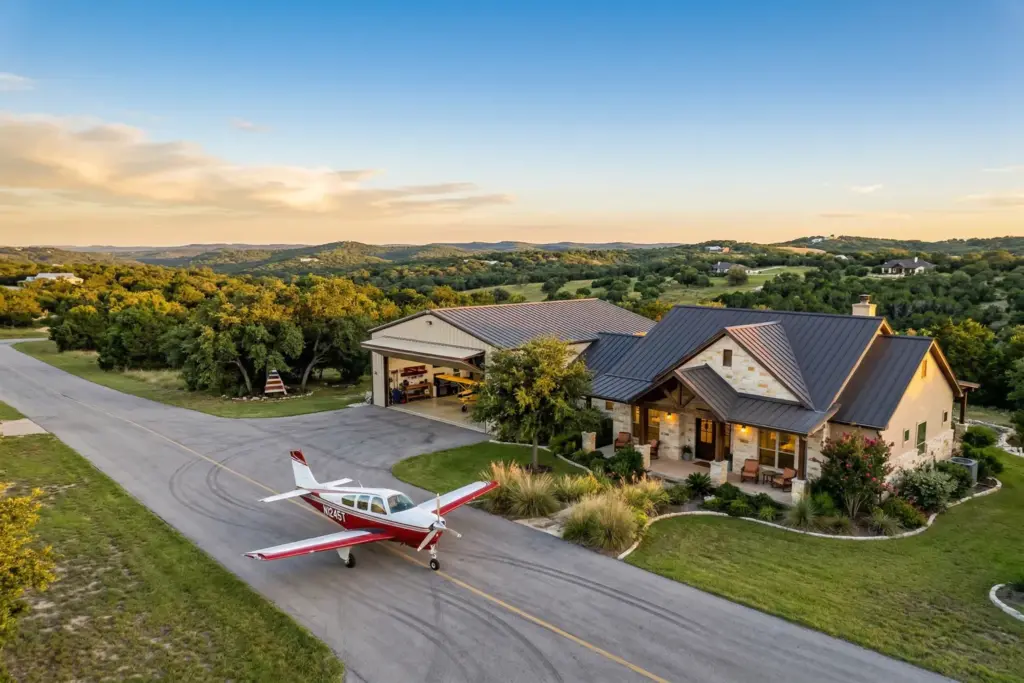
The average airpark home in Texas sells for 30 to 50 percent more than a comparable non-airpark home in the same area, according to aviation real estate transaction data. That premium can mean $100,000 to $500,000 extra depending on the market. So the question every pilot eventually asks is pretty simple. Is walking out your back door to your airplane worth that kind of money?
I’m a pilot and a real estate broker, so I get asked this one a lot. And the honest answer is that it depends on how you fly, how often you fly, and whether you see aviation as a lifestyle or a hobby. Lets break down the three real options because most people only think there are two.
Option 1: The Airpark Home (Taxiway to Your Door)
This is the dream right. You wake up Saturday morning, grab your coffee, walk out to the hangar attached to your house, pull the plane out, taxi to the runway, and you’re airborne. No driving to the airport. No waiting for someone to pull your plane out of a shared hangar. No ramp fees. Just you and the sky.
There are roughly 426 residential airparks in the United States, and Texas has about 70 of them (according to the Living With Your Plane Association). Places like Lakeway Airpark and communities out near Lago Vista have been attracting pilots for decades. And the community aspect is real. Your neighbors understand why you’re making noise at 6am on a Saturday. They get it because they’re doing the same thing.
But here’s what nobody tells you until you’re already looking at properties.
The costs beyond the sticker price. Airpark HOA fees typically run $85 to $100 per month just for runway and taxiway maintenance. Some communities charge a one-time runway access fee of $6,000 or more when you close. And Flying Magazine reported that many airpark HOAs haven’t adequately saved for major runway work. A repaving project can run $900,000 or more. If your HOA hasn’t been saving, that’s a special assessment headed your way.
The resale reality. This is the part where I have to be honest even though it might not be what you want to hear. When you sell an airpark home, your buyer pool is basically other pilots who want to live on an airpark. That’s it. Pilot forums describe the resale market as “tiny and growing tinier.” And banks typically classify your hangar as an outbuilding, not as living space, so the appraisal often doesn’t reflect what you actually paid for the aviation features.
I’ve seen this play out with other niche property types. Investment properties with unusual features always have this tension between what they’re worth to the right buyer and what the general market will pay. Benjamin Graham’s whole thing about price versus value applies perfectly here. The airpark premium is a lifestyle premium, not a market premium.
Best for: Pilots who fly 100+ hours a year. Families who want aviation as part of daily life. People who value the walk-to-your-plane convenience above everything else and understand they’re paying for a lifestyle, not an investment advantage.
Option 2: Home Near a Public Airport
So here’s where it gets interesting. And honestly this is the option I think more pilots should seriously consider.
You buy a normal home in a normal neighborhood, maybe 5 to 10 minutes from a public airport like Rusty Allen in Lago Vista or Lakeway Airpark (which has public ramp space too). You rent a T-hangar for $200 to $600 a month depending on the airport and hangar size. Or if you’re really watching the budget, you tie down outside for $50 to $100 a month.
What do you get for that? A LOT actually.
Full airport services. Fuel on the field. A mechanic who knows your engine. An FBO that can handle your guests. Some of these public airports have instrument approaches that most private airpark strips don’t. If you’re flying IFR or you have a larger aircraft that needs more runway (say 4,000 feet instead of 3,000), the public airport is probably the better operational choice anyway.
Normal resale. This is the big one. When you sell, your buyer is anyone who wants a home in that neighborhood. Not just pilots. Your home in a subdivision near Lakeway or Lago Vista or Bee Cave competes with the full market. More buyers means more competition for your house which means better offers.
More choices. Instead of picking from the 6 houses currently for sale in an airpark community, you’re shopping the entire market. Want a Lake Travis waterfront with a 10-minute drive to the airport? You can do that. Want something in the Hill Country with acreage and a shop for your project car and still be close to the field? Also doable.
The trade-off is obvious. You’re driving to the airport instead of walking. And yes that means loading your flight bag in the truck, driving over, opening the hangar, pulling the plane out. It adds maybe 20 to 30 minutes to your total door-to-wheels-up time. For some pilots that’s a dealbreaker. For most it’s just… fine.
Best for: Weekend flyers who go up 2 to 4 times a month. Budget-conscious pilots who want to fly AND build equity in a strong resale market. Pilots with larger aircraft that need more runway or instrument approaches. Anyone who wants the flying life without the financial constraints of the airpark premium.
Option 3: Home Near a GA Airport (No Airpark Features)
This is the option nobody writes about because it’s not sexy. But it’s what a huge number of pilots actually do.
You buy a home wherever makes sense for your life. Schools, commute, budget, neighborhood. Then you base your plane at a general aviation airport that might be 15 to 25 minutes away. You drive over when you want to fly, park your car, walk to your hangar, and go.
No community of pilots next door. No runway outside your window. No aviation lifestyle at home. Just a regular house and a hangar somewhere else.
And you know what? For a lot of pilots this is exactly right. Not everyone needs to live and breathe aviation 24/7. Some people just love to fly on the weekends and want their home to be about their family, their neighborhood, and their equity position. That’s fine. There’s nothing wrong with treating flying as a hobby that lives at the airport instead of a lifestyle that lives at your house.
The math is actually compelling right. You get the cheapest housing option because location is based on normal residential factors. Most GA airports in Texas have hangars available in the $200 to $400 per month range for a single-engine. You still get maintenance services, fuel, and usually a pilot community at the airport even if they don’t live next door.
Best for: Pilots who fly for fun and see it as separate from their home life. People who prioritize school districts, commute times, and traditional neighborhood features. Anyone who wants maximum home equity and minimal aviation premium baked into their mortgage.
Lets Do the Math
Ok here’s where my inner nerd comes out (my wife says I can’t help myself and she’s not wrong). I run numbers on real estate all day so lets put this comparison into actual dollars.
The airpark premium. Say the comparable non-airpark home is $500,000 and the airpark home is $650,000. That’s a $150,000 premium. On a 30-year mortgage at 6.5%, that $150,000 costs you roughly $950 per month in additional payment. Plus you’re paying maybe $100 per month in airpark HOA runway fees. So your total aviation convenience premium is about $1,050 per month.
The hangar rental alternative. If you buy the $500,000 home and rent a T-hangar for $400 per month… you’re saving $650 per month. Over 10 years that’s $78,000 in savings (and that’s before considering the better resale position of the non-airpark home).
The breakeven. If you’re saving $400 per month in hangar rent by living on the airpark (because your plane lives in your attached hangar for free), but paying $1,050 per month in premium costs, you’re actually spending $650 more per month for the convenience.
To break even on pure dollars? You’d need the airpark home to appreciate significantly faster than the comparable non-airpark home. And while some data suggests airpark homes have appreciated about 15% faster in certain markets, that’s not guaranteed and the smaller resale pool works against you.
Seth Godin has this great concept about decisions that are really about identity, not math. The airpark home is an identity purchase. If being a pilot is central to who you are and how you live, the math is almost beside the point. But if you’re trying to optimize financially, the numbers favor renting hangar space and buying a regular home. Every time.
What I Actually Tell People
When a pilot calls me (and yeah, being both a pilot and a broker means I get these calls), I ask one question.
“How important is it to you to walk out your back door and be at your airplane?”
If they light up and say “that’s the whole point,” airpark living is the right answer. Don’t even look at the breakeven math. You already know what you want and the premium is the price of living the life you actually want to live. Lets find you the right airpark community. I wrote a whole guide to fly-in communities in Central Texas that’s a good starting point.
If they pause and say “well it would be nice but…” then I know. Buy the best home you can in the best location for your family. Rent a hangar. Put the $100,000+ you saved back into the house, or into your flying budget (because lets be real, avgas isn’t getting cheaper and that annual inspection isn’t going to pay for itself).
And if they’re the analytical type who wants to run every scenario? I tell them to rent a hangar near the airport they like for 6 months first. Fly out of there. See how the drive feels. See if the 15-minute commute to the airport actually bothers you. Because some pilots think it will drive them crazy and then realize it’s actually kind of nice to have the separation. Your house is your house. The airport is your airport. A little bit of separation from church and state if you know what I mean.
A Few Things to Watch Out For
No matter which direction you go, here are the gotchas I’ve learned from working with pilot-buyers over the years.
If you’re buying airpark, check the HOA financials like you’re auditing a business. How much have they saved for runway maintenance? When was the last repaving? Are there pending special assessments? I’ve seen airparks where the HOA was basically broke and the runway was falling apart. Not fun to discover after closing.
If you’re renting a hangar, get on the waitlist early. Good hangars at good airports have waiting lists that can run 6 months to 2 years. Don’t buy a house near an airport assuming you’ll get a hangar right away. Call first.
Either way, look at the runway. Length, condition, approaches available. A 3,000-foot grass strip is great for your Cub. It’s not great for your Bonanza on a hot Texas day at density altitude. Match the runway to your airplane and your mission profile, then pick the living arrangement.
Frequently Asked Questions
Ready to Talk Airpark or Airport-Adjacent?
Look, I’ve been on both sides of this. I understand the pull of taxiway-to-your-door living and I also know the math usually favors the alternative. The right answer depends on you, not on a spreadsheet.
If you’re a pilot looking at real estate in the Austin or Hill Country area, whether it’s an airpark, an airport-adjacent neighborhood, or just a great house with a hangar down the road, lets talk. I can speak both languages.
Until next time, be safe, be good, and keep the shiny side up.


