 Ed Neuhaus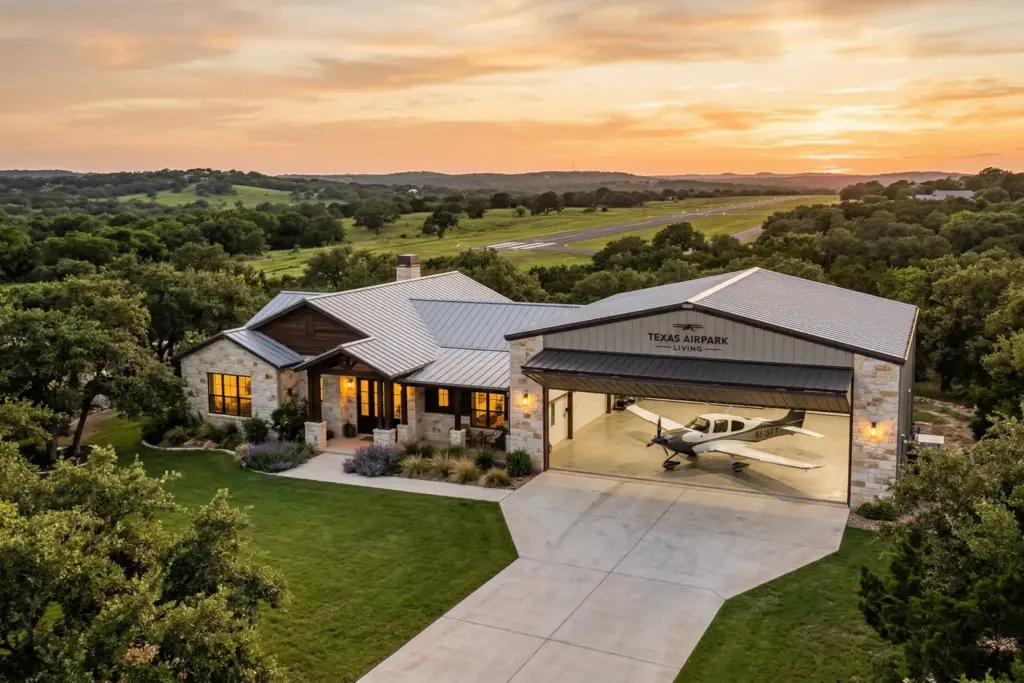
There are roughly 600 to 700 residential airparks across the United States, and Texas has more of them than any other state. According to AirparkMap.com and the Living With Your Plane Association, the Lone Star State is home to somewhere between 70 and 84 fly-in communities depending on who’s counting and how loose your definition is. Florida is right behind with around 50 to 80 (same counting problem). And if you’re a pilot who’s ever daydreamed about taxiing your Bonanza out of your garage and being wheels up before your coffee gets cold, you already know why these numbers matter.
I’m a pilot and a real estate broker. I’ve been selling homes in the Austin area for 19 years and I fly out of the Hill Country regularly. So I get both sides of this, the aviation side and the real estate side. And I can tell you that buying an airpark home is one of the most rewarding things a pilot can do, but it’s also one of the most misunderstood real estate transactions out there. The financing is weird. The appraisals are frustrating. The HOA drama is real. But when you wake up on a Saturday morning and your hangar is 30 feet from your back door, all of that fades pretty fast.
This is the complete guide. Whether you’re seriously shopping for airpark homes for sale right now or just starting to research fly-in communities, everything you need is here. Lets get into it.
What Exactly Is a Residential Airpark?
A residential airpark is a neighborhood built around a private runway where homes have hangar access and you can literally taxi your airplane from your property to the runway. Think of it as a gated community where the main road is a landing strip and your garage door opens onto a taxiway instead of a cul-de-sac.
Some airparks are tiny. Cross Country Estates out near Georgetown, Texas has 29 properties on a 2,500 foot turf runway. Others are massive. Spruce Creek in Florida (the world’s largest fly-in community) has nearly 5,000 residents, 1,300 homes, 700 hangars, and a 4,000 foot paved runway with GPS approaches. There’s also an 18-hole golf course and a clubhouse, because apparently some pilots need things to do when they’re not flying.
The thing that makes an airpark different from just “living near an airport” is the direct access. Your home connects to the taxiway. You walk out your back door, open the hangar, preflight, taxi to the hold short line, and you’re gone. No driving to the FBO. No waiting for a line crew to pull your plane out. No ramp fees. Just your house, your hangar, your runway.
And your neighbors get it. Nobody is calling the noise complaint line when you fire up the engine at 6am on a Saturday. Everyone who lives there chose to live there because they love aviation. It’s a different kind of community.
What Airpark Living Is Actually Like
Ok I’ll be honest. I’m biased. I think airpark living is one of the coolest lifestyle choices a pilot can make.
Here’s what a typical morning looks like. You wake up, grab coffee (the important part), walk to your hangar in your pajamas if that’s your thing, open the bifold door, and there’s your airplane. You do your preflight right there. Check the oil, sump the tanks, pull the prop through if it’s a cold morning. Then you taxi down the taxiway to the runway, run up, and go fly. The whole process from “I feel like flying” to wheels up can be 15 minutes. That’s not that hard right.
Compare that to driving 30 minutes to a public airport, waiting for someone to move the plane blocking yours, paying $200 a month in tie-down fees, and dealing with a gate code that changed again because the FBO forgot to tell you.
But it’s not just the convenience. It’s the community. Airpark neighborhoods have a different energy. People wave when you taxi by. Your neighbor texts you about a cool formation they saw. There’s always someone willing to help you with an annual inspection or argue about the best oil weight for a Lycoming. It’s hangar flying every day, except the hangars are actually attached to houses.
The flip side (and I’d be doing you a disservice not to mention it) is that airpark living comes with constraints. Runway easements mean you can’t plant a 40 foot oak tree wherever you want. HOA rules might restrict what hours you can fly. Your kids will grow up thinking the sound of a Continental IO-550 at 7am is normal. Which honestly might be the best part.
Types of Airpark Properties
Not all airpark homes are created equal. Here’s what you’ll find when you start looking at airpark homes for sale.
Hangar homes are the gold standard. The hangar is physically attached to the house, usually through a breezeway or shared wall. You walk from your kitchen to your airplane without going outside. These command the highest prices because the integration is seamless. At Stellar Airpark in Chandler, Arizona, hangar homes start around $1 million and can push past $4 to $5 million for newer custom builds with taxiway frontage.
Homes with separate hangars are the next tier. Your house sits on the property and the hangar is a separate structure, usually 50 to 200 feet away, connected to the taxiway. Still incredibly convenient. Still the dream. Just with a short walk between coffee and cockpit.
Taxiway-access lots without hangars are where a lot of buyers get creative. You buy the lot with taxiway access and build your own hangar to your specs. This is actually how I’d recommend most pilots approach it if you find the right airpark, because you can design the hangar around your specific airplane. A guy with a Cirrus SR22 needs a very different hangar than a guy with a Cessna 185 on floats. At Alpine Airpark in Wyoming (35 miles from Jackson Hole, 5,850 foot runway, absolutely stunning), 2-acre lots give you room to build exactly what you want.
Vacant airpark lots without any structures are the entry point. In some rural Texas airparks you can find these for under $100,000. In premium locations like Stellar or Spruce Creek, vacant lots still run $300K to $500K plus.
The price range across the country is enormous. Rural airpark homes in Texas or the Southeast might start around $300,000. A hangar home at Spruce Creek will run $500K to $1.5M. And the high end? Jumbolair in Ocala, Florida (that’s John Travolta’s place, with a 7,550 foot private runway) was listed at $10.5 million. The Alpine Airpark in Wyoming, where you’re 35 miles from some of the best fly fishing and skiing on the planet, pushes into similar territory for the larger estate properties.
The Buying Process: What’s Different About Airpark Real Estate
Here’s where most pilots get surprised. Buying an airpark home is not the same as buying a regular house. The core process is similar, sure, offer, inspection, appraisal, close. But the details are where things get interesting.
Runway easements. Most airpark properties have easements related to the runway. These restrict what you can build (height limits near approach paths), where you can plant trees, and sometimes what types of fencing are allowed. You need to read these before you make an offer. I’ve seen buyers get 30 days into a deal before discovering they couldn’t build the hangar they wanted because of a setback requirement they didn’t know about.
Appraisal challenges. This is the big one. Banks send out appraisers, and most appraisers have never valued an airpark home. They don’t know how to comp a property with a 2,000 square foot hangar and taxiway access. So what happens? They comp it against regular homes and assign almost zero value to the aviation features. A $1.2 million airpark home might appraise at $900K because the appraiser treated the hangar as a glorified shed.
The lifestyle premium is real, but it lives in the land value and the location, not in the appraised structure value. This is something your lender and your agent need to understand going in.
Unique inspection items. Beyond the normal home inspection, you want to look at taxiway condition (is the pavement cracking?), apron strength (can it handle your airplane’s weight?), hangar door mechanisms (bifold doors are expensive to repair), and drainage. Water pooling on a taxiway is not just annoying, it’s a safety issue. You also want to verify the exact boundaries of your taxiway access right. I’ve seen disputes where a buyer assumed they had direct taxi access and it turned out the easement required them to cross another owner’s property.
Aviation-savvy representation matters. And I’m not just saying that because I’m both a pilot and a broker (ok maybe a little). But seriously. An agent who doesn’t understand the difference between a taxiway and a driveway is going to miss things that cost you money. The runway orientation matters for prevailing winds. The pattern direction matters for noise exposure. Whether the airpark has VASI or PAPI on the approach matters for night operations. These aren’t things a typical residential agent thinks about.
Financing an Airpark Home
Lets talk money. This is where the process gets genuinely frustrating and I wish I could tell you it’s gotten easier over the years, but it really hasn’t.
Most conventional lenders treat hangars as “outbuildings” and assign them minimal value. Like, your-hangar-that-cost-$150,000-to-build-is-worth-$20,000-in-the-appraisal minimal. It’s maddening. The problem is structural. Fannie Mae and Freddie Mac guidelines don’t have a clean category for “residential aviation hangar,” so lenders default to the most conservative interpretation.
Here’s what works. Several approaches depending on your situation.
The most common strategy I see is financing the home conventionally and paying cash for the hangar. If you can separate the residential structure from the aviation structure in the transaction, you give the lender a normal home to underwrite and you handle the fun stuff yourself. This works especially well when you’re buying a lot and building.
Specialized aviation lenders do exist. HomePromise and a handful of smaller banks have experience with hangar home transactions. They understand the property type and won’t freak out when the appraisal comes in weird. Their rates may be slightly higher but the hassle factor drops considerably.
Home equity strategies are another option. If you already own a home with equity, you can use a HELOC or cash-out refinance to fund the hangar construction on your airpark property. The interest may even be deductible depending on your situation (talk to your CPA, not me, I sell houses).
Portfolio lenders (local banks and credit unions that keep loans in-house rather than selling to Fannie/Freddie) sometimes have more flexibility. They can underwrite based on the full picture rather than checking boxes on a standardized form. Worth asking around in the airpark community because someone there has almost certainly found a good one.
Benjamin Graham put it best when he said the market is a voting machine in the short run but a weighing machine in the long run. Airpark values work the same way. The appraiser might “vote” your hangar as worth nothing, but the actual market of qualified pilot-buyers absolutely weighs it as valuable. The disconnect is temporary and specific to the lending process.
Insurance: More Complicated Than You Think
Here’s something that catches almost every first-time airpark buyer off guard. Your homeowner’s insurance probably doesn’t fully cover your hangar, and it definitely doesn’t cover anything aviation-related inside it.
You need to think about three separate layers.
Homeowner’s insurance covers your house. Standard stuff. But many policies have exclusions or limitations for structures used in connection with aviation. Read the fine print. Some insurers will cover the hangar as a detached structure (like a pool house or workshop) but exclude anything related to aircraft storage or maintenance. Others won’t cover it at all.
Hangar/building insurance covers the physical structure itself. This is separate from your homeowner’s policy and covers things like storm damage, fire, theft of tools and equipment stored in the hangar. If you’ve ever priced a bifold hangar door replacement (easily $15,000 to $30,000 for a residential-sized hangar), you understand why this matters.
Aircraft insurance covers your airplane. But here’s the thing most people miss, it covers the airplane, not the building the airplane is in. If a windstorm takes your hangar roof off and drops it on your Cessna, the aircraft policy covers the plane and the hangar policy covers the building. Two separate claims, two separate adjusters, two separate checks.
And if you ever let a buddy store their airplane in your hangar (which happens constantly in airpark communities because that’s what pilot friends do), you might want hangarkeeper’s liability insurance. This covers damage to non-owned aircraft in your care, custody, or control. It’s mainly designed for FBOs and repair shops, but if your neighbor’s Mooney gets dinged in your hangar, you want to be covered. It’s not expensive. It’s just one of those things nobody tells you about until you need it.
Tax Considerations
Tax time with an airpark home gets interesting fast. The core question is how your county assessor classifies your hangar. Residential? Commercial? Agricultural? (yes, I’ve seen that one in rural Texas). The answer varies by county and it directly affects your property tax bill.
In most Texas counties, if the hangar is attached to or part of your residential property and used primarily for personal aircraft storage, it gets assessed as residential. That’s the best case. But some counties assess standalone hangars as commercial property even on residential lots, which can bump your effective tax rate significantly.
If you use your aircraft for business (and a lot of airpark owners do), there are potential deductions for the hangar as a business expense. The hangar becomes equivalent to a home office but for your flying business. Depreciation, maintenance, insurance, even a portion of the property taxes might be deductible. But the IRS has been paying closer attention to this in 2025 and 2026, particularly around what constitutes “business use” versus “personal use” of aircraft. Get a CPA who understands aviation, not just real estate. Seriously. This is not DIY tax territory.
One more thing. In Texas we don’t have state income tax (y’all already know this) but our property taxes are no joke. Protesting your appraisal is almost a sport here. And with an airpark home, you have extra leverage because the county appraiser is probably overvaluing the hangar relative to what the lending market would actually assign it. The irony is thick, the bank says your hangar is worth nothing, the county says it’s worth a fortune. Welcome to airpark ownership.
HOA and POA Rules: Every Airpark Has Drama
I say this with love. Every single airpark I’ve ever worked with has HOA or POA drama. It’s unavoidable when you put a bunch of opinionated pilots in a neighborhood with a shared runway.
The rules typically cover aircraft type restrictions (some airparks don’t allow jets, some restrict ultralights, some have weight limits), noise abatement hours (no touch and goes after 9pm is pretty common), operational procedures (right traffic vs left traffic, no straight-in approaches), and architectural standards for hangars and homes.
The runway itself is usually the single largest shared asset and the biggest source of disagreements. Who pays for repaving? How often does the grass get mowed? What happens when someone lands gear-up and tears up 200 feet of turf? According to FLYING Magazine, many airpark HOAs haven’t even conducted maintenance studies for future runway costs, which means a special assessment can appear out of nowhere.
At Breakaway Park in Cedar Park (one of the Austin-area airparks), there’s no HOA at all. Lots are 1 to 3 acres, and the airstrip access costs $5,000 upfront plus $500 a year. That’s a completely different experience from Spruce Creek where you’ve got golf course maintenance and tennis courts and a clubhouse in the budget.
My advice? Read the CC&Rs (covenants, conditions, and restrictions) cover to cover before you make an offer. Talk to at least three current residents. Ask them specifically about the last big disagreement and how it got resolved. If they say “we’ve never had a disagreement,” they’re either lying or they just moved in.
The Resale Reality
Ok lets talk about the elephant in the hangar. Selling an airpark home is harder than buying one.
The buyer pool is small. You need someone who is a pilot (or wants to be), can afford the home, wants to live in that specific location, and is ok with the airpark’s particular rules and runway specs. That’s a narrow Venn diagram right. Robert Greene would call it a “strategic patience” situation. You have to wait for the right buyer, not just any buyer.
This means airpark homes typically sit on the market longer than comparable non-airpark properties. I wouldn’t be surprised by 6 to 12 months for a properly priced airpark home, and longer if the pricing is aspirational.
And here’s the thing. The MLS is not enough. Most buyer agents don’t know what an airpark is, let alone how to search for one. You need to market to pilots directly. That means Trade-A-Plane (which has had aviation real estate listings since 1997), AirparkMap.com, the Aviation Real Estate Digital Magazine, targeted social media in pilot groups, and ideally, fly-in events where you can hand someone a flyer while they’re admiring your runway.
This is where having an agent who actually understands aviation matters more than anywhere else in the transaction. A regular listing agent will put it on the MLS with “hangar” in the description and hope for the best. An aviation-savvy agent knows where the buyers are and speaks their language. That’s not a small difference when your buyer pool is maybe 2% of the general market.
Texas Airpark Communities Near Austin
Since I cover the Austin and Central Texas market, let me walk you through the airparks in my backyard. I’ve written a detailed guide to fly-in communities in Central Texas that goes deeper on each of these, but here’s the overview.
Lakeway Airpark (3R9) is the crown jewel of Austin-area airparks. A 3,930 foot paved runway at 904 feet elevation, about 30 homes with direct taxi access, and you’re living in Lakeway with Lake Travis practically in your backyard. The combination of the Lake Travis lifestyle plus fly-in access is hard to beat anywhere in the country. Recent listings have been in the $1.5M to $2M range for homes with hangar access.
Breakaway Park / Hank Sasser Airport (40XS) in Cedar Park has a 3,000 foot paved runway (started as grass in 1977, paved in 2004-2005). It’s a private airstrip, so you need permission to land, but the trade-off is less traffic and more control. No HOA, 1 to 3 acre lots, and you’re 20 minutes from downtown Austin. The entry fee is $5,000 plus $500 annually. Some larger lots are even zoned for horses if you want to combine your two expensive hobbies.
Cross Country Estates (07TS) near Georgetown is the quiet one. Twenty-nine properties on a 2,500 foot turf runway (coastal bermuda, beautifully maintained by the POA). Every home has direct taxiway access. Six miles east of Georgetown, halfway between Georgetown and Taylor. If you fly a taildragger and prefer grass under your wheels, this is your place.
Lago Vista / Rusty Allen Airport (RYW) near Lago Vista is technically a public airport, not a residential airpark, but it has a 4,000+ foot runway and the surrounding area has properties where you can build hangars and be minutes from the field. Hill Country flying at its best.
I’m planning a full deep-dive article on each of these communities. If you’re interested in a specific one, reach out and I’ll make sure you see it when it publishes.
National Airpark Highlights
Texas might have the most airparks, but there are incredible fly-in communities across the country. A few that deserve mention.
Spruce Creek (7FL6), Florida is the world’s largest residential airpark. Nearly 5,000 residents, 1,300 homes, 700 hangars, and a 4,000 foot paved runway with GPS approaches and lighting. Seven miles south of Daytona Beach. The amenities read like a resort (golf course, tennis courts, clubhouse) and the aviation culture is unmatched. Homes range from $400K condos to $1.5M+ hangar homes. If Spruce Creek were a city, aviation would be the official religion.
Jumbolair Aviation Estates, Florida is famous because John Travolta parked his Boeing 707 in the front yard for years. The runway is 7,550 feet, which is the longest private residential runway in America. You could land a Gulfstream here. Travolta’s property was listed at $10.5 million (later reduced). The community also has an equestrian center, because apparently one niche expensive hobby isn’t enough.
Stellar Airpark (P19), Chandler, Arizona is the luxury benchmark. A 4,417 foot paved runway with RNAV approaches, 100LL and Jet A fuel onsite, 200 acres total. Over 100 taxiway homes ranging from $1M to $5M. The newer Stellar Airpark Estates II has 9 custom homesites with lots up to 47,000 square feet. Twenty minutes from Phoenix. Year-round flying weather. It’s the Scottsdale of airparks.
Alpine Airpark (46U), Wyoming is for the pilot who wants adventure with their runway. Thirty-five miles from Jackson Hole, a 5,850 foot runway with AWOS, GPS approach, and lights. Seventy-two hangar homes and 25 standalone hangars on the banks of Palisades Reservoir. You’re bordered by 6.4 million acres of Bridger-Teton and Caribou-Targhee National Forest. Fly fishing, skiing, hunting, all from a runway in your backyard. Not cheap, but the lifestyle is hard to argue with right.
I’ll be publishing detailed guides on each of these communities in the coming months. If you’re interested in a specific market, I either know it personally or I know an aviation-savvy agent who does. Lets talk.
Is Airpark Living Right for You?
Here’s my honest take after years of flying and selling real estate. Airpark living is perfect for a specific kind of person and completely wrong for another.
It’s right for you if flying is more than a hobby. If it’s part of your identity. If you’d rather spend $2 million on a house with a hangar than $2 million on a house with a bigger pool. If you want neighbors who understand the obsession and won’t look at you sideways when you talk about the weather in terms of ceilings and visibility instead of “is it nice out.”
It might not be right for you if you’re a casual pilot who flies 50 hours a year and your spouse has zero interest in aviation. The inconveniences are real. The runway easements limit your landscaping. The noise is constant (even if you love it, your family might not). And the resale constraints mean you’re making a commitment that’s harder to unwind than a regular home purchase.
Nassim Taleb wrote about the concept of “skin in the game,” how people make better decisions when they bear the consequences of those decisions. Airpark buyers have maximum skin in the game. You’re not just buying a house. You’re buying into a lifestyle, a community, and a set of compromises that only make sense if flying is fundamental to who you are.
For the right person, there is nothing like it.
Frequently Asked Questions
Ready to Explore Airpark Living?
If you’ve made it this far, you’re probably not just casually curious. You’re a pilot who’s seriously thinking about making the move to a fly-in community. And I get it. I really do.
For Texas airpark properties, especially anything in the Austin, Hill Country, or Central Texas area, lets connect directly. I’m a pilot and a broker, I speak both languages, and at Neuhaus Realty Group we specialize in the kind of unique properties that most agents don’t know how to handle.
For airpark homes outside of Texas, I have connections with aviation-savvy agents across the country. If you tell me where you’re looking, I’ll put you in touch with someone who actually understands aviation real estate rather than just someone who drew the floor-duty shift.
Either way. Be safe, fly smart, and maybe I’ll see you on the ramp.


