 Ed Neuhaus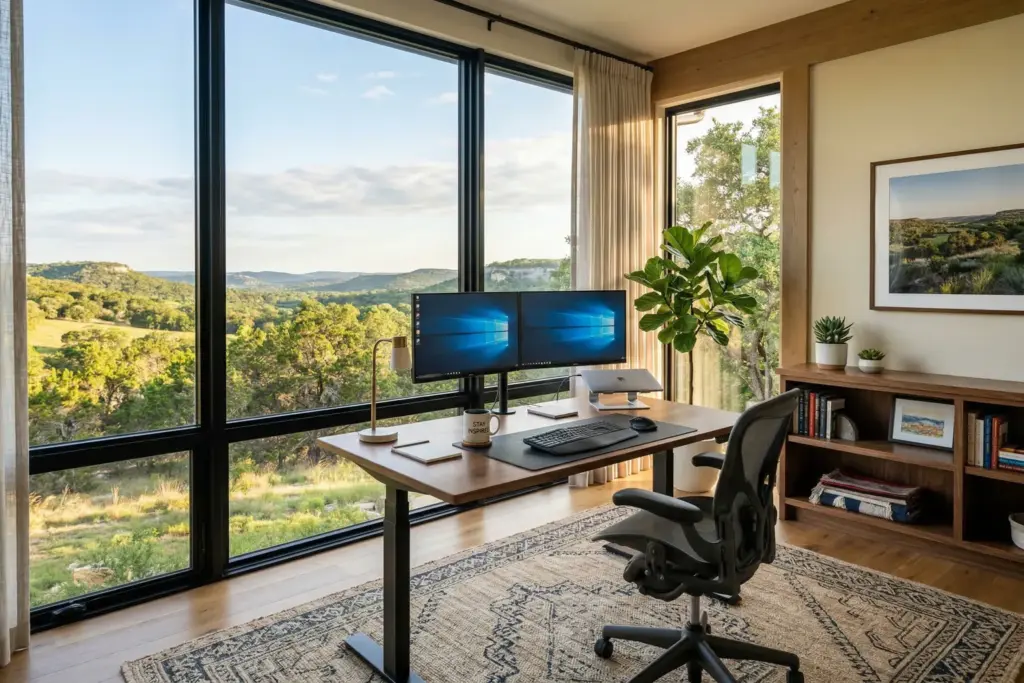
Twenty-eight percent of American workers are now fully remote according to Gallup’s 2025 workforce survey, and another 51% are hybrid. That means for roughly 4 out of 5 knowledge workers, the commute is no longer the thing that decides where you live. So what IS the thing?
I get this question constantly from buyers relocating to Austin (especially from California and the Northeast, where they just sold a $1.2M condo and suddenly have options). And the honest answer is: when you subtract commute from the equation, everything else gets louder. Internet speed matters. Whether you can walk to a coffee shop for your 2pm brain break matters. How much square footage you get for your money matters, because that spare bedroom just became your office and your office just became your second most important room in the house.
According to the Austin Board of Realtors February 2026 data, the Austin metro median sits around $400K right now. But the spread between neighborhoods is enormous. You can pay $330K in Hutto for a 2,400 square foot home with a dedicated office, or $2.6M in Westlake for roughly the same square footage with a much nicer view. When commute doesn’t matter, that decision becomes purely about lifestyle. So lets break it down by what actually matters to remote workers.
If You Want to Walk Out Your Front Door and Be Somewhere: East Austin, Mueller, South Congress
Walk Score data tells the story here. East Austin scores an 86 (Very Walkable), Mueller lands between 68 and 79, and South Congress hits 79. For context, Austin as a whole scores a 42. That’s a massive difference.
East Austin is the obvious answer if walkability is your top priority. Coffee shops on every corner (Cenote, Flat Track, Seventh Flag), restaurants you can actually get into on a Tuesday, and the kind of neighborhood energy that makes you want to close the laptop at 5pm and go be a person. Median prices run $450K to $550K depending on how close you are to the core. And both Google Fiber and AT&T Fiber have strong coverage here, which is non-negotiable if you’re on Zoom calls all day.
Mueller is the master-planned version of walkability. Thinkery museum, Alamo Drafthouse, HEB, parks, trails, all designed to be accessible on foot. It was literally built with the “15-minute neighborhood” concept before that phrase became trendy. Homes run $500K to $650K, and the lot sizes are smaller (that’s the tradeoff for walkability in a planned community). But if your daily routine involves walking to grab lunch, working from a coffee shop in the afternoon, and taking your dog to a park at 4pm, Mueller was designed for exactly that life.
South Congress is the aspirational pick. The vibe is unbeatable, the food scene is world-class, and you’re a bike ride from Barton Springs when you need a 3pm reset. But you’re also paying $600K to $800K+ and the homes are older, smaller, and sometimes quirky in ways that aren’t always charming (I showed a place last month where the “home office” was a converted closet, and not a walk-in closet). Still. If lifestyle is the priority and budget allows it, SoCo delivers.
All three of these neighborhoods have solid coworking options nearby too. atx FACTORY in East Austin caters to creative entrepreneurs, and there are half a dozen spots downtown within a short drive or bus ride.
If Your Ideal Work Break Is a Trail Run or a Kayak: Bee Cave, Lakeway, Dripping Springs
Ok here’s where it gets interesting. Because when you remove the commute constraint, the Hill Country opens up in a way it never could for someone driving to the Domain every morning.
Bee Cave is 25 minutes from downtown Austin with no traffic (which is when you’d be going, because you’re remote and you’re smart about timing). Median prices sit around $850K to $925K. But here’s the thing people miss about Bee Cave: the property tax rate is the lowest in the area at roughly 1.80%. On an $850K home, that’s saving you real money compared to Pflugerville at 2.18%. Over a 30-year mortgage that difference compounds into serious cash.
And the outdoor access is just different out here. Hamilton Pool Preserve is 30 minutes away. Lake Travis is right there. Pace Bend Park. The Hill Country Galleria gives you shopping and restaurants when you need a change of scenery from your home office. I’ve worked from the Galleria Starbucks more times than I’d like to admit.
Lakeway at $725K to $778K median gives you lake life. Like actual lake life, not “I can see the lake from my car” life. Marinas, boat ramps, the Lakeway Resort and Spa when you need to pretend you’re on vacation during a Wednesday lunch break. The best neighborhoods in Lakeway range from golf course communities to waterfront estates. Internet coverage is solid with Spectrum and expanding AT&T Fiber, though you’ll want to verify fiber availability at any specific address before you commit.
Dripping Springs is the quiet card. $550K to $650K gets you actual land (not a postage stamp lot). The wine country out here is legit. And the pace of life is exactly what some remote workers are looking for. The tradeoff? Fiber internet is spottier, coworking is basically nonexistent, and you’re 35 to 45 minutes from central Austin. If you’re fully remote and your idea of a perfect Tuesday is working from your back porch looking at live oaks, Dripping Springs delivers that. If you need to pop into the office twice a month, the drive gets old.
If You Want the Most House for Your Money: Pflugerville, Hutto, Kyle
This is the category that gets underrated by people who think “Austin” means “west of MoPac.” Remote work completely changed the math here.
Pflugerville at around $367K median gets you a 4-bedroom home with a dedicated office, a two-car garage, and probably a game room. In East Austin that same money gets you a 2-bedroom bungalow from 1952 with charming original plumbing (and I mean “charming” in the real estate agent sense where it actually means “old”).
Hutto is even more aggressive at roughly $330K median. That’s entry-level for a lot of the Austin market, but in Hutto it buys you a newer construction home with modern floor plans that actually account for remote work. Builders out here figured out years ago that the “flex room” or “tech room” on the first floor sells faster than a formal dining room nobody uses.
Kyle sits at about $370K and is growing fast on the south side. If your company is based in San Antonio and you need to drive down occasionally, Kyle puts you right on I-35 with a straight shot south.
The honest tradeoff with all three: property taxes run higher (2.10% to 2.18% effective rates), fiber internet is improving but not guaranteed everywhere, and the “vibe” is suburban new construction. If you’re coming from Brooklyn looking for character, these neighborhoods aren’t it. But if you’re a family with two remote workers who need two home offices and a playroom, the math is pretty compelling. Benjamin Graham’s whole framework in The Intelligent Investor was about not paying for things you don’t need. A remote worker paying a $300K premium for proximity to downtown is paying for a commute they don’t take.
If Money Isn’t the Constraint: Westlake and Barton Creek
Look, I live and work in this market so I’ll be straight with you. Westlake at a $2.6M median is not a “best value” play. But for a certain remote worker (and I’m thinking senior tech executive, founder, or someone who sold their company), Westlake is hard to beat.
Eanes ISD is the top-rated school district in the Austin metro. Period. The homes have actual dedicated office suites, not converted bedrooms. West Austin home prices have held better than most of the metro through the correction. And the lifestyle is Lake Austin, Barton Creek greenbelt access, 15 minutes to downtown, Hill Country views from your desk while you’re on a board call.
Barton Creek is the golf-and-country-club version of this. Four championship courses, a resort spa, and the kind of neighborhood where your “home office” might have its own entrance and bathroom. If you’ve ever read Robert Greene’s take on environment shaping performance, there’s something to be said for working from a room that overlooks a Tom Fazio fairway instead of a parking lot.
The fiber internet situation in Westlake is actually quite good (AT&T Fiber has expanded aggressively here), and you’re close enough to downtown for any coworking needs. The property tax rate is competitive at roughly 1.85%.
If You Want Small-Town Life and You Mean It: Wimberley
Wimberley is the wildcard nobody puts on these lists. About 50% of residents are 45 or older, the art scene is genuinely good (not “good for a small town” but actually good), and the Blanco River swimming holes are the kind of thing that makes your Slack status say “BRB, swimming” at 2pm on a Thursday.
Median prices run $450K to $550K, which is surprisingly reasonable for what you get. The catch is internet reliability. Wimberley is rural enough that you absolutely need to confirm service at a specific address. Some spots have excellent coverage, some spots are satellite-or-nothing. For a fully remote worker, this is a deal-breaker-or-deal-maker kind of thing. No middle ground.
But I’ll tell you what. I’ve had three clients in the last year who were fully remote tech workers, moved to Wimberley, and every single one of them said some version of “I should have done this five years ago.” The cost of living out here is meaningfully lower than central Austin, the community is tight, and the quality of life is hard to quantify but easy to feel.
The “Zoom Room” Premium: Why Your Home Office Matters More Than You Think
Quick tangent but this matters for your home search. Homes with a dedicated office (not a nook, not a corner of the living room, an actual room with a door) are selling faster across the Austin metro. The data on this is clear nationally: dedicated home office space has moved from “nice to have” to “required feature” for the 28% of workers who are fully remote.
When I’m helping remote workers search, I always filter for 4+ bedrooms even if they only have one kid (or no kids). Because that extra bedroom becomes the office, and the quality of that office directly impacts your daily life when you’re spending 8+ hours in it. Natural light, a door that closes, enough space for a proper desk setup. These things sound minor until you’ve spent a year working from the kitchen table with your kid’s Legos as a backdrop on Zoom calls (no judgment, we’ve all been there right).
Some builders in the outer suburbs are now marketing “tech suites” or “Zoom rooms” as standard floor plan features. That’s not a gimmick. It’s the market responding to real demand.
The Property Tax Reality Check
Since you’re choosing a neighborhood based on lifestyle rather than commute, property taxes become a bigger part of the decision than most people realize. Here’s the quick comparison:
Bee Cave at 1.80% on an $850K home = roughly $15,300 per year. Pflugerville at 2.18% on a $367K home = roughly $8,000 per year. Lakeway at 1.82% on a $725K home = roughly $13,200 per year. Hutto at 2.15% on a $330K home = roughly $7,100 per year.
That Bee Cave number looks high in absolute terms, but the rate is actually the lowest. And don’t forget the 2026 Texas homestead exemption is now $140,000, which knocks a meaningful chunk off your taxable value regardless of where you buy.
The real play for remote workers is this: if you’re earning a Bay Area or NYC salary while living in Texas, you’re already saving the 9% to 13% state income tax. Use some of that savings to buy in a neighborhood with a lower property tax rate and better lifestyle amenities. The math works out pretty well.
Fiber Internet: The Make-or-Break Factor
Lets be real about this. You can love a neighborhood’s vibe, schools, and restaurants all day long. If you can’t hold a stable Zoom call or your internet drops during a client presentation, none of it matters.
Here’s the current state of fiber in Austin as of early 2026. Google Fiber covers about 34.5% of Austin proper, concentrated in central and east Austin. AT&T Fiber covers roughly 46% and is expanding aggressively into the suburbs. Between the two, about 73% of Austin addresses have fiber available.
The safest bets for reliable high-speed internet: anywhere inside the Austin city limits, Mueller, East Austin, parts of South Austin, and increasingly Pflugerville and Round Rock. The spottier areas: outer Dripping Springs, rural Wimberley, parts of Hutto. Lakeway and Bee Cave fall somewhere in between, with Spectrum as a reliable backup even where fiber hasn’t reached yet.
My advice: before you fall in love with any property, check fiber availability at that specific address. Not the neighborhood, not the zip code, the actual address. I’ve seen houses across the street from each other where one has Google Fiber and the other doesn’t.
Frequently Asked Questions
Picking Your Neighborhood When the Commute Doesn’t Decide for You
Working remote in Austin is one of those rare situations where you genuinely get to choose based on what makes your life better, not what makes your drive shorter. That’s a luxury and it’s worth taking seriously.
My honest suggestion: rank your priorities before you start searching. Is it walkability? Go East Austin or Mueller. Outdoor access? Look at the Hill Country. Maximum space for your money? The outer suburbs are hard to argue with. Luxury lifestyle? Westlake, full stop. Small town feel? Wimberley might surprise you.
And whatever you do, check the internet first. I’m not kidding about that.
Working remote and choosing your neighborhood for the first time? Lets grab coffee and figure out which Austin neighborhood matches how you actually want to live. I’ve helped dozens of remote workers make this move over the last few years, and the conversation always starts the same way: “What does your ideal Tuesday look like?” We can go from there.


