 Ed
Ed 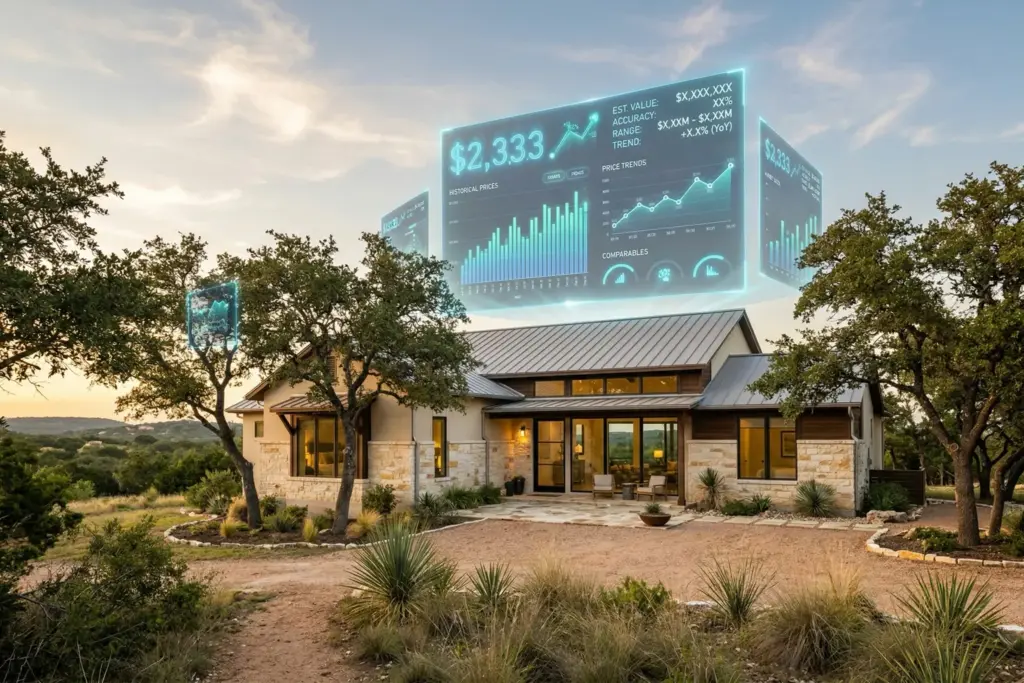
I asked ChatGPT what a house I know intimately was worth. It gave me a number with a straight face (well, as straight a face as a chatbot can give you), and then I ran the real CMA against my live MLS feed. The gap was about 11%. On a house in the mid-600s, that’s enough money to buy a really nice car, or to put a kid through a couple years of college, or to just plain disappear because you priced wrong.
Lets walk through what happened, because I think a lot of homeowners are going to do exactly what I did this week. They’re going to type their address into ChatGPT, get a number, and start making decisions off of it. So I figured I’d be the one to do it first and show you where it actually lands.
The Setup
I picked a home I know cold. A 4 bedroom in a Hill Country zip code west of Austin (I’ll keep it generalized because the actual owners don’t need their inbox blowing up). Roughly 3,400 square feet, built in the late 2010s, sitting on a little over a third of an acre, three-car garage, a pool that was added a few years back, and a kitchen that got refreshed last year.
This is the kind of house I help people buy and sell every week. I know what it should comp at. I know who the buyers are. I know what’s sitting on the market right now next door to it.
I gave ChatGPT all of that. Address-level detail, square footage, lot, bed and bath count, condition notes, recent updates. The only thing I deliberately held back was the live comp data. I wanted to see what it would do with just the property profile, because that’s what 99% of homeowners are going to do when they ask it.
What ChatGPT Said My House Was Worth
It came back with a range. Said the house was worth roughly $580,000 to $620,000 in today’s market (I’m rounding here to keep the example illustrative, not specific to one address). It explained the methodology too, which is the part that got me. It said it was looking at “recent comparable sales in your area” and “local market trends” and “typical price per square foot for homes of this age and condition.”
Sounds confident right. Sounds like it knows what it’s doing.
But here’s the thing. I asked it to list those comps. It gave me three addresses. One of them sold in 2022. One of them was a different neighborhood entirely. And the third one I’m not even sure existed, because I went and checked the MLS and the parcel records and could not find that house at that address. That’s the part nobody talks about. ChatGPT can confidently describe comps that aren’t real. I wrote about this hallucination problem before, but seeing it on a house I know inside and out really drove it home.
What My Real CMA Says
So then I did what I would actually do for a client. I pulled it up in the MLS. I ran three closed comps from the last 90 days, all within a half mile, all the same floor plan family or close to it. I looked at the two active listings nearby, what they’re asking, how long they’ve been sitting. I checked days on market trends in that specific subdivision, not the city as a whole. I looked at the seasonality (we’re in spring, which matters a lot in this market).
The real number came in closer to $680,000 to $695,000. Could go a hair higher with the right buyer, because the kitchen refresh and the pool are doing real work in that comp set right now.
That’s a $60,000 to $75,000 gap from what ChatGPT told me.
The Delta and Why It Matters
On a house in the mid-600s, an 11% pricing miss is real money. Lets play this out both ways, because the danger goes in both directions.
If you priced this house at $600,000 because ChatGPT told you to, you’d probably have multiple offers in a weekend, you’d feel like a genius, you’d close in 30 days. And you’d have left somewhere between $60,000 and $90,000 on the table that the market was perfectly willing to pay you. You’d never know, because the house sold “fast.” Fast sales are not always good sales.
Now flip it. If ChatGPT had been too optimistic and told you $740,000, you’d list there, you’d sit for 45 days, you’d do a price cut to $719,000, you’d sit another 30 days, you’d do another cut to $699,000, and you’d eventually close at $675,000 because the listing now looks tired. The market punishes stale listings. The number you finish at after a price cut is almost always lower than the number you would’ve gotten if you’d just priced right out of the gate. That’s not opinion, that’s just what the data shows over and over.
Either direction, getting pricing wrong by 10% is not a small mistake. It’s the difference between a clean transaction and one that costs you the down payment on your next house.
Where ChatGPT’s Number Came From
In plain English. ChatGPT is trained on a giant pile of public text. That includes a lot of real estate content, Zillow-style AVM patterns, news articles about home prices, generic per-square-foot benchmarks, old listing descriptions that got cached somewhere on the open web. It’s also frozen at a training cutoff, which means even when it does have real data, that data is months or years old.
It does not have the MLS. It does not have today’s closings. It does not have the contract that went pending yesterday three doors down for $20,000 over ask because the buyer needed to be in school district before August. It does not have the new construction inventory two miles away that’s pulling buyers out of the resale market right now.
It’s averaging vibes from old text. That’s actually a fine way to ballpark a national trend. It’s a terrible way to price your specific house in your specific neighborhood this specific week.
How to Use AI for Pricing Without Getting Burned
I’m not anti-AI. I use it every day, and I think it’s a real tool when you use it right. So here’s the actual play:
Treat the AI number as a sanity check, never a quote. If a real CMA from someone who knows your area comes back wildly different from what ChatGPT said, that’s interesting information. It might mean the local market is moving away from the national trend. It might mean your house has something special the AI couldn’t see. It’s a data point. Just not the data point.
Always ground the decision with a real CMA. Either from an agent, or from a paid AVM that pulls from actual MLS data, or both. The free chatbot answer is not a substitute for either of those.
Or feed AI real comp data and let it analyze that. This is the one most people miss. If you take live MLS comp data and paste it into ChatGPT and ask it to analyze the spread, weigh the variables, and tell you where your house fits in the distribution, it’s actually pretty good at that. The problem isn’t AI’s brain. The problem is its inputs. Garbage in, garbage out, and right now most people are feeding it garbage when they ask about home values.
What I Did About the Data Problem
This is where I’ll plug my own work for a second, because it’s relevant. I built something called Austin MLS MCP. It’s a connector that lets Claude or ChatGPT actually talk to the live Austin MLS, the same feed I use every day as a broker. Feed it real comps, real days on market, real price per square foot from this week, and the AI suddenly becomes a useful research partner instead of a confident liar.
This is the same thing I talk about in why AI gets real estate math wrong. It’s not the model. It’s what you’re feeding it. Real data in, real answers out. That’s the whole game.
The Realtor’s Takeaway
AI cannot price your house. Not yet. Not by itself.
AI with live MLS data is a genuinely useful research partner. AI alone, asked to value a specific home based on its training data, is a liability when there’s six figures on the line.
If you’re thinking about selling, the worst thing you can do is build a mental anchor off a number ChatGPT spit out before you ever talk to someone who has actually walked the neighborhood. That anchor will color every decision you make for the rest of the process. You’ll either feel cheated when a real CMA comes in lower, or you’ll feel like you’re getting away with something when it comes in higher, and both of those feelings will hurt your negotiation.
Start with real data. Use AI to help you think through the real data. That’s the order.
If you want to see this from the buyer side, I ran the same kind of experiment trying to actually buy a house with ChatGPT. Different problem set, same root issue. And if you want the full playbook, how to sell a house with AI and how to buy a house with AI are the two pillar guides where this all lives.
Frequently Asked Questions
Thinking About Selling?
The first step is knowing what your home is actually worth. Our free tool uses real MLS comps — not Zestimate guesswork.
Want a Real Price for Your House?
If you want a CMA done right (not a national average wearing a costume), reach out and lets talk through your house specifically. I’ll run real comps, walk you through what the market is actually doing in your zip code this month, and give you a number you can build a plan around. If you want to see how AI fits into that workflow on the data side, Austin MLS MCP is the piece that makes it actually work.


