 Ed Neuhaus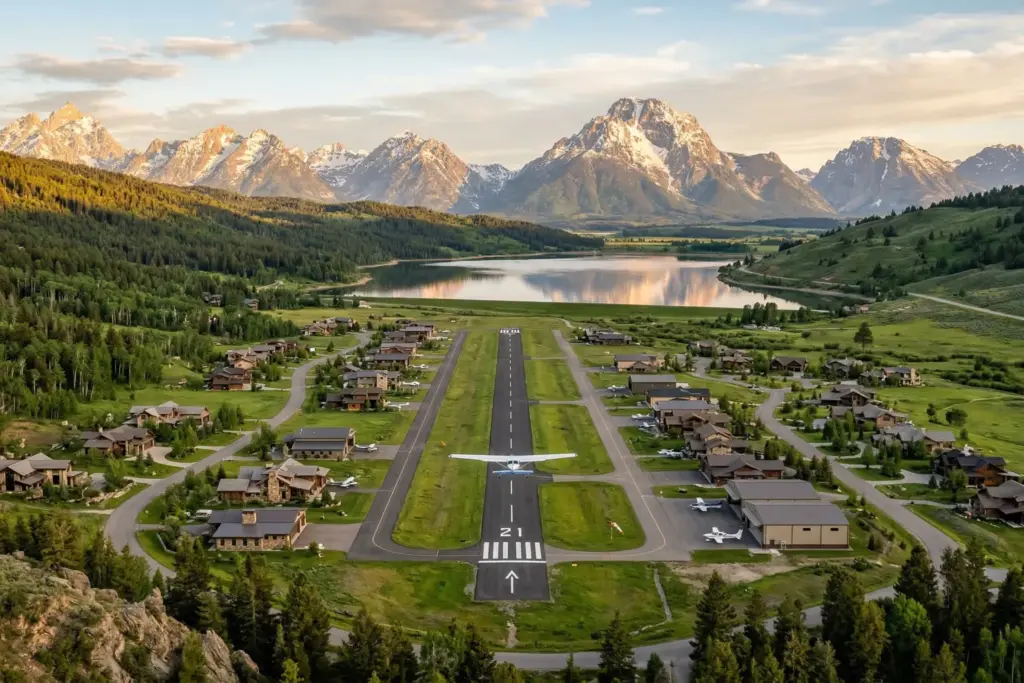
Lots starting at $2.25 million with a 5,850-foot runway and Grand Teton views. That is what Alpine Airpark in Wyoming is asking right now, and honestly the crazy part is they are selling. The mountain West fly-in ranch market is a completely different animal from the Texas airpark communities I cover regularly, and if you are a pilot who has ever looked west from the cockpit and thought “what if I just kept going,” this article is for you.
According to Aviation Real Estate Magazine’s January 2026 report, the aviation property market is shifting from a pure seller’s market to something more balanced, with inventory increasing across many airparks. But the premium mountain communities? Those are still commanding serious money. And for good reason.
I wrote the pilot’s guide to fly-in communities in Central Texas a while back, and I still get calls from pilots who read that piece. But here is what surprised me. About half those calls are from Texas pilots who already own (or want to own) a second home in Idaho or Wyoming. So lets talk about what mountain airpark living actually looks like, because it is as different from Lakeway Airpark as you can get.
Alpine Airpark: The One Everyone Talks About
If you have been in aviation circles for more than five minutes, someone has mentioned Alpine Airpark. And yeah, it lives up to the hype.
Located 35 miles south of Jackson Hole in Alpine, Wyoming, this community sits on the banks of the Palisades Reservoir at the confluence of three trophy trout streams. The airpark features over 72 hangar homes and 25 standalone hangars, with a 5,850-foot by 70-foot runway that can handle everything from a Super Cub to a Citation. That is not a typo. Jets land here.
So what makes Alpine the gold standard? Lets count.
The runway has AWOS (automated weather), GPS approaches, and full lighting. That GPS approach part matters more than most people realize right. When you are flying in the mountains and the weather closes in, having an instrument approach is the difference between getting home and spending the night in Idaho Falls. Most mountain strips do not have that. Alpine does.
Then there is the location. You have got the Bridger-Teton and Caribou-Targhee National Forests surrounding you (that is 6.4 million acres of public land for those keeping score). World-class skiing at Jackson Hole is a 35-minute drive. Fly fishing on your doorstep. Hunting, mountain biking, kayaking on Palisades Reservoir. It is the outdoor recreation equivalent of an all-you-can-eat buffet.
The price of admission? Lots start around $2.25 million, and that is before you build. Completed hangar homes go for significantly more. But consider what you are getting. A private runway community with instrument approaches, 35 miles from one of the most iconic mountain towns in America, with views of the Tetons from your hangar door.
I would argue that is actually reasonable for what it is. Try buying anything within 35 miles of Jackson Hole for under $3 million. Not happening.
SilverWing at Sandpoint: The Ski and Lake Play
SilverWing is a different flavor entirely, and honestly it deserves more attention than it gets.
Tucked between Schweitzer Ski Mountain and Lake Pend Oreille in Sandpoint, Idaho, SilverWing offers 44 exclusive lots with a setup most airparks cannot match. You are 15 minutes to Schweitzer for skiing and about 10 minutes to one of the largest natural lakes in the western United States. And here is the kicker. The airpark is practically in town. Most fly-in communities are 30 to 45 minutes from the nearest restaurant. SilverWing is minutes from shopping, dining, and a real downtown.
The homes are built above the hangars (55 by 56 foot hangars with over 3,000 square feet of living space on top). The model home runs four bedrooms, three baths, gourmet kitchen, the whole deal. And SilverWing has something most airpark buyers should pay close attention to: a perpetual easement for runway access and an approved residential through-the-fence agreement with Bonner County that runs in perpetuity. That “in perpetuity” part is huge. Benjamin Graham would call that a “margin of safety” for your real estate investment. I have seen airpark communities lose their runway access when agreements expire or local politics shift. SilverWing locked that down permanently.
For pilots who want mountain living but also want to actually live near civilization (not just visit it), SilverWing is the play. You can ski in the morning, have lunch downtown, and fly out for a backcountry trip in the afternoon. All without driving more than 15 minutes in any direction.
Greenleaf Air Ranch: The Working Pilot’s Mountain Home
Not every mountain airpark costs seven figures. Greenleaf Air Ranch in Greenleaf, Idaho sits about 20 miles west of Boise and represents what I would call the working pilot’s entry into mountain aviation living.
The community has a 2,500-foot runway with private taxiway access and custom homes on spacious lots. Canyon County, Idaho is not the Tetons, but that is sort of the point. You get the Idaho lifestyle (incredible backcountry flying, four seasons, genuine small-town community) without the Jackson Hole price tag.
Greenleaf is the kind of place where your neighbors actually fly. Not “I have a hangar for my car collection” neighbors, but actual stick-and-rudder pilots who are out every weekend. The aviation community there is tight-knit in a way that bigger developments sometimes lose, its the kind of place where everyone knows your tail number. And being 20 miles from Boise means you have access to real city amenities (hospitals, international airport, restaurants, Costco) without sacrificing the airpark lifestyle.
For a Texas pilot looking for a mountain base camp without spending Alpine Airpark money, Greenleaf is worth a serious look.
The Backcountry Culture: Why Idaho Is the Mecca
Ok, lets talk about the elephant in the hangar. The real reason pilots fall in love with the mountain West is not the airpark communities. It is the backcountry.
Idaho has more backcountry airstrips than any state in the country, and they are legendary. Johnson Creek (3U2) is the crown jewel, a 3,400-foot by 150-foot manicured turf strip deep in the central Idaho mountains that the AOPA calls Idaho’s premier backcountry base. It has hot showers, Wi-Fi, electricity, even a van you can take into the town of Yellow Pine for groceries. From Johnson Creek you can hop to Sulphur Creek, Dixie, Smiley Creek, or the famous Flying B Ranch.
Then there is Big Creek, sitting at 5,743 feet elevation and snow-free only about five months out of the year. The Idaho Aviation Foundation has been rebuilding the historic Big Creek Lodge as a public resource, and landing there feels like stepping back about a hundred years.
This is bucket-list aviation. And I say that as someone who flies over the Texas Hill Country regularly and loves it (the approach into Lakeway over Lake Travis is still one of my favorite flights). But threading a canyon in the Frank Church Wilderness at 8,000 feet with granite walls on both sides? That is a fundamentally different experience. The kind of thing that reminds you why you learned to fly in the first place.
What Is Different About Mountain Airpark Living (The Honest Version)
Here is where I put on the “I am also a broker and I have to be honest with you” hat. Because mountain fly-in living is not just Texas airpark living with better views. The flying is harder, the logistics are more complex, and if you do not respect the environment it can bite you.
Density altitude will humble you. At 5,000 to 6,000 feet elevation on a hot July afternoon, your airplane does not perform like it does at sea level. That 2,000-foot takeoff roll in Lakeway becomes 3,200 feet in Alpine. Your climb rate drops. Your engine makes less power. This is why Alpine’s 5,850-foot runway matters so much, and why shorter mountain strips require real skill and the right airplane. If you are flying a naturally aspirated Bonanza at gross weight on a 90-degree day at 6,000 feet, the math gets ugly fast. A turbocharged engine is not a luxury up there. It is closer to a necessity.
Mountain weather does not care about your schedule. Terrain-induced turbulence, mountain obscuration, wind shear on approach, and afternoon thunderstorms that build faster than you can divert. IFR capability is important (again, this is why Alpine’s GPS approaches are such a big deal), but honestly the bigger skill is knowing when NOT to fly. I have talked to mountain pilots who say they cancel about 20% of planned flights due to weather. If that kind of flexibility is not in your personality, mountain flying will frustrate you. No big deal right. Except it kind of is.
Wildlife on the runway is a real thing. Elk. Deer. Moose. The occasional bear wandering across at dawn. At Lakeway the biggest hazard is probably a confused deer. In Wyoming the elk can weigh 700 pounds and they do not care about your landing light.
Seasonal access varies wildly. Some of these communities are genuinely less accessible in winter. Not necessarily cut off, but road conditions can be challenging and some backcountry strips close entirely from November to May. SilverWing’s proximity to Sandpoint helps here since the town is maintained year-round. Alpine is accessible but Wyoming winters are no joke. Know what you are signing up for.
The views are worth all of it. I have to say that part too. Flying the Tetons at sunrise, dropping into a valley in the Sawtooths, cruising over the Bitterroot Mountains with zero other aircraft in sight. There is nothing like it. Nothing. It is the kind of flying that makes the complexity and the cost feel like a small price to pay.
What You Need as a Pilot
Lets be direct about the pilot requirements because this is not optional stuff.
Mountain flying training. Not “I watched a YouTube video.” Actual dual instruction with a mountain CFI. The AOPA Mountain Flying course is a start, but nothing replaces flying with an instructor who knows these specific canyons and valleys. McCall Mountain Canyon Flying Seminars in Idaho is the gold standard. Budget for at least two days of dual instruction before you solo into the backcountry. Nassim Taleb’s whole thing about “the risk you don’t see is the one that gets you” applies perfectly here. The canyon that looks fine from 2,000 feet above might not have an escape route once you are in it.
The right airplane. High-performance and turbocharged is strongly preferred. Something like a Cirrus SR22T, turbocharged Bonanza, or if you are doing serious backcountry work, a Husky or Super Cub on big tires. The airplane you fly out of a 5,000-foot sea-level runway is not necessarily the airplane you want at a 2,500-foot strip at 5,700 feet elevation.
Comfort with backcountry operations. Soft field technique, short field technique, one-way strips with rising terrain. If your flying has been mostly paved runways and GPS direct, you will want to build skills before committing to a mountain airpark lifestyle.
Insurance reality. Mountain operations can mean higher premiums. Not dramatically so if you have the training and experience, but your underwriter will ask questions. Get quotes before you make an offer on a property.
The Cross-Sell Angle (Why a Texas Broker Is Writing This)
So why am I, an Austin real estate broker, writing about fly-in ranches in Wyoming and Idaho? Because I understand both sides of this equation.
Many of the pilots I work with in Texas own (or want to own) a mountain property as a second home. They live in Bee Cave or Dripping Springs or Westlake full-time, and they fly to Idaho or Wyoming for summers, hunting season, or ski trips. That is a real lifestyle pattern I see regularly.
And it works both ways. I have had conversations with pilots in Boise and Jackson who want a warm-weather base in Texas. The Hill Country aviation scene (Lakeway Airpark, airpark communities throughout Central Texas) is a natural complement to a mountain home.
I get the appeal of mountain flying because it is as different from Hill Country flying as you can get. And I will admit I still get a little nervous on mountain approaches (a little bit out of shape on the steep descent profiles if I am being honest). One is low and slow over cedar and limestone. The other is high and careful through granite and ice. Both are incredible in their own way.
If you are a pilot thinking about the mountain play, whether that is a primary home, a second home, or just scouting communities for the future, lets talk. I can help with the Texas side of the equation, and I know enough about the mountain market to point you in the right direction on the other end too.
Frequently Asked Questions
Final Approach
Mountain fly-in ranch living is not for everyone. The flying is harder, the weather is less forgiving, the communities are smaller and more remote, and the price of entry at the top end is serious money. But for pilots who have done the training, own the right airplane, and want a lifestyle that combines world-class outdoor recreation with the kind of flying most people only dream about, there is nothing else like it.
Alpine Airpark is the headliner. SilverWing at Sandpoint is the smart sleeper pick. Greenleaf Air Ranch is the accessible entry point. And Idaho’s backcountry strips are the reason you will never want to leave.
If you are a Texas pilot thinking about a mountain property (or a mountain pilot thinking about Texas), I would love to hear from you. I have been working this market for 19 years and I am also a pilot, so I speak both languages. Lets grab coffee and talk about what makes sense for your situation. Be safe, be good, and be nice to people.


