 Ed Neuhaus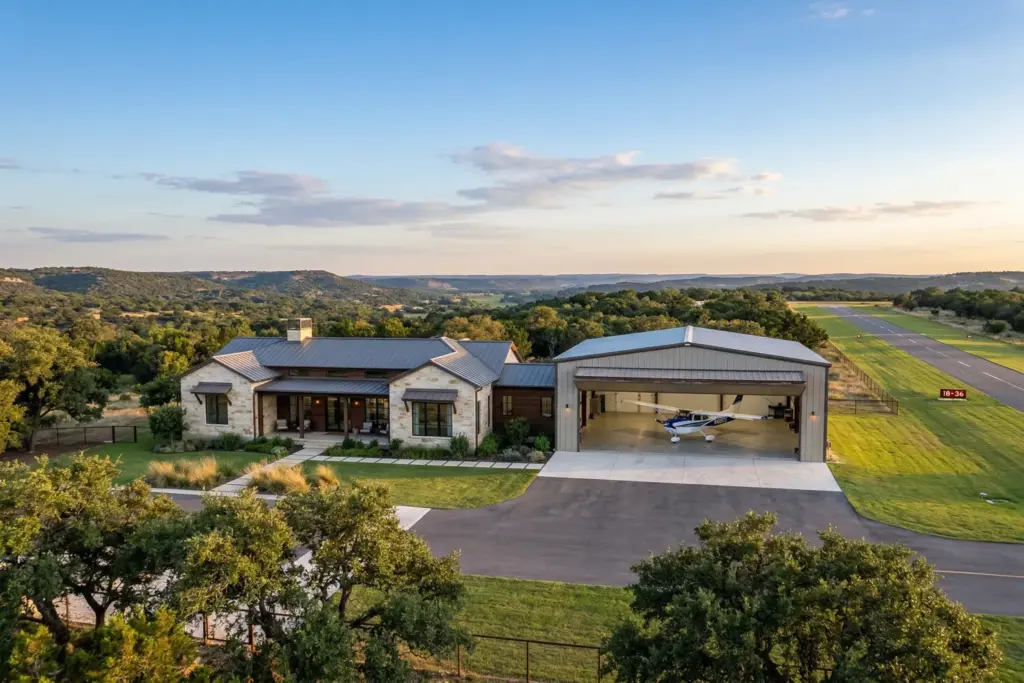
The International Residential Code requires a 1-hour fire-rated wall between any attached hangar and the living space of your home. That single building code requirement is the fork in the road for every pilot shopping for airpark property, and it shapes everything from your budget to your resale value to whether you can wrench on your Cessna at midnight without waking up the family.
I fly and I sell real estate. So I think about this stuff from both sides of the equation, which is either a blessing or a curse depending on whether you ask my wife or my clients. But this question comes up constantly from pilot-buyers, and honestly most of the “advice” out there glosses over the parts that actually matter. Lets fix that.
According to AirparkMap.com, Texas has over 70 residential airparks (112+ total airparks statewide). If you’re looking at any of them, this is the first decision you need to make. And it’s not as simple as “which one is more convenient.”
What We Mean by Hangar Home vs Separate Hangar
Quick definitions so we’re on the same page.
A hangar home is a property where the hangar is structurally attached to or integrated into the living space. Walk from your kitchen to your airplane. The hangar often doubles as a massive garage, workshop, or man cave (or woman cave, I don’t judge). Some are purpose-built as one unified structure. Others start as a large hangar with living quarters added on one end.
A separate hangar means your home and hangar are two distinct buildings on the same lot, connected by a taxiway, driveway, or short walk across the property. Your house is a house. Your hangar is a hangar. They just happen to share a property line and a really nice view of the runway.
Both get you taxiway access. Both let you live the airpark dream. But the tradeoffs are real, and I’ve seen pilots make expensive mistakes by not thinking them through.
The Case for an Attached Hangar Home
Lets start with the integrated option, because this is what most people picture when they hear “airpark living.”
Convenience is the obvious win. You roll out of bed, grab coffee, walk through a door, and you’re standing next to your airplane. In Texas summer heat (and if you’ve never preflighted a plane in 105-degree sun, I envy you) having a climate-controlled hangar attached to your house is not a luxury. It’s survival. You can extend your home’s HVAC into the hangar space, which keeps your avionics happier and your leather seats from cracking.
Security is the other big one. Your plane is essentially in your house. No walking across a dark ramp at 5am wondering if someone’s been messing with your tiedowns. The plane is behind the same locked doors and alarm system as everything else you own.
And there’s something about the unified design that just feels right. When it’s done well, a hangar home is one of the coolest residential concepts in real estate. You’re living inside your hobby.
But here’s where it gets complicated.
The Building Code Reality
The IRC (International Residential Code) has specific requirements for attached residential hangars, and they’re not optional. You need that 1-hour fire-rated separation wall between the hangar and living space, continuous from foundation to roof. The door between them needs to be a 3/4-hour fire-rated assembly with self-closing hardware and a 4-inch noncombustible raised sill. You cannot have a direct opening from the hangar into any room used for sleeping.
And here’s the one that catches people. Under current residential code, your hangar cannot exceed 2,000 square feet or 20 feet in height without triggering commercial construction requirements. That means sprinkler systems, fire-retardant interiors, explosion-proof electrical outlets, the whole nine yards. If you’re flying something bigger than a Bonanza, you might already be pushing those limits. A Cirrus SR22 fits fine. A King Air? You’re building a commercial structure whether you planned to or not.
The electrical, mechanical, and plumbing systems in the hangar also need to be completely independent from the house systems. So “just extending the house” isn’t as simple as running some ductwork and calling it done.
The Tax and Insurance Problem
This is the one nobody warns you about until it’s too late. When your hangar is attached to your home, the county appraiser may assess that hangar square footage at the same rate as your living space. That can dramatically overstate your property value and jack up your tax bill. A 2,000 sqft hangar assessed at residential rates versus agricultural or commercial rates is a meaningful difference in your annual property tax.
Insurance gets weird too. Some carriers won’t write a standard homeowner’s policy on a property with an attached hangar. Others will, but the premiums reflect the added risk of having aviation fuel and a combustion engine sharing a structure with your bedroom. I’ve seen pilots end up with fewer insurance options and higher premiums simply because of the attached configuration.
The Case for a Separate Hangar
Now lets talk about the two-building approach. It doesn’t get as much love in the aviation magazines, but for a lot of pilots it’s actually the smarter play.
Flexibility is the biggest advantage. Want to expand the hangar? Add a second bay? Upgrade the door height for a bigger aircraft? You do all of that without touching your house. No permits that affect the residential structure. No re-engineering the fire separation. No worrying about whether your upgrade just triggered commercial building codes for your entire property.
Building codes are simpler. Your house is just a house. Your hangar is an accessory structure. Each one follows its own code path without complicating the other. You avoid the fire separation walls, the rated doors, the independent utility systems, all of it. Your contractor will thank you (and so will your budget).
Resale is where this really shines. And this is the part I’d really encourage you to think about, even if you’re convinced you’ll live there forever. Benjamin Graham (the godfather of value investing) had this whole philosophy about margin of safety, buying assets where the downside is protected even if your thesis is wrong. Same principle applies here.
With a separate hangar, a non-pilot buyer can purchase the house and either sell the hangar separately, rent it to another pilot on the field, or just use it as the world’s most impressive workshop. That opens your buyer pool dramatically. An attached hangar home? Your buyer almost has to be a pilot. And as much as I love our community, pilots are maybe 0.2% of the population. That’s a thin resale market right.
The Tradeoffs
It’s not all upside. Two structures means two roofs, two foundations, two sets of maintenance. In a Texas hailstorm that’s twice the insurance claims. You may need separate utility connections for the hangar (especially electrical if you’re running compressors, welding equipment, or a paint booth). And on a cold, rainy morning, that 200-foot walk from house to hangar feels a lot longer than it looked on the property map.
Security is slightly more work too. You need to lock and monitor both structures independently. Not a dealbreaker, but it’s another thing on the list.
How to Decide: The Five Questions That Actually Matter
Forget the magazine articles with their tidy comparison charts. Here’s how I’d walk a client through this decision.
1. What are you flying (and what might you fly next)?
If you’re in a 172 or a Cherokee and you plan to stay there, an attached hangar home works great. The plane fits within the 2,000 sqft residential code limit with room to spare. But if you have upgrade-itis (and every pilot I know has upgrade-itis), a separate hangar gives you room to grow without rebuilding your house.
2. Do you wrench on your own airplane?
Be honest with yourself here. If you’re an owner-assisted annual type who spends weekends with a torque wrench and a parts catalog, you need to think about ventilation. Solvents, paint, avgas fumes, composite dust. All of that in an attached hangar means you need serious ventilation systems to keep it out of your living space. A separate hangar? Open the big door and let Texas do the ventilating. (Well, maybe not in August. Nothing ventilates in August.)
3. What does the community require?
Some airparks mandate attached hangars. Others require them to be separate. Some have minimum home square footage requirements before you can even build a hangar. Read the covenants before you fall in love with a lot. I’ve seen buyers put an offer on airpark property without reading the CC&Rs and then discover they can’t build what they wanted. That’s an expensive lesson.
4. What’s your timeline?
If you’re building, a separate hangar lets you phase the project. Build the house first, move in, then build the hangar when the budget recovers. An integrated hangar home is one big project from day one. That’s fine if the budget is there, but phasing gives you options.
5. How important is resale?
I already mentioned this but it bears repeating. The airpark real estate market is thin. Properties sit longer than conventional homes, and your buyer pool is limited. Anything you can do to broaden your appeal (like having a house that works for non-pilots too) is protecting your investment. No big deal right. Just hundreds of thousands of dollars of equity on the line.
My Take as a Pilot and a Broker
ok so if you want my honest opinion, here it is. For most pilots buying in Texas airpark communities, I’d lean toward the separate hangar configuration. And I say that as someone who absolutely loves the idea of walking from the kitchen to my plane.
The building code constraints on attached hangars are real, the tax implications are real, and the resale limitations are real. A separate hangar gives you more flexibility on every axis. Build it to your exact aircraft specs, modify it later without affecting your home, and sell either structure independently if life takes a turn.
The exception? If you’re building a purpose-designed hangar home from scratch with an architect who understands aviation residential codes, and you plan to live there for 20+ years, and your aircraft fits comfortably within the 2,000 sqft limit, go for it. Done right, a hangar home is one of the most incredible ways to live. Just go in with your eyes open about the code requirements and the narrower resale market.
If you’re looking at fly-in communities here in Central Texas, I wrote a full guide to the options from Lakeway to Spicewood to the Hill Country airstrips. And if you’re trying to figure out the financing side, that’s a whole separate conversation (spoiler: lenders treat hangars like outbuildings, which means almost zero appraised value for the hangar itself).
Frequently Asked Questions
Lets Talk Airpark Real Estate
Not many brokers fly and not many pilots sell real estate. I happen to do both. If you’re looking at airpark property in Central Texas or anywhere in the Hill Country, I can walk you through the aviation-specific stuff that most agents wouldn’t even think to ask about. Taxiway easements, runway orientation, pattern traffic, hangar door clearances, all of it.
Reach out anytime. Lets grab coffee and talk about your airplane and where you want to park it. Be safe, be good, and be nice to people.


