 Ed Neuhaus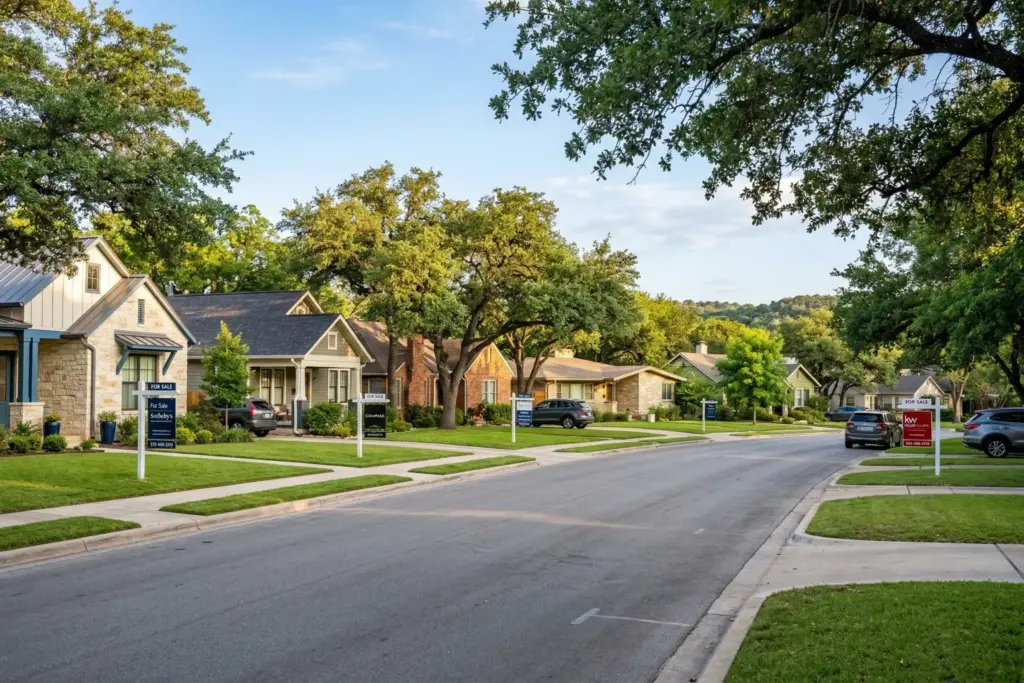
Austin is a buyer’s market right now, and it’s not even close. Nearly half of all active listings in the metro have already had at least one price cut, homes are sitting for 90+ days on average (the longest since 2011), and there are roughly 115% more sellers than buyers. That’s not my opinion. That’s what the numbers say.
According to the Texas Real Estate Research Center at Texas A&M, Austin’s months of inventory hit 4.77 in February 2026, up from 4.29 a year ago. And the Austin Board of Realtors data shows the median sold price dropped to $412,250, down 3.6% year over year and roughly 25% below the May 2022 peak of $550,000. Sounds like a lot of bad news right. But if you’re a buyer, this is the best setup you’ve had in over a decade.
I’ve been selling homes in Austin since 2007 and I’ll be honest, I didn’t call the 2022 correction perfectly (nobody did). But I watched the 2011 recovery, the 2020 frenzy, and the correction in real time. And what I’m seeing right now is a window that won’t stay open forever. Lets walk through the actual data so you can decide for yourself.
What Makes a Buyer’s Market (And Why Austin Qualifies)
The textbook definition is simple. A buyer’s market happens when supply exceeds demand, giving purchasers leverage on price, terms, and timing. The standard benchmarks:
Months of inventory above 4. Austin’s at 4.77 and climbing. Six months is considered “balanced,” and some price segments in the Austin metro are already past that. The $500,000 to $599,000 range is sitting at 8.0 months of supply. That’s not balanced. That’s buyers running the show.
Days on market above 60. The Austin metro average is hovering around 90 days right now. In our own MLS data, Austin city proper shows 94 days average. Compare that to 2021 when homes sold in under a week (sometimes before the sign went up in the yard). The market has done a complete 180.
Price reductions above 30%. About 47.8% of active listings in the Austin metro have cut their price at least once. In some suburbs it’s worse. Georgetown is at 55%, Kyle at 55.7%, and Liberty Hill leads at 62.8%. When almost half the market is repricing downward, sellers are no longer setting the terms.
So by every standard measure, yes, Austin is a buyer’s market in 2026. But the numbers tell a more interesting story than just “buyers win.”
The Five Numbers That Prove It
I track a lot of metrics. These are the five that matter most right now if you’re thinking about buying.
1. Days on Market: 90+ (Highest Since 2011)
Homes in the Austin metro are taking an average of 89 to 94 days to go under contract, depending on the data source. That’s the longest average days on market since March 2011, when the national housing market was still clawing its way out of the Great Recession.
What does that mean for you? Time. You have time to tour homes, compare neighborhoods, get inspections done right, and actually think through the process instead of panic-bidding on the first house you see. Benjamin Graham (the godfather of value investing) used to say the market is a voting machine in the short run and a weighing machine in the long run. Right now Austin’s weighing machine is giving buyers room to make rational decisions instead of emotional ones.
2. Price Reductions: Nearly Half the Market
47.8% of active listings have had at least one price reduction. And 22.2% have had multiple price cuts, the highest rate in the country. That means roughly 1 in 5 sellers has dropped their price twice or more and still hasn’t found a buyer.
But here’s what most people miss. The listed price reduction is only part of the story. Homes in Austin are closing at about 94.6% of their original list price according to our MLS data. So a home that listed at $500,000 is likely closing somewhere around $473,000. That’s a $27,000 gap between what the seller hoped for and what the market actually delivered. That gap is your leverage.
3. Months of Inventory: 4.77 and Climbing
A year ago Austin had 4.29 months of supply. Today it’s 4.77. For context, 6 months is considered a balanced market. Under 4 months favors sellers. Over 6 months favors buyers heavily.
We’re in that middle zone, but the trend line matters more than the snapshot. Inventory has been climbing for 18 months straight. And certain price points are already deep into buyer territory. If you’re shopping in the $500,000 to $600,000 range, you’re looking at 8 months of supply. That’s a lot of options and a lot of negotiating power.
4. Close-to-List Ratio: 90.6%
Homes are closing at roughly 90.6% of their original asking price. In 2021 and 2022, buyers were paying 103% to 108% of list price. Bidding wars, escalation clauses, waived inspections, the whole circus.
That circus has packed up and left town. When the close-to-list ratio drops below 95%, sellers have lost control of pricing. At 90.6%, buyers are regularly negotiating $20,000 to $40,000 off the original ask on a typical Austin home. Some are getting seller concessions on top of that (covering closing costs, rate buydowns, repairs). It’s a different world.
5. Seller-to-Buyer Ratio: 115% More Sellers Than Buyers
This one is pretty straightforward. Austin has roughly 115% more sellers than active buyers right now, making it the second-largest seller-to-buyer imbalance among major U.S. metros. Two sellers for every buyer. You can take your time, tour three more houses, sleep on it, and the listing will still be there next week. That’s a luxury buyers haven’t had in this market for years right.
How Does This Compare to Past Austin Markets?
Some context helps here because Austin buyer’s markets are rare.
2011: The last time DOM was this high. Austin was recovering from the financial crisis. Prices were low but lending was brutally tight. If you could qualify for a mortgage, you got incredible deals. Most people couldn’t qualify.
2018-2019: A brief softening. Inventory ticked up, prices flattened. But it lasted maybe 6 months before the market tightened again. Not a real buyer’s market, more of a pause.
2020-2022: The seller’s market to end all seller’s markets. Sub-3% rates, remote work migration, and a housing shortage created bidding wars on everything. Homes sold in hours. Buyers waived inspections, paid $50,000 over list, wrote love letters to sellers. It was genuinely nuts.
2026: What’s different now is that the correction has been sustained. This isn’t a 6-month blip. Inventory has been building since mid-2024. The Texas Real Estate Research Center forecasts “further but lessening losses” over the next 12 months. Prices aren’t crashing (the crash didn’t happen), but the leverage has firmly shifted to the buy side.
What This Means If You’re Thinking About Buying
Ok so the data is clear. Austin is a buyer’s market. But data alone doesn’t buy you a house. Here’s what this actually means for your strategy.
You can negotiate. Not just on price. On everything. Closing cost contributions, repair credits, home warranties, rate buydowns, extended option periods. Sellers who listed 90 days ago and haven’t gotten an offer are motivated. Use that.
You have options. With 20,000+ active listings across the metro, you don’t have to settle. If a home doesn’t have the right school district, the right commute, the right layout (or the right vibe, which matters more than people admit), keep looking. Another one will hit the market tomorrow.
You don’t have to waive anything. Remember when buyers were waiving inspections to win bidding wars? Yeah don’t do that. Get your inspection. Use the option period. Negotiate repairs. The power dynamic has flipped and you should use it.
Rates aren’t the whole story. I hear this all the time. “I’ll wait for rates to come down.” And I get it, 6.5% doesn’t feel great compared to what your neighbor locked in at 2.8% in 2021. But waiting for lower rates means competing against everyone else who was also waiting. When rates drop significantly, demand surges, inventory tightens, and the buyer’s market disappears. You lose your leverage.
Here’s how I think about it. The terms you can negotiate today (price, concessions, buydowns) are worth more than the theoretical rate cut you might get in 2027. Renting while you wait isn’t free either. Run the math on what 12 more months of rent costs versus locking in a home at today’s prices with seller-funded rate buydowns. Most people are closer to buying than they think.
Where Buyers Have the Most Leverage Right Now
Not every part of Austin is created equal. Some areas are deeper into buyer territory than others.
The suburbs are the softest. Georgetown, Kyle, Liberty Hill, Hutto, and Pflugerville all have price reduction rates above 50%. If you’re open to a 20-30 minute commute, the deals out there are real. New construction builders in these areas are throwing incentives at buyers (rate buydowns, free upgrades, closing cost coverage) because they need to move inventory.
West Austin and Hill Country are adjusting slower. Bee Cave, Lakeway, Dripping Springs, and Westlake are still seeing longer days on market and price cuts, but less dramatically than the suburbs. Luxury inventory moves differently. If you’re shopping above $750,000 in west Austin, you have leverage but the sellers are less desperate.
The $300,000 to $500,000 range is the sweet spot. This is where first-time buyers and move-up buyers have the most options. Inventory is deepest here, competition is lowest, and sellers are most willing to negotiate. If you’re trying to figure out what income you need to get into this range, the answer is more achievable than you’d expect.
The Counter-Argument: Is This Really a Buyer’s Market or Just Balanced?
I want to be honest about this because I’ve seen other agents cherry-pick data to tell whatever story benefits them.
Technically, at 4.77 months of inventory, Austin is approaching balanced territory, not a full-blown buyer’s market by the strictest academic definition. A true buyer’s market starts at 6+ months. Some economists would call this a “soft buyer’s market” or “balanced-to-buyer.”
But here’s what the textbook definition misses. The trend direction matters as much as the current number. Inventory is climbing. DOM is climbing. Price cuts are climbing. Close-to-list ratios are falling. Every single indicator is moving in the buyer’s direction and has been for over a year.
I would argue that the on-the-ground reality is a buyer’s market even if the technical definition is still catching up. When I’m writing offers for my buyers, we’re negotiating $15,000 to $30,000 below list, getting seller concessions, keeping our option period, and not competing with other offers. That’s not balanced. That’s a buyer’s market.
Frequently Asked Questions
Lets Talk About Your Situation
Every buyer’s situation is different and the data only tells part of the story. What matters is how these numbers apply to your budget, your timeline, and the neighborhoods you’re looking at. At Neuhaus Realty Group, this is what we do every day, helping buyers use market conditions to get better deals.
If you’re thinking about buying in Austin (or anywhere in the Hill Country), I’d love to walk you through what the data looks like for your specific price range and area. No pressure, just real numbers and honest advice. Reach out to me directly and lets set up a time to talk.
Be safe, be good, and be nice to people.
Ed


