 Ed Neuhaus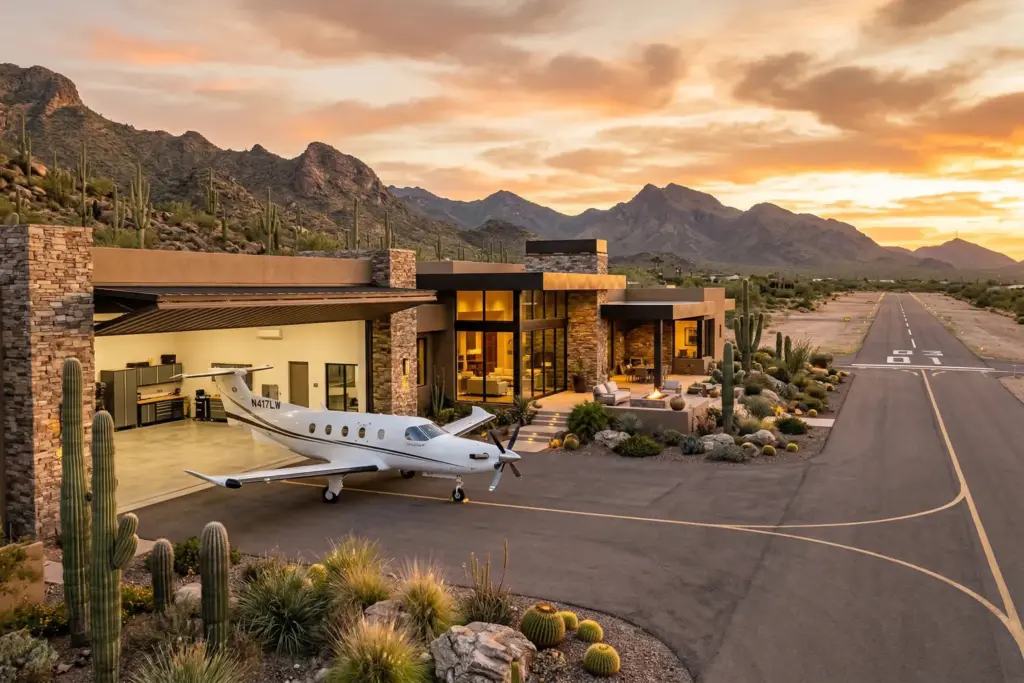
The median home price at Pegasus Airpark in Queen Creek, Arizona is $3.2 million, and the top listing right now is $19 million. That’s for a house where you taxi your Pilatus out of the garage and you’re wheels-up in under three minutes. Sounds like a lot right. But for the buyer profile that gravitates toward luxury airpark homes, the price includes something no gated golf community can offer: your airplane lives with you.
I’m a licensed pilot and a real estate broker, and I’ll be honest, the intersection of those two worlds is one of my favorite things to talk about. According to a survey by Living With Your Plane, over half of all residential airpark properties are second homes. That tracks with what I see in the market. These are typically business owners, executives, or retired professionals who own turbine aircraft and want both the aviation lifestyle and resort-quality living in one place. So lets walk through six communities that define what luxury airpark living looks like in 2026.
Pegasus Airpark, Queen Creek, Arizona
Pegasus is the one that usually comes up first when people ask me about high-end fly-in communities, and for good reason. Three hundred twenty acres. A 5,000-foot paved and lighted runway. Gated. And here’s what makes it genuinely unique: it’s a combined equestrian and aviation community. You can keep your horses and your airplane on the same property.
Lots start at one acre minimum, which means you’re not looking at your neighbor’s hangar door while you eat breakfast. The price range runs from about $860,000 to $19 million, with the median sitting around $3.2 million based on current listings. There’s on-site fuel, which matters more than non-pilots realize (nobody wants to ferry their plane to a commercial airport just to top off tanks).
The buyer here is typically running a business in the Phoenix metro and wants space that doesn’t exist inside the city. One acre, a runway, horses, and a Cessna 400 in the hangar. That’s a Tuesday at Pegasus.
Alpine Airpark, Alpine, Wyoming
If Pegasus is the desert luxury play, Alpine is the mountain version. And I would argue it might be the most spectacular setting of any airpark in the country.
Alpine sits 35 miles from Jackson Hole on the banks of Palisades Reservoir at the confluence of three trophy trout streams. The runway is 5,850 feet with AWOS, a GPS approach, and full lighting, so you can fly a King Air or a Citation in there year-round. That matters. A lot of mountain airparks have short grass strips that shut you out for half the year. Alpine doesn’t have that problem.
The community has 76 hangar homes and 25 standalone hangars. Lots start at $2.25 million for about two acres. And the backyard (if you can call 6.4 million acres of Bridger-Teton and Caribou-Targhee National Forest a backyard) is genuinely ridiculous. Fly fishing, skiing, hiking, snowmobiling. Benjamin Graham wrote about margin of safety in investing. The margin of lifestyle safety here is about as wide as it gets.
But here’s the real play. Jackson Hole real estate is absurdly expensive. Alpine gives you the same access to world-class recreation at a fraction of the cost, with a runway attached. For a pilot, that math is pretty straightforward.
Jumbolair Aviation Estates, Anthony, Florida
Ok so this one has the best backstory of any airpark in America and it’s not close.
The property started as Muriel Vanderbilt’s 380-acre horse ranch. Then Arthur Jones (the guy who invented the Nautilus exercise machine) bought it in 1980 and built a runway. Not just any runway. At 7,550 feet, Jumbolair has the largest private paved runway in the United States. It’s 250 feet wide. You could land a 737 on it. In fact, John Travolta did basically that. He was one of the first buyers, and he flew his personal Boeing 707 (yes, a former Qantas airliner) in and out of this place for years.
The 550-acre community has multiple three-acre lots connected by taxiways that lead to the runways. The entire community has been listed between $10.5 and $15.5 million at various points. It’s part equestrian, part aviation, all Florida. And the combination of that Vanderbilt-era provenance with the aviation infrastructure is something no developer could recreate today (the permitting alone would take a decade).
I bring up Jumbolair not because most people are shopping for a $15 million community, but because it represents the ceiling of what airpark living can be. When someone asks me “how big can this get,” I point them here.
Stellar Airpark Estates, Chandler, Arizona
Stellar is the Phoenix metro answer for pilots who want luxury but don’t need 320 acres of desert. It’s gated, it’s modern, and it’s right in the middle of everything.
Phase II of the development (built by Forte Homes) offers 9 custom homesites ranging from 20,000 to 47,000 square feet. The homes themselves run 3,550 to 5,000+ square feet with prices in the $1.3 to $3 million range. One of the more interesting builds I’ve seen specs out at 4,737 square feet of living space attached to a 3,800 square foot hangar with a door that’s 58 feet wide by 17 feet high. You’re basically parking your aircraft in your house.
Every home has direct taxi access to the runway, and residents are part of the Stellar Runway Utilizers Association (I love that there’s a formal association for “people who use the runway,” but that’s aviation for you). The location near the 202 and 101 freeways means you’re 20 minutes from anywhere in the valley. So your plane gets a hangar and you still get a normal commute. Not bad.
Lakeway Airpark, Lakeway, Texas
Ok now I get to talk about my own market and I’m not going to pretend I’m not biased.
Lakeway Airpark has a 3,930-foot paved runway about 20 miles west of downtown Austin, right on Lake Travis. It’s the only aviation community in Texas with property available to build new luxury hangar homes, and new construction is running $1.2 to $2.3 million for 3,700 to 6,000 square feet. For the Austin market in 2026, that’s actually competitive with non-aviation luxury homes in Lakeway.
What makes Lakeway Airpark special (and I say this as someone who knows this area extremely well) is the combination of aviation access with the Lake Travis lifestyle. You fly in, you’re on the lake in 10 minutes. Golf courses everywhere. The restaurants and nightlife of Austin are a short drive. And the community around Lake Travis has been growing steadily for years.
I’ve written extensively about fly-in communities in Central Texas and the broader Lakeway real estate market. But if you’re a pilot looking at luxury airpark homes in the Austin area, Lakeway Airpark deserves serious attention. The runway is shorter than Alpine or Pegasus (so you’re probably in a piston single or light turboprop, not a Citation), but the surrounding lifestyle is hard to beat.
SilverWing at Sandpoint, Idaho
SilverWing is the newest concept on this list, and it’s a fascinating model.
Forty-four exclusive lots between Schweitzer Ski Mountain and Lake Pend Oreille in northern Idaho. The community includes a 10,000 square foot recreation center with pool, spa, exercise room, and BBQ area. Ownership is fee simple (you own the land), and here’s the detail that makes aviation attorneys’ ears perk up: SilverWing has a perpetual runway easement and a through-the-fence agreement with Bonner County at $150 per year per home. That’s significant because the FAA has declared that no future residential through-the-fence agreements will be approved on publicly funded airports. SilverWing got grandfathered in. That’s a permanent competitive advantage that no new development can replicate.
The location is one of those places where you land and immediately understand why people build here. Mountain lake, ski resort, walkable downtown Sandpoint, and you taxied to all of it from your hangar.
What Sets Luxury Airpark Communities Apart
There’s a clear dividing line between a standard residential airpark (and there are over 700 of them in the US) and a luxury fly-in community. The premium tier shares a few characteristics.
Runway length and infrastructure. The communities on this list all have paved runways over 3,900 feet, with several exceeding 5,000 feet. That’s the threshold for turbine aircraft. A 2,500-foot grass strip is fine for a Piper Cub, but if you’re flying a TBM or a King Air, you need real infrastructure. Alpine’s GPS approach and AWOS system means you can fly IFR into a mountain valley. That’s not just convenience, that’s the difference between flying and not flying on a cloudy day.
The lifestyle around the runway. Golf, equestrian, fishing, skiing, lake access. These aren’t just airstrips with houses. They’re resort communities that happen to have runways. Robert Greene talks about mastery being the intersection of multiple skills. Luxury airpark living is the intersection of multiple lifestyles, and that’s what justifies the price.
Security and exclusivity. Most luxury airparks are gated. The HOA handles runway maintenance, landscaping, and security. You’re not worrying about trespassers on the taxiway or who’s responsible for crack sealing the runway. That’s all handled.
Lot size. One to five acres minimum. You’re not sharing walls with anyone. Your hangar is yours, your ramp is yours, and the space between you and your neighbor feels like a ranch, not a subdivision.
The Buyer Profile
The typical luxury airpark buyer is a business owner, executive, or retired professional in the 45-65 age range who owns turbine or high-performance piston aircraft. And more than half are buying these as second homes. That’s a key insight. These communities function as retreats. You fly in for the weekend, or the month, or the season. The plane is both transportation and lifestyle.
For investors, it’s worth noting that luxury airpark homes tend to hold value well because supply is genuinely constrained. You can’t build a new airpark easily (the FAA permitting, the environmental reviews, the noise studies). And the communities that exist with real runway infrastructure, like the six on this list, have a competitive moat that gets wider every year as regulations tighten.
Frequently Asked Questions
Thinking About Luxury Airpark Living?
I help clients buy and sell homes at every price point, including luxury airpark properties in the Austin area. Lakeway Airpark is one of the finest aviation communities in Texas, and I know it well, both as a broker and as a pilot. And for communities like Alpine, Pegasus, Stellar, or SilverWing, I work with aviation-savvy luxury agents nationwide who understand this niche.
If you’re a pilot exploring luxury airpark homes (or you just want to talk airplanes and real estate, which honestly is my idea of a perfect afternoon), lets connect. Be safe, be good, and be nice to people.


