 Ed Neuhaus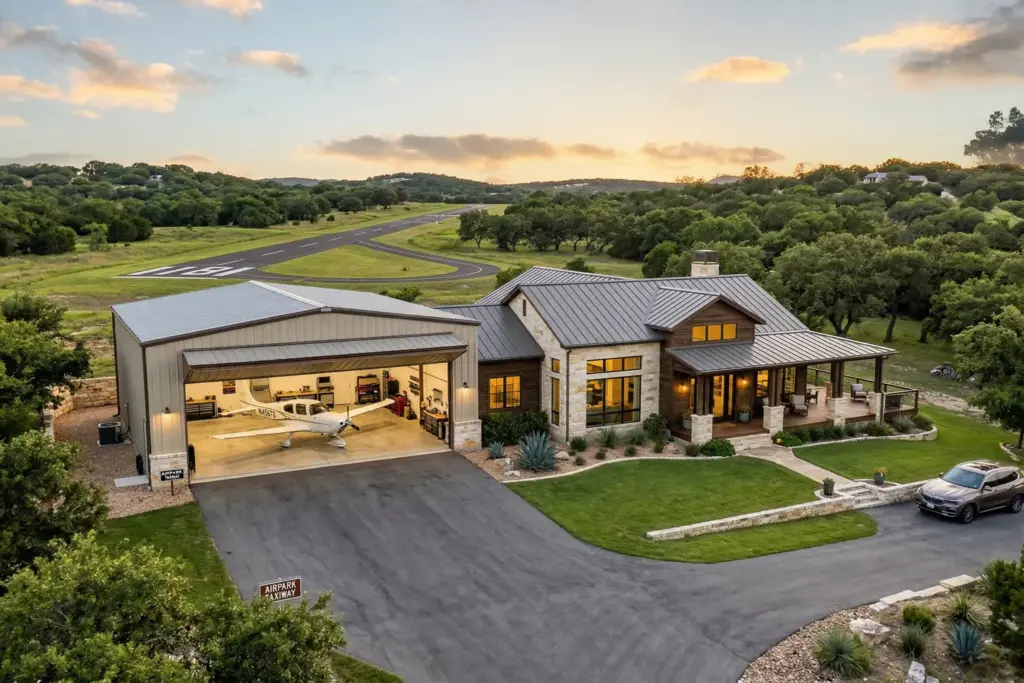
Conventional 30-year mortgages work just fine for most airpark homes. The house qualifies like any other residential property. The part that trips people up is everything attached to it: the hangar, the taxiway, the runway easements, and the fact that your appraiser has probably never set foot on a residential airstrip.
I am a pilot and a real estate broker, and I have been working the Hill Country market for 19 years. So when a buyer calls me about an airpark home, I am not Googling how this works. I have actually lived this. And the number one thing I tell every pilot-buyer is this: the financing is totally doable, but you need to think about it as three separate purchases, not one. The home. The hangar. The airplane. Each one finances differently, and if you try to lump them together you are going to confuse your lender and frustrate yourself.
Lets walk through how each piece actually works.
The Home Itself: Conventional Mortgage, No Drama
Here is the good news. The residential portion of an airpark home qualifies for a conventional mortgage the same way any house does. Fannie Mae and Freddie Mac do not care that there is a runway 200 feet from your back door. They care about your credit score, your debt-to-income ratio, and whether the appraised value supports the loan amount.
So if you are buying a 3,500 square foot home on two acres in a fly-in community, and the home itself appraises at $850,000, you can get a conventional 30-year fixed mortgage on that $850,000 value. 20% down, 6.5% rate, standard underwriting. No special programs required.
The catch (and there is always a catch right) is in how the appraiser values the property. More on that in a minute.
One thing worth knowing: some lenders get nervous when they see “airpark” or “runway” in the property description. Not because the loan does not qualify, but because they have never done one before. And lenders are creatures of habit. If your loan officer has to call their underwriting department to ask what a taxiway easement is, that is not a great sign. You want a lender who has closed airpark transactions before. Ask the airpark POA for recommendations. They will know exactly who to call.
The Hangar: This Is Where It Gets Interesting
Ok so the house is the easy part. The hangar is where most buyers run into a wall.
Banks classify hangars as “outbuildings.” That is the same category as a detached garage, a barn, or a workshop. And outbuildings get minimal appraised value relative to what they actually cost to build. You might spend $150,000 to $300,000 on a hangar (depending on size, insulation, doors, electrical, and whether you want climate control for your aircraft), and the appraiser might give you $40,000 of credit for it.
That gap between construction cost and appraised value is the fundamental problem with hangar financing. A bank is not going to lend you $250,000 to build something their appraiser says is worth $60,000.
So what do you do?
Strategy 1: Pay cash for the hangar. This is the most common approach I see. Buy the home with a conventional mortgage. Build the hangar with cash. It is clean, simple, and avoids the entire lender headache. If you are buying into an airpark community, you probably have the financial profile to pull this off. Most airpark buyers are higher net worth individuals (not everyone obviously, but the overlap between people who own aircraft and people who have capital is… significant).
Strategy 2: Home equity after closing. Buy the home. Wait for it to close. Then use a HELOC or home equity loan to fund the hangar construction. This works because the home equity lender is lending against the house, not the hangar. By the time the hangar is built, the overall property value goes up, but you have already secured the financing based on the home value alone. Benjamin Graham put it best when he talked about margin of safety. You are essentially using the equity in the house as your margin to fund the aviation piece.
Strategy 3: Specialized aviation lenders. Companies like Air Capital Group and HomePromise focus specifically on aviation real estate. They understand hangars, they understand taxiway easements, and they will not flinch when they see “runway proximity” on the appraisal. Some hangar providers and FBO construction companies also offer direct financing, typically at 85% loan-to-value with 5 to 10 year terms. The rates will be higher than a conventional mortgage (think commercial loan territory), but the terms exist for people who need them.
And then there is the scenario where you are buying into a community with shared hangar condos. This is common at places like Lakeway Airpark, where some of the freestanding hangar buildings house four aircraft each. Financing a condo hangar through a traditional lender is almost impossible because you often do not own the land underneath it. You own the hangar unit, and maybe a fractional interest in the land, but the lending structure does not fit neatly into any conventional loan product. Most people who buy hangar condos do it in cash. That is just the reality of it.
Aircraft Financing: A Completely Separate Event
I want to address this because every airpark buyer is thinking about it even if they do not bring it up with their mortgage broker. Your aircraft is a completely separate financing event from your home.
Specialized aviation lenders (AOPA Finance, Dorr Aviation, US Aircraft Finance, and a handful of others) will finance up to 85 to 90% of the aircraft’s value. Current rates are running 7% to 9% depending on the aircraft type and your credit profile, with terms from 15 to 20 years and typically a 15% down payment for loans under a million dollars.
The aircraft loan does not affect your mortgage qualification unless the monthly payment changes your debt-to-income ratio enough to matter. And here is where I tell every pilot-buyer to get organized early. If you are buying a home, building a hangar, AND financing an aircraft, you need to sequence these correctly. Get the home mortgage locked first. Close on the house. Then handle the hangar and aircraft financing separately so the debt load does not stack up and blow your DTI before the home loan closes.
I know that sounds obvious but I have seen it go sideways. A buyer gets excited, starts the aircraft loan process at the same time as the mortgage, and suddenly their lender is looking at an additional $2,000 a month in projected obligations that were not there when they got pre-approved. Not ideal.
The Appraisal Problem (And How to Solve It)
This is the part of the airpark buying process that creates the most unnecessary friction. And honestly it is the part where having a broker who understands aviation real estate matters the most.
Here is the problem. Your lender orders an appraisal. The appraiser shows up. They have probably never appraised an airpark home before. They look at the house and think ok, 3,500 square feet, four bedrooms, nice kitchen, got it. Then they see the hangar. Then they see the taxiway. Then they look for comparable sales and find… almost nothing. Because airpark homes are so rare that there might be three or four sales in the entire metro area over the past two years.
So the appraiser does their best. They pull comps from regular neighborhoods. They treat the hangar as an outbuilding. They assign zero premium for runway access because their training does not include a line item for “can literally taxi your airplane to your front door.” And the appraisal comes in low. Maybe way low.
Now your lender thinks you are overpaying. Your loan-to-value ratio looks terrible. And the whole deal is at risk.
Here is what I do to get ahead of this. Before the appraiser even shows up, I prepare a package. Recent airpark sales from across the region (not just the local MLS, but from aviation real estate databases and pilot community networks). A breakdown of what the hangar cost to build. Documentation from the airpark POA about property values and recent transactions. And a clear explanation of why taxiway access has value even though no standardized appraisal form has a field for it.
You are essentially educating the appraiser. And most of them appreciate it because they know they are working outside their comfort zone. The good ones will incorporate the data you give them. The not-so-good ones will ignore it. But you have to try, because the alternative is accepting a low appraisal and either coming up with more cash or watching the deal fall apart.
I would also recommend requesting an appraiser who has experience with unique or specialty properties. Some appraisal management companies will accommodate that request if you make it early in the process. It is worth asking. The worst they can say is no.
FHA and VA Loans: Possible But Complicated
Lets talk about government-backed loans because I get this question from military pilots specifically.
Can you use a VA loan to buy an airpark home? The short answer is maybe, but probably not worth the headache.
VA loans have Minimum Property Requirements that every home must meet. The big issue is the runway protection zone. If the home is newly constructed within a runway clear zone, it is not eligible for VA financing. Period. If it is an existing home in or near a clear zone, the VA requires the buyer to sign an acknowledgment that they understand the risks. That is doable but adds a step.
The trickier issue is the private road and easement requirements. VA loans require that access to the property be protected by a recorded permanent easement. In most airpark communities, the taxiway and runway access are governed by POA agreements, not traditional road easements. Whether a VA underwriter will accept the POA’s access agreements as equivalent to a recorded easement depends on the specific lender and the specific POA documents. Some will. Some will not.
FHA loans are actually a bit more flexible here. Homes near runway protection zones can qualify for FHA financing as long as there is full disclosure to the buyer about the runway proximity. But FHA appraisals are notoriously strict on property condition, and the unique nature of airpark properties can create questions that slow the process down.
My honest advice? If you are a veteran or active military pilot looking at an airpark home, start with a conventional loan. You will have fewer hoops to jump through. Save the VA loan for your next non-airpark purchase where it is straightforward. I know the zero-down benefit is attractive but the headache of navigating VA underwriting through an airpark transaction is real. And I am being diplomatic about that.
Budgeting Your All-In Cost
Here is the part where I put on my investor hat. Because when I evaluate an airpark property for myself or for a client, I do not just look at the home price. I look at the all-in cost of the aviation lifestyle at that property. And you should too.
Lets run some real numbers. Say you are looking at a home in one of the Central Texas fly-in communities listed at $1.2 million.
The home:
Purchase price: $1,200,000
Down payment (20%): $240,000
Mortgage (30yr fixed at 6.5%): roughly $6,065/month
Property taxes (2.1% in Travis County): roughly $2,100/month
Insurance: roughly $500/month (higher than typical due to hangar)
The hangar (if building new):
Construction cost: $175,000 to $300,000 depending on size and features
Financing: cash or HELOC after closing
The aircraft (if not already owned):
Purchase price varies wildly. Say $350,000 for a nice single engine.
Down payment (15%): $52,500
Aircraft loan (7.5% for 15 years): roughly $2,700/month
Annual operating costs (fuel, maintenance, insurance, annual inspection): $25,000 to $40,000/year
Monthly total (home + aircraft): roughly $11,365 to $12,000 before hangar construction costs
And that does not include the airpark association dues, fuel for personal flying, or the inevitable hangar upgrades you will convince yourself are necessary. You will, trust me, I have been there.
The point is not to scare anyone off. The point is to plan accordingly. If you know the all-in number going in, you can structure each financing piece strategically instead of discovering halfway through that you are stretched too thin.
Ed’s Playbook for Pilot-Buyers
I have helped pilots buy into airpark communities and I have navigated the aviation financing maze myself. Here is what I would tell you if we were sitting at a table together.
Get pre-approved before you fall in love with a property. I say this to every buyer but it is especially true for airpark homes because the financing is complex enough that you want to know your exact budget before emotions get involved. The worst position to be in is loving a property and then discovering your lender will not touch it.
Talk to the POA first. The property owners association at any airpark community will know which lenders have successfully closed transactions there. They will know which appraisers understand the properties. And they will know the gotchas specific to their community. This is insider knowledge you cannot get from any website.
Budget the hangar separately from day one. Do not try to roll hangar construction into your home mortgage. It will complicate the underwriting and probably lower your appraised value. Keep them separate. Finance the home. Build the hangar with cash or a HELOC after closing.
Sequence your financing. Home first. Hangar second. Aircraft third (or whenever). Do not try to do all three at once because the cumulative debt will tank your debt-to-income ratio and make every lender nervous.
Understand what you are really buying. An airpark home is not just a house. It is a lifestyle infrastructure. The premium you pay for taxiway access, runway proximity, and the ability to walk from your kitchen to your cockpit in three minutes is real, even if the appraiser cannot quantify it. You are buying convenience and freedom that no amount of driving to the FBO can replicate.
As Howard Marks likes to say, the price is what you pay, the value is what you get. With an airpark home, the value extends well beyond the appraisal.
Frequently Asked Questions
Ready to Talk Airpark Real Estate?
If you are a pilot looking at homes in Lakeway or any of the fly-in communities in the Hill Country, lets talk. I have been on both sides of this transaction, as a pilot and as a broker, and I can help you structure the deal so the financing does not become the obstacle.
Check out my full guide to fly-in communities in Central Texas for a breakdown of every airpark in the region. And when you are ready to get serious, reach out to me directly. Lets figure out which runway fits your life.


