 Ed Neuhaus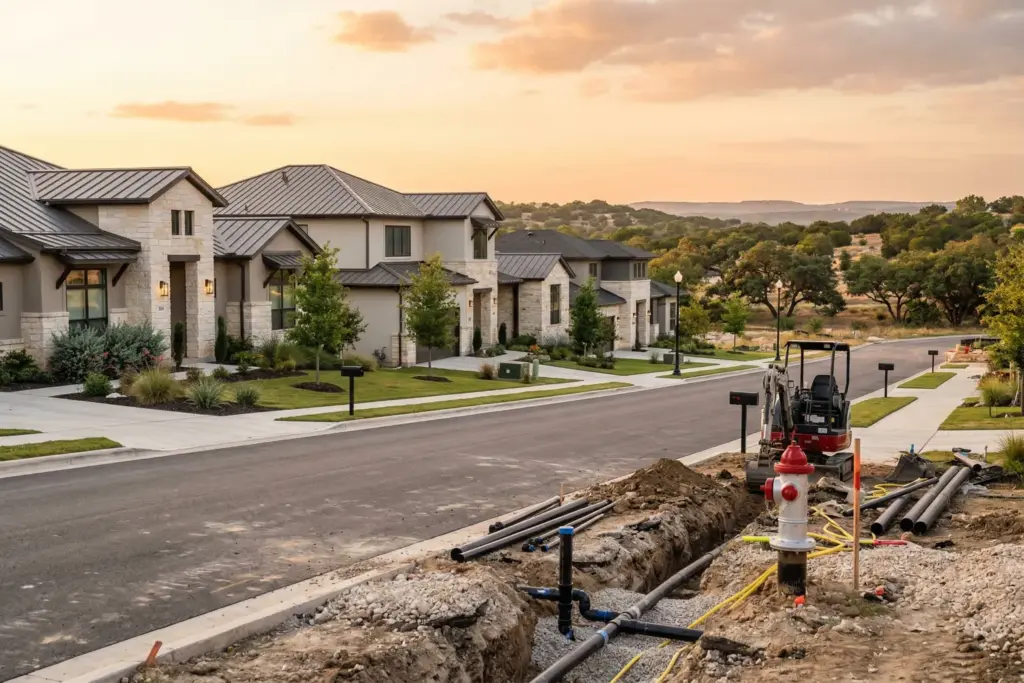
Travis County has 54 Municipal Utility Districts layered on top of the regular taxing entities, and some of them add $0.75 to $1.00 per $100 of assessed value to your annual tax bill. On a $450,000 home, that’s an extra $3,375 to $4,500 per year that a lot of buyers don’t see coming. According to the Travis Central Appraisal District, the county now has 127 local taxing jurisdictions, and four brand new MUDs started levying taxes just last year (Creedmoor MUD, Lund Farm MUD, Pilot Knob MUD #1, and Triada MUD).
So yeah. That shiny new construction home with the great price per square foot? There’s a decent chance the reason it looks affordable is because a MUD or PID is doing the heavy lifting on infrastructure costs. And those costs land squarely on your tax bill. Lets talk about what that actually means for your wallet.
What Is a MUD District in Austin TX (and Why Does It Exist)
A Municipal Utility District is a political subdivision of the State of Texas. I know that sounds like something from a government textbook, but here’s the plain English version: a developer wants to build 500 homes on a piece of land that has no water lines, no sewer, no drainage, no roads. The city isn’t going to pay for all that infrastructure. So the developer creates a MUD, the MUD issues bonds to fund construction, and then the homeowners who eventually buy in that community pay back those bonds through a special tax on their property.
It’s basically a financing mechanism. The developer gets to build without fronting tens of millions in infrastructure costs. The city doesn’t have to foot the bill. And the homebuyer gets a (usually) lower purchase price because the developer’s cost basis is lower. But you pay for it every single year on your tax bill until those bonds are retired.
Benjamin Graham would call this the difference between price and value. The sticker price of the home is lower, but the total cost of ownership is higher. You’re just paying for the infrastructure over time instead of upfront.
The MUD has its own elected board of directors (usually five people who live in the district), and they set the tax rate annually. Early in a community’s life when there are fewer homes splitting the bond payments, the MUD tax rate tends to be highest. As more homes get built and more taxpayers share the load, the rate typically comes down. Typically. Not always.
How a PID Works (and Why It’s Not the Same Thing)
A Public Improvement District operates under Chapter 372 of the Texas Local Government Code, and it’s a fundamentally different animal than a MUD. Where a MUD is its own political entity that levies taxes, a PID is created by a city to charge assessments against properties within a defined area.
Here’s why that distinction matters to you as a buyer.
With a MUD tax, your payment fluctuates based on your property’s assessed value. If your home value goes up, your MUD tax goes up. If the board raises the rate, your bill goes up. There’s no predetermined end date baked into your closing paperwork.
With a PID assessment, the amount is fixed at the time of your purchase. You get a printed schedule showing exactly what you’ll pay every year for the life of the assessment (usually 20 to 30 years). It doesn’t change based on your property value. And once the assessment is paid in full, it’s done. Gone. No more charges on that property, period.
Whisper Valley east of Austin is probably the best known PID community in the metro. Their PID assessment replaces what would otherwise be City of Austin ad valorem taxes. So you’re not paying city taxes AND a PID on top of it. You’re paying a PID instead of city taxes. That’s a pretty important “instead of” right.
Specific Austin Communities and What They Charge
Lets get into the actual numbers because this is where it gets real.
Easton Park (Southeast Austin)
Easton Park sits in multiple Pilot Knob MUD districts, and the total tax rates range from about 2.58% to 2.70% depending on which section of the community your lot is in. The MUD portion alone (Pilot Knob MUD #2 through #5) runs between $0.83 and $0.95 per $100 of assessed value. On a $400,000 home, that MUD tax alone is $3,320 to $3,800 per year. That’s on top of Travis County, Del Valle ISD, ACC, and the healthcare district.
For context, a $400,000 home inside Austin city limits (no MUD) in the same school district would have a total tax rate closer to 2.0%. That MUD is costing you roughly $2,300 to $2,800 more per year in taxes.
Whisper Valley (East Austin/Manor Area)
Whisper Valley uses a PID instead of a MUD, which means the assessment is a fixed annual amount disclosed at closing. The PID replaces City of Austin taxes, so you’re not double-paying. But the total effective rate can still be comparable to what you’d pay in a MUD community. The advantage is predictability. You know exactly what you’re paying for 30 years. No surprises from an elected board deciding to raise rates.
Sweetwater (Bee Cave Area)
Now here’s an interesting comparison. Sweetwater in Bee Cave sits in a MUD, but it’s in the Bee Cave ETJ where tax rates are already among the lowest in the Austin metro. So even with a MUD overlay, the total tax bill in Sweetwater can be competitive with (or even lower than) non-MUD communities in other parts of Travis County. The base rate is just that much lower to start with.
That’s the thing about MUD taxes. You can’t evaluate them in isolation. A community with a MUD tax in a low-base-rate area might still cost you less than a community with no MUD in a high-base-rate area. You have to look at the total effective rate.
Travisso (Lakeway/Leander Area)
Travisso sits in Williamson County and has its own MUD overlay. The total rate there reflects both the Leander ISD taxes (which aren’t cheap) and the MUD debt service. I’ve seen buyers surprised by Travisso’s total bill because the home prices feel reasonable for the quality of construction, but the annual tax burden closes that gap pretty quickly.
The Math Nobody Does Before Making an Offer
Ok lets do the math because this is the part that actually changes decisions.
Say you’re comparing two homes. Home A is $425,000 in a community with no MUD, total tax rate of 2.1%. Home B is $375,000 in a MUD community with a total rate of 2.8%.
Home A annual property tax: $8,925.
Home B annual property tax: $10,500.
Home B is $50,000 cheaper to buy. But it costs $1,575 more per year in taxes. Over 10 years, that’s $15,750 in extra taxes (and that’s before any value appreciation increases). Over 30 years, you’ve paid an extra $47,250 in taxes on the “cheaper” home.
But wait, it’s actually worse than that. Your lender includes property taxes in your monthly payment for escrow purposes right. So that extra $1,575 per year is $131 per month added to your PITI. Which means when the lender calculates how much house you can afford, that MUD tax is eating into your buying power. You might qualify for $50,000 less house precisely because of that MUD overlay. So you saved $50,000 on the purchase price, but you can afford $50,000 less. The MUD giveth and the MUD taketh away.
This is exactly the kind of thing Robert Kiyosaki talks about in Rich Dad Poor Dad. The price of an asset is not the cost of an asset. Two homes at the same purchase price can have wildly different carrying costs depending on which taxing jurisdictions they sit in.
How to Find Out if a Property Is in a MUD or PID
This part is actually pretty straightforward. A few ways to check:
1. Travis Central Appraisal District (TCAD)
Go to austincad.org, search the property address, and look at the list of taxing entities. If the home is in a MUD, it will show up by name (something like “Pilot Knob MUD #3” or “Travis County MUD No. 22”). Each entity has its tax rate listed right there.
2. The MUD Notice at Contract
Texas law requires that buyers receive a notice if the property is in a MUD. Under Texas Property Code Section 5.014, the seller (or builder) must provide a written MUD notice before the purchase contract is executed. It’s a separate document that explains the MUD’s authority to levy taxes, issue bonds, and charge for services. If you’re buying new construction and nobody hands you a MUD notice, ask for it. If they tell you there isn’t one, get that in writing.
3. Travis County Tax Office
The Travis County Tax Office publishes tax rate information for every taxing entity. You can look up a specific property and see every jurisdiction that has taxing authority over it, along with the current rates.
4. Just Ask Your Agent
Honestly this should be the first thing your agent tells you. Not buried in disclosure documents at closing (well, technically the documents do disclose it, but by then you’ve already mentally committed to the house). A good buyer’s agent brings this up during the search, not after you’ve fallen in love with the kitchen.
When MUD Taxes Go Away (Spoiler: Don’t Hold Your Breath)
MUD taxes can technically end. When the bonds are fully paid off, the debt service portion of the MUD tax goes away. But there are a couple of realities nobody mentions.
First, bond payoff typically takes 20 to 40 years. So if you buy in a new MUD community in 2026, you might see that tax disappear sometime around 2050 to 2065. Maybe.
Second, MUDs can (and often do) issue new bonds. Need a new water treatment plant? New drainage infrastructure? The MUD board can issue new bonds and the tax continues. I’ve seen MUDs where the original bonds were nearly paid off and then a new round of infrastructure needs popped up.
Third, there’s a maintenance and operations (M&O) component that never goes away. Even if all the bonds get retired, the MUD still needs to operate and maintain the water system, drainage, roads, etc. That M&O tax sticks around.
The other path to MUD elimination is city annexation. If the city annexes the MUD territory, the city takes over services and pays off remaining bonds. The MUD dissolves and you start paying city taxes instead. According to the City of Dripping Springs, their policy is not to dissolve a MUD unless all debt has been paid off or remaining debt can be covered by residents.
So can MUD taxes go away? Technically yes. Should you buy a home assuming they will? Absolutely not.
The Trade-Off That Nobody Frames Correctly
Here’s what I actually tell my buyers. A MUD district isn’t inherently bad. It’s a trade-off, and the question is whether you understand the trade-off before you commit.
The MUD trade-off: Lower purchase price. Brand new infrastructure. Often newer schools, parks, community amenities. But higher annual carrying costs that compound every year you own the home. And no guaranteed end date.
The established-area trade-off: Higher purchase price. Infrastructure already paid for (no special district taxes). Potentially lower total tax rate. But the home might be 15 to 30 years old, the kitchen hasn’t been updated since 2005, and the AC is on borrowed time (and if you’ve lived in Austin in August you know exactly what I mean).
For some buyers, the new construction in a MUD community is the right call. Especially if you plan to be there less than 10 years, the lower purchase price and lower upfront costs can win even with the higher taxes. For long-term holds, the math usually favors established communities where you’re not carrying that MUD payment into your 60s.
And for investors? This is even more critical. That MUD tax comes straight off your cash flow. A rental property in a MUD community with an extra $3,000 per year in taxes needs to generate $250 per month more in rent just to break even with a non-MUD property. Run the numbers on any Hill Country investment property with the full tax picture before you make an offer.
The Disclosure Requirement (and Why It Matters More Than You Think)
Texas takes MUD disclosure seriously. Builders and sellers are legally required to inform buyers that a property sits in a MUD before the contract is executed. Not at closing. Not during the option period. Before you sign the contract.
The Texas seller disclosure requirements include specific MUD notification language. If you’re buying new construction directly from a builder, they should hand you a MUD notice along with your other contract documents. If you’re buying a resale in a MUD community, the seller’s agent should provide it.
I would argue the disclosure requirement is actually one of the better consumer protection rules in Texas real estate. But here’s the catch: disclosure doesn’t mean explanation. A seller can hand you a legal document full of terms like “ad valorem taxation” and “bond obligations” and technically meet their disclosure requirement. That’s why having an agent who actually explains this stuff in plain English matters.
Frequently Asked Questions
Want the full picture on Austin property taxes beyond MUDs and PIDs? Our Complete Guide to Property Taxes in Austin covers every taxing entity, the 2026 homestead exemption increase to $140,000, protest strategies, and a city-by-city rate comparison.
Bottom Line: Know What You’re Paying Before You Sign
Look, I’m not here to scare anyone away from MUD or PID communities. Some of the best new construction in the Austin metro sits in special districts, and for good reason. These financing mechanisms make it possible to build communities that wouldn’t exist otherwise. But the difference between a good purchase and a regret is whether you went in with your eyes open.
Before you make an offer on any home in the Austin area, pull up the TCAD records, add up every taxing entity, and calculate the real monthly cost. Don’t just look at the purchase price. Don’t just look at the mortgage payment your lender quotes (which may or may not include the correct tax estimate). Look at the total annual tax burden including any MUD or PID, and then decide if the trade-off works for you.
If your tax estimate has line items you don’t recognize, or the total property tax seems higher than you expected, give me a call. I’ll walk you through every line item so there are no surprises at closing. And if you’re already in a MUD community and your homestead exemption or tax protest strategy could use a second look, lets talk about that too.
Explore all of our seller resources, guides, and tools.


