 Ed
Ed 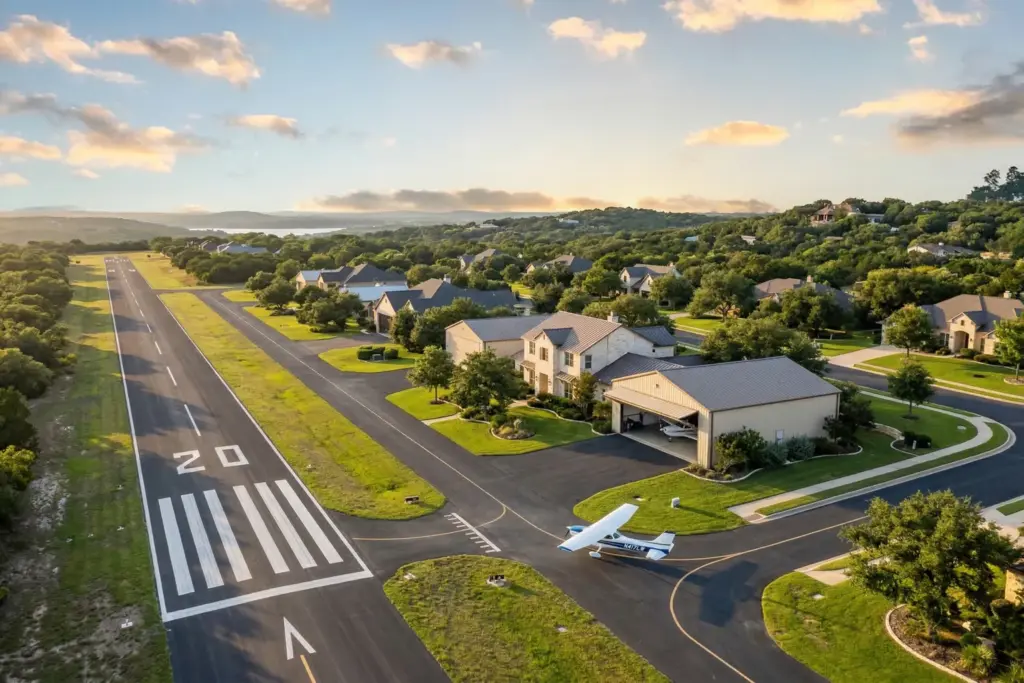
Lakeway Airpark has had exactly three aircraft incidents beyond the runway boundary in over 30 years. Three. For a community where airplanes taxi past front yards every day, that is a safety record most subdivisions would envy (and they dont even have runways). I bring this up because the first question I get from pilot families is never about hangars or runway length. Its about their kids.
And honestly, thats exactly the right question to ask.
I am a pilot and a real estate broker, so I sit at the intersection of these two worlds every day. Airpark family living is one of the most misunderstood lifestyles in residential real estate. People either romanticize it or they are terrified of it. The reality is somewhere in between, and it depends almost entirely on which community you pick and whether your whole family is genuinely on board. Not just the pilot.
So lets talk about what it actually looks like to raise kids on a residential airpark in Central Texas.
Safety Is Not a Concern, Its a Culture
I know that sounds like something you would put on a brochure. But hear me out.
The reason airpark safety records are so strong is because everyone who lives there has skin in the game. These are not random neighborhoods that happen to be near an airport. Every homeowner either flies or chose to live around people who do. That changes the dynamic completely. According to the Lakeway Airpark safety page, the community has maintained strict operational protocols since the 1970s, with sunrise-to-sunset flying only and a 12,500 pound aircraft weight limit enforced by city ordinance.
But rules on paper only matter if people follow them right. And this is where airpark culture is different from a typical HOA. Try leaving your trash cans out on the wrong day in a regular subdivision and maybe your neighbor sends a passive aggressive text. Violate a safety protocol on an airpark and the entire community is on you immediately. Not because they are busybodies. Because their kids play in those yards too.
The Living With Your Plane Association publishes specific guidelines for kids on airparks that most communities adopt as baseline rules. No playing on runways or taxiways, period. No bikes, skateboards, or rollerblades on paved aircraft surfaces. Kids wear reflective gear if they are outside near taxiways after dusk. And here is the one most parents miss: you need to brief visiting children before they play outside. Your kids know the rules. Their friends from school probably dont.
I tell families to think about it like growing up on a ranch. Kids who grow up around horses learn to respect a 1,200 pound animal pretty quickly. Kids who grow up around airplanes learn the same thing about prop wash and hot exhausts. You teach them young, you reinforce it a couple times a year, and it becomes second nature. My friend who lives at Lakeway Airpark says his kids could identify which direction an airplane was taxiing by sound before they were in first grade. Thats not scary. Thats awareness.
Schools: The Factor Most Pilots Overlook
Ok this is where I put on my real estate broker hat for a minute.
Pilots shopping for airpark homes tend to obsess over runway length, fuel availability, and instrument approaches. Makes sense. But if you have school-age kids, the school district attached to that airpark is going to matter more to your daily quality of life than whether the runway is 3,000 or 4,000 feet.
And the range of school quality across Central Texas airparks is enormous.
Lakeway Airpark sits inside Lake Travis ISD, which is one of the top-performing districts in the state. 97.7% graduation rate, Gold distinction on the College Board AP honor roll, and Lake Travis High School is consistently ranked among the best public high schools in Texas. If you want airpark family living with elite public schools, this is the play. I wrote a full breakdown in my Hill Country school district comparison if you want the deep dive.
Breakaway Park up in Cedar Park feeds into Leander ISD, which is solid. Good schools, growing district, and you get the suburban convenience of the Cedar Park and Round Rock corridor. The tradeoff is a 3,000 foot runway versus Lakeway’s 3,930 feet (AirNav 40XS). For a Cessna 172 or a Bonanza, the shorter strip is fine. For anything bigger, you are going to want more runway.
Cross Country Estates near Georgetown is in Hutto ISD. Decent schools but a newer district that is still building its reputation. The community itself is more rural and laid back (29 properties on 1-5 acre lots), which some families love and others find too isolated.
And then there is Pecan Plantation down near Granbury. Great family amenities (more on that in a minute) but it feeds into Granbury ISD, which is about three hours from Austin. If your work is in Austin, the commute math gets tough fast. Daniel Kahneman wrote about how humans are terrible at predicting what will make them happy long term, and I think commute times are the classic example. That 175-mile drive sounds fine on a Saturday test visit. Its a different story on a Tuesday morning in January.
The Family Upside Nobody Talks About
Here is what I love about airpark family living and what I wish more people understood.
These communities produce kids who are different. And I mean that in the best possible way.
When your neighbor’s garage has a Cessna in it instead of a minivan, aviation becomes normal. Not exotic, not intimidating, just part of life. I know families at Lakeway Airpark where the kids started ground school at 14 and had their private pilot certificate before their driver’s license. At 16 or 17, these kids are soloing an airplane. Thats not just a cool hobby right. Thats discipline, responsibility, and a level of confidence that most teenagers never get close to.
But the aviation stuff is honestly just the surface.
The real family upside is the community itself. Airparks are small. Lakeway has 32 homes. Breakaway has maybe 50 properties along the runway. Cross Country has 29 lots. These are places where everyone knows each other. Not in the “I wave at my neighbor from the car” way. In the “we have hangar parties on Fourth of July and our kids grew up together” way.
Fly-in events are a big deal at most airparks. Pilots from other communities fly in for pancake breakfasts, cookouts, or just to hang out and look at each other’s airplanes (we are not that hard to entertain, honestly). For kids, these events are basically block parties with airplanes. And because most airpark lots are 1-5 acres, your kids have actual room to play. No shared fences six feet from your neighbor’s window. No cookie-cutter subdivision where every yard looks the same. My guide to fly-in communities in Central Texas covers the specific lot sizes and community details if you want the full inventory.
The Spouse Conversation You Need to Have
Ok lets get real for a second.
I have seen this play out enough times to know that the pilot in the family is usually sold on airpark living before they ever call me. Its the non-pilot spouse who needs to be genuinely convinced. And “convinced” does not mean “agreed to stop arguing about it.” It means they actually want this lifestyle.
So here is what I tell the non-pilot spouse when they are sitting across from me looking skeptical.
Amenities matter more than you think. Pecan Plantation in Granbury has two golf courses, swimming pools, tennis courts, a marina, playgrounds, a grocery store inside the gates, and its own EMS team. Its basically a small town that happens to have a runway. Living there as a non-pilot spouse is genuinely pleasant even if you never set foot in an airplane. Compare that to a rural grass strip airpark where the nearest grocery store is 20 minutes away and the “community amenities” are a windsock and a fuel pump. Same lifestyle label, completely different daily experience.
Noise is real, but its manageable. Most airparks operate sunrise to sunset only. At Lakeway, thats a city ordinance. And the aircraft are small, single or twin engine, under 12,500 pounds. This is not living next to Austin-Bergstrom with 737s overhead every three minutes. Its a Cessna taking off at 9am on a Saturday. Some people genuinely dont notice it after the first month. Others never get used to it. Be honest with yourself during the home search.
Distance from town is the hidden variable. Lakeway Airpark is 17 miles from downtown Austin with a Target, an HEB, and good restaurants within 10 minutes. Breakaway Park is right in Cedar Park with suburban everything at your doorstep. But some of the more rural airparks in the Hill Country put you 30-45 minutes from a hospital. If you have young kids, that matters. I am not saying rural airparks are wrong for families. I am saying you need to audit the drive times to the places you actually go every week, not just the ones you visit once a year.
My Picks for Austin-Area Airpark Families
If someone called me tomorrow and said “Ed, we are a pilot family with school-age kids, where should we look,” I would point them at two communities.
Lakeway Airpark is my top pick for families who want the best of everything. Lake Travis ISD schools, a paved 3,930 foot runway with GPS approach, 32 homes in a tight-knit community, and the full Lakeway resort lifestyle surrounding it. Golf, lake access, dining, medical facilities, all within minutes. The only downside is inventory. With only 32 homes, properties here dont come up often, and when they do, they move fast.
Breakaway Park in Cedar Park is my pick for families who want suburban convenience with aviation access. Leander ISD schools, no HOA (which some families love), a small lake for the kids, and the entire Cedar Park commercial corridor right there. The shorter runway limits you to lighter aircraft, but for a lot of family flyers thats perfectly fine. And the price point is significantly more accessible than Lakeway.
Both of these keep you inside the Austin metro, close to good healthcare, and in strong school districts. That combination is hard to find in the airpark world.
Frequently Asked Questions
Bottom Line
Airpark family living is not for everyone. Lets be honest about that. But for pilot families who do their homework, pick the right community, and make sure both spouses are genuinely excited about the lifestyle, it can be one of the most rewarding ways to raise kids. Large lots, close-knit neighbors, and children who grow up with a level of awareness and confidence that you just dont get in a typical subdivision.
If you are a pilot family considering the move, or if your spouse is reading this trying to figure out whether you have lost your mind, give me a call. I have been working the Hill Country aviation real estate market for years, and I fly out of this area myself. I will walk you through the options and help you figure out which runway fits your family.
Be safe, be good, and be nice to people.


