 Ed Neuhaus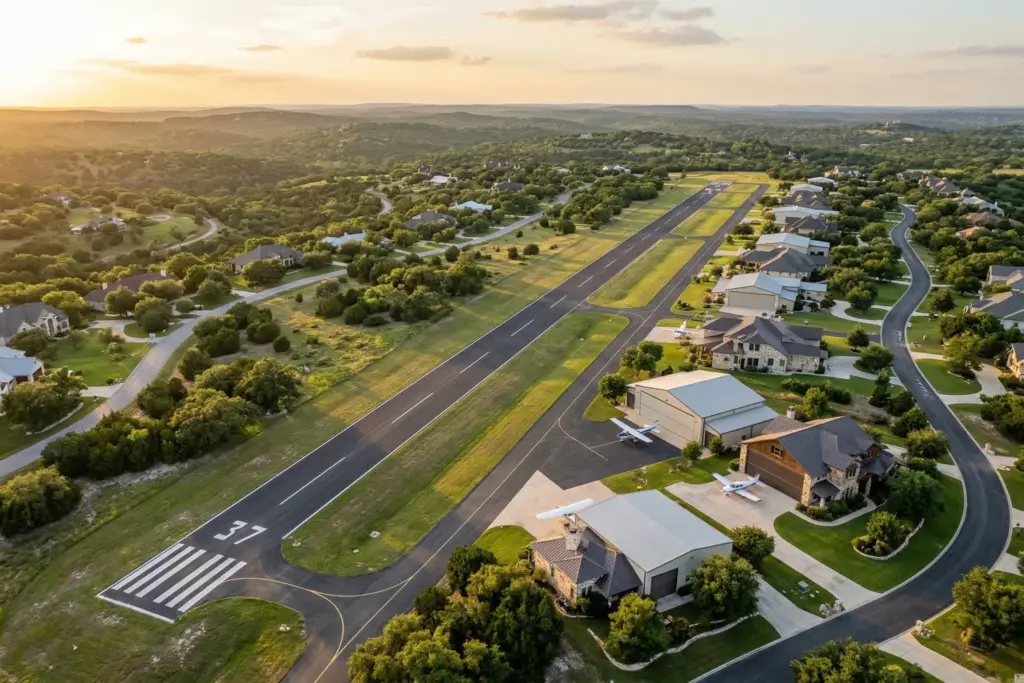
Texas has 84 residential airparks, more than any other state in the country. Florida is second with about 80. And having flown over a good chunk of them and sold real estate near several, I can tell you the gap between Texas and everyone else is not just about the number of runways. Its about the whole package.
No state income tax. VFR weather most of the year. Property costs that make California and Florida pilots do a double take. And a general aviation culture that actually supports private flying instead of trying to regulate it out of existence. According to AOPA’s state advocacy page, Texas has roughly 300 public-use airports, and the state has consistently ranked among the most pilot-friendly in the nation.
So if you are a pilot thinking about where to park your plane and your life, Texas should be at the top of the list. And if you are already here but driving 30 minutes to an FBO every time you want to fly, there might be a better option.
Lets walk through the best residential airparks in Texas, region by region.
Austin Area: Where I Fly and Sell
I will start with the area I know best because I live here, I fly here, and I have sold homes within a few miles of most of these runways. The Austin metro has four legitimate airpark communities, each with a completely different personality.
Lakeway Airpark (3R9)
This is the crown jewel of Central Texas aviation real estate and its not particularly close. Lakeway Airpark sits on 39 acres just 17 miles from downtown Austin, right in the heart of Lakeway. The runway is 3,930 feet of asphalt, 70 feet wide, with an RNAV GPS approach to runway 16 for those less than perfect weather days.
There are 32 residences surrounding the airpark. 30 of them have attached taxiways and hangars right on the property. The airpark is owned by a not-for-profit formed in 1995 when homeowners purchased it from Ross Perot’s Hillwood Corporation. Operations are sunrise to sunset, max 12,500 lbs.
Price range here is roughly $800K to well over $2M, and honestly things rarely come on the market. When they do they move fast. You are getting the full Lake Travis lifestyle on top of the aviation: golf, marinas, private clubs, restaurants, and an award-winning medical center. Its an airpark embedded in one of the best communities in the Hill Country.
Best for: Pilots who want luxury lakeside living with serious aviation access. Single and light twin operators.
Cross Country Estates (07TS)
About 30 minutes north of Austin near Georgetown, Cross Country Estates is a quieter, more rural airpark with 29 homes on 1 to 5 acre lots. The runway is 2,500 feet of coastal bermuda turf (plus 200-foot overruns on both ends), and every home has direct taxiway access.
This is a private community. Hangars and tie downs are for residents only. The vibe is more “ranches and hangars” than “lakeside luxury.” City water through Jonah Water, septic systems, and the kind of peace and quiet where you can hear your neighbor’s Continental fire up from across the field.
Best for: Pilots who want acreage, privacy, and a tight-knit flying community north of Austin. Taildragger and light sport friendly.
Breakaway Park (40XS)
This one surprises people because its in Cedar Park, which most people think of as suburban Austin (and it is). Breakaway Park has been here since 1977, with a 3,000-foot paved runway right in the middle of a residential neighborhood. Some homes sit along the runway with private hangars attached.
Its private use, residents only. Entrance fee is $5,000 with annual dues of $500. That is remarkably affordable for what you get. The catch is that inventory is extremely limited and when lots do come available they tend to go to people who already know someone in the community. So networking is part of the deal right.
Best for: Austin-area pilots who want suburban convenience with airpark living. Great schools, close to everything, and you can still taxi out of your garage.
Lago Vista / Rusty Allen Airport (KRYW)
Lago Vista on the north shore of Lake Travis has its own public airport. Rusty Allen is a legit facility with 3,808 feet of asphalt at 1,230 feet elevation. Its not a taxiway-to-your-door situation like Lakeway Airpark, but the surrounding homes give you aviation proximity at a fraction of the cost.
Lago Vista is the affordable entry point to Lake Travis living. Homes near the airport can be found for significantly less than their Lakeway or Bee Cave equivalents. For a pilot who wants lake life and a short drive (not taxi) to the runway, this is the value play.
Best for: Budget-conscious pilots who want Lake Travis proximity. The airport is public and well-maintained, just no residential taxiway access.
I wrote a much deeper dive on all the Austin-area airparks in my guide to fly-in communities in Central Texas. If the Austin area is your focus, start there.
Hill Country: Jet-A and IFR in Ranch Country
Threshold Ranch (5C1)
Ok if Lakeway is the crown jewel of Austin aviation real estate, Threshold Ranch might be the crown jewel of Texas aviation real estate, period.
Located in Boerne (about 30 minutes northwest of San Antonio), Threshold Ranch sits on Boerne Stage Airfield with a 5,005-foot paved and lighted runway. That is long enough for some serious iron. They have self-serve Avgas AND Jet-A, GPS approaches, AWOS III weather reporting, and on-field maintenance.
Lets pause on that for a second. Jet-A at a residential airpark. IFR approaches. A 5,000-foot runway. That is not a grass strip behind somebody’s ranch. That is a real airport with homes built around it.
The community is private and gated, built in 2010, with homesites ranging from half an acre to over an acre. Each lot has a private taxiway leading directly to the airfield. You can build a hangar (required on runway frontage lots).
I do not have current pricing because inventory is thin, but think Hill Country custom homes on acreage next to a 5,000-foot runway. You can do the math.
Best for: Serious IFR pilots, turboprop and light jet operators, anyone who needs Jet-A at home. The pilot who wants mission capability, not just a hobby strip.
DFW Area: Where the Airline Pilots Live
The Dallas-Fort Worth metroplex has the largest concentration of airline pilots in the country (American Airlines alone is based there), and the airpark market reflects it. These communities are bigger, more established, and in some cases more like full resort developments that happen to have runways.
Pecan Plantation / The Landings (0TX1 / 66TE)
This is the big one. Pecan Plantation in Granbury is a 4,200-acre gated community about an hour southwest of Fort Worth, and it has not one but TWO airparks. The original airpark (0TX1) has a 3,100-foot paved runway, and demand got so intense they opened a second one, The Landings (66TE), which is now down to its final 30 taxiway-access homesites.
Benjamin Graham wrote about finding value where others are not looking. But here is the thing, plenty of people ARE looking at Pecan Plantation. More than 174 airpark lots have sold in fewer than three years, with August 2025 marking the strongest sales month in the project’s history. American, Southwest, and Delta pilots are buying here because the commute to DFW or Love Field works, the community is incredible, and lots start from $189K.
And Pecan Plantation is not just an airpark. It is a full resort community with golf, swimming, tennis, equestrian facilities, a marina on the Brazos River, fire and police, and about 3,000 homes total. The airpark is one amenity among many, which means your property value is not solely dependent on the aviation market. That matters.
Best for: Airline pilots based at DFW or DAL. Families who want resort-style amenities AND taxiway access. Probably the best value in Texas airpark living right now.
Hidden Valley Airpark
One of the oldest airpark communities in Texas, Hidden Valley in Shady Shores (near Denton, about 40 minutes north of DFW) has been around since 1967. The 2,600-foot paved runway serves 95+ homes, and the price range is enormous: from around $285K for a smaller property to nearly $1.9M for a fully built hangar home on premium acreage.
That range is actually one of the most interesting things about Hidden Valley. You can get into an airpark community for under $300K or you can build a dream compound. Not many airparks offer that kind of flexibility.
The community has a real sense of history. Almost 60 years of pilots living, flying, and maintaining aircraft together. If you want the grassroots airpark experience (not a developer’s vision of what an airpark should be, but an actual community that grew organically around a runway), this is it.
Best for: Pilots at all budget levels north of DFW. Anyone who values community history and character over new construction polish.
Eagles Nest Estates (T56)
Eagles Nest in Midlothian (south of Dallas) was designed and built by pilots, for pilots. That distinction matters. The 3,216-foot concrete runway has pilot-controlled lighting, and every lot is over an acre with dedicated taxiway access.
The community sits in the Midlothian ISD (which is solid) and benefits from Ellis County tax rates. Inventory here is extremely limited. One of the very last unimproved lots was recently available at just over an acre. So if you want Eagles Nest, you are probably buying an existing home, not building new.
Best for: DFW pilots south of the metroplex who want a mature, pilot-designed community with concrete runway and good schools.
Houston Area: Room to Stretch
Covey Trails (X09)
West of Houston near Fulshear, Covey Trails offers something the other airparks on this list do not: space. The 3,352-foot turf runway is 100 feet wide (most residential strips are 30 to 75 feet), and the lots are generously sized with room for both a home and a proper hangar.
Fulshear is one of the fastest growing areas west of Houston, which means the surrounding infrastructure (schools, shopping, medical) is catching up fast while property values continue climbing. For Houston-area pilots, Covey Trails is the primary option for true taxi-from-your-hangar living.
Best for: Houston-area pilots who want spacious lots and a turf runway experience. Good for taildraggers and bush planes that do not need pavement.
East Texas: The Quiet Option
Tailwind Airpark (1TA7)
This is the one that makes me a little jealous. Tailwind Airpark in Edgewood (about 60 miles east of Dallas, near Canton) has a 2,500-foot paved runway with a 1,400-foot turf overrun, and here is what sets it apart: on-site A&P mechanics, certified IAs, flight instruction, and aircraft rentals. All at the airpark.
Ryan Holiday wrote that the obstacle is the way. For most airpark buyers the “obstacle” is maintaining an aircraft in a rural area with limited services. Tailwind just removed that obstacle entirely. You do not need to ferry your plane anywhere for annuals or repairs. Its all right there.
The community is known for hangar gatherings, social events, and the kind of neighborly vibe where people actually know each other (and each other’s airplanes). Homes list from around $680K to $885K. For East Texas, that buys you serious property.
Best for: Pilots who want full-service aviation on their doorstep. Retirees, weekend flyers, and anyone who values the social side of flying.
Why Texas for Airpark Living
I am obviously biased. I fly here and I sell real estate here. But the case for Texas airpark living is not about bias, its about math and policy.
No state income tax. For airline pilots making $200K to $400K (which is a lot of the airpark buyer pool right now), the difference between Texas and California is $20K to $50K per year in state taxes alone. That is not a rounding error. That is a down payment on an airpark lot every year or two.
Weather. Central Texas averages over 220 VFR days per year. The DFW area is similar. You are not hangaring your plane for five months of winter like you would in Michigan or Minnesota. When you want to fly, you can almost always fly.
Cost of living. A $1.5M airpark home in Texas would cost $3M to $5M in parts of California or South Florida. The land cost differential alone is staggering. And your property taxes, while not low (this IS Texas), are offset by zero state income tax.
GA infrastructure. Texas has roughly 300 public airports and a state government that is generally supportive of general aviation. Try getting a new airstrip permitted in most northeastern states. Good luck with that right.
Growing economy. Major corporate relocations (Tesla, Oracle, Samsung, Caterpillar) keep driving population growth, which supports property values across the state. Airpark homes benefit from the same macro tailwinds as conventional real estate, with the added scarcity premium of limited runway-adjacent inventory.
The Comparison: Texas Airparks at a Glance
| Airpark | Location | Runway | Surface | Approx. Price Range | Standout Feature |
|---|---|---|---|---|---|
| Lakeway Airpark (3R9) | Lakeway (Austin) | 3,930 ft | Paved | $800K – $2M+ | Lake Travis luxury + GPS approach |
| Cross Country Estates (07TS) | Georgetown | 2,500 ft | Turf | Varies | 1-5 acre lots, private, rural feel |
| Breakaway Park (40XS) | Cedar Park | 3,000 ft | Paved | Varies | Suburban Austin, low dues ($500/yr) |
| Lago Vista / Rusty Allen (KRYW) | Lago Vista | 3,808 ft | Paved | Affordable (Lake Travis value play) | Public airport, lake proximity |
| Threshold Ranch (5C1) | Boerne (Hill Country) | 5,005 ft | Paved, lighted | Custom home pricing | Jet-A, IFR approaches, 5K runway |
| Pecan Plantation (0TX1/66TE) | Granbury (DFW) | 3,100 ft | Paved | Lots from $189K | TWO airparks, 4,200-acre resort community |
| Hidden Valley Airpark | Shady Shores (DFW) | 2,600 ft | Paved | $285K – $1.9M | Est. 1967, wide price range |
| Eagles Nest Estates (T56) | Midlothian (DFW) | 3,216 ft | Concrete | Limited inventory | Designed by pilots, Midlothian ISD |
| Covey Trails (X09) | Fulshear (Houston) | 3,352 ft | Turf | Varies | 100 ft wide runway, spacious lots |
| Tailwind Airpark (1TA7) | Edgewood (East TX) | 2,500 ft | Paved | $680K – $885K | On-site A&P mechanics, flight instruction |
Frequently Asked Questions
Lets Talk Airparks
I fly in Texas and I sell real estate in Texas. If you are a pilot thinking about moving here, I can help you find the right airpark home. And if you are already in Texas but spending too much time driving to an FBO, lets talk about making the move to living with your plane.
I have been working the Hill Country and Austin market for 19 years and I have helped buyers navigate everything from Lakeway lakefront homes to rural acreage with runway access. Every airpark on this list has a different personality and a different buyer profile. The trick is matching the right community to the right pilot.
Reach out to me and lets figure out which runway fits your life. Be safe, be good, and be nice to people.


