 Ed Neuhaus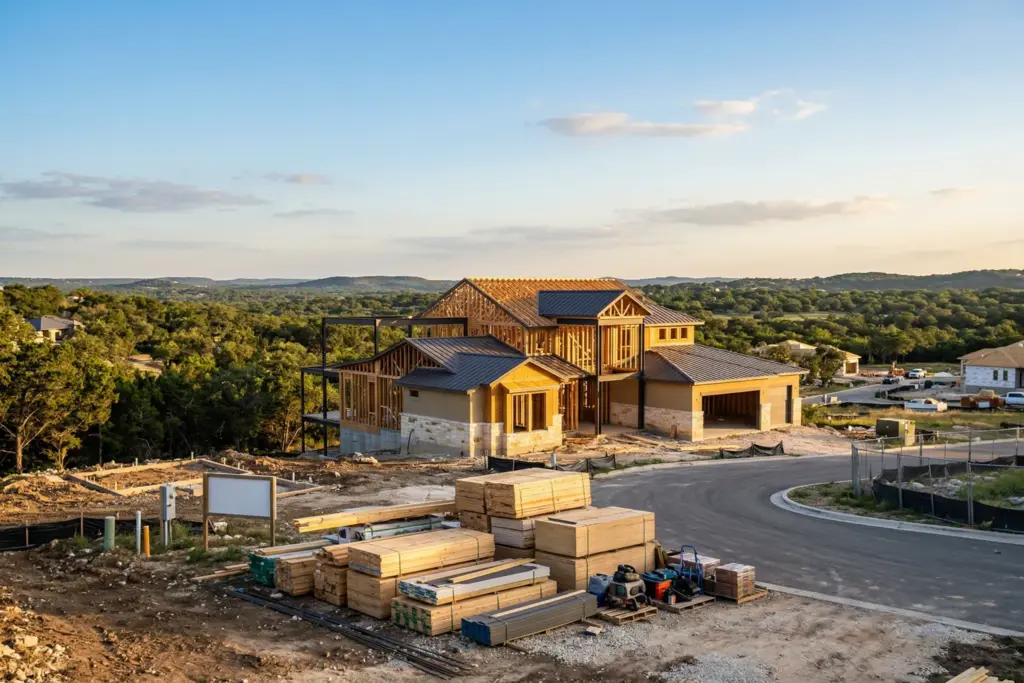
I was sitting at my desk last week running numbers on a new build in Provence (that new community in Bee Cave) when a client texted me: “Ed, should I lock in my contract now before these tariffs hit?” And honestly? It was a better question than most people realize.
So lets talk about what’s actually happening with tariffs and new construction costs. Not the political stuff. I don’t care who you voted for. I care about what this means for your wallet if you’re building or buying new in the Austin market right now.
The $10,900 Number Everyone’s Talking About
The National Association of Home Builders surveyed their members in April and the average response was pretty clear: tariffs are adding roughly $10,900 to the cost of building a single home. Some estimates run higher. Brookings pegged the total hit to residential construction at $30 billion nationally. The Center for American Progress thinks we’ll see 450,000 fewer homes built through 2030 because of it.
Now $10,900 doesn’t sound like the end of the world, right? On a $600,000 new build in Dripping Springs that’s less than 2%. But here’s the thing. That $10,900 is the average across all price points nationally. The actual number depends heavily on what’s going into your specific home. And in the Hill Country, where custom and semi-custom builds use a lot of imported materials, the number could be higher.
Benjamin Graham used to talk about how markets overreact to headlines and underreact to math. This is one of those situations where the math matters more than the headline.
What Materials Are Getting Hit (and How Hard)
Ok so lets break down what’s actually being tariffed because it’s not just one thing. It’s a pile-on.
Canadian softwood lumber is the big one. Canada supplies about 85% of our lumber imports and roughly a quarter of total domestic supply. The combined duty rate has climbed to around 45%. That’s countervailing duties, anti-dumping duties, and a 10% Section 232 tariff all stacked together. A year ago that number was 14.5%. So yeah. That’s a massive jump.
Steel and aluminum are sitting at 50% tariffs. Every beam, every nail, every piece of structural hardware, every HVAC duct. It adds up fast.
Gypsum (that’s your drywall for the non-construction folks) has more than half its US supply imported from Canada and Mexico. All subject to tariffs now.
And then there’s the stuff people forget about. Kitchen cabinets and vanities jumped to 50% as of January. Doors, windows, frames. Even appliances are seeing price increases running more than twice the rate of general inflation.
Building material costs were already up 34% since December 2020 before any of this happened. So we’re piling new tariffs on top of an already inflated cost base, right? Not ideal.
Why Austin Feels This More Than Most Cities
Here’s where it gets interesting for us locally. About 31% of all active listings in the Austin metro right now are new construction. That’s almost a third of the market. And when you look at pending sales, new construction accounts for closer to 40%.
We are a new-build town right now. I probably drive past more construction sites in a week than most people see in a year. (My wife says my idea of sightseeing is checking on framing progress in Headwaters. She’s not wrong.) If you’ve driven through Dripping Springs, Bee Cave, or Leander lately you’ve seen the cranes and the framing crews. Communities like Provence in Bee Cave, Headwaters in Dripping Springs, Travisso in Leander. They’re all actively building.
So when the cost of lumber goes up 30 points, or steel doubles its tariff rate, Austin’s market feels it disproportionately. A city where 10% of inventory is new construction can absorb material cost increases differently than a city where a third of the market is new.
And Austin was already what the data calls “significantly oversupplied” with new home lots. Builders have a lot of inventory sitting. That creates an interesting tension that I want to explain.
Here’s what I think most people are getting wrong about this. They hear “tariffs raise costs” and assume prices go up across the board. But in a market like Austin where builders are already sitting on unsold homes? The pressure actually goes the other direction. Builders can’t pass costs through when they’re competing for a shrinking buyer pool. So instead of rising prices, I think what we’ll see in Q2 and Q3 of 2026 is a margin squeeze that forces some smaller builders to pause new starts entirely. And that eventual slowdown in supply is what actually pushes prices up later. The tariff impact isn’t a spike. It’s a slow burn that shows up 12 to 18 months from now.
The Builder Incentive Squeeze
This is the part I keep getting questions about. Right now builders in the Austin area are offering some of the most aggressive incentives I’ve seen in my 19 years. We’re talking $10,000 to $30,000 in closing cost credits, rate buydowns, and design center allowances. Some builders (David Weekley for example) have been offering up to 10% of the base price back as flex dollars in certain communities.
That’s a lot of money on the table.
So the question becomes: if tariffs are adding $10,000+ to building costs, where does that money come from? Do builders raise prices? Or do they pull back incentives to offset the hit?
I would argue it’s going to be a mix. And the answer depends on which builder and which community you’re looking at. Builders sitting on a lot of unsold inventory (and there are plenty in the Austin market right now) can’t exactly raise prices. They’re already competing for every buyer. So for those builders, the incentive pool is probably going to shrink. That $30,000 package might become $20,000. The rate buydown from 5.5% to 4.99% might become a buydown to 5.25%.
Builders in stronger positions with less inventory pressure might just quietly raise base prices over the next few quarters. A $5,000 bump here, a spec change to a cheaper material there. Death by a thousand cuts.
And here’s the part that ties it all together for Austin specifically. We’ve got 31% of active inventory as new construction, tariffs adding five figures to every build, and builders already offering incentives they can barely afford. Something has to give. My prediction: by late 2026, you’ll see at least two or three national builders quietly pull out of planned Austin-area communities that haven’t broken ground yet. They’ll blame “market conditions” but the math just won’t work anymore at the price points those communities were designed for.
Either way the buyer’s effective cost is going up, right? The question is whether it shows up in the sticker price or in the fine print.
What This Means in Real Dollars for Hill Country Buyers
Lets get specific because I know that’s what you actually want.
Say you’re looking at a new build in Dripping Springs listed at $550,000. Under current conditions you might get $20,000 in builder incentives, bringing your effective price to $530,000 with a bought-down rate.
If tariff costs push that builder’s margins down and they pull $10,000 from the incentive package, your effective price just went to $540,000. That’s an extra $55 per month on a 30-year mortgage at 6.5%. Over the life of the loan that’s about $20,000 in additional interest.
Not catastrophic. But not nothing either. Especially when you’re already stretching to make the numbers work.
For the luxury market out in Westlake or Spanish Oaks where custom homes run $1.5M to $3M+, the tariff impact could be $25,000 to $50,000 or more. Custom builds use more imported stone, specialty fixtures, and high-end materials that all have their own tariff exposure.
The Silver Lining Nobody’s Talking About
Ok so here’s where I’m going to say something that might surprise you. For buyers who are ready to act, this tariff situation might actually create a short window of opportunity. And here’s why.
Builders priced their current inventory based on pre-tariff material costs. The homes that are framed, drywalled, and sitting in model-home condition right now were built with cheaper materials. The tariff costs haven’t fully flowed through yet.
So the inventory on the ground today is essentially priced at yesterday’s costs with today’s incentives still attached. That combination won’t last. Once builders start repricing for the new cost reality (and they will), those incentive packages are going to tighten up.
I’ve seen this pattern before. After the 2021 lumber spike, builders who had locked in material costs at lower prices were still offering pre-spike pricing for a few months. Buyers who moved during that window got better deals than anyone who waited.
Nassim Taleb has this concept in Antifragile about how some systems benefit from volatility while others get crushed by it. In this case, the informed buyer who understands what’s happening has an advantage over the buyer who just reads the headline and freezes.
Resale Homes: The Unexpected Beneficiary
Something else worth mentioning. When new construction gets more expensive, resale homes start looking better by comparison. That new construction vs. existing homes math shifts.
A 10-year-old home in Lakeway or Falconhead was built when lumber was cheaper, steel was cheaper, and cabinets weren’t subject to 50% duties. Yes it might need updated fixtures or a new roof at some point. But the bones were built at a lower cost basis. And that home isn’t subject to any tariff premium.
I’ve been telling my buyer clients to look at both options with fresh eyes. The new build has that new-car smell (well, unless the AC quits on you in August before your warranty inspection). But the resale home might represent better value right now, especially if the seller is motivated.
What You Should Actually Do About This
I’m not going to tell you to panic. I’m also not going to tell you to ignore it. Here’s what I’d actually recommend based on what I’m seeing on the ground.
If you’re already under contract on a new build: You’re fine. Your price is locked. Builder absorbs the cost increase on their end. But get your options and upgrades finalized sooner rather than later. Some builders are starting to reprice option sheets.
If you’re shopping new construction right now: Move faster than you normally would. Those incentive packages are as good as they’re going to get. Negotiate hard on closing costs and rate buydowns while builders still have the margin to give. Six months from now the same conversation gets harder.
If you’re on the fence between new and resale: Run the numbers on both. I wrote a whole piece on how to think about that comparison and tariffs just shifted the math. A resale home at $500,000 might deliver more square footage and a better lot than a tariff-adjusted new build at the same price.
If you’re waiting for prices to drop: I would argue you’re looking at this backwards. The Austin market forecast for 2026 already showed price stabilization. Tariffs adding cost to the supply side means builders have less room to cut prices, not more. The floor just got firmer.
If you’re an investor: New construction in Hill Country investment zones still pencils out if you’re buying at today’s incentive levels. But do the math assuming those incentives shrink by 30-50% over the next year.
Frequently Asked Questions
The Bottom Line
Tariffs are a real cost that’s working its way through the Austin new construction market right now. The $10,900 NAHB number is a national average. Your actual number depends on what you’re buying, where you’re buying, and when you pull the trigger.
But the sky isn’t falling. Austin’s new construction market was already in a buyer-friendly position with oversupply and aggressive incentives. Tariffs complicate the picture but they don’t change the fundamental opportunity for buyers who are paying attention and doing the math.
That’s what I’m here for. I’ve been helping buyers navigate exactly this kind of market for 19 years. I know which builders are absorbing costs, which ones are cutting corners, and which communities still have the best incentive packages. If you’re thinking about new construction anywhere in the Hill Country, lets talk. I’ll walk you through the numbers specific to whatever you’re looking at. No pressure, just math.
Be safe, be good, and be nice to people.


