 Ed Neuhaus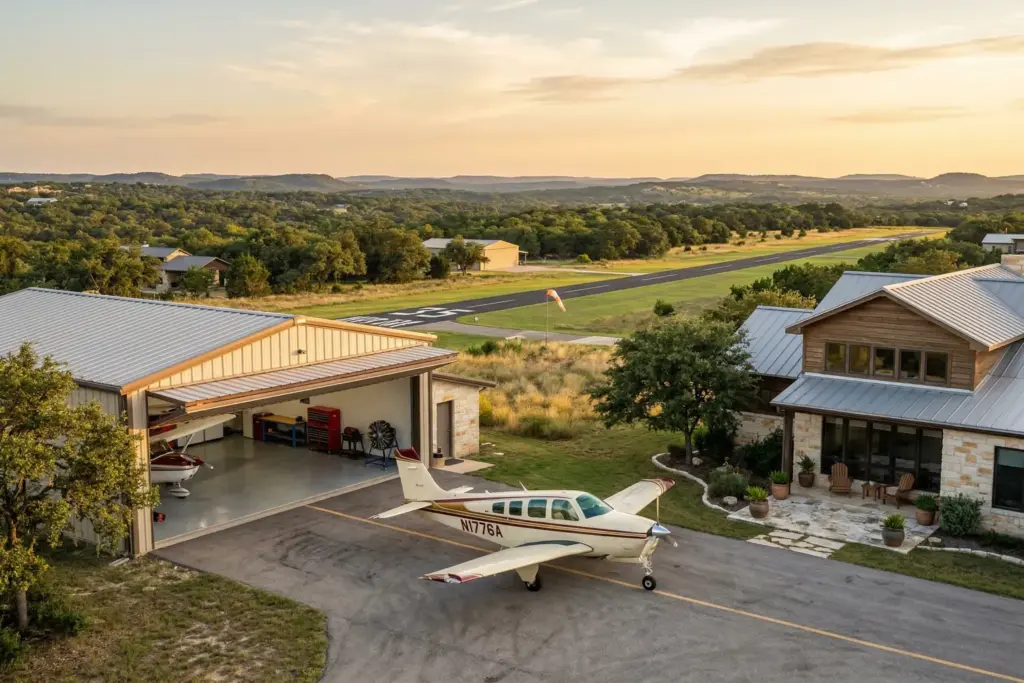
There are over 600 residential airparks in the United States, and the people who live on them will tell you it is the best real estate decision they ever made. According to the E3 Aviation Association, demand for airpark properties has been climbing steadily since 2020, with some Texas communities seeing transaction volume jump 80% year over year. That tracks with what I am seeing in the Hill Country market right now.
But here is the thing most articles about airpark living get wrong. They either sell you the dream with zero caveats, or they write about it from the outside like a Wikipedia entry. I am a pilot. I am a real estate broker. I have walked through more hangar homes than I can count and I have spent enough time at Lakeway Airpark to know what the lifestyle actually looks like on a Tuesday morning, not just in the brochure. So lets talk about what it is really like.
The Morning
Ok so picture this. Your alarm goes off. Not early, just normal early. Coffee. Maybe you check the weather on ForeFlight while the pot brews (you check ForeFlight the way most people check Instagram, and you know it). Walk out to the hangar in whatever you are wearing. Could be jeans and a button-down. Could be a robe. Nobody cares because your hangar is attached to your house.
Open the door. There is your 182. Or your Bonanza. Or that RV-7 you spent four years building in the garage before you moved here (and your spouse is very glad is no longer in the garage).
Preflight takes ten minutes. You know every rivet on this airplane because you see it every single day. No driving 45 minutes to the airport. No waiting for line service to pull you out of a T-hangar. No ramp fees. You are on your own taxiway, rolling to the runway, and wheels up before most people in Austin have merged onto MoPac.
That is the pitch. And I am not going to lie, it really is that good. The convenience of having your airplane 30 feet from your kitchen is hard to overstate to someone who has spent years driving to a distant FBO, paying $200 a month for a hangar they share with spiders, and burning half a Saturday just getting airborne. That is not a great use of a Saturday right. Airpark living eliminates all of that friction. You fly more. Period.
The Community That Comes With It
This is the part that surprises people. The airplane gets them interested. The community is what makes them stay.
Your neighbors are pilots. The barbecue conversation is not about who has the best lawn service or whether the HOA is going to fine someone for their trash cans. It is about the new ADSB-out mandate, someone’s engine overhaul, who flew to Fredericksburg for breakfast tacos, or whether that Cirrus owner down the street is ever going to learn how to grease a landing (sorry Craig).
David Meerman Scott wrote this whole book about the Grateful Dead’s marketing strategy, and the core insight is that the Dead didn’t build a customer base. They built a tribe. People who showed up because they belonged there. Airpark communities work the same way. You move there because you are a pilot, and you stay because you found your people.
Kids grow up around airplanes. They learn what a windsock does before they learn to ride a bike. The Fourth of July flyover is done by your neighbor in his Stearman. And yeah, at Lakeway Airpark there is a guy who actually does this. It is exactly as cool as it sounds.
I wrote a detailed guide to the fly-in communities in Central Texas if you want the full breakdown of which airparks are where, runway lengths, pricing, all of that. This article is different. This one is about what it feels like to actually live there.
The Honest Reality Check
Ok so here is where I put on my broker hat for a minute. Because airpark living is genuinely fantastic for the right person, and genuinely miserable for the wrong one. And the difference usually comes down to whether you went in with eyes open.
Noise Is Part of Life
You love the sound of a Lycoming at full throttle. Great. You also need to love it at 7am on a Saturday when someone is doing pattern work and your spouse is trying to sleep in. At Lakeway operations are sunrise to sunset, so there are limits. But “sunrise” in June is 6:20am. That is early if you are not the one flying.
The residents who are happiest on airparks are the ones who hear a Cessna overhead and smile. The ones who hear it and flinch probably should not have moved there. And yet (this is the frustrating part) some people buy airpark homes because they are beautiful homes on big lots, and then they complain about the airplanes. Every airpark community has at least one of these people. Sometimes they end up on the HOA board. That is when things get interesting.
HOA Politics Are Real
According to Flying Magazine, airpark HOA disputes are one of the biggest challenges in these communities. And I have seen it firsthand. Runway maintenance is expensive. A full resurface can cost six figures, and that money has to come from somewhere. When the assessment bill hits, not everyone agrees on timing, scope, or how much to save versus spend.
Then you get the aircraft type debates. Should the airpark allow jets? What about ultralights? Helicopters? (Helicopter owners, you already know how this goes.) Every airpark has its own rules, and those rules get debated constantly. It is basically a regular HOA but with higher stakes because the shared asset is a runway, not a swimming pool.
So before you buy, ask about the reserve fund. Ask about the last time the runway was resurfaced. Ask who makes the decisions and how those decisions get made. This stuff matters more than the granite countertops.
The Resale Reality
Lets be honest about this. When you sell an airpark home, your buyer pool is small. Really small. You are selling to the intersection of “can afford this home” and “owns an airplane” and “wants to live on an airpark.” That is a Venn diagram with a very small middle.
Your home may sit on the market longer than a comparable property in a regular neighborhood. It probably will. No big deal right. Well, it is a big deal if you need to sell fast. The good news is that the scarcity works in your favor on price. I covered the investment dynamics in my fly-in communities guide, but the short version is this: nobody is building new runways inside the Austin metro. The supply is capped. So when the right buyer comes along, they do not have many options, and that gives you leverage on price. You just need to be patient.
Not Every Airpark Is Healthy
Some airparks are thriving. New construction, active community, well-funded reserves, paved taxiways that look like they were laid last year. Others are aging. Cracked asphalt, deferred maintenance, half the hangars sitting empty, an HOA that cannot agree on anything.
Visit before you buy. And I do not mean drive through on a Tuesday afternoon when nobody is there. Visit on a weekend morning when people are flying. Talk to residents. Ask them what they love and what frustrates them. If you get a lot of awkward pauses, that tells you something.
The Non-Pilot Spouse Perspective
This is the section nobody writes and everybody needs to read.
Airpark living works when the whole family wants it. Full stop. If one partner is a pilot who dreams of taxiing out the back door, and the other partner just sees a house on a noisy street with limited shopping nearby, you have a problem. And that problem is going to get worse, not better, over time.
So what does the non-flying partner actually get out of this?
Honestly, quite a bit if they are open to it. The community aspect I mentioned earlier is not just for pilots. Spouses, kids, retirees who sold the airplane but kept the house. Airpark communities tend to be tight-knit in a way that normal subdivisions are not. People actually know each other. There are potlucks, holiday events, impromptu gatherings at the hangar. Arnold Palmer wrote about how the best clubs are not about the golf, they are about the people who show up. Airparks are the same.
But the downsides for a non-pilot are real too. Some airparks (especially the rural ones) are remote. The nearest grocery store might be a 20 minute drive. Dining options can be limited. And if your spouse’s hobby is, say, yoga classes and boutique shopping, a community of 30 homes built around a runway in the Hill Country might feel isolating.
My honest advice. Both partners need to visit. Spend a full weekend. Meet the neighbors. And have an honest conversation about whether this is a lifestyle you both want, not just one you are tolerating. Because I have seen the couples where one partner loves it and the other resents it, and those situations do not end well (for the house or the marriage).
The Intangibles That Make It Worth It
Ok, broker hat off. Pilot hat back on.
There is something about walking out your back door to your airplane that I cannot adequately describe in an article. It is pride. It is convenience. It is the feeling that you built a life that matches who you actually are, not just a life that works on paper.
Teaching your kids to fly from home. Not driving to the airport, not scheduling around FBO hours, just walking out to the hangar on a Saturday and saying lets go fly. That is a memory they will carry forever.
The $100 hamburger becomes a $20 hamburger. No FBO fees. No ramp fees. No fuel markup from a full-service operation. You top off from the community fuel farm (usually at or below wholesale), fire up the engine, and you are eating lunch in Fredericksburg or Llano or wherever sounds good. Round trip for less than most people spend on a night out.
And then there is the sunset. Hangar door open. Cold beer in hand. Your airplane behind you. The Hill Country doing its thing in the distance. The sound of someone taxiing back from an evening flight.
I know that sounds like a brochure. I am literally a real estate broker, I am aware of the irony. But I have stood in that exact spot at Lakeway Airpark and I can tell you it is not marketing. It is just what a good life looks like if aviation is your thing.
Is Airpark Living Right For You
Here is my simple filter. If you are a pilot and you answer yes to all three of these, you should be looking at airpark properties right now.
1. You fly at least a few times a month and the drive to your current airport is eating into that.
2. Your partner is on board. Not just “fine with it” but genuinely interested in the lifestyle.
3. You are comfortable with a longer timeline if and when you sell, in exchange for a lifestyle that makes you happy every single day you live there.
If even one of those is a no, an airpark might not be the right call. And that is fine. There are plenty of great homes near airports that give you proximity without the full commitment.
But if all three are a yes? Start looking. Central Texas has more airpark options than almost anywhere in the country, from Lakeway Airpark’s 32 homes on 3,930 feet of asphalt to brand new lots at Georgetown Airpark to the Lake Travis lifestyle at Windermere Oaks near Spicewood. The supply is limited and it is not growing.
Frequently Asked Questions
Lets Talk About It
I am a pilot and a broker, and airpark properties are one of the most interesting corners of the market I work in. If you are thinking about making the move to a fly-in community in Central Texas, or you just want to talk through what is available and whether it makes sense for your situation, give me a call. I have walked these taxiways. I know the communities. And I will give you the honest version, not the brochure version.
Be safe, be good, and be nice to people.


