 Ed Neuhaus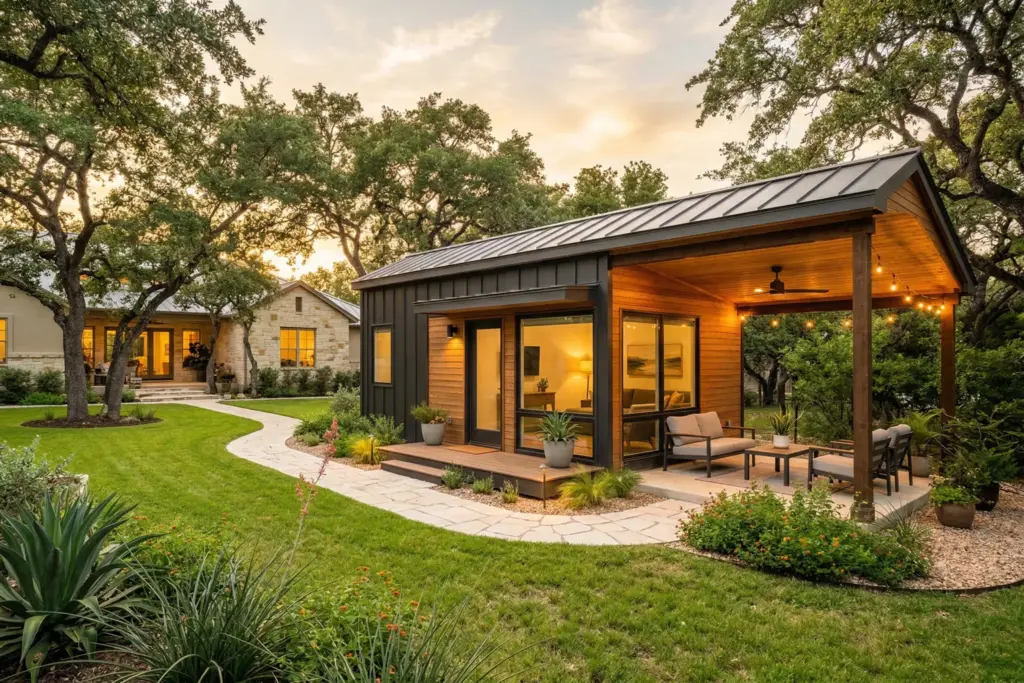
Austin homeowners can now build up to two ADUs on a single residential lot, on lots as small as 2,500 square feet, with zero parking requirements. That’s not a typo. The city’s HOME Initiative made Austin one of the most ADU-friendly cities in the entire country, and most homeowners haven’t caught up to what that actually means for their property.
Sounds like a big deal right. It is. According to the City of Austin’s development services data, ADU permit applications have been climbing steadily since the rules changed. And when you look at the math (rental income of $1,500 to $3,000 a month on a $150K to $350K build), this is one of the few investments where you can see a real return without buying a whole separate property.
I’ve been watching this space closely because I own STR properties myself, and the ADU question comes up in probably a third of my buyer conversations now. Parents want space for aging family. Investors want rental income. Remote workers want a backyard office that could become a rental later. So lets break down exactly what you can build, what it costs, and where people get tripped up.
What Exactly Is an ADU (And Why Austin Loves Them)
An ADU is a separate living unit on the same lot as your main house. You might hear them called granny flats, casitas, backyard cottages, mother-in-law suites, or guest houses. The key word is “separate.” It has its own kitchen, bathroom, entrance, and living space. It’s basically a small independent home that shares your lot.
Austin has been loosening ADU regulations for years now, but the HOME Initiative (Housing Options for Mobility and Equity) really blew the doors open. Before that, you needed a bigger lot and the rules were more restrictive. Now? The barriers are genuinely low by Texas standards.
And here’s something a lot of people miss. Texas as a whole is NOT particularly ADU-friendly. Most Texas cities still have tight restrictions. Austin is the outlier. If you own property in Austin city limits and you’re zoned residential, you probably have more ADU flexibility than homeowners in Dallas, Houston, or San Antonio.
Austin ADU Rules in 2026: Size, Setbacks, and What’s Allowed
Ok lets get into the specifics because this is where it matters.
How many ADUs can you build? Up to two per residential lot. That’s new as of the HOME Initiative changes. Previously it was one.
Maximum size: Your ADU can be up to 1,100 square feet or 15% of your lot area, whichever is less. If you go two stories, the second floor can’t exceed 550 square feet. And the whole thing has to stay under 30 feet tall.
Minimum lot size: 2,500 square feet. This is huge. The old minimum was 5,750 square feet, which excluded a massive number of urban lots. The new threshold means most residential lots in Austin proper now qualify.
Setbacks: Standard requirements are 25 feet from the front property line, 5 feet from the sides, and 10 feet from the rear. If your lot backs up to an alley or multifamily district, you might get more flexibility (15 feet front, 5 feet rear). There’s no required setback between the ADU and your main house as long as you meet fire safety codes.
Zoning: You need to be in SF-1, SF-2, or SF-3 zoning. That covers the vast majority of single-family residential lots in Austin.
Parking: None required. Zero. Austin eliminated all minimum parking requirements for new construction in November 2023, and that includes ADUs. This was a game changer because the old parking requirement basically killed ADU feasibility on smaller lots.
One thing I always tell people, check your HOA restrictions separately. The city might say yes but your HOA might say absolutely not. I’ve seen that happen more than a few times in neighborhoods around Bee Cave and Lakeway where the HOA covenants predate the city’s ADU reforms.
What It Actually Costs to Build an ADU in Austin
Here’s where people’s eyes get big, and I get it. Building anything in Austin isn’t cheap right now (and tariff uncertainty isn’t helping construction material costs). But lets look at real numbers.
The typical all-in cost for an ADU in Austin runs $150,000 to $350,000. That’s a wide range because it depends on size, finishes, site conditions, and whether you go prefab or stick-built. A basic 400 square foot studio is a completely different project than an 1,100 square foot two-bedroom with full kitchen and covered patio.
Prefab vs. Stick-Built: The Real Comparison
Prefab ADUs run about $200 to $300 per square foot plus delivery and installation. You’re looking at a 4 to 6 month timeline from order to move-in. The big advantage is cost predictability. The factory controls most variables, so you’re less likely to get surprised by change orders. The downside is limited customization. You’re choosing from predetermined layouts, usually with 20 to 30 customizable elements like finishes and fixtures.
Stick-built ADUs cost $350 to $550 per square foot and take 8 to 12 months. You get unlimited design flexibility, which matters if your lot has weird dimensions or slopes (pretty common in the Hill Country). But you’re also exposed to weather delays, subcontractor scheduling, and the general chaos of construction in a market where every contractor is booked out.
So which one? If your lot is flat, your timeline is tight, and you’re ok with a standard layout, prefab can save you 20% or more. If you need a custom design to fit an unusual site or you want specific architectural details to match your main house, stick-built is the way to go. Benjamin Graham had this concept about margin of safety in investing. Same idea applies here. If the prefab option gives you a bigger financial cushion, that margin of safety matters more than custom tile work.
And don’t forget permits. Budget $1,500 to $3,500 for the permitting process itself, separate from construction costs.
The Permitting Process (Plan for Patience)
I’m not going to sugarcoat this. Austin’s permitting process is… Austin’s permitting process. It’s gotten better but it’s still not fast.
Initial plan review takes about 15 to 25 business days. If you need corrections (and most people do on the first submission), resubmittals take another 10 business days. Realistically, plan for 2 to 4 months just to get your permit in hand if everything goes smoothly. Some projects take longer.
From the day you start the feasibility review to the day you get a certificate of occupancy, you’re looking at 8 to 12 months total. I’ve seen it go faster with prefab units that come with pre-reviewed plans, and I’ve seen it go much slower when there are site complications or incomplete submissions.
Three things that speed up the process:
- Hire an architect or designer who has done ADUs in Austin before. They know what the city wants to see and can avoid the most common rejection reasons.
- Get a survey done early. You need a current survey showing your lot lines, existing structures, and easements. This is step one and a lot of people wait too long to order it.
- Consider a permit expediter. Yes, it’s another cost ($2,000 to $5,000). But if time is money and you want to start collecting rent sooner, the math usually works out.
Rental Income: What Can You Actually Make?
This is the question everyone wants answered right. A well-located ADU in Austin can generate $1,500 to $3,000 per month in long-term rental income, depending on size, location, and finishes. Some neighborhoods in central Austin push higher than that. I’ve seen numbers north of $2,500 for a nice one-bedroom ADU near South Lamar or East Austin.
Lets do the back-of-napkin math on a mid-range build. Say you spend $225,000 on a 700 square foot one-bedroom ADU and rent it for $2,000 a month. That’s $24,000 a year in gross rental income. After you account for property management (if you’re not self-managing), maintenance, insurance, and the property tax increase, you’re probably netting $16,000 to $18,000 a year. That’s roughly a 7 to 8% return on your investment.
Not going to lie, that’s a solid return for something attached to a property you already own. And that’s just the cash flow side. Studies from high-demand markets like Austin, Seattle, and Portland show that homes with permitted ADUs sell for 20% to 35% more than comparable properties without them. On a $500K home, that’s $100K to $175K in added property value. Sometimes more than the ADU cost to build.
Charlie Munger (Warren Buffett’s partner, who I always found more interesting than Buffett himself) had this line about finding situations where you get paid multiple ways. ADU rental income is one of those. You get monthly cash flow AND equity appreciation AND a more flexible property that appeals to a wider buyer pool when you eventually sell.
The STR Question: Can You Airbnb Your ADU?
This is where it gets complicated and I need to be straight with you because I see a lot of bad information floating around about this.
If your ADU was built after October 1, 2015, you can only use it as a short-term rental for a maximum of 30 days per calendar year. That’s the rule. Thirty days total, not 30 days at a time. So if you were dreaming about turning your backyard cottage into a year-round Airbnb, pump the brakes.
And starting July 1, 2026, the City of Austin will begin requesting that platforms like Airbnb and Vrbo remove unlicensed STR properties. All listings are required to display a city-issued permit number. The enforcement is getting real, not just theoretical. I’ve written about the significant STR rule changes coming to Austin and the 2025 regulatory shifts in detail.
But here’s the thing. Long-term rental has zero restrictions. If your ADU tenant signs a lease of 30 days or more, none of the STR regulations apply. And honestly? With Austin’s rental demand, long-term rental income on a well-built ADU is strong enough that you don’t need the STR premium to make the numbers work.
If you already own a pre-2015 ADU or your main house is the one you want to STR while renting the ADU long-term, that’s a different conversation. The rules vary based on your specific property, license type, and location. The legal landscape for STR investing in Texas has layers, and getting it wrong can mean fines.
How to Pay for It: ADU Financing Options
Most people don’t have $200K sitting in a savings account, so lets talk about how real people actually finance these projects.
HELOC (Home Equity Line of Credit): This is the most common path I see. You borrow against the equity in your existing home. The big advantage is you keep your current mortgage and its rate (which matters a lot if you locked in something in the 3% range a few years ago). You only pay interest on what you draw during the initial period, which is nice during construction when cash is flowing out fast. The catch is you need enough equity to borrow against.
Renovation Loan: If you don’t have a ton of equity yet, renovation loans let you borrow based on what your home will be worth AFTER the ADU is built. That’s a powerful tool for people who bought recently and haven’t built up much equity but have a property that’s perfect for an ADU.
Construction Loan: Designed specifically for ground-up builds. Funds get released in draws tied to construction milestones (foundation poured, framing done, rough-in complete). The lender inspects before each draw. More paperwork and oversight, but it protects both you and the lender from a project going sideways.
Cash-Out Refinance: You replace your existing mortgage with a larger one and take the difference in cash. This can work if current rates are close to your existing rate, but if you’re sitting on a 3% mortgage from 2021, refinancing at 6.5% to fund an ADU build doesn’t make financial sense for most people. Do the math carefully.
One thing I tell every client. Run the numbers on at least two financing options before you commit. The right choice depends on your existing mortgage rate, your equity position, and whether you want a fixed monthly payment or flexible draws. A good lender who understands ADU construction can walk you through the specifics.
Common Mistakes I See (And How to Avoid Them)
After years of working with buyers and investors in the Austin market, here are the mistakes I see most often with ADU projects.
1. Not checking the HOA first. I mentioned this already but it deserves its own section. City zoning approval does not override your HOA’s CC&Rs. I’ve seen people get architectural plans drawn up, hire a contractor, and then discover their HOA prohibits detached structures. That’s an expensive lesson. Check the HOA FIRST.
2. Underestimating site costs. That $200 per square foot prefab quote doesn’t include the foundation, utility connections, grading, or landscaping restoration. On a lot with slope, rock, or existing trees (welcome to Dripping Springs and the Hill Country), site prep can add $30,000 to $50,000 to your budget. Get a site assessment before you fall in love with a floor plan.
3. Skipping the survey. You need a current ALTA survey showing lot lines, easements, and existing structures. An old survey from when you bought the house might not be accurate enough for permitting. Budget $500 to $1,000 and just get it done early.
4. Building without permits. I know it’s tempting. The permit process is slow and it costs money. But an unpermitted ADU is a liability nightmare. It won’t count toward your property value at resale (appraisers can’t include it), your insurance probably won’t cover it, and if the city finds out you could face fines and a mandatory demolition order. Not worth it.
5. Forgetting about the property tax increase. Adding an ADU will increase your property’s assessed value, which means higher property taxes. In Travis County, that can be meaningful. Budget for it in your cash flow projections. The good news is your homestead exemption still applies to your primary residence, and you can protest the new assessment just like any other property tax bill.
How ADUs Affect Your Property Value
This is the part of the conversation that gets investors excited. Research across high-demand markets consistently shows that a permitted ADU adds 20% to 35% to a home’s resale value. In Austin specifically, where housing demand remains strong and rental inventory is tight, that premium tends to track toward the higher end.
But here’s a nuance that matters. The ADU has to be permitted. An unpermitted backyard structure is a liability to a buyer, not an asset. When I’m representing a buyer looking at a property with an ADU, the first thing I check is the permit history. If it’s clean, that ADU is a genuine value-add. If it’s not, it’s a negotiation point in the opposite direction.
The other thing driving value is flexibility. Buyers increasingly want properties that can generate rental income, house extended family, or serve as a home office. An ADU checks all three boxes. In a market like Westlake where properties are already $2M plus, an ADU might be a pool house conversion. In the Hill Country investment market, it’s pure cash flow. Either way, it expands what the property can do.
Frequently Asked Questions
Thinking About an ADU? Lets Talk Numbers
If you’ve made it this far, you’re probably already running the math in your head. Good. That’s exactly what you should be doing. An ADU isn’t a decision you make on vibes. It’s a real financial investment that needs real analysis based on your specific lot, your specific financing situation, and what you actually want the space to do.
I help homeowners and investors evaluate ADU potential on their properties all the time. Sometimes the answer is “absolutely, build it yesterday.” Sometimes the answer is “your lot makes it impractical” or “the HOA won’t allow it” or “the numbers work better if you buy a separate investment property instead.” I’d rather give you an honest answer than tell you what you want to hear.
If you want to run the numbers on your property, reach out to me and lets figure out if an ADU makes financial sense for your situation. No pressure, just math.


