 Ed Neuhaus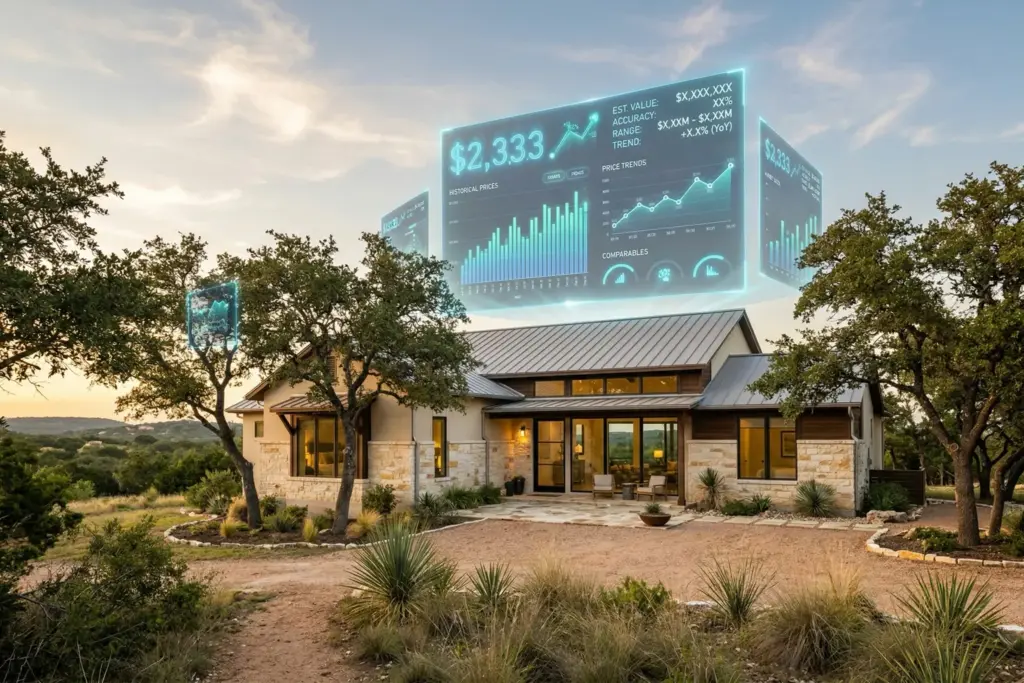
Zillow’s Zestimate has a nationwide median error of 7.5% on off-market homes. On a $500,000 house in Bee Cave, that’s $37,500 in either direction. And that’s the median, meaning half of all estimates are worse than that.
Sounds like a lot right. But here’s the thing, nobody actually tests these numbers locally. Zillow publishes national accuracy stats, Redfin publishes theirs, and everyone just kind of takes their word for it. According to Zillow’s own accuracy page, their on-market error rate is around 3.2% nationally. But what about Central Texas specifically? What about Bee Cave vs 78734 vs Dripping Springs? Nobody was measuring that. So I decided to build something that would.
Why I Stopped Guessing and Started Measuring
I get the Zestimate question constantly. “Ed, Zillow says my house is worth $650,000, is that right?” And honestly, I never had a great answer beyond “probably not, but lets look at the comps.” That bugged me. I’ve been selling homes in this market for 19 years and the best I could do was “probably not”?
The problem is that AI home valuations accuracy varies wildly depending on the neighborhood, the price point, the property type, and a dozen other factors that national averages just wash out. A Zestimate might be dead accurate on a cookie-cutter subdivision home in Pflugerville and off by $100,000 on a custom build on acreage in 78738. But nobody was tracking that difference in any systematic way.
Daniel Kahneman’s whole thing in Thinking Fast and Slow is that we’re terrible at evaluating accuracy intuitively. We remember the one time Zillow nailed it and forget the five times it didn’t. Or vice versa. The only way to actually know is to measure it at scale, with real closing prices, across enough transactions to see patterns.
What We Built: The Ed’s Opinion of Value System
At Neuhaus Realty Group, we built what we’re calling the Ed’s Opinion of Value system (EOV for short). Here’s what it does. When a home hits the MLS in Central Texas, our system captures what four different AI valuation models say the home is worth at that exact moment. Then we wait. When that home eventually closes, we compare what the models predicted against the actual sale price.
That’s it. No fancy algorithms on top. No secret sauce. Just a straightforward test: you said this home was worth X, it sold for Y, how far off were you?
We’re currently tracking 2,492 active listings across Central Texas. Four estimation modes running simultaneously on every single one. The system has been live since early 2026, and the first wave of closings should start rolling in around June.
Why Four Models Instead of One
So you might be wondering why bother with four different approaches. Because different models fail in different ways.
Think about it like this. If you asked four different appraisers to value your home, they’d probably come back with four different numbers. But the pattern of where they agree and disagree tells you something useful. If three out of four say $500,000 and one says $650,000, that outlier is probably wrong (or maybe it spotted something the others missed). Either way, you learn more from the disagreement than from any single number.
Our four modes each take a slightly different approach to the same question. Some lean heavier on recent comparable sales. Some weight neighborhood trends more. Some factor in property characteristics differently. By running all four simultaneously, we can eventually answer not just “how accurate is AI” but “which approach works best for which type of property in which area.”
That’s the kind of granularity that doesn’t exist anywhere right now. Not in Austin, not anywhere I’ve seen.
What This Means for Homeowners Right Now
Ok so we don’t have results yet. I want to be upfront about that. The experiment is running but the first closings haven’t happened. I’m not going to make claims about accuracy until I have actual data to back them up.
But here’s what I can tell you right now based on 19 years of pulling comps and helping people price homes.
AI home valuations are a starting point. Not an ending point. They’re useful for getting in the ballpark, but they consistently miss things that matter in this market. Renovations that aren’t in public records. Views that add $50,000 to a property but don’t show up in any dataset. The fact that one side of a street backs up to a greenbelt and the other side backs up to a commercial development. That kind of context still requires a human who knows the area.
If you want to see what the models say about your home right now, you can run it through our home value tool. It pulls real MLS data and gives you a solid estimate. But I’d treat any automated number (ours included) as the beginning of the conversation, not the end of it.
Why Nobody Else Is Doing This
I keep asking myself that. And I think the answer is pretty simple: it’s not in anyone’s financial interest to test their own accuracy.
Zillow doesn’t want you to know their Zestimate was off by $80,000 on your neighbor’s house. Redfin doesn’t either. These tools exist to get you onto their platform and clicking around. The accuracy claim is a marketing feature, not a research finding. And look, that’s fine, they’re businesses. But somebody should be checking their homework right?
The Urban Institute published research in January 2026 showing that automated valuation models produce errors 3.4 percentage points higher for Black homeowners than for white homeowners. That’s not a rounding error. That’s a systemic problem baked into the algorithms. And it only came to light because someone actually tested the models against real outcomes across demographic groups.
Our study isn’t measuring that specific dimension (yet), but the principle is the same. You don’t know what you don’t measure. And the companies building these tools have every incentive not to measure too carefully.
What Happens in June
When closings start rolling in this summer, we’re going to publish the results. Not the cherry-picked good ones. All of them. Median error by zip code, by price range, by property type. Which model performed best in which conditions. Where the AI nailed it and where it face-planted.
This is a living experiment. I’ll keep updating the data as more closings come through, and I imagine by the end of 2026 we’ll have enough transactions to draw some real conclusions about AI home valuations accuracy in Central Texas specifically.
And honestly, I’m curious what we’ll find. Maybe the Zestimate is better than I think it is. Maybe one of our models outperforms everything. Maybe they’re all terrible in Westlake and great in Round Rock. That’s the whole point of measuring instead of guessing.
The Bottom Line
I got tired of saying “probably not” when clients asked if their Zestimate was right. So instead of guessing, we’re running the largest local AVM accuracy study I’m aware of in Central Texas. 2,492 homes. Four models. Real closing prices. First results coming soon.
If you’re trying to figure out what your home is actually worth right now (and you don’t want to wait for our study to finish), here’s what I’d recommend. Start with our free home value tool to get a data-driven estimate. Then reach out to me and lets compare that number against what I’m seeing in your specific neighborhood. I’ve been doing this long enough to know where the models get it right and where they fall apart.
How Much Equity Do You Have?
Home values have shifted. Find out where you stand with a free, data-driven estimate based on recent sales near you.
And when the results drop this summer, you’ll be the first to know. Be safe, be good, and be nice to people.
Frequently Asked Questions
Need Strategic Guidance on Real Estate Technology?
Ed Neuhaus advises brokerage leadership, MLS organizations, and PropTech companies on AI strategy, data architecture, and technology decisions.


