 Ed Neuhaus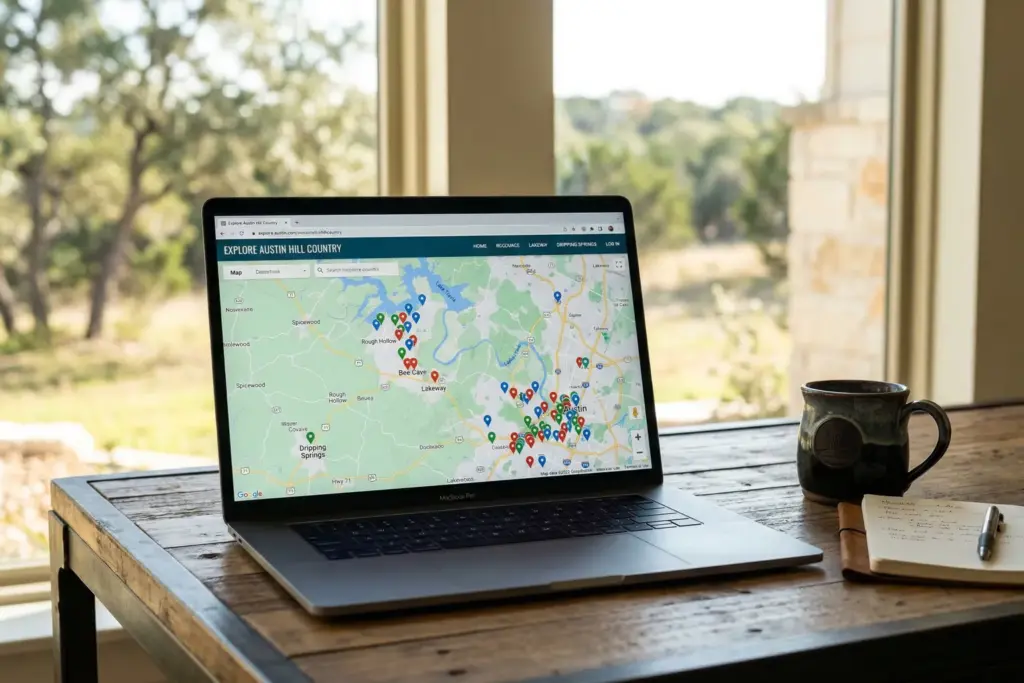
My website has over 14,000 location pages. Not 14. Not 140. Fourteen thousand. Each one covers a specific neighborhood, school zone, zip code, or community in the Austin metro, and each one is a landing page designed to show up when someone types that exact search into Google. That number sounds absurd for a single-agent brokerage right. But it’s the reason Neuhaus Realty Group shows up in searches that most agents don’t even have pages for.
According to the National Association of Realtors, about 70% of brokers and 69% of sales agents have a website. So roughly a third of agents don’t even have a web presence at all. And the ones who do? Most of them are running a template site with maybe 10 to 20 pages. A homepage, an about page, a contact form, and a handful of blog posts they wrote in January and never touched again. That’s not an SEO strategy. That’s a digital business card.
Here’s what I’m seeing in my market. The agents who are winning organic search aren’t the ones with the prettiest websites. They’re the ones with the most comprehensive coverage. And AI is what makes that kind of coverage possible for someone who doesn’t have a marketing department.
The Problem with Most Real Estate Websites
Lets be honest about what the typical agent website looks like. You’ve got a homepage that says “Your trusted Austin Realtor” with a stock photo of a skyline. Maybe there’s an IDX feed pulling in listings. A blog with four posts from 2023. And that’s it.
So when someone searches “homes for sale in Circle C Ranch” or “Bee Cave real estate market,” your website has nothing for Google to show them. You literally don’t have a page that answers that question. And if you don’t have a page, you don’t rank. It’s that simple.
The SEO advice most agents get is “blog more” and “use keywords.” Which is fine as far as it goes but it’s like telling someone to get in shape by doing more pushups. Technically correct, practically useless without a real plan. Seth Godin put it well: “you can’t be seen until you learn to see.” Most agents aren’t even looking at what their website is missing. They’re just hoping their homepage ranks for “[city] realtor” and calling that a strategy.
Why 14,000 Pages and Not 14
Think about how people actually search for real estate. Nobody types “Austin homes” anymore. They type “homes for sale in Lakeway under 800k” or “best neighborhoods near Dripping Springs ISD” or “78738 real estate market.” The searches are hyperlocal. They’re specific. And each one of those searches needs a page that directly answers it.
I have dedicated pages for neighborhoods like Spanish Oaks, Falconhead, Rough Hollow, and hundreds more. Pages for school attendance zones, for zip codes, for entire cities. Each page has actual data on it (active listings, price ranges, market stats) not just a paragraph of fluff and a search widget.
The math is pretty straightforward. If a typical agent has 20 pages on their site, they can theoretically rank for maybe a few dozen keyword combinations. If I have 14,000 pages, I have 14,000 opportunities to match someone’s exact search query. It’s not even a fair fight. And before you think that’s some kind of black hat trick, it’s not. Every page is a legitimate, content-rich landing page for a real geographic area that real buyers search for. Google rewards comprehensiveness.
AI Is the Only Way This Scales
Ok lets address the obvious question. How does one person create 14,000 pages of content?
The answer is you don’t. Not manually. Not in any reasonable timeframe. Creating comprehensive location content for every neighborhood, school zone, and community in the Austin metro would take a team of writers years if done the traditional way. And by the time they finished, half the data would be stale.
This is where AI changes everything for real estate. I use AI to generate location-specific content at a scale that would be impossible otherwise. But here’s the thing most people get wrong about AI content, the AI isn’t the strategy. The AI is the tool that executes the strategy. The strategy is hyperlocal coverage. The strategy is being the answer to every geographic search query in your market. AI just makes it physically possible.
And I’m not talking about spinning up 14,000 pages of generic garbage. Each page pulls from real MLS data, real market statistics, real neighborhood information. The AI helps me create, maintain, and update content across all of those pages. It would take me 10 years to write them all by hand. Or I can use AI and have comprehensive coverage in a fraction of that time.
I wrote about how AI is reshaping real estate tech stacks a few months ago. SEO is one of the areas where that shift is most dramatic. The agents who figure out how to use AI for content at scale are going to have an insurmountable advantage over those who don’t.
The Optimization Machine That Never Sleeps
Publishing 14,000 pages is step one. Step two is making sure they actually perform.
I run continuous optimization on my entire site. An AI system tests different page titles and meta descriptions across thousands of pages, measures what drives more clicks from search results, and automatically rolls back anything that hurts performance. It’s like having a full-time SEO analyst who works 24 hours a day, 7 days a week, and never asks for a raise (or takes a vacation, which is more than I can say for myself).
Most agents don’t test anything. They write a page title once and never look at it again. I’m running experiments across thousands of listing pages simultaneously to find the title patterns that get more clicks. When something works, it gets applied broadly. When something doesn’t, it gets rolled back automatically. No guessing, no hoping, just data.
And the thing about SEO is it compounds. Every page that starts ranking for a long-tail keyword sends a signal to Google that this site knows what it’s talking about in this geographic area. That authority spreads to other pages on the site. So page 14,001 has a better chance of ranking than page 1 did, because it’s backed by the authority of 14,000 pages that came before it. Benjamin Graham called this the margin of safety in investing. In SEO, that margin comes from depth of coverage.
Why Organic Search Beats Paid Ads (for the Long Game)
I get it. Google Ads are easier to understand. You pay money, you get clicks, you get leads. And for a lot of agents, that’s the whole marketing plan.
But here’s the problem. Google Ads for real estate run about $2.50 per click with a conversion rate around 3.3%. That works out to roughly $75 to $170 per lead depending on your market. And the second you stop paying? Those leads disappear. You’re renting attention.
Organic search is the opposite. Every page I publish is an asset that can generate leads for years. The cost per lead goes down over time because the pages keep working even when I’m not spending money on them. And with AI Overviews now appearing in nearly half of all Google searches, having content-rich pages that AI can cite is more important than ever.
Classic organic search lost 11 to 23 percentage points of click share last year to paid ads and AI features. That sounds scary until you realize that organic search still drives over half of all website traffic. The agents who are building organic presence now are the ones who’ll still be getting leads when their competitors’ ad budgets run out. The tortoise wins right. It always does.
What Most Agents Get Wrong About AI Real Estate SEO
I talk to agents all the time who say they’re “doing SEO.” And what that usually means is they wrote a blog post that mentions their city name a few times. Or they paid someone $500 a month to “optimize” their site, which usually means changing a few meta tags and calling it a day.
Real AI real estate SEO isn’t about tricks or shortcuts. It’s about coverage and consistency. Lets break down the actual math.
The recommended benchmark for real estate content is 2 to 4 blog posts per month, building to maybe 30 to 50 posts in your first year. That’s fine for starters. But 50 blog posts covering broad topics is not going to compete with 14,000 pages covering every specific search query in your market. It’s the difference between having a store on Main Street and having a store on every street in town.
And honestly, 38% of real estate websites fail Google’s Core Web Vitals test. Almost 4 out of 10 agent sites are being penalized in rankings before the content even gets evaluated. So a lot of agents are starting from behind without even knowing it (which is kind of wild when you think about it).
The Compound Effect
Here’s what I didn’t fully appreciate when I started building this out. The compound effect is real.
When your site has 14,000+ pages all focused on one geographic market, Google starts treating you as the authority for that market. Your new pages get indexed faster. Your rankings are more stable. Your site shows up in Google’s AI Overviews and in the sources that AI chatbots pull from when people ask questions about Austin real estate.
I’ve already seen this play out. When someone asks ChatGPT or Perplexity about the Austin housing market, my content gets cited. Not because I gamed the system, but because I have the most comprehensive, data-backed content about this specific market. AI models cite sources that demonstrate unique expertise. And having 14,000 location pages is about as unique as it gets for a single-agent brokerage.
This ties into something I’ve been thinking about a lot. AI is changing how people find real estate information. I wrote about how AI doesn’t care about pocket listings and how AI is already reshaping what matters in real estate tech. SEO is part of that same shift. The agents who are visible to AI models (not just Google) are going to have a massive advantage going forward.
Can Other Agents Do This?
Yes. That’s the honest answer. Any agent could build a content-rich, AI-powered website that covers their market comprehensively. The tools exist. The AI is available to everyone.
But most won’t. And I say that not to be arrogant about it (I promise) but because I’ve watched this industry for 19 years. Most agents treat their website like a necessary evil. Something they set up once because their broker told them to, then never think about again. The idea of building 14,000 pages sounds like work, and it is. The AI handles the heavy lifting but someone still has to have the strategy, the data infrastructure, and the discipline to keep optimizing.
It’s the same thing I see with real estate investing. Everyone knows buying a property a year is a path to wealth. I wrote about that exact strategy over a decade ago. But most people never start because the gap between knowing and doing is where most good ideas go to die. Ryan Holiday’s whole thing in The Obstacle Is the Way is that the impediment to action advances action. The hard part IS the advantage.
So yeah, any agent could do this. The same way any agent could write 400+ blog posts, build dedicated seller pages for 60 communities, or create an automated home valuation tool. They could. But they probably won’t. And that’s where the competitive advantage lives.
Frequently Asked Questions
The Bottom Line
SEO isn’t a side project for me. It’s a machine. While other agents pay for ads to appear in search results, I’m building a permanent organic presence that grows every month. AI is what makes that possible for a one-person operation.
If you’re an agent reading this, the window to build this kind of advantage is open right now. AI tools are accessible, the strategy is proven, and most of your competition isn’t paying attention. By the time they figure it out, you could already have thousands of pages indexed and ranking.
And if you’re a buyer or seller wondering why my site keeps showing up in your searches, now you know. It’s not luck. It’s not magic. It’s 14,000 pages of content, continuous optimization, and a belief that the long game always wins.
Have questions about the Austin market? Lets talk. I’ve got a page for your neighborhood. I probably have three.


