 Ed Neuhaus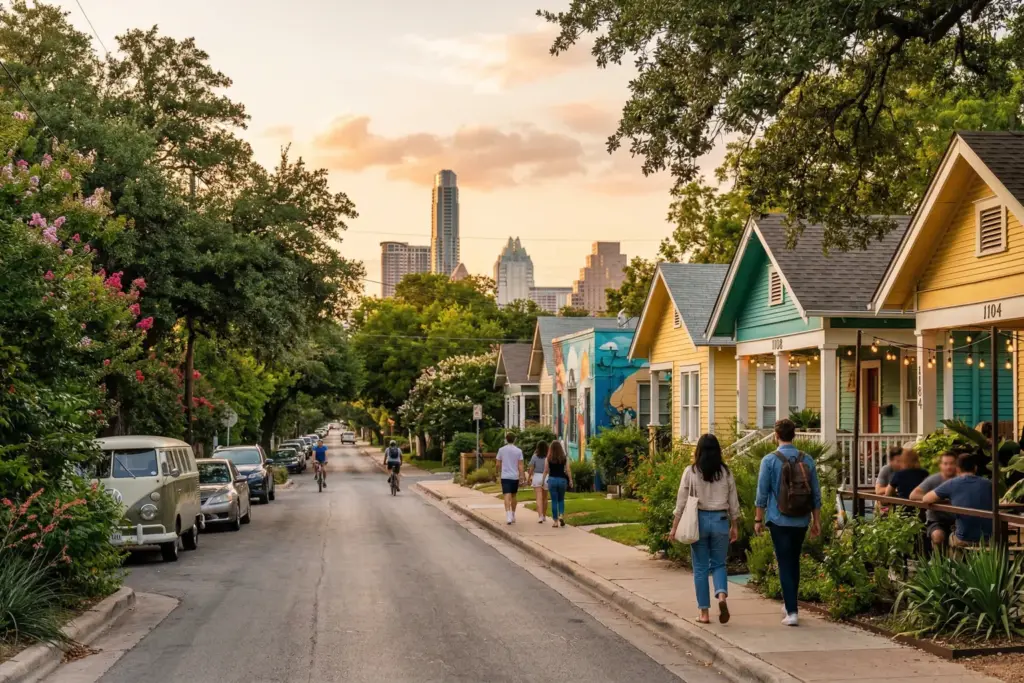
Austin’s median home price is $456,000 as of March 2026, sitting 17% below the May 2022 peak of $550,000. That gap represents roughly $94,000 in savings compared to buying at the top. And with 4.89 months of inventory on the market right now, you’re shopping in a buyer’s market for the first time since before the pandemic.
Sounds like a lot of money still right. But here’s the thing, 929 homes are actively listed between $200,000 and $400,000 just within Austin city limits according to our MLS data. Toss in the surrounding suburbs and that number nearly triples. If you’re a young professional making the average Austin tech salary of $119,983, you have more options than you probably think. Lets break it down by what actually matters to you.
The Social Scene Neighborhoods (Where You’ll Spend Your Weekends)
East Austin and East Cesar Chavez
East Austin is where the city’s creative energy lives right now. East 6th Street has the dive bars and live music. East Cesar Chavez has the taquerias and coffee shops. The walkability score here is 84, which for Austin is borderline miraculous.
The tradeoff is price. East Austin has gotten expensive over the last decade. You’re looking at a median around $450,000 for a single-family home, though condos and townhomes can drop you into the $280,000 to $350,000 range. If you’re renting first, expect $1,400 to $1,800 for a one-bedroom.
But here’s why I still recommend it for young buyers who can stretch: the light rail is coming. CapMetro’s first phase runs east along Riverside Drive with construction starting in 2027. Properties near those future stops are going to appreciate. That’s not speculation, that’s just how transit-oriented development works in every city that’s built rail.
South Congress (SoCo) and Bouldin Creek
South Congress is the postcard version of Austin. Weird shops, great food, the “I Love You So Much” wall. Bouldin Creek sits right behind it with a Walk Score of 82 and tree-lined streets that feel more like a small town than a city of 1.1 million people.
The problem for young buyers is the same as East Austin. Median prices here push $500,000 plus for houses. Condos exist in the $300,000 range but they go fast. This is more of a “rent here in your 20s, buy here when your stock options vest” kind of neighborhood. (Not that I’m judging. I rented longer than I’d like to admit before buying my first property.)
North Loop and Hyde Park
Ok so this is my sleeper pick for young professionals who want neighborhood character without East Austin’s price tag. North Loop has locally owned record shops, a great farmers market, and the kind of neighborhood bar where the bartender knows your name after two visits.
Hyde Park is the neighborhood just south of it. Beautiful old craftsman homes, giant pecan trees, and you can bike to campus or downtown in 15 minutes. Walk Scores in the low 70s here.
Median home prices run $400,000 to $475,000, which is still not cheap, but you get significantly more square footage than East Austin. And the rental market is friendlier here. You can find a decent one-bedroom for $1,200 to $1,500.
The Tech Corridor (Where You’ll Spend Your Weekdays)
The Domain and North Austin
If you work at Apple, Meta, Amazon, IBM, or any of the companies clustered along the Parmer Lane corridor, living in North Austin just makes sense from a commute perspective. The Domain is sometimes called Austin’s second downtown and honestly that’s not wrong anymore. It has more restaurants and retail than some entire cities I’ve worked in.
The Domain area itself is apartment-heavy with rents from $1,500 to $2,200. But expand your search south into North Lamar or east into Rundberg and you’ll find homes in the $280,000 to $350,000 range. These aren’t flashy neighborhoods. I’m not going to pretend they are. But they’re 10 minutes from a $200,000 salary job, and that math works.
Round Rock is another strong play here. Median active listing of $345,000, solid schools if you’re thinking a few years ahead, and Samsung’s massive semiconductor fab is right there in northeast Austin. The Samsung CORP program for new graduates is actually a really well-designed onboarding pipeline, and I’ve helped several of those new hires find homes in the Round Rock and Pflugerville areas.
Downtown Austin
Downtown is startup central. If you’re working at a Series A company in one of those creative offices along Congress Avenue, the Walk Score is 90 and you might not even need a car. That’s a massive quality-of-life advantage (and saves you roughly $9,000 a year in car ownership costs if you do the math).
The buy-in is steep though. Expect $350,000 to $500,000 for a condo. But the rent vs. buy math actually favors buying downtown right now because rents are so high. A $375,000 condo with 5% down at 6.5% costs you roughly $2,600 per month all-in. A comparable one-bedroom apartment rents for $2,100 to $2,400. The gap has narrowed enough that building equity starts making sense sooner than most people realize.
The Outdoor Lifestyle (Where You’ll Recharge)
Zilker and Barton Hills
If the Barton Creek Greenbelt is your gym and Zilker Park is your living room, these neighborhoods are the obvious choice. You’re walking distance to Barton Springs Pool (the single best amenity in Austin, I will die on that hill) and the hike-and-bike trail.
Prices here reflect the lifestyle premium. Median homes are $600,000 plus. But there’s a strategy I use with first-time buyers: look at the condos and duplexes on the edges of these neighborhoods. South Lamar has townhome developments where you can get in under $400,000 and still be a 10-minute bike ride from Zilker.
Mueller
Mueller is the master-planned community built on the old Robert Mueller Municipal Airport site. It was designed around walkability before walkability was a real estate marketing buzzword. Parks, trails, a lake, restaurants, the Thinkery children’s museum, and an Alamo Drafthouse all within the development.
Homes here range from $350,000 (townhomes) to $600,000 plus (single-family). The sweet spot for young professionals is the $350,000 to $425,000 townhome range. Good layout, reasonable HOA fees, and you’re 10 minutes from downtown. Charlie Munger (Warren Buffett’s partner, one of those guys I keep coming back to) had this concept about “sit on your ass investing,” waiting for the right pitch. Mueller is that pitch for young buyers who want urban convenience without downtown prices.
Where $300,000 Actually Gets You a House
Ok so lets talk about the neighborhoods where a young professional making $80,000 to $120,000 can realistically buy their first home without needing a trust fund or a side hustle selling NFTs.
I pulled the numbers from our MLS database for homes actively listed between $200,000 and $400,000. Here’s what the market actually looks like right now:
Pflugerville
209 active homes in the $200K to $400K range. Median active listing: $341,000. Pflugerville has quietly become one of the best value markets in the Austin metro. For $300,000 you’re getting a 3-bedroom, 2-bath home with a garage and a yard. Not a condo, not a townhome. An actual house.
The commute to the Domain tech corridor is 15 to 20 minutes. Downtown Austin is 25 to 35 depending on traffic. Pflugerville’s own Stone Hill Town Center has enough restaurants and shopping that you don’t need to leave on weekends unless you want to.
Manor
156 homes in the $200K to $400K range. Median: $333,000. Manor is where the real first-time buyer deals are right now. You can find new construction 4-bedroom homes under $350,000. Lets just sit with that for a second. A brand new 4-bedroom house, in the Austin metro, for under $350K. That wasn’t possible two years ago.
The downside is the commute. Manor to downtown is 30 to 45 minutes. But Manor to the Samsung fab or the tech companies along 290 East is much shorter. And the MetroRail expansion eventually connecting to the east side will change the equation entirely.
Del Valle
78 homes in our price range. Median: $320,000. Del Valle is the least known name on this list, and that’s exactly why the prices are lower. It’s southeast of Austin, near the airport, and the land out here still has that rural feel even though you’re 20 minutes from downtown.
The Austin-Bergstrom International Airport area is developing rapidly. If you work in the airport corridor (logistics, travel, hospitality) this is your spot. And honestly even if you don’t, $320,000 for a home that would cost $450,000 in East Austin is worth a slightly longer drive.
Kyle and Buda
Kyle has 344 homes between $200K and $400K with a median of just $304,000. That’s the lowest median on this list. Buda (pronounced “Byooda” not “Booda,” this matters if you want to sound like a local) sits right next to Kyle on I-35 south with 190 options and a $335,000 median.
Both towns have exploded with new construction. The downside is they’re 20 to 30 miles south of Austin. But I-35 improvements are ongoing (finally) and remote work has made this less of an issue. If you’re hybrid with 2 to 3 days in the office, the savings on your mortgage easily cover the gas for those commute days.
The Rent vs. Buy Math for Young Earners
Here’s the income breakdown that I walk through with every first-time buyer who sits across from me:
At $80,000/year income:
- Max comfortable purchase price: roughly $300,000 to $320,000
- Monthly payment (5% down, 6.5% rate, taxes, insurance): around $2,400
- Best neighborhoods: Manor, Del Valle, Kyle, Buda
- Rent equivalent: $1,600 to $1,800 for comparable space
At $100,000/year income:
- Max comfortable purchase price: roughly $380,000 to $400,000
- Monthly payment: around $2,900
- Best neighborhoods: Pflugerville, Hutto, North Austin, East Austin condos
- Rent equivalent: $1,800 to $2,200
At $120,000/year income (Austin tech average):
- Max comfortable purchase price: roughly $450,000 to $475,000
- Monthly payment: around $3,400
- Best neighborhoods: Mueller, North Loop, Hyde Park, East Austin houses
- Rent equivalent: $2,000 to $2,500
The rent vs. buy tipping point in Austin right now sits at roughly the 3 to 4 year mark. If you’re planning to stay at least 3 years, buying usually wins. Seth Godin has this concept about the “dip,” that uncomfortable middle zone where the thing you’re pursuing gets hard before it gets rewarding. Buying your first home is exactly that. The down payment hurts, the paperwork is annoying, the first property tax bill makes you question your life choices. But 5 years in, when you’ve built $60,000 to $80,000 in equity while your rent-paying friends have built zero, the dip was worth it.
Down Payment Assistance (Free Money Most People Don’t Know About)
This is the part that makes me genuinely frustrated because so many first-time buyers don’t know these programs exist.
City of Austin DPA: Up to $40,000 in down payment and closing cost assistance. Zero percent interest. Deferred and forgivable after 5 to 10 years. You literally get free money to buy a house if your household income is at or below 80% of the area median income. For a single person that’s roughly $64,000. For a couple, roughly $73,000.
Texas Department of Housing (TDHCA): Offers a 30-year fixed-rate mortgage with up to 5% of the loan amount in down payment assistance.
Home Sweet Texas Program: Up to 5% of the loan amount as a grant (yes, a grant, you don’t pay it back) or a deferred forgivable second lien.
Travis County Hill Country Home: 4% to 6% of your loan amount for down payment or closing costs.
On a $300,000 home, the City of Austin program alone could cover your entire down payment AND closing costs. That turns a “$15,000 to close” situation into a “$0 to close” situation. I’ve helped buyers use these programs dozens of times. The application process takes some patience (government paperwork right, shocking) but the payoff is real.
Transit and Walkability: Where You Don’t Need a Car
If ditching your car payment is part of the plan, here are the neighborhoods where that’s actually realistic:
MetroRail Red Line Stops (existing, runs Leander to downtown):
- Crestview Station (Walk Score: mid-60s, homes from $400K)
- Highland Station (Walk Score: 60s, apartments and condos from $250K)
- MLK Station (Walk Score: 70s, near UT campus)
- Plaza Saltillo (Walk Score: 80+, East Austin, condos from $300K)
- Downtown Station (Walk Score: 90)
Future Light Rail Corridor (construction 2027, service by 2029-2030):
- North to 38th Street
- South on Congress Avenue
- East along Riverside Drive
- Future extensions to the airport and Crestview
Plaza Saltillo is probably the single best transit-oriented value play for young professionals right now. Walk Score above 80, MetroRail access to downtown and north, future light rail connection, and condos in the $300,000 to $375,000 range. The area around it has transformed from industrial to hip in about 5 years.
The Neighborhoods I’d Actually Tell a 28 Year Old to Look At
Ok so you’ve read the data. Here’s my honest ranking if I’m advising a young professional with different priorities:
“I want to be where things are happening”: East Cesar Chavez or North Loop. Rent first, save aggressively, buy a condo within 2 years while prices are still soft.
“I want to build wealth as fast as possible”: Pflugerville or Kyle. Buy now with DPA assistance. Your $300K house will be worth $360K to $380K in 5 years based on the 3 to 4% annual appreciation Austin has averaged historically. That’s $60K to $80K in equity from a home that cost you very little to get into.
“I want the best commute to tech”: Domain area for Apple/Meta/IBM corridor. Round Rock for Samsung. Look at North Lamar or Rundberg for the hidden value.
“I want outdoor lifestyle”: Mueller if you can swing $375K plus. South Lamar townhomes as the budget alternative. Both put you within biking distance of the Greenbelt and Lady Bird Lake trail.
“I’m not sure how long I’ll stay”: Rent downtown or in East Austin. Don’t buy unless you’re committed to 3 plus years. The buying process in Austin rewards patience.
Frequently Asked Questions
Ready to Start Looking?
Austin is a buyer’s market right now and that window won’t stay open forever. If you’re a young professional thinking about your first home, the combination of soft prices, down payment assistance programs, and seller concessions makes 2026 one of the best entry points I’ve seen in 19 years of working this market.
I work with first-time buyers every week. The process doesn’t have to be intimidating, and honestly it shouldn’t be. Lets grab coffee and look at what’s actually available in your budget. Reach out anytime and we’ll figure it out together.


