 Ed Neuhaus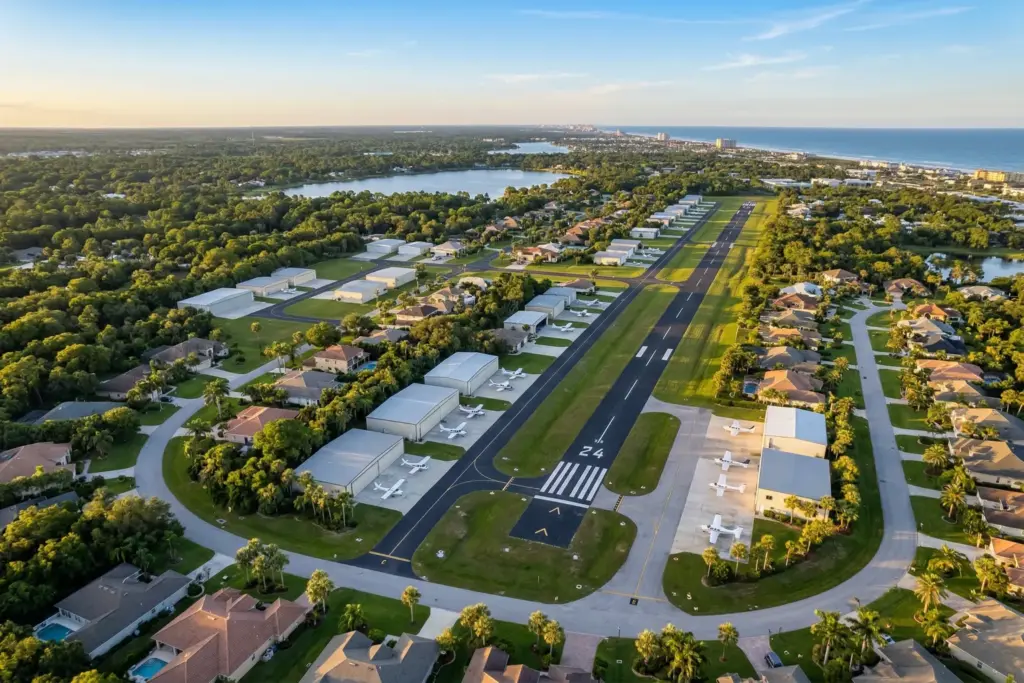
Florida has 80 residential airparks, the second most of any state in the country (Texas edges them out with 84, and yeah I might be a little biased about that). Homes range from $200,000 starter condos at Spruce Creek to multi-million dollar estates at Jumbolair where John Travolta used to park his Boeing 707. If you are a pilot thinking about airpark living in the Sunshine State, this is the most complete guide you will find.
According to the Florida Department of Transportation, the state has 129 public airports, over 600 private airports, and 27 military airfields. That is an absurd amount of aviation infrastructure for one state. And when you combine that with no state income tax, VFR weather roughly 300 days a year, and easy access to Caribbean and Bahamas flying, you start to understand why so many pilots end up in Florida.
I am a licensed pilot and a real estate broker in Texas, so I spend a lot of time thinking about fly-in communities. I wrote the guide on Central Texas airparks and I have walked through more hangar homes than most people know exist. But I would be doing you a disservice if I pretended Texas was the only game in town. Florida is legitimate. Lets break down the communities worth knowing about.
Spruce Creek: The Standard Everyone Else Is Measured Against
Spruce Creek in Port Orange is the largest fly-in community in the world by population, and it is not particularly close. We are talking about 1,300 homes, 700 hangars, over 400 aircraft, and roughly 5,000 residents living on a 1,250 acre former World War II Naval Airfield. The runway is 4,000 feet by 176 feet (recently resurfaced) with VASI lights and over 13 miles of taxiways connecting homes to the strip.
That last number is worth sitting with for a second. Thirteen miles of taxiways. You could taxi from your hangar to the runway and back and call it your morning commute.
The amenities read like a country club brochure because it basically is one. Championship 18-hole golf course, har-tru tennis courts, pickleball (because apparently every community in America now has pickleball), casual and fine dining, fitness center, pool, and a children’s summer camp. The whole thing is gated with 24/7 security.
So what does it cost? Over the past year, 39 homes changed hands at an average sale price of about $724,000. The range is massive though. You can find condos and smaller homes starting around $200,000, and the high end pushes past $2 million into the $6 million range for estate properties with private hangars. The list-to-sell ratio sits at 96%, which tells you buyers are not extracting huge discounts here. Average days on market is 83, which for a niche product like this is actually pretty healthy.
Location wise, you are 20 minutes from Daytona Beach and about an hour from Orlando. Not bad for a community that feels completely removed from everything.
If I am being honest (and when am I not right), Spruce Creek is the benchmark. Every other fly-in community in Florida gets compared to it whether they want to be or not.
Jumbolair: When a Normal Runway Just Will Not Do
Ok so Jumbolair is a different animal entirely. Located in Anthony, about seven miles northeast of Ocala, it sits on 550 acres and has the largest private paved airfield in the United States. The runway is 7,550 feet long and 250 feet wide. For context, that is long enough to land a Boeing 707, which is exactly what John Travolta did for years (he has since sold it, but the point stands).
The history here is genuinely fascinating. The property started as a 380-acre horse ranch built by Muriel Vanderbilt. Arthur Jones, the guy who invented Nautilus exercise equipment, bought it in 1980. After Jones and his wife Terri divorced in 1989, she developed it into the fly-in community it is today. The Travoltas were among the first to buy land.
Every lot is roughly three acres, with taxiways connecting to the main runway. The runway itself is elevated 100 feet above the surrounding terrain to prevent flooding during Florida downpours. Smart engineering for a state that gets biblical rain sometimes.
This is not a place where I can give you a typical price range because properties almost never hit the open market. When the entire Jumbolair development itself listed for $15.5 million a few years ago, Robb Report covered it. That should tell you the caliber of what we are talking about.
Jumbolair also doubles as an equestrian estate (this is Ocala horse country after all), which gives it this unusual aviation plus equestrian identity that you really do not find anywhere else. If you own both a Cessna and a Thoroughbred, congratulations, this is your place.
Leeward Air Ranch: The Pilot’s Pilot Community
If Spruce Creek is the country club and Jumbolair is the ultra-exclusive estate, then Leeward Air Ranch is the community built by pilots, for pilots. Period.
Located on 500 acres in Ocala, Leeward features a 6,250 foot by 165 foot reinforced turf runway that Mac McClellan of Flying Magazine once called “the most perfectly constructed and maintained turf runway.” That is not a casual compliment from a guy who has probably landed on a thousand strips.
Here is what makes Leeward different from most fly-in communities. You have to be an active licensed pilot and aircraft owner to buy here. That is not a soft guideline, it is a hard requirement. So every single one of your neighbors is a pilot. Every conversation at the hangar happy hour is about aviation. The community runs fly-ins, warbird roundups, aviation days, aerobatic demos, and social events out of their famous Red Barn.
There are over 180 hangar homes on half-acre to one-acre lots, with prices currently running between $569,000 and $899,000. VFR conditions over 300 days a year. And the community has been growing steadily since it was established in 1983.
I will say this about Leeward. The price point makes it one of the more accessible serious fly-in communities in Florida. You are getting a real hangar home on real acreage with a world-class turf runway for less than what a non-aviation house costs in a lot of Florida markets right now. Benjamin Graham (the father of value investing) would have appreciated that kind of math. You are buying intrinsic value, not just paying for a brand name.
More Florida Fly-In Communities Worth Knowing About
Florida has 80 airparks, so I am obviously not covering all of them. But here are a few more that deserve to be on your radar.
Wellington Aero Club (Wellington)
This one is in the heart of South Florida’s equestrian country. 240 custom homes on one-acre lots, many with private hangars, connected to a 4,000 foot paved and lighted runway. Mediterranean and Key West style architecture. Prices run $1 million to $4 million. If you want airpark living with proximity to Palm Beach, this is it.
Ridge Landing (Frostproof)
A newer community with 99 lots on one-plus acres, stabilized grass taxiways, and a 3,000 foot paved runway. This is for the pilot who wants to get in on the ground floor (pun absolutely intended). Rural Central Florida location means you are trading convenience for space and value.
Love’s Landing (Weirsdale)
Private gated community near The Villages with a lighted 3,600 foot runway. All homes are close to the runway with direct hangar access. Smaller and more intimate than the big-name communities.
The Florida Keys Options
And then there are the truly unique options. Summerland Key has a fly-in community with a 2,394 foot paved runway and waterfront living in the Keys. North Captiva Island (Salty Approach) has an airstrip that literally bisects the neighborhood on a barrier island accessible only by boat or plane. These are not your typical airpark experience, but if combining ocean access with aviation is your thing, Florida is the only state that can offer this.
Why Florida for Airpark Living
Lets talk about what makes Florida specifically attractive for pilots, beyond just the number of communities available.
Weather. VFR conditions over 300 days a year in most of Central Florida. You are not sitting in your hangar watching a ceiling at 800 feet wondering if you should cancel your flight plan. The flying season is essentially year-round.
No state income tax. Florida is one of the handful of states that does not tax your income. For pilots who are often high earners (or retirees living off investments), this is not a trivial consideration. No estate tax either, which matters when you are passing down property.
General aviation infrastructure. 129 public airports and over 600 private fields means you are never far from fuel, maintenance, or a divert option. The GA community in Florida is deep and well-established.
Caribbean and Bahamas access. From most of Florida, the Bahamas is a short hop across the Gulf Stream. Bimini is 50 nautical miles from Fort Lauderdale. If international flying is part of your lifestyle, Florida puts it right at your doorstep.
Property values. Airpark homes have been appreciating faster than conventional homes nationally (roughly 15% faster according to recent market data), and Florida’s population growth continues to drive demand across the state.
Florida vs Texas: A Pilot’s Honest Comparison
Ok I know what some of you are thinking. Ed, you sell real estate in Texas, why are you writing about Florida? Fair question right.
Here is the thing. I work with pilots. I wrote the guide on Texas fly-in communities and I know the Texas airpark market inside and out. But I would lose credibility fast if I pretended one state was objectively better than the other. They are different, and the right choice depends on what matters most to you.
Florida’s advantages: Better year-round flying weather (no ice, less convective activity in winter), ocean access for seaplane and island flying, more established legacy fly-in communities like Spruce Creek that have decades of infrastructure built up, and proximity to the Caribbean.
Texas advantages: Slightly more airparks (84 vs 80), significantly lower property taxes in most areas, larger lots for your money, more affordable entry points, and zero hurricane risk. I have a whole article on Hill Country investment properties that shows just how far your dollar goes in Central Texas.
What they share: Neither state has an income tax. Both have massive GA communities. Both have warm climates (though I would argue Texas summers test your commitment to outdoor hobbies in a way that Florida humidity does not, and yeah Florida has humidity too, so pick your poison).
My honest take? If you want the biggest, most established fly-in community experience with year-round flying weather and you do not mind Florida’s property insurance costs and hurricane season, Spruce Creek or Leeward Air Ranch are hard to beat. If you want more land, lower carrying costs, and you enjoy the idea of Hill Country flying with dramatic terrain, Texas airparks deserve serious consideration.
Frequently Asked Questions
Thinking About Making the Move?
Look, I specialize in Texas airpark real estate. That is my market and that is where I can give you the kind of hyperlocal, I-have-walked-every-taxiway knowledge that actually matters when you are spending this kind of money. But I also know that Florida has communities that are genuinely world-class, and pretending otherwise would just be dishonest.
So here is my offer. If you are a pilot looking at Texas airparks, lets talk directly. I have done this a lot and I can walk you through every community from Lago Vista to Horseshoe Bay. And if Spruce Creek or Leeward Air Ranch is calling your name, I work with trusted aviation-savvy agents in Florida and I can connect you with the right person.
Either way, you should be working with someone who understands what a 4,000 foot runway with VASI lights actually means for your daily life. Not every agent gets this world.
Be safe, be good, and keep the blue side up.


