 Ed Neuhaus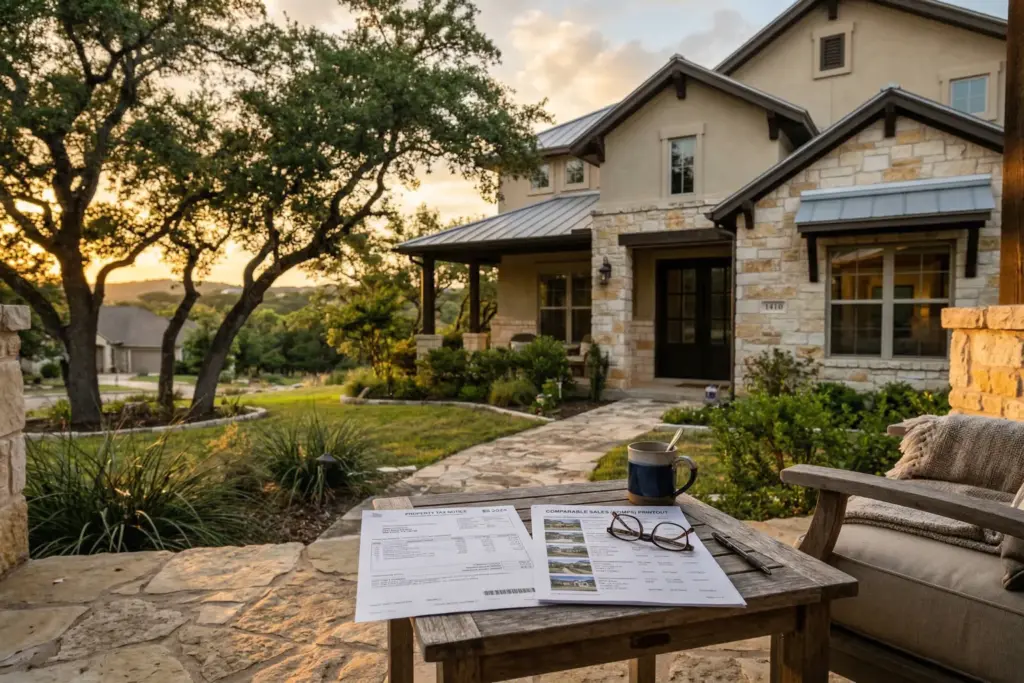
Travis County homeowners saved an average of $1,200 per year on property taxes when they showed up to their protest hearing with comparable sales data that proved their home was over-appraised. And roughly 85% of homeowners who brought real evidence walked away with a reduction.
So why do most people skip it? Because they think pulling comps is something only realtors or appraisers know how to do. It’s not. But there is a right way and a wrong way to do it, and the difference between the two is usually the difference between winning your protest and wasting an afternoon.
I’ve put together CMAs for hundreds of clients over my 19 years in the Austin market. And I can tell you that the comparable sales you’d use to price a home for sale are NOT the same ones you’d use to protest your property taxes. The strategy is completely different. Lets walk through exactly how to pull the right comps, build your case, and present it in a way that actually gets results.
How the Appraisal District Values Your Home (And Why They Get It Wrong)
Here’s the thing most people don’t understand about how TCAD (or any Texas county appraisal district) comes up with your appraised value. They’re not sending someone to look at your house. They’re running what’s called a Computer Assisted Mass Appraisal, or CAMA.
According to the Texas Comptroller, mass appraisal is “the process of valuing a universe of properties as of a given date using standard methodology.” That sounds reasonable until you think about what it actually means. They’re valuing hundreds of thousands of properties at once using statistical models. They classify your home by size, age, construction type, and location, then they apply sales data from recent transactions across the area.
But here’s where it breaks down. By definition, when you apply a statistical curve to a group of properties, about half will be over-valued and half will be under-valued. The curve smooths everything out so the averages look right. But your house isn’t an average. Your house has that kitchen from 2004 that you keep saying you’ll renovate (maybe next year right). Your house has the foundation issue you’ve been monitoring. Your house backs up to the commercial lot that went in three years ago.
The mass appraisal model doesn’t know any of that. And that’s your opening.
A Comparative Market Analysis works the opposite way. Instead of starting with a model and fitting your home into it, a CMA starts with YOUR home and finds the most similar properties that actually sold recently. It’s individual, specific, and it accounts for the things that make your property different from the one down the street.
What Makes a Good Comp for Tax Protest (vs. Selling Your Home)
Ok this is the part where most people get tripped up, and it’s the single most important thing I can teach you in this article.
When I’m pricing a home to sell, I want comps that show the HIGHEST reasonable value. I want to find every sale that supports a strong list price. That’s my job as a listing agent.
When you’re protesting your property taxes, you want the opposite. You want comparable sales that support a LOWER value than what the appraisal district assigned. Same data source, completely different strategy.
Here’s what makes a strong comp for a tax protest:
Proximity matters more than you think. For a tax protest, closer is always better. A sale on your street beats a sale half a mile away every time. The ARB (Appraisal Review Board) gives more weight to comps within your subdivision or immediate area. If you can find 3 sales within a quarter mile that closed below your appraised value, that’s a strong case.
The January 1 valuation date is everything. Your 2026 appraised value is based on what your home was worth on January 1, 2026. So the most relevant comps are sales that closed in the 6-12 months before that date. A sale from July 2025 is gold. A sale from March 2026 is still useful but carries less weight because it happened after the valuation date. The appraisal district typically looks back 12 months and sometimes three months forward.
Sold price, not list price. I see people bring in active listings as “evidence” all the time. And look, if homes similar to yours are sitting on the market at prices below your appraised value, that’s worth mentioning (it tells a story about market conditions). But the ARB cares about what buyers actually PAID, not what sellers are asking. Closed sales are your primary weapon.
Condition adjustments are where you win. This is the part the appraisal district almost always gets wrong. If your home has a 20-year-old roof and the comp has a brand new one, that’s a legitimate adjustment. If the comp was fully renovated and your kitchen still has laminate countertops from the Bush administration, say so. Bring photos. The mass appraisal model treats your home like a data point. You need to show the ARB that your home is a specific property with specific conditions that reduce its value relative to the comps.
You’re not trying to lowball. This sounds obvious right. But I want to be clear about this. The goal isn’t to claim your $500,000 house is worth $300,000. The ARB sees that and you lose credibility instantly. The goal is to demonstrate, with evidence, that the appraisal district’s number is higher than what the market data supports. A $30,000 to $80,000 reduction is realistic and defensible. That’s $700 to $1,900 a year in tax savings depending on your tax rate. Every year. For the life of your homestead cap.
How to Actually Pull Comparable Sales
So you know what you’re looking for. Now where do you find it?
Option 1: The appraisal district’s own data. Go to your county’s appraisal district website (traviscad.org for Travis County, wcad.org for Williamson, hayscad.com for Hays) and search for properties in your area. You can see appraised values for neighboring properties, which is useful for an “unequal appraisal” argument. But here’s the problem. The appraisal district records show appraised values, not actual sale prices. And those are two very different things.
Option 2: County deed records. Actual sale prices are recorded in deed records when properties change hands. You can look these up at the county clerk’s office or online. But it’s clunky, slow, and you’re searching one property at a time.
Option 3: A realtor’s CMA. This is the fastest and most complete option. A CMA from a real estate agent pulls directly from the MLS, which has the actual sold prices, days on market, price per square foot, and all the property details you need to make adjustments. It’s the same data bank appraisers use when they do mortgage appraisals.
At Neuhaus Realty Group, we pull CMAs for people all the time. And not just for clients who are buying or selling. If you want comparable sales data for your tax protest, our free home value tool is a good starting point to see where your home stands relative to recent sales.
I’ve written a detailed step-by-step on the full protest process and deadlines here if you want the complete walkthrough. But lets focus on the CMA angle since that’s where most people either win or lose their case.
How a Realtor’s CMA Differs from the Appraisal District’s Valuation
I want to be really specific here because this is something I get asked about constantly.
The appraisal district uses mass appraisal. They classify properties into groups and apply statistical models. Texas Tax Code Section 23.01 requires them to follow USPAP (Uniform Standards of Professional Appraisal Practice), but the reality is they’re valuing your home as part of a batch, not individually.
A realtor’s CMA is an individual analysis. I look at your specific home, select 3-5 comparable sales that closely match your property, and make adjustments for differences. More bedrooms? Adjust up. Smaller lot? Adjust down. Pool? Adjust up (though pools in Central Texas don’t add as much value as people think). No updates since 2005? Adjust down significantly.
Here’s the catch though. A CMA from a realtor carries less formal weight with the ARB than a certified appraisal from a licensed appraiser. The ARB treats a CMA as supporting evidence, not definitive proof. But here’s why it’s still your best tool: a certified appraisal costs $400-$600. A CMA is usually free. And in my experience, the data in a well-prepared CMA is just as compelling to the ARB panel as a formal appraisal, because the underlying sales data is identical.
Benjamin Graham (the investor, not a tax guy, but bear with me) had this concept that price and value are different things. The appraisal district is assigning a price to your home based on a model. Your CMA shows what the actual VALUE is based on what real buyers paid for comparable homes. That’s a powerful distinction to make at your hearing.
Building Your Protest Case: The 5 Things to Bring
Alright lets get tactical. Here’s what your evidence package should look like when you walk into your hearing (or submit it online).
1. Your 3-5 best comparable sales. Print them out. For each one, include the address, sale date, sale price, square footage, lot size, year built, and price per square foot. Highlight the ones that closed below your appraised value. If you got these from a CMA, include the CMA report.
2. A price-per-square-foot comparison. Calculate the price per square foot for each comp and for your appraised value. If the comps are averaging $225/sqft and TCAD has you at $265/sqft, that’s a clear visual argument. The ARB panel can do math fast but this makes it easy for them.
3. Photos of your home’s condition. Foundation cracks, aging roof, that bathroom you’ve been meaning to update since your kids were in elementary school (and they’re in college now). Anything that makes your home less valuable than what the appraisal district’s model assumes. Be honest, don’t fake damage, just document reality.
4. Active listings in your area that aren’t selling. If homes similar to yours are sitting on the market at prices below your appraised value, include those listings. They tell a market story. Even though the ARB cares most about closed sales, unsold inventory at lower prices reinforces your argument.
5. The appraisal district’s own comp sheet. When you file your protest, TCAD will usually send you their evidence packet showing the comps THEY used. Review it carefully. I often find that the district’s comps are farther away, less similar, or include sales of renovated homes being compared to non-renovated homes. If you can pick apart their comps, that’s powerful.
Bring five copies of everything. One for you, one for each ARB panel member (there are usually three), and one for the appraisal district representative.
The Informal vs. Formal Hearing: Where Your Comps Do the Heavy Lifting
Most protests in Travis County start with an informal hearing. You (or your agent) sit down with a TCAD appraiser one-on-one and present your evidence. About 72% of protests are now filed electronically at traviscad.org, and TCAD may even send you a settlement offer by email before any meeting happens.
If the informal settlement works, great. You’re done. But if you don’t agree with what they offer, you have the right to a formal hearing with the Appraisal Review Board.
The formal hearing is where your comparable sales really matter. You’ll have about 15-20 minutes to present your case. The ARB panel is looking for one thing: is there credible evidence that the appraised value exceeds market value? Your CMA comps are the answer to that question.
Here’s a tip from sitting through more of these than I’d like to admit (I once watched a guy spend his entire 15 minutes complaining about potholes on his street, which, fair point, but not exactly what the ARB can help with). Don’t ramble. Don’t complain about your tax rate (the ARB doesn’t set tax rates). Don’t get emotional. Present your comps, walk through the adjustments, show the math, and let the data do the talking.
The ARB’s decision comes by certified mail about 3-4 weeks after your hearing. If you still disagree, you can appeal to district court or binding arbitration, but most homeowners get a reasonable result at the ARB level.
DIY vs. Hiring a Tax Protest Company
So should you do this yourself or pay someone?
The data actually surprised me here. According to Harris County records, homeowners who protest their property taxes themselves routinely outperform protest companies, achieving higher success rates and larger median reductions. DIY protesters not only win more often, they tend to get bigger reductions on average.
Why? I think it’s because nobody knows your house like you do. You can point to specific condition issues, neighborhood factors, and comparable sales that a protest company doing 500 cases a day simply won’t take the time to find.
Protest companies typically charge 30-50% of your tax savings as a contingency fee. Some use hybrid models with a $50-$150 upfront fee plus 25-30% of savings. So if they get you a $1,000 reduction in taxes, you might keep $500-$700 of that in year one. The math works in your favor more if you DIY it.
That said, there are cases where hiring help makes sense. If you own commercial property or a unique residential property that’s hard to comp, professional expertise can be worth it. If you just genuinely don’t have time (and I get it, life happens), a protest company is better than not protesting at all.
But for a standard single-family home in Bee Cave, Lakeway, Dripping Springs, or anywhere in the Austin area? You can absolutely do this yourself. Pull a CMA, gather your photos, file your protest, show up, and present the data. Should take you maybe two hours total. And you keep 100% of the savings.
The Deadlines You Cannot Miss
I covered this in detail in my full property tax protest guide, but it bears repeating because missing the deadline means you’re stuck.
May 15, 2026 is your deadline to file a protest (or 30 days after your Notice of Appraised Value was mailed, whichever is later). This applies across most Texas counties. TCAD doesn’t care if their website crashed, if you were traveling, or if your dog ate the notice. No extensions. File early.
You should also make sure your homestead exemption is filed. That’s a separate form, separate benefit, and it’s free money you should already have in place.
Getting Your Free CMA for Tax Protest Season
Look, I get that pulling comps sounds intimidating if you’ve never done it. But the data is the data, and a well-organized set of comparable sales is legitimately the most powerful tool you can bring to a property tax hearing.
If you want to start with a quick snapshot of where your home’s value stands relative to recent sales, check out our free home value tool. It’s a good first step before you dive into the full CMA.
Is Your Tax Appraisal Too High?
Compare your county\'s assessed value to what your home is actually worth on the open market. Free and instant.
And if you want a proper CMA with actual MLS sold data that you can take straight to your hearing, reach out to me. I pull these for homeowners every tax protest season. No cost, no obligation, and no I’m not going to try to sell your house (unless you want me to, in which case lets talk). It takes me about 10 minutes and it could save you thousands.
Frequently Asked Questions
Ready to Fight Your Property Tax Bill?
Protesting your property taxes in Texas is one of those things that sounds harder than it actually is. Get a CMA, pull your comps, file by May 15, and show up with the data. The success rate speaks for itself.
And hey, if you need help pulling those comps or want a second opinion on your case, lets grab coffee. I do this every spring and I’m happy to help. Be safe, be good, and be nice to people.


