 Ed Neuhaus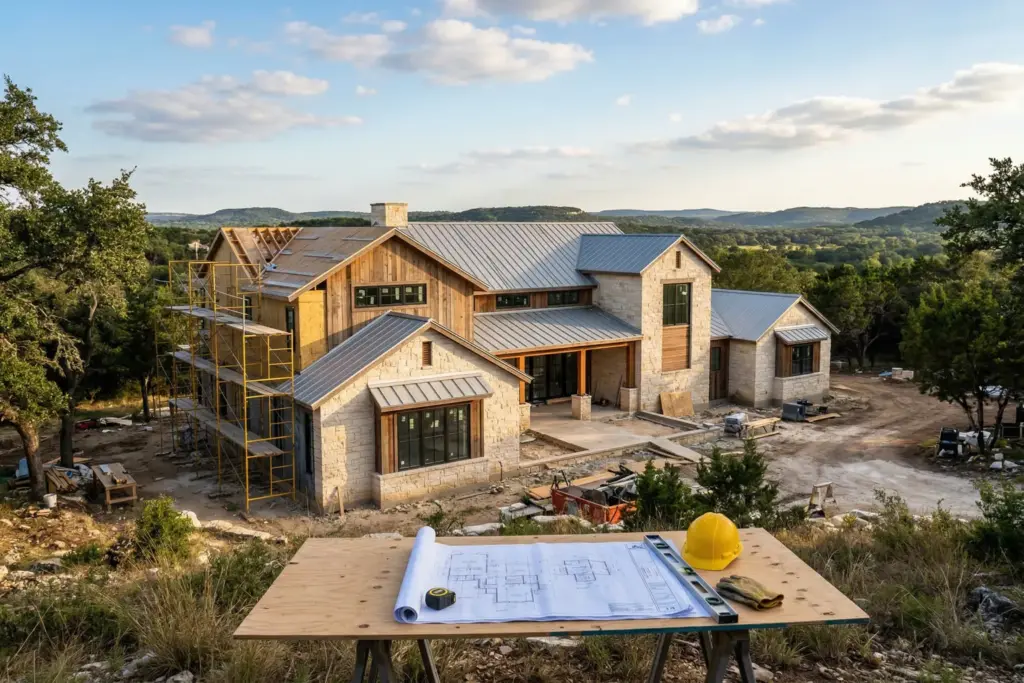
A full custom home in the Austin Hill Country runs $325 to $500 per square foot in 2026, which puts a 3,000 square foot house somewhere between $975,000 and $1.5 million before you buy the dirt underneath it. According to multiple Austin custom builders (Sterling Custom Homes, Jenkins Design Build, AC Cornerstone), that range has held pretty steady since late 2024, with one big exception: tariffs on Canadian lumber and imported steel pushed material costs up another $10,000 to $25,000 per project starting in early 2026.
Sounds like a lot right. But here’s the thing, that per-square-foot number everyone throws around is only about 60-65% of your total budget. The rest is land, site work, design fees, permits, and a dozen line items that never make it into the glossy builder brochure. I’ve helped buyers through custom builds in Dripping Springs, Bee Cave, and Spicewood where the “surprise” costs added 25-30% to what they originally expected. So lets walk through the real math.
What Does “Price Per Square Foot” Actually Mean in Austin?
First, some context. When a builder tells you “$350 per square foot,” they’re quoting hard construction costs. That’s the lumber, the concrete, the labor, the HVAC, the finishes inside the house. What it usually does NOT include:
- Land
- Site prep (grading, tree removal, retaining walls)
- Driveway (and on a Hill Country lot with 200 feet of limestone between the road and your build pad, that driveway can cost $30,000 to $80,000 by itself)
- Well and septic (if you’re outside city utilities, which most Hill Country properties are)
- Pool and landscaping
- Architectural and engineering fees
- Permits and impact fees
- Construction loan interest
So when I say a custom home costs $325 to $500 per square foot, I’m talking about the vertical construction. Your all-in budget needs to account for everything else. And that “everything else” in the Hill Country can be substantial.
The Four Tiers of New Construction in Austin
Not all new construction is created equal. Here’s how the market breaks down in 2026:
Tier 1: Production/Spec Homes ($175 to $225 per square foot)
These are your Lennar, Meritage, Taylor Morrison builds in master-planned communities. You pick from a menu of floor plans, choose your countertops and cabinet color from a design center, and the builder handles everything. In places like Dripping Springs and the Highway 290 corridor, production homes are running $175 to $225 per square foot for the structure. Total purchase price for a 2,400 sqft production home in a community like Headwaters or Caliterra typically lands between $450,000 and $650,000 (land included, because the builder already owns the lot).
Tier 2: Semi-Custom ($225 to $325 per square foot)
This is where things get interesting. Semi-custom builders let you modify floor plans, upgrade materials beyond the standard package, and sometimes bring your own architect for the design phase. Builders like Grand Endeavor Homes and Wilde Custom Homes operate in this space. You get more flexibility than production, but you’re still working within the builder’s systems and preferred subcontractors. Budget $225 to $325 per square foot for hard costs, and expect the total project (with a lot in West Austin or the Hill Country) to run $700,000 to $1.2 million all-in.
Tier 3: Full Custom ($325 to $500 per square foot)
Now we’re talking about a house designed from scratch for your family, your lot, and your lifestyle. You hire an architect. You interview builders. Every decision from the foundation type to the door hardware is yours. Sterling Custom Homes, Jenkins Custom Homes, and Zbranek & Holt are examples of builders working at this level in the Austin market. At $325 to $500 per square foot for construction, a 3,500 sqft full custom home runs $1.1 million to $1.75 million in hard costs alone. Add land, design, and site work and you’re looking at $1.4 to $2.2 million total.
Tier 4: Luxury Custom ($500+ per square foot)
This is the Eppright Homes, Sterling estate tier. We’re talking imported stone, commercial-grade appliances, home automation systems that cost more than some people’s cars, and build quality that would make a Swiss watchmaker nod approvingly. In communities like Spanish Oaks or on acreage along Hamilton Pool Road, luxury custom builds can push $800 to $1,500 per square foot. At that level, a 5,000 sqft estate could cost $4 million to $7.5 million or more. I would argue this is where the difference between a good builder and a great builder becomes worth every penny.
Land Costs: The Variable That Changes Everything
Here’s where most people’s budget math falls apart. The lot is a massive variable, and in the Hill Country it varies wildly depending on where you want to build.
Based on active listings in our MLS database right now (March 2026):
| Area | Active Land Listings | Median Lot Price |
|---|---|---|
| Spicewood | 212 | $259,495 |
| Wimberley | 100 | $327,500 |
| Dripping Springs | 115 | $459,900 |
| Lakeway | 19 | $475,000 |
| Austin (city limits) | 442 | $514,888 |
| Bee Cave | 3 | $1,890,000 |
A couple things jump out. Spicewood has by far the most available lots and the lowest median price, which is why a lot of custom builders steer clients that direction (more bang for your buck, bigger parcels, gorgeous lake access). Bee Cave has basically no raw land left, which is why those three listings are priced like small kingdoms.
And Dripping Springs is the sweet spot for a lot of custom build buyers I work with. You can still find 1-3 acre lots in the $300,000 to $600,000 range with Dripping Springs ISD schools, which consistently rank among the best in the region.
Benjamin Graham wrote in The Intelligent Investor that the margin of safety is the most important concept in investing. With land purchases for custom builds, your margin of safety IS the lot price relative to what the finished home will appraise for. Buy a $500,000 lot and build a $1.2 million home, and you want that finished product to appraise for at least $1.7 million in the current market. If it doesn’t, you’re underwater before you move in.
The Full Budget Breakdown: Where Your Money Actually Goes
Lets get specific. Here’s how a $1.5 million total custom home budget typically breaks down in the Hill Country:
| Category | Percentage | Dollar Amount | What’s Included |
|---|---|---|---|
| Land | 25-35% | $375,000-$525,000 | Lot purchase, closing costs on land |
| Hard Construction | 45-55% | $675,000-$825,000 | Everything inside the foundation footprint |
| Soft Costs | 8-12% | $120,000-$180,000 | Architect, engineer, permits, surveys, geotech |
| Site Work | 5-10% | $75,000-$150,000 | Grading, driveway, utilities, well/septic, retaining walls |
| Contingency | 5-10% | $75,000-$150,000 | Change orders, material price swings, the unexpected |
That contingency line is not optional. Every experienced custom builder I know will tell you the same thing: budget 10% for contingency and pray you only need 5%. Change orders are the single biggest budget killer in custom builds. You’re three months in, the framing is up, and suddenly you realize the master closet would be perfect if it were just two feet wider. That “small” change might cost $8,000 to $15,000 depending on what it affects structurally.
Hidden Costs That Nobody Warns You About
This is the section I wish every buyer read before signing a builder contract. These are the line items that routinely blindside people:
Impact fees. The City of Austin charges development impact fees for water, wastewater, and transportation. Depending on your location and lot size, these can run $5,000 to $25,000. Some MUD and PID districts add their own fees on top.
Utility hookups. If you’re on a rural lot outside city water and sewer, you’re drilling a well ($15,000 to $40,000 depending on depth) and installing a septic system ($10,000 to $30,000 for conventional, more for aerobic). Our guide to wells and septic in the Hill Country covers this in detail.
Construction loan interest. During the 12-18 month build, you’re making interest-only payments on drawn funds. At current rates around 7-8% on a construction loan, that’s $4,000 to $8,000 per month once you’re 60-70% drawn. Over a full build, you might pay $40,000 to $80,000 in interest alone before your permanent mortgage kicks in.
Temporary housing. If you sold your existing home to fund the build (and most people do), you need somewhere to live for 12-18 months. At Austin rental rates, that’s $2,000 to $4,000 per month. Budget $24,000 to $72,000 unless you have family nearby willing to adopt you for a year (no big deal right).
The driveway nobody budgeted for. I keep coming back to this because it catches people every single time. A flat suburban lot needs maybe $5,000 for a driveway. A Hill Country lot with a 300-foot setback, a creek crossing, and limestone bedrock? I’ve seen driveway costs hit $60,000 to $100,000. That’s not a typo.
The 2026 Tariff Factor
I wrote about this extensively in How Trump’s Tariffs Could Make Your Austin New Build More Expensive, but the short version: Canadian softwood lumber now carries a 45% combined duty rate, steel and aluminum face 50% tariffs, and even kitchen cabinets and vanities got hit with a 50% tariff.
The National Association of Home Builders estimates tariffs are adding roughly $17,500 to the average new home nationwide. For Austin custom builds, I’m hearing $10,000 to $25,000 on most projects, with luxury homes seeing higher increases because of imported specialty materials (Italian tile, European fixtures, custom steel work).
The bigger concern isn’t just the dollar amount. It’s the unpredictability. Lumber prices have been on a roller coaster since COVID, and tariffs just added another loop. Smart builders are locking in material prices early and including tariff escalation clauses in their contracts. If your builder’s contract doesn’t address material price volatility, that’s a red flag.
Timeline: How Long Does a Custom Build Actually Take?
The honest answer: plan for 14 to 20 months from the day you start with an architect to the day you get your certificate of occupancy.
Here’s how that breaks down:
- Design and engineering: 3-5 months (architectural plans, structural engineering, interior design selections)
- Permitting: 2-4 months in Austin proper, 4-8 weeks in unincorporated Travis or Hays County. Austin’s permitting office is notoriously slow, though they’re piloting an AI review system that might help.
- Site prep and foundation: 4-6 weeks
- Framing through dry-in: 6-10 weeks
- MEP rough-in (mechanical, electrical, plumbing): 4-6 weeks
- Finishes and trim: 8-12 weeks
- Final inspections and punch list: 2-4 weeks
So if you want to be in your new custom home by summer 2027, you should be talking to architects right now. Not next month. Now.
And one thing I tell every buyer: the permitting timeline in the City of Austin is different from building in Bee Cave or Lakeway or unincorporated Hays County. If speed matters to you (and paying rent for 18 months while you wait usually makes speed matter), the ETJ and smaller municipalities outside Austin can cut months off your timeline.
Build vs. Buy: When Does Custom Actually Make Sense?
Ok lets do some honest math. Because building custom is not always the right call.
Scenario: $900,000 total budget
Buy existing: A $900,000 existing home in Bee Cave or Lakeway gets you roughly 3,000 to 3,500 sqft, probably built 2010-2018, updated kitchen, decent lot. You close in 30 days and start living.
Build custom: That same $900,000 buys a $250,000 lot in Spicewood and a $650,000 construction budget, which at $275/sqft gets you about 2,350 sqft of semi-custom home. You’re living in a rental for 14-18 months, paying construction loan interest, and managing a project.
At $900K, buying existing usually wins on pure value. The math starts to favor building when your budget passes $1.2 million, because above that price point the existing inventory in the Hill Country thins out and you’re competing with other buyers for a shrinking pool of homes. Plus you get exactly what you want instead of compromising on someone else’s floor plan.
Scenario: $1.5 million total budget
Buy existing: Limited inventory. Maybe 15-20 active listings in the Hill Country at this price. You’ll probably compromise on lot size, layout, or location.
Build custom: A $400,000 lot in Dripping Springs plus $1.1 million in construction gets you 3,000+ sqft of full custom home on acreage, designed exactly for how your family lives. Your dollar goes further because you’re not paying a previous owner’s equity markup.
At $1.5M and above, building almost always makes more sense if you can handle the timeline and the complexity.
When building is the clear winner:
- You need a specific lot or location with no existing homes available
- You have unusual space requirements (multigenerational suites, large workshops, horse facilities)
- You’re an investor building to a specific rental pro forma
- The finished home will be your “forever” house and you want it done right
When buying existing is smarter:
- Your budget is under $1 million
- You need to move in the next 6 months
- You hate making 500 decisions about tile grout and cabinet hardware (and that’s a real thing, I’ve watched marriages get tested over backsplash tile)
- You found a home that checks 90% of your boxes and the other 10% is fixable with a $50,000 renovation
Kahneman’s whole thing in Thinking Fast and Slow is that humans are terrible at predicting how much effort and stress a project will take. Custom building is the ultimate example. It’s incredibly rewarding when it’s done, but the 14-18 months in the middle will test you. Just being honest.
Financing Your Custom Build
The financing for a custom home is different from buying existing, and it trips people up.
Construction-to-permanent loan (one-time close). This is the most common approach. You get approved for one loan that covers both the construction phase and the permanent mortgage. During construction, you make interest-only payments on the amount drawn. When the house is complete, it automatically converts to a standard mortgage. The advantage is one application, one closing, one set of closing costs. Our closing costs guide for Texas buyers explains what those costs look like.
Two-close construction loan. You get a separate construction loan for the build phase, then refinance into a permanent mortgage when construction is complete. This can sometimes get you a better rate on the permanent loan (you’re shopping rates 12-18 months in the future), but you pay closing costs twice.
Lot loan + construction loan. If you’re buying land now and building later, you’ll need a separate lot loan. These typically require 20-30% down, carry higher interest rates than mortgages (think 7-9% in 2026), and have shorter terms (2-5 years). The lot loan gets paid off when your construction loan funds.
Most Austin-area lenders require a 680+ credit score, debt-to-income ratio under 45%, and at least 20% down for construction loans. If you already own the land free and clear, that equity usually counts toward your down payment. SouthStar Bank and RBFCU are two local lenders I’ve seen handle construction loans well in this market.
How to Choose a Custom Builder (Without Getting Burned)
I represent buyers in new construction deals regularly, and the builder selection is the most important decision you’ll make. More important than the lot. More important than the floor plan. Here’s what to look for:
Check their financial health. Ask for bank references. A builder who’s undercapitalized will cut corners when the budget gets tight, and the budget always gets tight. This is something most buyers never think to ask about and it matters enormously.
Visit homes they completed 3-5 years ago. New houses all look great. The question is how they hold up after a few Texas summers. Are the windows sealing properly? Is the foundation settling evenly? How’s the stucco (or stone veneer, or whatever exterior they used) handling the heat cycles?
Read the contract like your financial life depends on it. Because it does. Look for: allowance amounts (are they realistic or artificially low to make the bid look good), change order markup percentages, payment draw schedules, warranty terms, and what happens if the builder goes over budget or over timeline.
Get your own representation. A buyer’s agent who knows new construction in this market will catch things you won’t. Builder contracts are written by the builder’s attorney to protect the builder. Having someone on your side of the table matters. And it doesn’t cost you anything extra on most custom builds.
Frequently Asked Questions
Thinking About Building? Lets Talk Numbers.
At Neuhaus Realty Group, we represent buyers in custom builds and new construction across the Hill Country. I’ve walked clients through builder contracts, negotiated allowance packages, and helped people figure out whether building or buying makes more financial sense for their specific situation. If you’re in that “thinking about it” phase and want someone to run the numbers with you, lets connect. No pressure, no commitment, just an honest conversation about what your budget can actually do in this market.
And hey, be safe, be good, and be nice to people.


