 Ed Neuhaus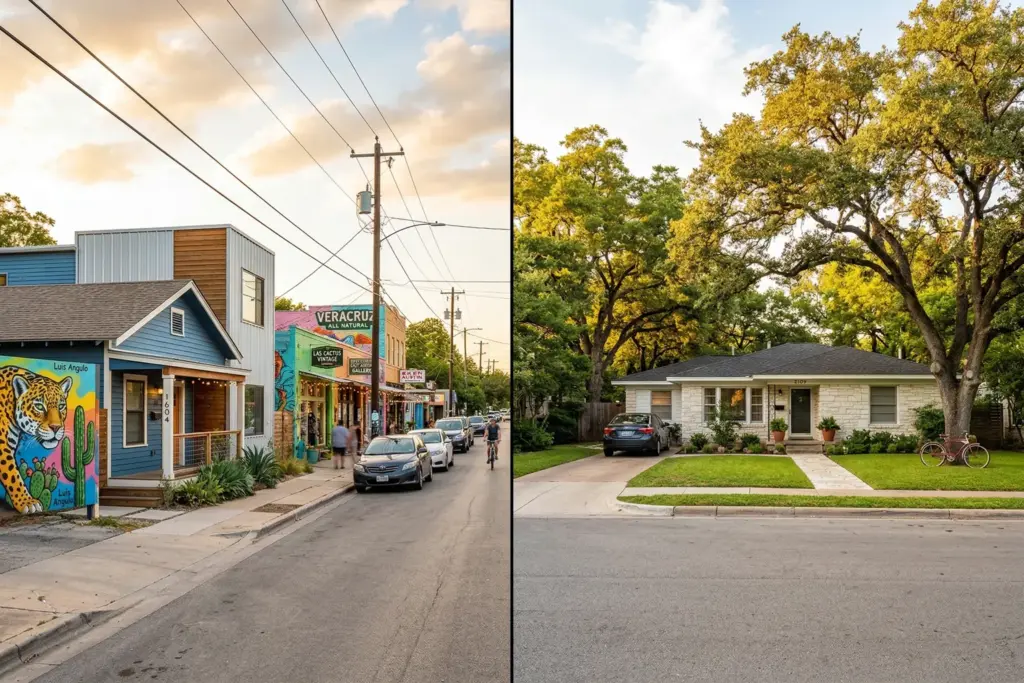
The median home in East Austin’s 78702 zip code is sitting at $650,000 right now with a price per square foot of $541. In South Austin’s 78704, that median jumps to $799,000 at $612 per square foot. So if you’re comparing East Austin vs South Austin for your next home purchase, you’re looking at a $150,000 gap between the two most iconic zip codes in the city. That’s real money right.
But here’s what those numbers don’t tell you. These two neighborhoods couldn’t be more different in terms of vibe, trajectory, and who actually thrives there. I’ve been selling homes in both areas for 19 years now, and the buyers who end up in East Austin versus the ones who land in South Austin are almost always looking for completely different things. Lets break this down honestly.
According to U.S. Census data, East Austin’s 78702 saw a 74.3% rise in median household income between 2010 and 2020. That’s the single largest income growth of any zip code in Austin. And it tells you everything about where East Austin has been and where it’s going.
What East Austin Actually Feels Like in 2026
East Austin is the part of the city that changed the most and the fastest. Ten years ago, 78702 was where artists and musicians lived because they could afford it. Now it’s where tech workers and young professionals live because they want the energy that those artists created. That’s the honest version of the gentrification story, and it’s more complicated than most people want to admit.
The food scene over here is genuinely world class at this point. Birdie’s won Food & Wine’s Restaurant of the Year in 2023. Nixta Taqueria picked up a Michelin Green Star. Justine’s feels like a French brasserie dropped into a warehouse district. Dai Due is doing farm to table the way it was actually meant to be done (not the way restaurants in strip malls use the phrase). And that’s before you even get into the taco trucks and barbecue trailers that have been here for decades.
But the thing about East Austin is that it changes block by block. One street is quiet residential bungalows. The next block is a brewery, a coffee shop, and a condo development going up. The block after that might still be an auto repair shop from the 1970s. I always tell buyers, you cannot evaluate East Austin from a car. You have to walk the specific streets around any home you’re considering. You just have to.
The neighborhoods that make up East Austin proper include East Cesar Chavez, Holly, Govalle, Johnston Terrace, and if you push north a bit, Cherrywood and Mueller. Each one has its own personality. Cherrywood is the quieter, more established pocket that’s been seeing about 9.2% appreciation. Mueller is the planned community that feels nothing like the rest of East Austin (some people love that, some people find it a little too organized for the neighborhood). East Cesar Chavez is ground zero for the transformation, with new construction mixed right in with original homes from the 1940s and 50s.
Walkability is one of East Austin’s genuine advantages. The 78702 zip code is one of the most walkable areas in Austin, which in a city that scores a 42 overall on Walk Score is actually saying something. You can walk to restaurants, bars, coffee shops, and even bike downtown in about 10 minutes from most spots.
The South Austin Vibe (It’s Not What Instagram Shows You)
South Austin is the part of the city that everyone pictures when they think of “Keep Austin Weird.” And honestly, that’s still partly true, but it has gotten a lot more expensive. The 78704 is probably the most coveted zip code in Austin right now, and the median price reflects that at $799,000 for residential properties.
Here’s what people get wrong about South Austin. They see South Congress (SoCo) with the boutiques and the “I Love You So Much” mural and they think that’s all of it. SoCo is maybe 15 blocks of South Austin. The neighborhoods that actually make up South Austin, like Zilker, Barton Hills, Bouldin Creek, Travis Heights, and South Manchaca, each have their own thing going on.
Zilker is where you live if you want Barton Springs Pool to be your backyard. Barton Hills has some of the lowest crime rates in the city and sits right on the greenbelt. Travis Heights has the old Austin character with mature trees and homes that have been there since the 1930s. Bouldin Creek is the artsy pocket south of the river that’s become impossibly desirable (and priced accordingly).
South Manchaca is where you go when you want South Austin energy but can’t quite stomach the 78704 prices. And honestly that’s a smart move right now.
The food scene in South Austin is more established and spread out than East Austin’s. Home Slice Pizza has been a South Congress institution forever. Perla’s does the oyster bar thing with a massive patio. Jo’s Coffee is where half the city goes on Saturday morning. And if you push further south on Lamar, you hit the food truck parks and taco joints that are the real backbone of South Austin dining.
But South Austin’s Walk Score tells a different story than East Austin’s. The 78704 scores a 57 overall, which means some pockets like Bouldin and Travis Heights and the SoCo strip are very walkable, and other areas require a car for basically everything. Once you get south of Ben White Boulevard, the walkability drops off pretty dramatically.
The Price Breakdown (Because That’s What Actually Matters)
Ok lets get into the numbers because this is where the decision usually gets real.
If you’re looking at East Austin broadly (not just the premium 78702), the picture looks like this based on what’s active in the MLS right now:
78702 (East Cesar Chavez, Holly): $650,000 median, $541 per square foot. 191 active listings. This is the expensive part of East Austin and it knows it.
78721 (Govalle, Johnston Terrace): $530,000 median, $389 per square foot. 80 active listings. This is the value play in East Austin. Slightly further from downtown but still very much in the mix.
78723 (Windsor Park, University Hills): $565,000 median, $384 per square foot. 141 active listings. More space for your money, more of a neighborhood feel, and appreciation that’s tracking strong.
For South Austin:
78704 (Zilker, Bouldin, Travis Heights, SoCo): $799,000 median, $612 per square foot. 287 active listings. The crown jewel zip code. If you can afford it and you love the lifestyle, you probably already know you want to be here.
78745 (South Manchaca, Westgate): $475,000 median, $336 per square foot. 246 active listings. This is South Austin’s best kept sort of secret. You get the culture without the premium pricing. Benjamin Graham would call this the margin of safety play, and I think he’d be right.
78741 (East Riverside, Oltorf): $340,000 median, $287 per square foot. 115 active listings. This zip code is in transition. Tons of new development, proximity to the river, and prices that feel almost too good for how close you are to everything. There’s risk here though because the character of the neighborhood is changing fast. No big deal right.
So if you’re comparing apples to apples, the core East Austin experience (78702) runs about $150,000 less than the core South Austin experience (78704). But if you’re willing to explore adjacent zips, you can get into either area for mid $400s to low $500s. I walk buyers through this exact math all the time at Neuhaus Realty Group. The sticker price of the “famous” zip code is not the only option.
Development and Growth: Where’s the Momentum?
East Austin’s growth trajectory is, frankly, steeper than South Austin’s. And I don’t mean that as a value judgment. It’s just math.
South Austin, particularly the 78704, is largely built out. There’s not a ton of vacant land left. New inventory comes from teardowns and rebuilds, which keeps supply constrained and prices high. That’s great if you already own there. It means your appreciation is protected by simple scarcity. But it also means the neighborhood in 2030 is going to look a lot like the neighborhood in 2026. Not much runway for dramatic change.
East Austin still has room to transform. There are vacant lots, commercial properties converting to mixed use, and entire blocks that haven’t been touched yet. The City of Austin launched a comprehensive planning initiative specifically for the 78702 area to address growth pressures and preserve cultural heritage. That tells you two things: there’s serious development coming, and the city is actively trying to manage it rather than let it happen randomly.
For investors or people who think like investors (which honestly should be everyone buying a house, Robert Kiyosaki’s whole point in Rich Dad Poor Dad), East Austin probably offers more upside. South Austin offers more stability. Neither answer is wrong. It depends on whether you want to ride the wave or park on solid ground.
Who Should Buy in East Austin
You should seriously look at East Austin if you’re a first time buyer who wants to be close to downtown without paying downtown prices. If you work in tech and want to bike to the office (or at least to a coffee shop where you pretend to work remotely). If you’re the kind of person who gets excited about a neighborhood that’s still figuring itself out, where a James Beard nominated restaurant sits next to a tire shop. If you want walkability that actually works in Austin.
East Austin buyers tend to be younger, more tolerant of construction noise and neighborhood change, and more interested in being part of something that’s actively evolving. I recently helped a couple relocating from Portland who said East Austin felt more like the Portland they moved to 10 years ago than Portland does now. That tracks. I personally live out in Bee Cave so I’m the boring suburban guy in this comparison, but I spend enough time in both areas to have strong opinions.
You should probably not buy in East Austin if you want quiet established streets, if construction activity stresses you out, or if you need the schools question settled. AISD zoning in East Austin can be complicated and the school quality varies more than in South Austin’s established neighborhoods.
Browse East Austin homes for sale
Who Should Buy in South Austin
South Austin is for the buyer who knows exactly what they want and is willing to pay for it. If you want Barton Springs, Zilker Park, the greenbelt, and SoCo all within a 10 minute drive of your front door. If you have kids and want established neighborhoods with mature tree canopy and that settled feeling. If you’re relocating from out of state and want the “Austin experience” without having to explain to your family why there’s a construction crane visible from the backyard.
South Austin buyers tend to be slightly older (or at least further along in life), more settled in what they want from a neighborhood, and less interested in being on the frontier of anything. That’s not a knock. Knowing what you want and being willing to pay for it is a perfectly valid strategy.
The schools question is generally more straightforward in South Austin. You’re typically in AISD but the specific campuses in the 78704 and 78745 tend to be well regarded. Zilker Elementary, Barton Hills Elementary, Joslin Elementary. These are names that Austin parents actually seek out.
If you’re a first time buyer on a budget, check what income you actually need and then look hard at 78745. You get the South Austin lifestyle, access to everything on South Lamar and South Congress, and a median price that’s almost half of the 78704. That’s the move a lot of smart buyers are making right now.
Browse South Austin homes for sale
Frequently Asked Questions
The Bottom Line
Look, both of these neighborhoods are great. That’s not a cop out, it’s just true. But they attract different people for different reasons, and the worst thing you can do is buy in the wrong one because you fell in love with the idea of it instead of the reality.
East Austin is momentum. South Austin is foundation. East Austin is the neighborhood that’s still becoming itself. South Austin largely already knows what it is.
If you’re trying to figure out which one is right for you, the best thing you can do is spend a full Saturday in each one. Not driving through. Walking around. Eat breakfast in East Austin, then eat dinner in South Austin (or the other way around). You’ll know within about 4 hours which one feels like home.
And if you want someone to walk you through the actual listings and tell you what the numbers look like for your specific budget, that’s literally what I do. Lets talk. No pressure, just honest numbers and the kind of opinions you only get from someone who’s been doing this in Austin since 2007. Be safe, be good, and be nice to people.


