 Ed
Ed 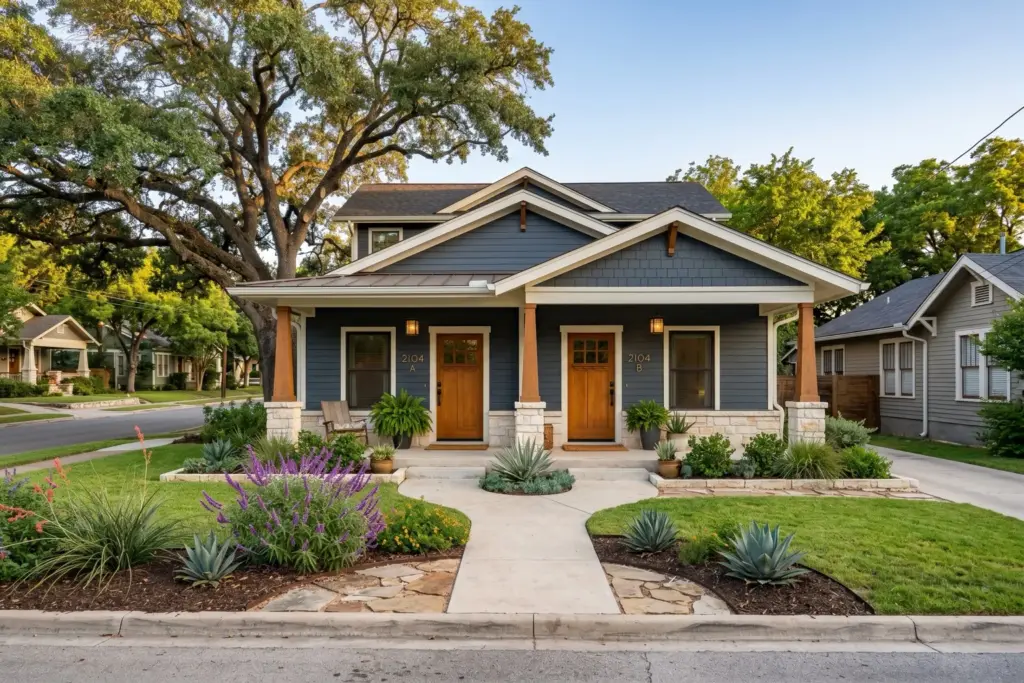
You can buy a duplex in Austin for as little as $25,600 down. That is 3.5% on a $731,700 FHA loan (the 2026 limit for two-unit properties in Travis County), and you get to live in one unit while your tenant in the other unit covers most of your mortgage. Sounds like a lot of steps right. But the math here is actually simpler than most people think, and this is the single best entry point into real estate investing that I know of.
According to HUD’s 2026 loan limit schedule, the FHA program covers properties with up to four units under the same residential loan rules as a single-family home. Same 3.5% minimum down payment. Same credit score requirements. The only catch is you have to live in one of the units for at least 12 months.
So lets break this down. I have helped buyers do this exact play multiple times, and I have seen it change people’s financial trajectory faster than almost any other move in real estate. FHA multifamily is how you make that first one count twice.
What Is an FHA Multifamily Loan
An FHA multifamily loan is just a regular FHA loan. There is no separate program or special application. The standard FHA 203(b) loan, the same one your buddy used to buy his three-bedroom ranch, works for duplexes, triplexes, and fourplexes.
The key requirement: you have to owner-occupy one of the units as your primary residence. This is not optional and it is not something you can fake (FHA does check). You move in within 60 days of closing and you stay for a minimum of 12 months. After that year is up, you can move out, keep the property, rent all the units, and go do it again with a conventional loan if you want.
This is what people call “house hacking” and it is the closest thing to a cheat code in real estate investing.
2026 FHA Loan Limits for 2-4 Unit Properties
FHA loan limits vary by county and by the number of units. Here are the numbers that matter for 2026.
Travis County (Austin) 2026 FHA Limits:
| Units | FHA Loan Limit |
|---|---|
| 1-unit | $571,550 |
| 2-unit (duplex) | $731,700 |
| 3-unit (triplex) | $884,450 |
| 4-unit (fourplex) | $1,099,150 |
National Floor (standard-cost areas):
| Units | FHA Loan Limit |
|---|---|
| 2-unit | $693,050 |
| 3-unit | $837,700 |
| 4-unit | $1,041,125 |
Those numbers are higher than most people expect. A $731,700 limit on a duplex in Travis County gives you serious buying power. And if you are shopping in Williamson or Hays County the limits are similar (check HUD’s site for your exact county).
Down Payment and Credit Requirements
Here is where the FHA program really shines for new investors.
Minimum down payment: 3.5% with a credit score of 580 or higher. If your score falls between 500 and 579, you need 10% down. Below 500, FHA is off the table entirely.
Lets put real numbers on a duplex purchase at $450,000 (which is realistic for a side-by-side duplex in some Austin suburbs):
- 3.5% down payment: $15,750
- Upfront MIP (1.75%, can be financed): $7,597
- Base loan amount: $434,250
- Total financed (with UFMIP rolled in): $441,847
Compare that to buying the same property as a pure investment with a conventional loan. You are looking at 25% down, which is $112,500. That is a difference of nearly $97,000 in cash at the closing table. And yeah, the conventional loan has no mortgage insurance once you hit 20% equity, but $97,000 is $97,000.
For a first-time investor who does not have six figures sitting around (which is most people I talk to), the FHA path is the only realistic path.
How Rental Income Helps You Qualify
This is the part that surprises people. When you buy a duplex with an FHA loan, your lender can count 75% of the projected rental income from the unit you are NOT living in toward your qualifying income.
So if the appraiser estimates the other unit would rent for $1,800 per month, your lender adds $1,350 (75% of $1,800) to your monthly income for qualification purposes. That can make a massive difference in your debt-to-income ratio.
Here is where it gets even better for duplexes specifically. Unlike three and four-unit properties, duplexes are NOT subject to the FHA self-sufficiency test (more on that in a minute). That means the qualification math is more straightforward and frankly more forgiving.
I have seen buyers who could not qualify for a $350,000 single-family home end up qualifying for a $450,000 duplex because of the rental income offset. Counterintuitive right. But the lender sees the rental income and says ok, this borrower’s effective housing cost is actually lower.
The Self-Sufficiency Test (3-4 Units Only)
If you are looking at a triplex or fourplex with FHA financing, you need to know about the self-sufficiency test. Duplexes are exempt from this, which is one reason I usually steer first-timers toward a duplex.
The self-sufficiency test works like this: 75% of the appraiser’s estimated market rent for ALL units (including the one you will live in) must be equal to or greater than your total PITI payment (principal, interest, taxes, and insurance).
Lets say you are buying a fourplex for $800,000 at 6.5% with 3.5% down. Your monthly PITI might be around $5,800 including MIP and property taxes. If each unit rents for $1,600 per month, total gross rent is $6,400. Multiply by 75% and you get $4,800.
$4,800 is less than $5,800. That fourplex fails the self-sufficiency test and you cannot use FHA financing for it.
This is the math that kills a lot of three and four-unit FHA deals in today’s rate environment. When rates were 3% this test was easy to pass. At 6.5%, the monthly PITI is so much higher that rents have to be proportionally higher too. And rents have not kept up with the rate increases.
For duplexes, none of this matters. That is one of the reasons the FHA duplex play is still the best entry point for most new investors.
MIP: The Cost Nobody Wants to Talk About
FHA loans come with mortgage insurance premium, and I would be lying if I said it was cheap. There are two pieces:
Upfront MIP (UFMIP): 1.75% of your base loan amount, paid at closing. Most people finance this into the loan so you do not actually write a check for it, but it does increase your loan balance.
Annual MIP: 0.55% of your loan balance for most borrowers, divided into monthly payments. On a $434,250 loan that is about $199 per month.
And here is the part that makes people groan. If you put down less than 10% (which is most FHA borrowers), the annual MIP stays on the loan for the entire life of the loan. Not until you hit 80% LTV. Not for 11 years. Forever. Unless you refinance into a conventional loan once you have enough equity (which you should absolutely plan to do).
On a $450,000 duplex with 3.5% down, the MIP adds roughly $199 per month to your payment. Is that painful? A little. But remember, you have a tenant paying $1,800 on the other side. That MIP is coming out of your tenant’s rent, not your paycheck.
MIP is a cost of entry. The question is whether the return justifies it (spoiler: on a well-bought duplex, it absolutely does).
Real Numbers: A Duplex Purchase Example
Ok lets walk through a real scenario. I like showing the actual math because I think it builds trust better than just saying “it works” (and honestly, I cannot help myself).
The Property:
- Side-by-side duplex in Austin, TX
- Purchase price: $450,000
- Each unit: 2 bed / 1 bath, ~900 sq ft
The Financing:
- FHA loan, 3.5% down
- Down payment: $15,750
- Upfront MIP (financed): $7,597
- Total loan amount: $441,847
- Interest rate: 6.5%
- 30-year fixed
Monthly Costs:
- Principal & Interest: $2,792
- Property taxes (est.): $750
- Homeowners insurance: $200
- Annual MIP (0.55%): $199
- Total PITI + MIP: $3,941
Monthly Income:
- Rent from Unit B: $1,800
Your Net Housing Cost:
- $3,941 minus $1,800 = $2,141 per month
So you are living in a two-bedroom unit and your out-of-pocket housing cost is $2,141. For comparison, a one-bedroom apartment in central Austin is running $1,400 to $1,600 right now. Yes you are paying more, but you are building equity in a $450,000 asset while someone else covers nearly half your mortgage.
After 12 months you move out and rent your unit for $1,800 too. Now you are collecting $3,600 per month in gross rent against a $3,941 payment. That is close to break-even before you even account for principal paydown, appreciation, and tax benefits. Not bad right.
And that does not include the depreciation deductions you can take on the rental portion of the property, which can shelter a meaningful chunk of that rental income from taxes.
FHA Property Condition Requirements
FHA is pickier about property condition than conventional loans. The FHA appraiser is looking for “safe, sound, and secure” and they have a specific checklist.
The big items FHA appraisers flag:
- Roof: Must have at least 2 years of useful life remaining. Missing shingles, active leaks, or visible damage will be called out.
- HVAC: Heating system must be functional and capable of maintaining at least 50 degrees. Window units alone usually will not cut it.
- Plumbing and electrical: Must be functional and up to code. Exposed wiring, non-functional outlets, or leaky pipes are deal killers.
- Lead paint: If the home was built before 1978, any chipping or peeling paint must be remediated before closing.
- Structural integrity: Foundation cracks, water damage, termite damage. The appraiser is looking for anything that compromises the structure.
- Safety: Working smoke detectors, proper bedroom egress (windows large enough to escape through), no trip hazards.
This is where a lot of older duplexes run into problems. Multifamily properties, especially the ones priced well enough to make the math work, tend to have some deferred maintenance. And FHA does not let that slide the way a conventional appraisal might.
My advice: get your own inspection done early in the process (which you should always do anyway). If the inspector finds issues that would likely fail an FHA appraisal, you can negotiate repairs with the seller before the appraiser ever shows up. Or walk away and save yourself the appraisal fee.
The 12-Month Occupancy Rule and What Happens After
You have to live in one unit for 12 months. That is non-negotiable. HUD considers this occupancy fraud if you do not comply, and they do audit.
But here is the good news. After 12 months, you have options:
Option 1: Stay and collect rent. Keep living in your unit, keep collecting rent from the other side. Simple. No changes needed.
Option 2: Move out and rent both units. After 12 months, you can convert the entire property to a rental. Your FHA loan stays in place (you do not have to refinance). Now both units generate income and you can go buy another primary residence.
Option 3: Refinance to conventional. If you have built enough equity (through appreciation, principal paydown, or improvements), refinance into a conventional loan to drop the MIP. This usually requires at least 20% equity but it saves you that $199 per month.
Option 4: Buy another property with a new FHA loan. FHA generally only allows one FHA loan at a time. But if you have occupied the property for 12+ months, are relocating, or have outgrown the home, you may qualify for another FHA loan on your next primary residence. Talk to a lender about the specific scenarios.
This is the “property a year” strategy I wrote about in my original article on building wealth through real estate. Buy an owner-occupied property, live in it for a year, move to the next one, keep the first as a rental. Repeat as many times as your spouse will let you (I am only half joking).
FHA Duplex vs. Conventional Investment Property
I get asked this all the time: why not just buy an investment property with a conventional loan? Fair question. Lets compare.
| FHA Duplex (Owner-Occupied) | Conventional Investment Property | |
|---|---|---|
| Down payment | 3.5% | 15-25% |
| On a $450K property | $15,750 | $67,500 – $112,500 |
| Mortgage insurance | Yes (0.55% annual + 1.75% upfront) | No (with 20%+ down) |
| Interest rate | Lower (owner-occupied rate) | Higher (0.5-0.75% premium) |
| Credit score minimum | 580 | 680-720 typically |
| Rental income for qualifying | 75% of non-occupied units | Varies by lender |
| Occupancy requirement | 12 months in one unit | None |
| Property condition | Stricter (FHA standards) | Less restrictive |
The conventional route gives you no occupancy requirement and no MIP, which is nice. But you need four to seven times more cash at closing. And the interest rate is higher because lenders price investment properties at a premium.
For most people under 40 who I work with, the choice is not “FHA or conventional.” The choice is “FHA or keep renting.” The down payment gap is just too wide for conventional to be realistic as a first investment.
If you already own multiple properties and have capital, that is a different conversation. At that point you might look at DSCR loans or portfolio loans which qualify based on property cash flow rather than personal income.
Finding FHA-Eligible Multifamily Properties
Here is the honest truth: FHA-eligible duplexes are not as common as single-family homes, and the good ones go fast. A few tips from what I have seen working this market:
Look in established neighborhoods, not new construction. Most new construction in Austin is single-family. The duplexes that work for FHA tend to be in older neighborhoods where someone built a two-unit property decades ago. East Austin, some parts of South Austin, and a few pockets in Bee Cave and Lakeway have scattered options.
Watch the condition carefully. Like I mentioned above, FHA has strict property condition requirements. That “great deal” on a rundown duplex might not survive the FHA appraisal without $20,000 in repairs first. Factor that into your offer.
Do not overlook converted properties. Some single-family homes have been legally converted to duplexes with separate entrances, kitchens, and meters. These can be great FHA candidates as long as the conversion was permitted and inspected (unpermitted work is a red flag for FHA).
Consider a 203(k) rehab loan. If you find a duplex that needs work but has great bones, the FHA 203(k) loan lets you finance the purchase AND the renovation into a single loan. It is more paperwork but it opens up properties that would otherwise fail the standard FHA appraisal.
Get pre-approved with a lender who does FHA multifamily regularly. Not all lenders are comfortable with FHA two-to-four unit loans. Some will add extra requirements or turn them down entirely because they do not want the headache. Find a lender who has closed FHA multifamily deals in the last six months.
Common Pitfalls (and How to Avoid Them)
I have seen each of these kill a deal or cost someone money. Learn from other people’s mistakes.
1. Underestimating repairs. Older duplexes need work. Budget for it. I tell my buyers to keep at least $10,000 in reserves after closing for the surprises that will absolutely happen (and in Texas, “surprise” usually means the AC dying in July).
2. Forgetting about MIP for life. If you put 3.5% down, the MIP stays on the loan forever unless you refinance. Build your refinance timeline into your plan from day one. Most people target 2-3 years, depending on how fast they build equity.
3. Failing the self-sufficiency test on 3-4 units. If you want a triplex or fourplex, run the self-sufficiency math before you even make an offer. At today’s rates, this test eliminates a lot of properties. Stick with duplexes if you want the simplest path.
4. Not screening tenants properly. Your tenant is literally paying your mortgage. A bad tenant who stops paying or damages the property can turn your investment into a nightmare. Run credit checks, verify employment, call references. This is not the place to cut corners.
5. Ignoring the refinance plan. The FHA loan is step one, not the final destination. Your goal should be to build enough equity to refinance into a conventional loan within 3-5 years. That drops the MIP and potentially lowers your rate. Plan backward from the refinance.
6. Treating it like a flip. This is a long-term wealth building strategy, not a quick flip. If you are looking for fast returns, this is not your play. But if you are patient, the combination of rental income, equity buildup, appreciation, and tax benefits compounds in ways that most people cannot achieve through any other vehicle. I have been doing this for 19 years and I still think owner-occupied multifamily is the single best first move.
Frequently Asked Questions
Ready to Run the Numbers on a Duplex?
If you have been thinking about getting into real estate investing but the capital requirements keep stopping you, the FHA duplex path is worth a serious look. The barrier to entry is lower than almost any other investment strategy and the long-term math is compelling.
I have helped buyers at every stage of this process, from finding FHA-eligible duplexes to connecting them with lenders who actually understand multifamily, to running the cash flow projections before they make an offer. If you want to talk through whether this makes sense for your situation, lets connect. No pressure, just math and honest conversation. That is kind of my thing.
Be safe, be good, and be nice to people.
Related: For the complete deep dive covering financing, cash flow projections, tax benefits, and the best Austin neighborhoods for every house hacking strategy, read our Complete Guide to House Hacking in Austin (2026).


