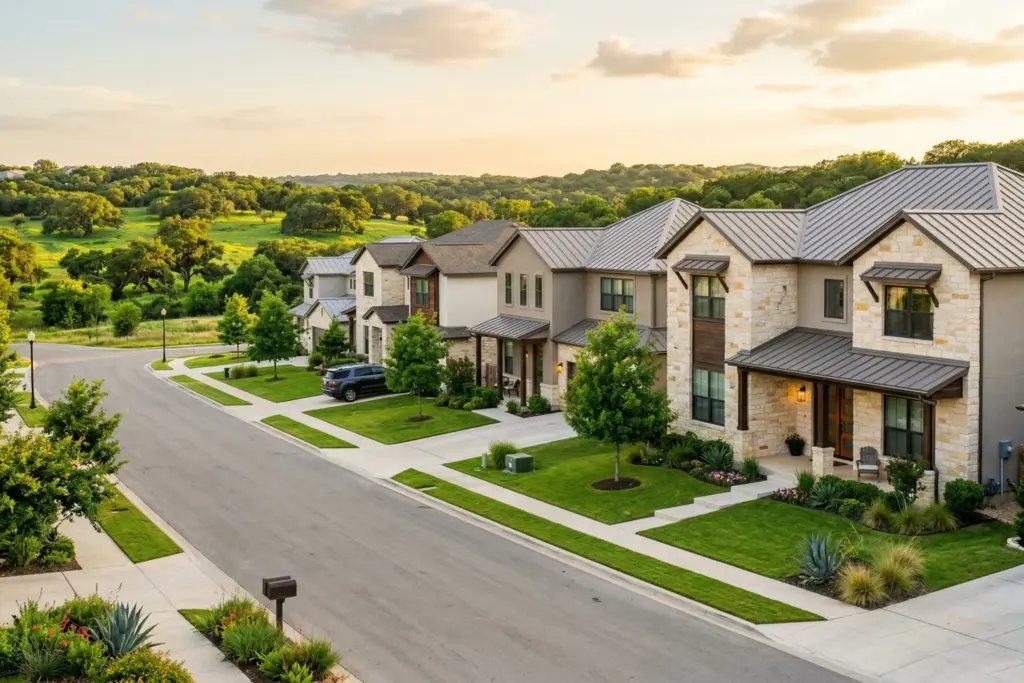
There are 3,552 new construction homes actively listed for sale across the Austin metro as of March 2026, with a median price of $411,000 and builder incentive packages averaging $10,000 to $30,000. That represents roughly one out of every four homes on the market right now. According to the Texas Real Estate Research Center, the Austin-Round Rock metro authorized 27,438 residential building permits in 2025, and The Pew Charitable Trusts reported in March 2026 that Austin’s construction surge has been one of the most aggressive in the country.
Whether you are comparing production builders in Kyle or spec homes in Dripping Springs, buying new construction is a different process than buying a resale home. The contracts are different, the negotiation leverage is different, the timeline is different, and the mistakes buyers make tend to be more expensive. This guide covers every angle: the builders, the communities, the contracts, the upgrades, the warranties, and the strategy that separates a good new construction purchase from a regrettable one.
Austin New Construction Market Snapshot: March 2026
The numbers tell a clear story. New construction makes up about 26% of all active residential listings in the Austin metro, according to MLS data tracked by Neuhaus Realty Group. That is a much larger share than the national average, and it gives buyers meaningful leverage at the design center and the negotiating table.
Here is how those 3,552 listings break down by price:
| Price Range | Active Listings | Share of Market |
|---|---|---|
| Under $300,000 | 800 | 22.5% |
| $300,000 to $400,000 | 924 | 26.0% |
| $400,000 to $500,000 | 555 | 15.6% |
| $500,000 to $600,000 | 364 | 10.2% |
| $600,000 to $750,000 | 332 | 9.3% |
| $750,000 to $1,000,000 | 285 | 8.0% |
| Over $1,000,000 | 292 | 8.2% |
Nearly half of all new construction inventory sits below $400,000, concentrated in communities east and north of Austin proper. The luxury segment above $750,000 still accounts for more than 16% of available new builds, with custom and semi-custom homes in areas like Dripping Springs, Leander, and Liberty Hill driving those numbers.
The Austin-Round Rock metro ranked sixth in the nation for new residential building permits in 2024 (32,294 units authorized) and held the ninth spot in 2025, according to the St. Louis Federal Reserve’s FRED database. That pipeline is massive, and it is the reason buyers have so much negotiating power with builders right now.
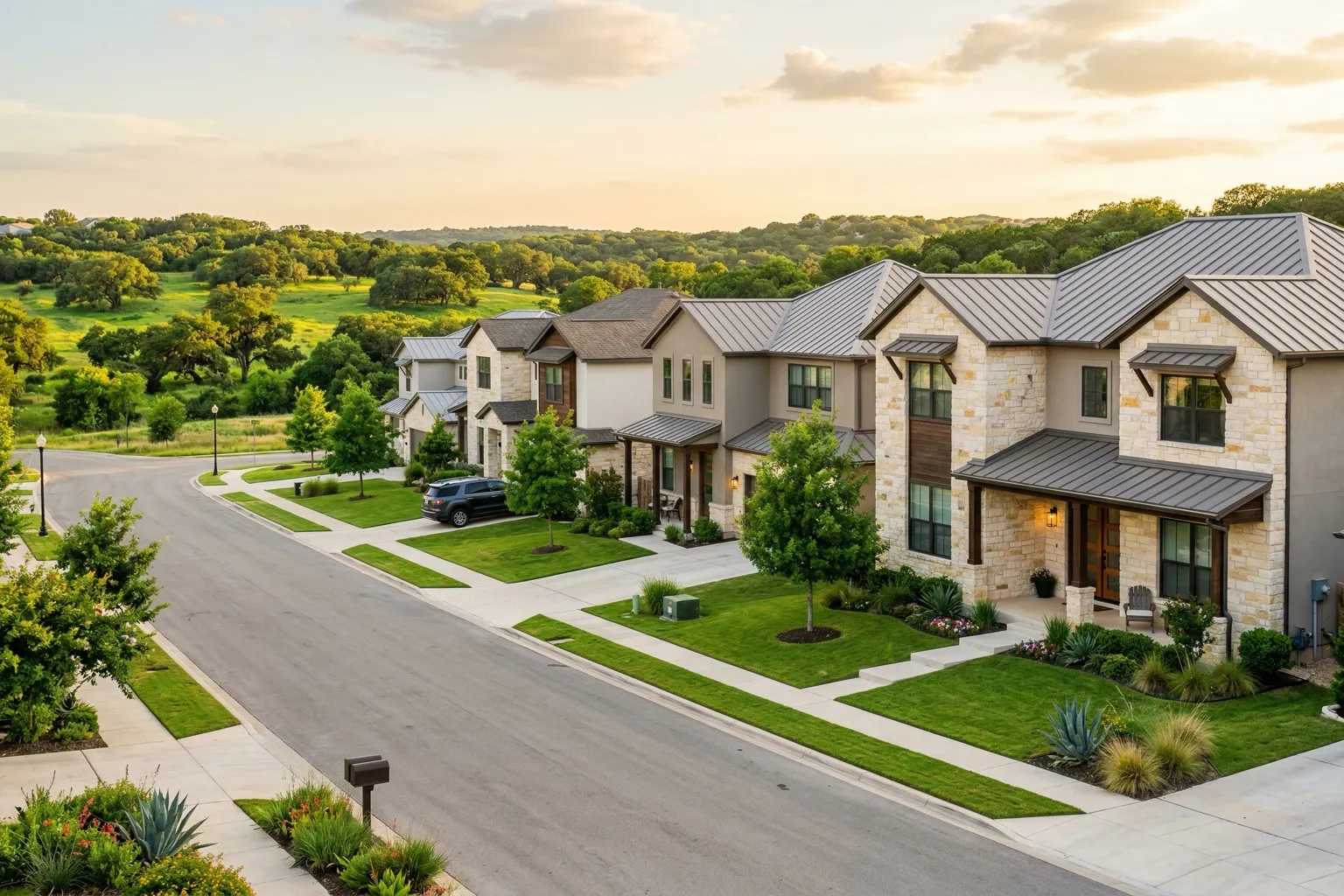
Where New Homes Are Being Built: Top Cities and Communities
New construction is not evenly distributed across the metro. Some cities have hundreds of active new builds. Others have a handful. The location you choose determines your builder options, your price range, your commute, and your school district.
| City | Active New Builds | Median Price | Notable Communities |
|---|---|---|---|
| Austin | 469 | $639,000 | Easton Park, Whisper Valley, Mirador |
| Georgetown | 351 | $579,000 | Wolf Ranch, Parmer Ranch, Parkside on the River |
| Kyle | 261 | $330,000 | 6 Creeks, Plum Creek |
| Liberty Hill | 241 | $590,000 | Santa Rita Ranch, Lariat |
| Hutto | 198 | $371,000 | Flora, Prairie Winds, Cotton Brook |
| Leander | 156 | $635,000 | Travisso, Crystal Falls |
| Elgin | 148 | $300,000 | Trinity Ranch, Briarwood |
| Pflugerville | 135 | $388,000 | Meadowlark Preserve |
| Dripping Springs | 84 | $531,000 | Heritage, Caliterra, Headwaters |
| Round Rock | 94 | $400,000 | Avery Centre |
A few patterns are worth calling out. Kyle and Elgin offer the lowest entry points, with median new construction prices at $330,000 and $300,000 respectively. If you are a first-time buyer stretching to get into a new home, those two cities are where the math works best.
Liberty Hill and Leander, on the other hand, skew much higher. Santa Rita Ranch alone accounts for 84 active new construction listings in Liberty Hill, with an average price near $666,000. These are not starter homes. They are large-lot, semi-custom builds in master-planned communities targeting move-up buyers.
For Hill Country buyers looking west of Austin, Dripping Springs has 84 active new builds with a median near $531,000. The Heritage community leads that market with 41 listings. See the full Dripping Springs new construction guide for community-by-community pricing.
Top Builders in the Austin Metro: Who Is Building What
Twenty different builders have 40 or more active listings in the Austin MLS right now. That is an enormous amount of competition for your business, and smart buyers use it. Here are the biggest players, ranked by current inventory:
| Builder | Active Listings | Avg. Price | Market Position |
|---|---|---|---|
| Lennar | 397 | $292,000 | Entry-level, everything included |
| Meritage Homes | 160 | $364,000 | Energy efficiency focus |
| Perry Homes | 160 | $657,000 | Premium production, Texas stalwart |
| DR Horton | 146 | $340,000 | Volume builder, value pricing |
| Taylor Morrison | 103 | $489,000 | Design-forward, midrange |
| Pulte Homes | 98 | $461,000 | Life-tested floor plans |
| M/I Homes | 95 | $483,000 | Customization options |
| Century Communities | 92 | $341,000 | Affordable new homes |
| Coventry Homes | 83 | $661,000 | Semi-custom, premium lots |
| Brohn Homes | 77 | $296,000 | First-time buyer specialist |
| Westin Homes | 75 | $698,000 | Luxury production |
| Highland Homes | 75 | $627,000 | Texas luxury tradition |
| Chesmar Homes | 68 | $546,000 | Personal touch midrange |
| David Weekley Homes | 57 | $553,000 | Build-on-your-lot options |
| Drees Custom Homes | 54 | $945,000 | True semi-custom builds |
| Ashton Woods | 49 | $417,000 | Award-winning design |
| Scott Felder Homes | 46 | $659,000 | Austin-born, Hill Country focus |
For the full list of builders with profiles, floor plans, and community maps, visit the Austin Home Builders Directory.
Notice the spread. Lennar’s average listing price is $292,000. Drees Custom Homes averages $945,000. Same metro, same market, completely different product. Understanding where each builder sits on the spectrum helps you narrow your search before you ever walk into a model home.
Builder Tiers Explained
Not all builders operate the same way. The industry breaks into three categories, and the buying experience differs significantly across them.
Production builders (Lennar, DR Horton, Meritage, Century Communities, Brohn) build homes from a set menu of floor plans. You pick a plan, you pick a lot, you select finishes from a predetermined options list. The upside: lower cost per square foot ($130 to $200), faster build times (8 to 10 months), and often the most aggressive incentive packages because these builders need volume. The downside: limited customization, and you will share your floor plan with your neighbor down the street.
Semi-custom builders (Perry Homes, Taylor Morrison, Coventry, Highland, Chesmar, David Weekley, Drees) start with a base floor plan but allow meaningful modifications. Moving walls, expanding rooms, adding a covered patio, choosing cabinet styles that go beyond the standard three options. Cost per square foot runs $200 to $275, and build times stretch to 10 to 14 months. This is where most move-up buyers in the Austin market land.
Custom builders (Drees at the higher end, plus dozens of smaller local firms) build from scratch. You bring plans from an architect, or work with the builder’s design team to create something from a blank page. Expect $275 to $350 or more per square foot in Austin, with build times of 12 to 18 months after a 2 to 4 month design and permitting phase. A 3,500 square foot custom home in the Hill Country will typically run $1.2 million to $1.8 million all in, including the lot.
Builder Incentives: What Is on the Table Right Now
This is where 2026 gets interesting for buyers. Builders across the Austin metro are sitting on significant inventory, and they are spending money to move it. The typical incentive package right now ranges from $10,000 to $30,000, but some builders are going well beyond that on homes that have been sitting for 60 or more days.
Common incentive types include:
- Interest rate buydowns. The most valuable incentive in a 6% rate environment. Many builders offer 1 to 2 percentage points below market rate through their preferred lender, which can reduce a monthly payment by $300 to $600 on a $450,000 home. Some offer temporary buydowns (lower rate for the first 1 to 3 years) while others offer permanent buydowns.
- Closing cost credits. Flat dollar amounts ($5,000 to $20,000) applied toward closing costs. Often contingent on using the builder’s preferred lender and title company.
- Design center allowances. Free upgrades at the design center, typically $5,000 to $15,000 worth. This might cover upgraded countertops, better flooring, or additional fixtures.
- Lot premium waivers. Some builders waive the $5,000 to $25,000 lot premium on less desirable lots (backing to a road, smaller backyards) to make the overall number work.
- Price reductions on completed inventory. Spec homes (already built, never occupied) often carry the steepest discounts, sometimes $20,000 to $50,000 off, because the builder is paying carrying costs every month that home sits empty.
A critical note: most builder incentives are contingent on using the builder’s preferred lender and title company. Before you assume those incentives are free money, compare the total cost. The preferred lender’s rate may be higher than what you could get on the open market, and the title company fees may be inflated. Run the math both ways. Sometimes keeping your own lender and forgoing the incentive actually saves you money.
For a deeper look at how tariffs are affecting new construction costs, see how tariffs could make your Austin new build more expensive.
Production Homes vs. Semi-Custom vs. Custom: Choosing Your Path
The decision between production, semi-custom, and custom comes down to three factors: budget, timeline, and how much you care about making the house uniquely yours.
| Factor | Production | Semi-Custom | Custom |
|---|---|---|---|
| Cost per sq ft | $130 to $200 | $200 to $275 | $275 to $350+ |
| Build time | 8 to 10 months | 10 to 14 months | 14 to 22 months |
| Floor plan flexibility | Choose from menu | Modify base plan | Start from scratch |
| Design selections | 3 to 5 packages | Wide range | Unlimited |
| Builder incentives | Aggressive ($10K to $30K) | Moderate ($5K to $15K) | Rare |
| Typical price (2,500 sq ft) | $325,000 to $500,000 | $500,000 to $687,000 | $687,000 to $875,000+ |
| Best for | First-time buyers, value seekers | Move-up buyers, specific needs | Luxury, unique requirements |
One thing that trips up buyers: they assume “semi-custom” means “basically custom.” It does not. A semi-custom builder gives you structural modification options within limits. Want to extend the primary bedroom by four feet? Probably doable. Want to completely reimagine the kitchen layout? That is custom territory, and you are going to pay a custom price.
Master-Planned Communities Worth Knowing About
Austin’s master-planned communities account for the majority of new construction activity. Each one has a personality, a price point, and a set of trade-offs worth understanding.
Santa Rita Ranch (Liberty Hill)
The biggest new construction community in the metro with 84 active listings. Builders include Perry Homes, Taylor Morrison, Highland Homes, and Chesmar. Average price: $666,000. Located in Liberty Hill ISD and Georgetown ISD (Source). The community has resort-style amenities, a working ranch atmosphere, and large lot sizes. This is where buyers who want space and a sense of community are landing.
Easton Park (Southeast Austin)
A 2,700-acre development just 12 miles from downtown Austin. When complete, it will include over 12,000 homes and 350 acres of park space. Current builders include David Weekley, Meritage, Perry Homes, and Taylor Morrison, with prices ranging from the $300,000s to the $700,000s. Del Valle ISD. The draw: proximity to downtown with master-planned amenities at a lower price point than anything west of I-35.
Travisso (Leander)
A 2,100-acre community in northwest Austin with builders including Drees, Highland Homes, Taylor Morrison, and Toll Brothers. Prices range from the mid-$300,000s to the upper $800,000s with over 80 floor plans available. Leander ISD. The Palazzo Clubhouse, a 2,000 square foot fitness center, resort pool, tennis courts, and miles of trails make this one of the most amenity-rich communities in the metro.
Whisper Valley (East Austin)
The sustainability play. A 2,063-acre community offering net-zero-capable energy homes with on-site organic farming and over 700 acres of open space. Homes start just over $300,000. Del Valle ISD (a new high school opened in 2026). Named Austin’s Master-Planned Community of the Year by the Home Builders Association of Greater Austin. If your energy bill matters as much as your mortgage payment, this community is worth a look.
Wolf Ranch (Georgetown)
Georgetown’s flagship new construction community with 48 active listings and an average price near $675,000. Georgetown has become one of the hottest new construction markets in the metro, with 351 total new builds available. Georgetown ISD is one of the top-rated districts in the region.
Heritage (Dripping Springs)
The Hill Country option. Heritage leads Dripping Springs new construction with 41 active listings and an average price of $492,000. Dripping Springs ISD. This is where buyers who want Hill Country character without the full custom price point are gravitating. Rolling terrain, mature trees, and a small-town feel that is increasingly hard to find as Austin expands.
The New Construction Buying Process: Step by Step
Buying a new construction home does not follow the same playbook as buying a resale. The timeline is longer, the contract is different, and the negotiation dynamics are different. Here is the process from start to finish.
Step 1: Get Pre-Approved (Before You Visit a Model Home)
This is non-negotiable. Builders will not take you seriously without a pre-approval letter, and their on-site sales agents are trained to push you toward the builder’s preferred lender before you have a chance to shop rates. Get your own pre-approval first, then compare it to what the builder’s lender offers. You want leverage, not a sales pitch.
Step 2: Bring Your Own Agent
Here is something most buyers do not realize: if you walk into a builder’s sales center without an agent, the builder’s on-site sales agent represents the builder. Not you. They are paid by the builder to sell homes at the highest possible price with the fewest concessions.
An independent buyer’s agent costs you nothing extra (the builder pays the commission either way), and they bring experience negotiating builder contracts, identifying red flags in the construction timeline, and pushing back on unfavorable terms. The first time you visit a new community, register your agent’s name at the sales office. Most builders require this on the first visit or they will not honor the agent relationship later.
Step 3: Choose Your Community and Lot
Lot selection in a new construction community is more important than most buyers realize. Here is what to evaluate:
- Lot premium. Corner lots, cul-de-sac lots, and lots backing to green space carry premiums of $5,000 to $25,000 or more. Lots backing to a commercial area or main road may have negative premiums (discounts).
- Orientation. In Texas, a west-facing backyard means brutal afternoon sun from May through October. A covered patio helps, but an east or north-facing backyard is cooler and more usable.
- Drainage. Check the plat map for drainage easements. If your lot sits at the low point of the street, you will collect everyone else’s runoff during heavy rain.
- Future phases. What is currently a wooded buffer behind your lot may be Phase 3 of the development in two years. Ask the builder for the master plan showing all future phases.
Step 4: Select Your Floor Plan and Structural Options
Structural options (room extensions, additional bathrooms, garage configurations, covered patios) must be chosen before construction begins. These cannot be added later without significant expense. Design selections (countertops, flooring, fixtures, paint) happen at the design center later in the process.
Priority structural options to consider:
- Extended covered patio (you will use it more than you think in Austin’s climate)
- Pre-plumbing for a future outdoor kitchen
- Media room pre-wire
- Enlarged garage (going from a 2-car to a 3-car garage during construction adds $15,000 to $25,000; doing it after construction costs three to five times that)
- Additional windows or upgraded window packages (natural light sells homes at resale)
Step 5: Sign the Builder’s Contract
Builder contracts are not the standard Texas Real Estate Commission (TREC) residential purchase contracts used in resale transactions. They are proprietary documents written by the builder’s attorneys, and they heavily favor the builder.
Key differences from a standard resale contract:
- No option period. Most builder contracts do not include the standard Texas option period. Once you sign and put down earnest money, your exit options are limited.
- Escalation clauses. Some contracts allow the builder to increase the price if material costs rise during construction. Read the fine print carefully.
- Completion timeline. Builders typically provide an estimated completion date, not a guaranteed one. Delays of 30 to 90 days are common and usually not a breach of contract.
- Earnest money. Builder earnest money requirements are often higher than resale ($5,000 to $10,000 or more) and may not be fully refundable.
- Binding arbitration. Many builder contracts require disputes be resolved through arbitration rather than litigation. This limits your legal options.
Have your agent and a real estate attorney review the builder contract before you sign. This is not optional.
Step 6: Design Center Selections
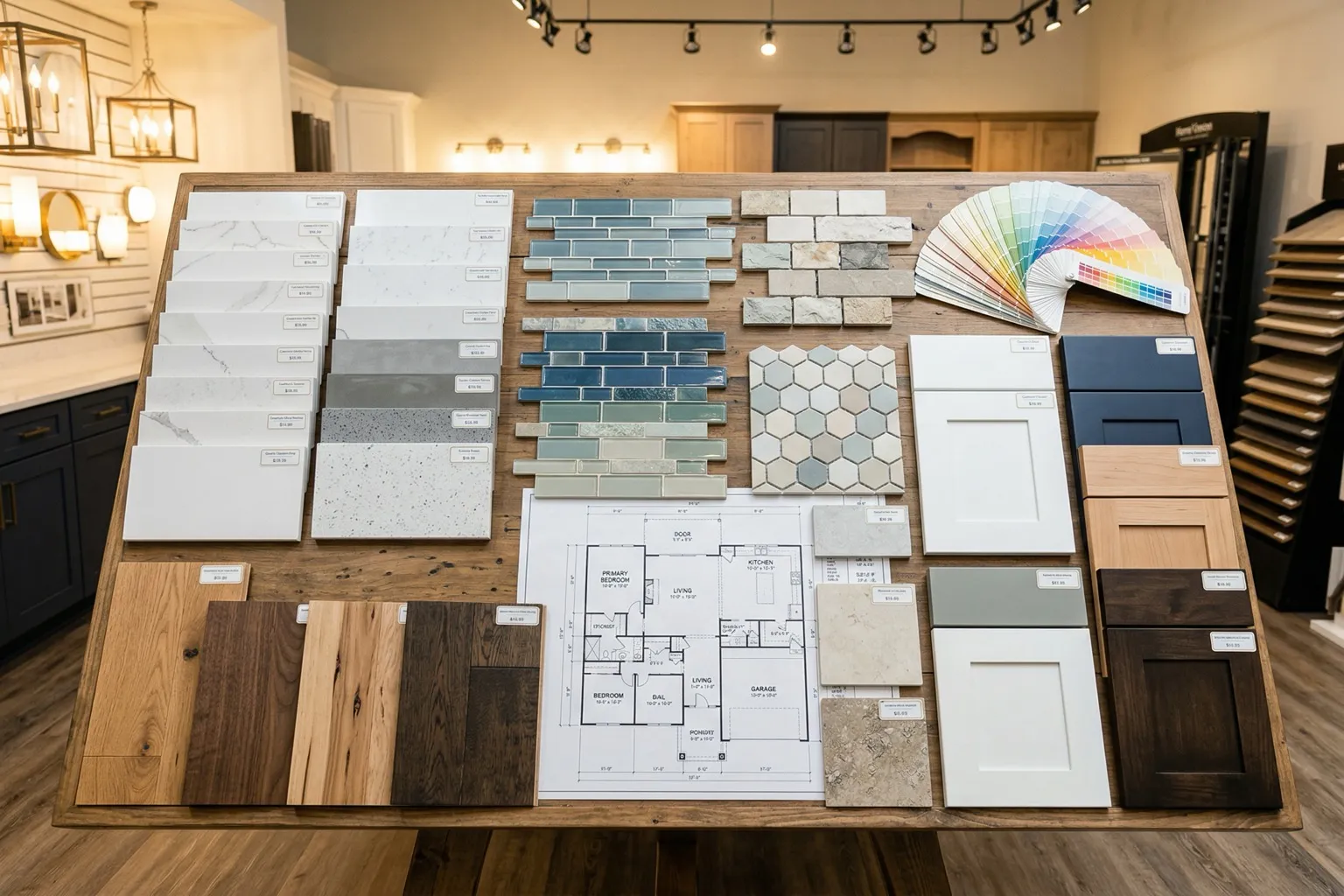
The design center appointment happens 4 to 8 weeks after contract execution. This is where you choose your finishes: countertops, cabinets, flooring, tile, fixtures, paint colors, and more. A few survival tips:
- The design center exists to upsell. Set a budget before you walk in and do not exceed it.
- The “standard” option is almost always the lowest quality. Budget to upgrade at least countertops and primary areas flooring.
- Some upgrades are hard to add later (electrical rough-ins, plumbing locations, structured wiring). Prioritize those.
- Other upgrades are easy to add after closing for less money (light fixtures, backsplash tile, landscaping). Skip those at the design center.
Step 7: Construction Phase Inspections
This is where most new construction buyers make their biggest mistake: they skip independent inspections during the build.
A builder’s municipal inspections are code minimum. They verify the house will not fall down and the plumbing will not leak. They do not verify quality of workmanship, and they do not catch the dozens of issues that an experienced construction inspector will find.
Schedule at least three independent inspections:
- Pre-pour (foundation). Before the concrete is poured, have an inspector verify rebar placement, post-tension cable layout, plumbing stub-outs, and soil preparation. Once concrete is poured, problems become very expensive to fix.
- Pre-drywall (framing). After framing, electrical, plumbing, and HVAC rough-in are complete but before drywall goes up. This is your only chance to see the guts of the house. Missing fire blocking, incorrect HVAC duct sizing, and plumbing errors are all common finds.
- Final inspection (before closing). A full home inspection just like you would order on a resale home. Check everything from the roof to the foundation, HVAC performance, appliance installation, and cosmetic defects.
Each inspection costs $300 to $600. Total investment: about $1,200. On a $450,000 home, that is 0.27% of the purchase price. Cheap insurance. For more detail on what inspectors look for in the Austin area, read the Austin home inspection checklist.
Upgrades Worth Paying For (and Upgrades to Skip)
The design center is where builders make a significant portion of their profit margin. Knowing which upgrades add value and which are pure margin for the builder will save you thousands.
Upgrades Worth the Money
- Structural upgrades. Anything that changes the bones of the house (covered patio extensions, additional garage bay, room extensions, pre-plumbing for outdoor kitchen). These are impossible or absurdly expensive to add later.
- Kitchen countertops. The kitchen is the first thing buyers notice at resale. Upgrading from builder-grade laminate to quartz or granite ($3,000 to $8,000) pays for itself.
- Primary areas flooring. Upgrading main living area flooring from carpet or basic vinyl to engineered hardwood or luxury vinyl plank ($2,000 to $6,000 for main areas) is worthwhile. Do not bother upgrading secondary bedrooms or closets.
- Electrical and data rough-ins. Additional outlets in the kitchen, USB outlets in bedrooms, ethernet drops to the home office, and pre-wire for surround sound. Once drywall is up, adding these means cutting into walls.
- Water softener loop. Austin’s water is notoriously hard. A water softener loop costs $200 to $500 during construction and lets you add a softener system anytime. Retrofitting after construction costs five times more.
- Upgraded HVAC. Going from a 14-SEER to a 16-SEER or higher unit pays for itself within a few years through lower energy bills in Austin’s extreme heat. The upgrade is typically $1,500 to $3,000.
Upgrades to Skip at the Design Center
- Light fixtures. Builder markup on light fixtures is typically 40% to 60%. Buy your own from a lighting showroom or online retailer and have an electrician install them after closing for a fraction of the cost.
- Backsplash tile. Another high-markup item. A local tile installer will do it for less with better selection.
- Blinds and window treatments. Builder pricing on blinds is consistently 30% to 50% above what you would pay from a direct retailer.
- Landscaping beyond the minimum. Most builders offer basic landscaping packages that are overpriced for what you get. A local landscaper will do the same work for less and with more design flexibility.
- Appliance upgrades. Unless you are getting a significant bundle discount, appliance prices at the design center are typically at or above retail. Wait for holiday sales and buy your own.
Understanding Texas New Construction Warranties
Texas does not require builders to provide a statutory warranty on new homes. The state’s residential construction warranty law expired in 2009 when the Texas Residential Construction Commission was abolished, so warranty coverage today is a matter of contract and industry practice (Source). Most Austin builders still voluntarily follow the same tiered 1-2-10 structure the old law used:
| Coverage Type | Duration | What It Covers |
|---|---|---|
| Workmanship | 1 year | Paint, caulking, drywall cracks, trim, grout, doors, windows not operating properly |
| Distribution Systems | 2 years | Plumbing, electrical, HVAC, and mechanical systems |
| Structural | 10 years (industry standard, not a legal requirement) | Foundation, load-bearing walls, roof structure, floor systems, beams, columns |
That structural warranty matters more in Texas than almost anywhere else. According to the 2-10 Home Buyers Warranty organization, Texas home foundations fail at a rate 10 times higher than the national average. The expansive clay soils common throughout Central Texas swell when wet and shrink when dry, putting constant stress on foundations. This is not a scare tactic. It is geology.
During year one, document everything. Every crack in the drywall, every door that does not close properly, every faucet that drips. Submit a comprehensive warranty claim at the 11-month mark (most builders call this the “11-month walkthrough”). After the one-year workmanship warranty expires, you lose the ability to claim cosmetic and minor issues.
Third-Party Warranty vs. Builder’s Own Warranty
Some builders provide warranty coverage through a third-party warranty company (2-10 Home Buyers Warranty, StrucSure, HOME of Texas). Others self-insure. Third-party warranties provide an additional layer of protection if the builder goes out of business or refuses to honor claims. Always ask which type of warranty your builder offers and get the warranty documentation in writing before closing.
The Builder Contract: What to Watch For
The single most important document in a new construction purchase is the builder contract. It is not a TREC form. It is a proprietary document, sometimes 30 to 50 pages long, drafted by attorneys whose job is to protect the builder.
Red flags to watch for:
- Material substitution clauses. Some contracts allow the builder to substitute “equivalent” materials without your approval. Push to require written notice and buyer consent for any material changes.
- Price adjustment clauses. In a tariff and inflation environment, some builders have added clauses allowing base price increases if material costs rise by a certain percentage. Know what your cap is and whether you can cancel if the price increases beyond a threshold.
- Completion date language. “Estimated completion” is not “guaranteed completion.” If you need to move by a specific date, negotiate a guaranteed completion clause with penalties for builder delay (and be prepared for the builder to say no).
- Earnest money forfeiture. Many builder contracts state that if you cancel for any reason other than financing denial, you forfeit all earnest money. On a $10,000 deposit, that is significant.
- Mandatory arbitration. Most builder contracts include binding arbitration clauses. This is not necessarily bad, but you should understand that it limits your ability to pursue legal remedies in court.
- HOA obligations. In a master-planned community, the builder typically controls the HOA until a certain percentage of lots are sold. This means the builder sets the initial HOA dues, reserves, and governing documents. Ask what the projected HOA dues will be once the community is fully built out.
MUDs, PIDs, and Special Taxing Districts
Many new construction communities in the Austin metro are located within Municipal Utility Districts (MUDs) or Public Improvement Districts (PIDs). These special taxing districts fund infrastructure (roads, water, sewer, drainage) that the developer needed to build the community.
The tax impact is real. A MUD or PID assessment can add 0.5% to 1.5% to your effective property tax rate on top of the standard county and school district taxes. On a $450,000 home, that translates to an additional $2,250 to $6,750 per year.
Always ask the builder or your agent whether the community is in a MUD or PID, and what the current assessment rate is. Some MUDs have a defined “sunset” date when the bonds will be paid off and the assessment drops. Others do not. For a deeper explanation, see how MUD and PID districts affect your property tax bill.
New Construction vs. Resale: The Real Trade-Offs
The decision between new construction and a resale home is not as straightforward as “new is better.” Each path has distinct advantages, and the right choice depends on your priorities.
New construction wins on:
- Energy efficiency (modern insulation, windows, HVAC systems cut utility bills 20% to 40% compared to homes built before 2015)
- Warranty coverage (1 to 10 years vs. buying “as-is” or with a home warranty that may not cover much)
- Customization (choose your finishes, floor plan modifications, structural options)
- Builder incentives ($10,000 to $30,000 in current market conditions)
- Lower immediate maintenance costs (everything is new, nothing needs replacing for years)
Resale wins on:
- Established neighborhoods with mature landscaping and known character
- Often better school zoning (many new communities feed into newer, unproven campuses)
- Larger lots in central locations (infill new construction lots are typically smaller)
- Faster move-in timeline (buy today, close in 30 to 45 days vs. 8 to 18 months for new builds)
- No MUD/PID taxes (older neighborhoods have paid off their infrastructure bonds)
- Location (the best locations in Austin were developed decades ago)
For a detailed side-by-side comparison specific to the Hill Country market, see new construction vs. existing homes in the Hill Country.
Financing a New Construction Home
Financing new construction adds complexity that resale purchases do not have. The loan type and timing depend on whether you are buying a completed spec home or building from a dirt lot.
Completed Spec Homes
If the home is already built and ready for occupancy, the financing works exactly like a resale purchase. Standard conventional, FHA, VA, and USDA loans all apply. This is the simplest path and the one with the least risk.
Homes Under Construction (To-Be-Built)
For homes that have not yet been completed, most buyers use a construction-to-permanent loan. This starts as a construction loan during the build phase (often interest-only payments) and converts to a standard mortgage once the certificate of occupancy is issued.
Important financing considerations:
- Rate lock timing. If you lock your rate at contract signing and the build takes 10 months, your rate lock may expire before closing. Ask your lender about extended rate lock options (typically 9 to 12 months) and what the cost is. Builder preferred lenders often offer longer locks as part of their incentive package.
- Appraisal risk. The home will be appraised before closing. If the builder raised the price or you added significant upgrades, the appraisal may not support the purchase price. Have a plan for this scenario.
- Builder’s preferred lender. Compare total cost (rate, fees, closing costs) between the builder’s lender and two to three outside lenders. The incentive package may make the builder’s lender cheaper even at a slightly higher rate. Or the rate gap may be large enough that an outside lender saves money despite losing the incentive. Run the numbers both ways.
For comprehensive mortgage guidance including loan type comparisons and Austin-specific lender programs, visit the complete guide to getting a mortgage in Austin.
The Tariff Factor: How Trade Policy Affects Your New Build Price
This is a 2026-specific concern that did not exist a few years ago. Tariffs on imported building materials (lumber, steel, aluminum, appliances, and other components) have increased construction costs across the board. According to the National Association of Home Builders, the impact adds $7,500 to $15,000 to the cost of a typical new home, depending on materials used and home size.
The good news: homes currently in inventory or under construction were largely purchased with pre-tariff materials. Builders who bought ahead have not yet passed those costs through. But new contracts signed in late 2026 and 2027 will increasingly reflect higher material costs.
Ed Neuhaus, broker of Neuhaus Realty Group, points out that buyers purchasing completed spec homes or homes already under construction are essentially buying at pre-tariff pricing with post-tariff incentives. That combination is unusually favorable and may not last. For a full analysis, see how tariffs could make your Austin new build more expensive.
School Districts in New Construction Areas
School district quality varies dramatically across Austin’s new construction hotspots. This matters even if you do not have school-age children, because school district ratings directly affect resale value.
| City/Area | School District | Rating | Notes |
|---|---|---|---|
| Dripping Springs | Dripping Springs ISD | A-rated | Rapidly growing, new campuses opening |
| Georgetown | Georgetown ISD | A-rated | Consistently top-ranked |
| Liberty Hill | Liberty Hill ISD | B-rated | Growing fast, adding capacity |
| Leander | Leander ISD | A-rated | Large district, many campuses |
| Pflugerville | Pflugerville ISD | B-rated | Diverse, improving scores |
| Hutto | Hutto ISD | B-rated | Rapid growth, new schools |
| Kyle | Hays CISD | B-rated | Affordable area, steady improvement |
| Elgin | Elgin ISD | C-rated | Lowest rated among new construction areas |
| Southeast Austin | Del Valle ISD | C-rated | New high school opened 2026 |
For Hill Country buyers specifically, see the comparison of Eanes, Lake Travis, and Dripping Springs ISD.
Common Mistakes New Construction Buyers Make
After years of helping buyers through the new construction process in Central Texas, certain patterns emerge. These are the mistakes that come up again and again.
1. Walking Into the Sales Center Without an Agent
The builder’s sales agent is friendly. They offer you coffee. They know the floor plans inside and out. And they work for the builder, not for you. Once you sign in at the sales center without an agent, many builders will refuse to honor an agent relationship later. Always bring your agent to the first visit or register their name before you walk in the door.
2. Falling in Love with the Model Home
Model homes are professionally staged with every upgrade, custom lighting, and expensive furnishings. The base model you are actually buying looks nothing like it. Always ask for the base spec sheet so you know exactly what is included at the listed price and what costs extra.
3. Skipping Independent Inspections
“It is new, so it does not need an inspection.” Wrong. New homes can have just as many issues as older homes, sometimes more, because the trades (plumbing, electrical, HVAC, framing) are often subcontracted to the lowest bidder and working on tight timelines. The pre-pour, pre-drywall, and final inspections discussed earlier in this guide are not optional if you want to protect your investment.
4. Ignoring the Resale Value of the Lot
Saving $15,000 on a lot that backs to a retention pond or a busy road feels good at contract signing. It feels significantly less good when you try to sell five years later and that lot discount becomes a permanent price penalty. The best lots (backing to green space, on cul-de-sacs, with no rear neighbors) command premiums for a reason.
5. Not Budgeting for Post-Close Expenses
A new construction home does not come move-in ready in the way most buyers expect. You will need landscaping (the builder provides sod and basic shrubs, nothing more), window treatments, a fence ($6,000 to $15,000 depending on lot size), possibly a patio or deck extension, and all the items the builder considered “not included.” Budget an additional $10,000 to $30,000 for move-in expenses beyond closing costs.
6. Not Understanding the MUD or PID Tax Impact
This one catches so many buyers off guard. The sales agent quotes you a monthly payment based on the base property tax rate. Then your first tax bill arrives and it is $2,000 to $5,000 higher than expected because of the MUD or PID assessment. Always ask about special districts and factor the full tax burden into your budget.
Timeline: From First Visit to Moving In
Buying a Completed Spec Home
30 to 60 days from contract to close. The fastest path into a new home. The home is built, inspected, and ready for occupancy. You still have time for a final inspection and appraisal.
Buying a Home Under Construction
3 to 8 months remaining, depending on where in the build process you are entering. Buying during framing gives you some design center flexibility. Buying after drywall means you are inheriting whatever selections the builder made for the spec.
Building from a Dirt Lot (Production)
8 to 12 months. This includes lot preparation, foundation pour, framing, rough-in (electrical, plumbing, HVAC), drywall, finishes, and final inspections. Add 4 to 6 weeks of buffer for weather delays, material shortages, and permit processing.
Building Semi-Custom or Custom
12 to 22 months. Add 2 to 4 months of pre-construction for design development, engineering, and permitting. Custom homes in the Hill Country often take longer due to topography, rock removal, and well/septic requirements.
A note on delays: they are normal. A 30-day delay on a new construction home is not unusual. A 90-day delay is frustrating but not uncommon. Builders are juggling subcontractor schedules, material deliveries, and municipal inspections across dozens or hundreds of homes simultaneously. Plan accordingly and do not schedule your lease termination for the exact estimated completion date.
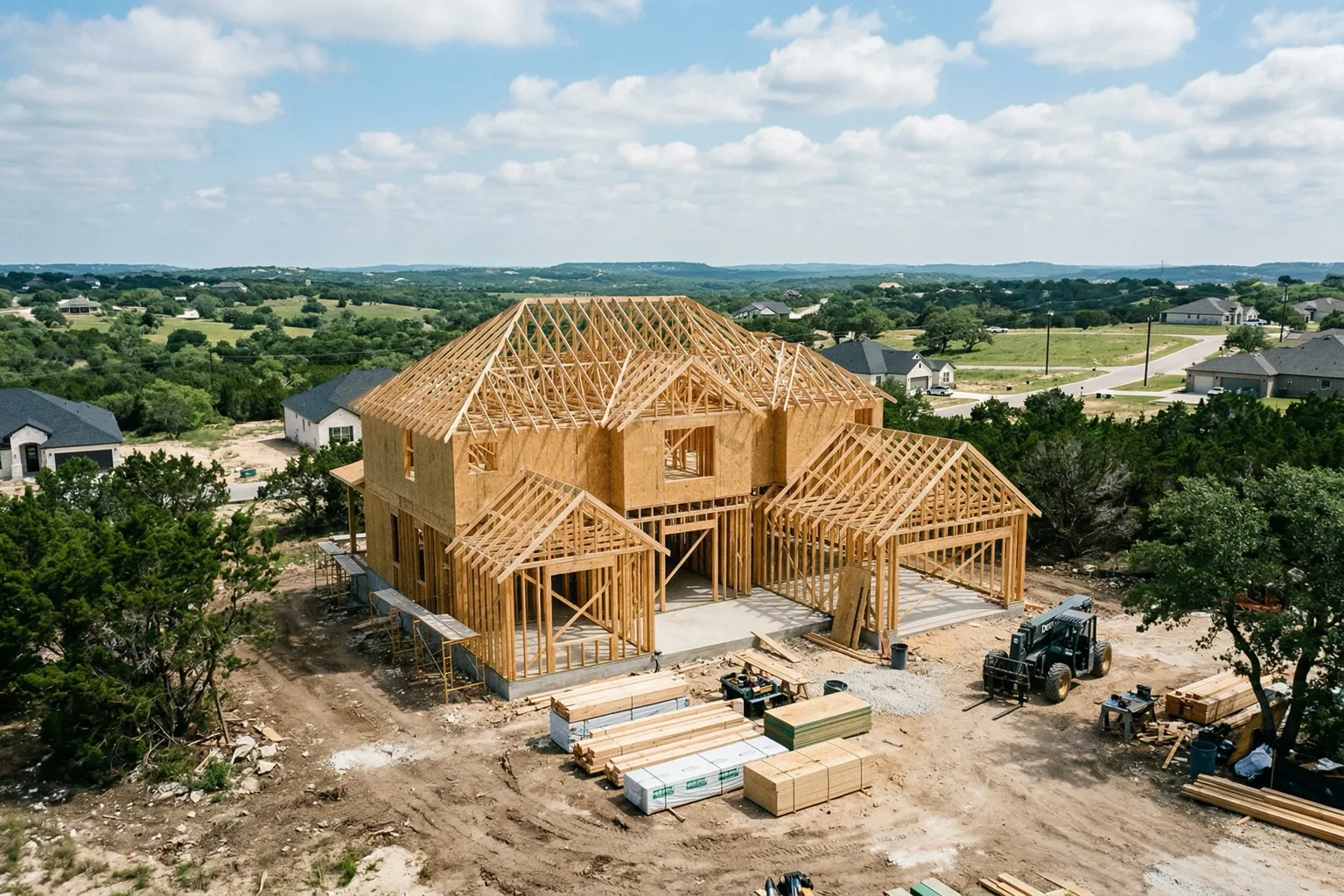
Working with Neuhaus Realty Group on New Construction
For buyers exploring new construction in the Austin metro and Hill Country, working with an agent who knows the builder landscape makes a real difference. Neuhaus Realty Group covers new construction communities across West Austin, Bee Cave, Lakeway, Dripping Springs, and the broader metro, with direct relationships with the builders operating in those markets.
A knowledgeable buyer’s agent does not just open doors. They know which builders are sitting on excess inventory (and therefore most likely to negotiate), which communities have MUD or PID assessments that will surprise you at tax time, which lot positions hold value at resale, and how to read a builder contract for the clauses that actually matter. That is the kind of detail that saves buyers real money.
Frequently Asked Questions
Getting Started
The Austin new construction market in 2026 offers a combination of high inventory, aggressive builder incentives, and pre-tariff pricing that may not last. Whether you are a first-time buyer eyeing a $300,000 Lennar in Kyle or a move-up buyer comparing semi-custom options in Santa Rita Ranch, the fundamentals are the same: bring your own agent, get independent inspections, understand the MUD or PID tax impact, and run the math on the builder’s incentive package before assuming it is the best deal available.
For community tours, builder comparisons, or contract review on any new construction home in the Austin metro, reach out to Neuhaus Realty Group. The team covers new construction communities across Bee Cave, Lakeway, Dripping Springs, and the greater Austin area.


