 Ed Neuhaus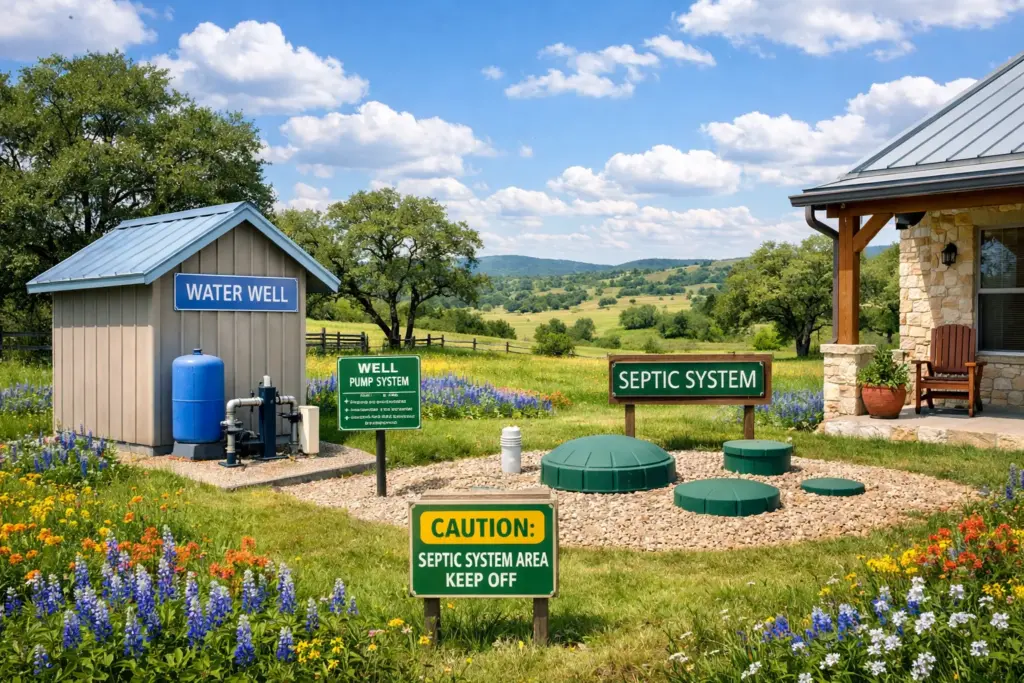
I had a buyer a few years back who fell completely in love with a place in Wimberley. Five acres, a spring-fed creek, the kind of Hill Country property that makes you feel like you found something. They went under contract, paid for inspections, got excited. Then the well flow test came back at 0.4 gallons per minute.
For reference: you need at least 1 GPM for a lender to touch the property. A family of four is comfortable at 3-5 GPM. At 0.4, you are not watering your yard or filling your bathtub without rationing everything. It was not a bad house. It was not bad land. It was a water problem, and nobody caught it until we were deep in the option period.
Water and septic are the two things that consistently trip up Hill Country buyers who come from inside the Austin city limits or from out of state. In the suburbs you’re used to a water bill, a utility company, someone else managing the infrastructure. Out here? You are the infrastructure. Understanding what you are buying is not optional.
The Hill Country Is Not One Water Market
The first thing to understand is that there is no single “Hill Country water situation.” What applies in Bee Cave is completely different from what applies in Wimberley, and Dripping Springs has its own mix of utility service areas, municipal supply, and private wells depending on exactly where you are.
Roughly speaking, here is how water supply breaks down in the areas where we work:
City or Utility Water (MUD/WCID Districts)
Developed communities closer to Austin, including most of Bee Cave, Lakeway, and the larger master-planned communities in Dripping Springs, are served by either a city water system or a special utility district. In Lakeway, that’s the Lakeway Municipal Utility District. In parts of Bee Cave, it’s Travis County MUD 18 or one of several WCID (Water Control and Improvement District) entities. These function like a water company. You get a bill every month, rates are set by the district board, and the infrastructure is their problem.
MUD and WCID districts also carry a property tax component. It varies, but you’ll typically see an additional 0.05% to 0.35% of assessed value on your tax bill for your water district. That number matters when you’re comparing properties across different areas.
The water in these systems often comes from the Lower Colorado River Authority, which pulls surface water from the Highland Lakes chain. Lake Travis levels directly affect LCRA supply allocations to downstream utilities. When the lake drops, districts can trigger conservation restrictions and surcharges.
Private Wells
Get further out, and the properties are on private wells. Most of Wimberley is on well water. A substantial portion of rural Dripping Springs is on well water. Spicewood, Volente, most of the unincorporated Hill Country between towns. If you are buying on acreage or in a rural subdivision outside city limits, you are almost certainly looking at a well.
This is not inherently a problem. Plenty of Hill Country families have had the same well for thirty years with zero issues. But it requires due diligence that most buyers who grew up on city water have never done before.
The Aquifer Underneath You
The Hill Country sits on two primary aquifers: the Edwards Aquifer to the south and west, and the Trinity Aquifer to the north and central areas. Both are karst limestone systems, meaning water moves through fractures and channels in the rock rather than through soil. That affects two things. First, recharge can happen quickly after rain, which is good for long-term supply. Second, contamination can spread quickly too, because there’s nothing filtering it through layers of soil before it enters the aquifer.
Each part of the Hill Country is also governed by a Groundwater Conservation District (GCD). In our area, that’s most commonly the Hill Country Underground Water Conservation District or the Hays Trinity Groundwater Conservation District. These districts regulate well drilling, spacing requirements, and sometimes pumping rates. The rules differ by district. Before you buy, know which GCD covers the property and what restrictions apply.
What to Actually Do During Your Option Period: Wells
Ok, so the property has a well. Here is what you need to do before the option period expires.
The Flow Test
This is non-negotiable. A flow test pumps the well continuously for four hours and measures output in gallons per minute. It tells you the sustainable yield of that well under stress conditions, not just what the pump can pull out in five minutes on a good day.
1 GPM is the floor. Most lenders will not finance a property with less than that. A family of four living a normal life, running laundry, filling a tub, irrigating a modest garden, realistically needs 3-5 GPM to do it comfortably. 5+ GPM and you’re in good shape. Under 1 GPM and you have a negotiation on your hands, at minimum.
Costs for a flow test typically run $300-$600. Worth every dollar.
Water Quality Testing
A flow test tells you how much water you have. A lab test tells you what’s in it.
For Hill Country well water, a comprehensive panel should include at minimum: total coliform and E. coli, nitrate and nitrite (critical in rural areas with septic and agricultural activity), total dissolved solids, pH, hardness, iron, and manganese. In karst areas, I’d add arsenic and lead. An accredited lab test runs $100-$300 depending on what you’re testing for.
Don’t skip this. I’ve seen wells with elevated arsenic, wells with high iron that stains everything in the house, wells with bacteria from inadequate sanitary seals. Most of these problems are fixable with treatment systems. But you want to know about them before you own it.
The Physical Inspection
Hire a licensed well driller or pump specialist to look at the physical components. They’ll check the wellhead casing for cracks or deterioration, verify the sanitary seal is intact (the seal prevents surface water from entering the well casing), test the pump performance and pressure tank function, and note the static water level. That last one matters in drought years. If the static water level is already 200 feet below grade and there hasn’t been rain in six weeks, that tells you something about the well’s drought resilience.
While you’re at it, note how far the well is from the septic drain field. Texas state minimum is 50 feet, but 100 feet or more is the TCEQ guideline and better practice. If they’re closer than you’d like, that’s a conversation to have.
Shared Wells
Occasionally you’ll come across a property that shares a well with a neighbor. Sometimes it’s a formal shared-well agreement, sometimes it’s been a gentleman’s handshake arrangement for decades. Before you buy into a shared well situation, you need a written agreement that covers cost-sharing for maintenance and repairs, water rights allocation if supply ever becomes constrained, and what happens if one party wants to drill their own well. Without that paperwork, you are buying someone else’s future argument.
Septic Systems: Conventional vs. Aerobic
Outside utility service areas, nearly every Hill Country property treats its own wastewater on-site. The two systems you’ll encounter most often are conventional septic and aerobic treatment units (ATUs).
Conventional Septic
The classic gravity-fed or pressure-dosed system. Wastewater flows from the house to a septic tank, where solids settle out. The liquid effluent then disperses through a drain field, where soil filters it before it re-enters the ground. Conventional systems are simpler, have fewer moving parts, and cost less to maintain. Annual pumping ($300-$500) and occasional drain field attention is typically the extent of it.
The catch in the Hill Country is terrain. Conventional systems need soil that “percs,” meaning it has enough depth and absorption capacity to treat the effluent before it reaches groundwater. Rocky, shallow Hill Country soil often doesn’t. That’s why you see the next option everywhere once you get into certain areas.
Aerobic Treatment Units
Aerobic systems treat wastewater more aggressively by injecting air into the process, producing a cleaner effluent. Instead of dispersing through a drain field, the treated water typically gets sprayed over the yard through spray heads. You’ve probably seen them if you’ve toured any rural Dripping Springs homes. Those little spray nozzles scattered around the lawn are the effluent disposal system.
Aerobic systems are required in many Hays County areas precisely because conventional systems won’t work on the terrain. They produce cleaner output, which is why they’re approved where conventional systems aren’t.
The tradeoff: they’re more complicated. There’s an air pump, a control panel, spray heads, sometimes a chlorinator. They require electricity. And here is the part buyers don’t always realize: Texas state law requires an annual maintenance contract on aerobic systems. It’s not optional. The Texas Commission on Environmental Quality (TCEQ) regulates these as On-Site Sewage Facilities (OSSFs), and maintenance reporting goes to the permitting authority. Expect to budget $200-$400 per year for that contract, plus any repair costs.
When a spray head breaks or an air pump fails, it’s not a catastrophe, but it’s a service call. Factor that into your ownership cost picture.
What to Do During Option Period: Septic
Get a licensed septic inspector, not just a general home inspector checking boxes. The inspection should include pumping the tank, checking baffle condition, and evaluating the drain field or spray system. For aerobic systems specifically, they should test the control panel, air pump operation, and spray heads.
Failed septic systems in Texas have to be repaired or replaced before a lender will close. Repair costs range from $5,000 to $15,000+. Full replacement is $15,000-$30,000 for conventional and $10,000-$20,000 for aerobic. Knowing about it during your option period is very different from discovering it after close.
Drought, Restrictions, and Long-Term Water Reality
The Hill Country has been in and out of significant drought conditions for the better part of the last decade. The Hill Country Underground Water Conservation District declared a Stage 4 Critical Drought in August 2023. Wells that had produced reliably for twenty years started dropping static levels. Some ran dry.
This is not a reason to avoid the Hill Country. But it is a reason to buy smart.
When you’re evaluating a well property, ask the seller directly: has this well ever had problems during drought? Has the static water level changed significantly in recent years? Has there been any service work on the pump in the last five years? Sellers don’t always volunteer this information, but they’re legally required to disclose known material defects. Ask the questions.
If you’re on utility water through a MUD or city system, drought still affects you. LCRA and local districts implement tiered restriction stages that can limit outdoor watering, car washing, and irrigation. Tier pricing means the more you use during shortage conditions, the more your per-gallon rate climbs. Some Lakeway and Bee Cave residents have been surprised by utility bills in the $300-$400/month range during hot summers when they’re running irrigation systems at normal rates. Know the rate structure of your district before you assume the water bill is a fixed cost.
A growing number of Hill Country homes, particularly on larger lots, have rainwater harvesting systems alongside their wells. Texas law explicitly allows rainwater collection, and a well-designed cistern system can meaningfully supplement supply during dry periods. If a property has one, that’s a feature, not a quirk.
How Water and Septic Affect Property Value
Directly. And sometimes brutally.
A low-flow well, unresolved failing septic, or a property in an area with known water supply problems will hit your appraisal and your resale. Lenders have floors for well production, and if the property can’t hit them, your buyer pool shrinks to cash purchasers only. That’s not impossible to sell, but you are working with a smaller market at a discount.
On the flip side, a property with a strong well, documented water quality, a properly maintained aerobic system with current inspection records, and good documentation of everything is a better property. Not just legally but practically. It’s easier to finance, easier to insure, and easier to sell when your time comes. I’ve seen buyers pass over otherwise comparable homes because they couldn’t get a straight answer about the water situation.
If you’re buying on acreage in Dripping Springs, Wimberley, or Spicewood areas, I’d argue that water and septic documentation is as important as the square footage. Maybe more. You can renovate a kitchen. You can’t renovate the aquifer under the property.
Real Examples from This Market
I worked with a couple relocating from Chicago who were under contract on a beautiful five-acre property near Spicewood. Their home inspector, who did great work on the house itself, noted the well and septic as “present, visual inspection only.” They called it good. I pushed them to get the actual flow test and septic pump. The septic revealed a cracked baffle in the tank and some drain field that was within a few years of needing replacement. They negotiated a $12,000 credit and went into that house with eyes open. They’d have discovered it eventually anyway, the difference was who paid for it.
Another client was looking at a newer construction home in a Dripping Springs subdivision, fully on aerobic and well, built around 2018. The builder had done everything right, permits were clean, the aerobic maintenance records were complete. That’s actually a really good situation. The system was young, documented, and the previous owner cared. Not every older property has records that clean.
The point isn’t that rural Hill Country properties are risky. It’s that the risk is manageable if you look at it directly.
Frequently Asked Questions
Working With an Agent Who Knows the Infrastructure
This is one of those areas where having a generalist agent who primarily works inside Austin’s urban core can genuinely hurt you. The questions to ask about Hill Country water and septic are not standard. The inspectors you want to hire are different. The negotiation leverage around a low-flow well or aging aerobic system is specific to this market.
I’ve been selling in the Dripping Springs, Lakeway, and Hill Country corridor for 16 years. The water conversation is one I have with every buyer who’s considering property outside the utility service areas. It should not be a surprise at the end of your option period.
If you’re considering a purchase in the Hill Country and have questions about what you’re seeing on a specific property, I’m happy to talk through it. Reach out to Ed Neuhaus at Neuhaus Realty Group directly. This is exactly the kind of conversation that changes how you go into a contract.
Also worth reading if you’re in the research stage: the Austin Hill Country real estate guide covers the broader market, and Dripping Springs vs Bee Cave vs Lakeway gets into community-level differences that connect directly to what water infrastructure you’re likely to encounter in each area.
Ask the water questions early. Not after you love it.


