 Ed Neuhaus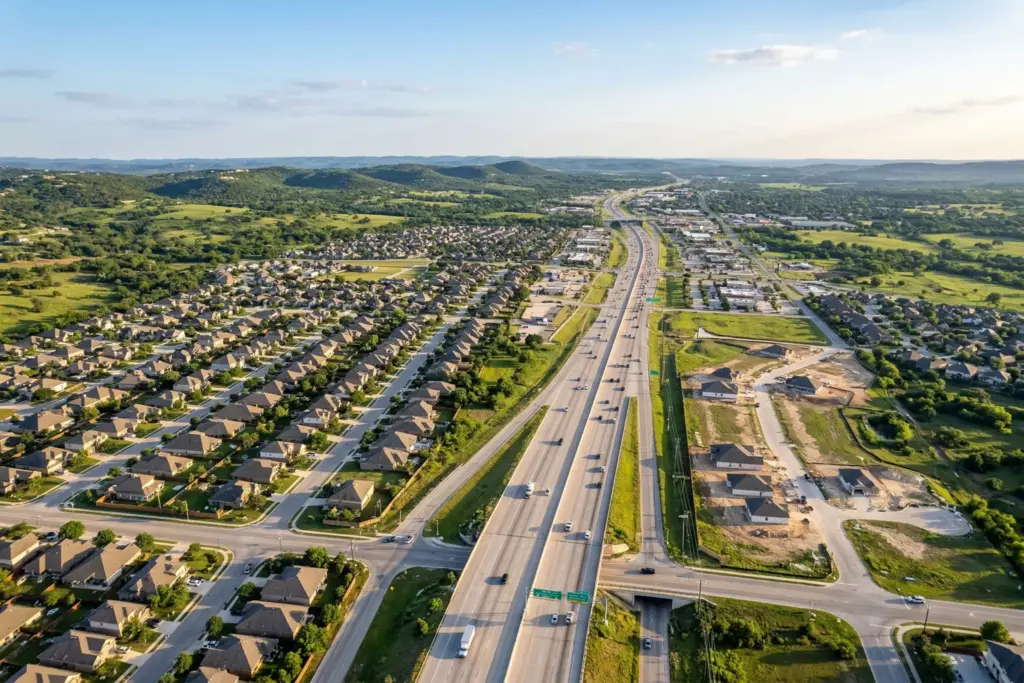
The median home price in Kyle is $344,990 right now, Buda is sitting at $364,990, and San Marcos comes in at $348,495 (that is straight from our MLS database, not some aggregator number from six months ago). Three cities, all on I-35, all in Hays County, and all within about 20 minutes of each other. But they could not feel more different.
I get some version of this question every week. Someone relocating from California or Dallas or Houston pulls up a map, sees these three dots south of Austin, and asks me which one to pick. And honestly the answer depends on what phase of life you are in, what you are willing to spend, and how much you care about your commute. So lets break it down.
The I-35 South Corridor at a Glance
Before we get into the city-by-city breakdown, here is the 30-second version. Kyle is the growth engine with the most inventory and lowest entry point. Buda is the small-town-that-stayed-small-ish with better tax rates but fewer options under $350,000. San Marcos is the wildcard, a college town with Texas State University, a river running through it, and a personality the other two just do not have.
All three sit in Hays County, which the U.S. Census Bureau ranked as the fastest-growing county in the nation at 5.1% annual growth. That growth is not slowing down. The I-35 expansion project is going to reshape this entire corridor over the next decade, and the people buying here now are going to benefit from infrastructure that does not exist yet.
Kyle: The Inventory King
Kyle has 531 active residential listings right now. That is more than Buda and San Marcos combined. If you are a buyer who wants options (and leverage to negotiate), Kyle is where you start looking.
The numbers tell a pretty clear story. Median list price is $344,990, average price per square foot is $187, and homes are spending about 49 days on market. There are 282 homes listed under $350,000 in Kyle right now. In Buda that number is 134. You can do the math on which city gives a first-time buyer more to work with.
Kyle also holds the title of second-fastest-growing city in the U.S. among cities with populations over 50,000, according to the Census Bureau. The population hit 65,833 in 2025 (a 41.78% jump since 2020). That kind of growth means two things: new construction everywhere and retail/commercial development chasing the rooftops.
But here is the part that makes some buyers nervous. Kyle is growing fast, and fast growth sometimes means the infrastructure is playing catch-up. Roads get congested before they get widened. Schools fill up before new ones open. If you have driven through Kyle at 5pm on a weekday you know what I am talking about.
The school situation is solid though. Kyle sits in Hays CISD, which earned a B rating (80 out of 100) from the Texas Education Agency for the 2024-25 school year. Only one campus scored below a C. For a district growing this fast, that is genuinely impressive right.
One thing I always tell buyers looking at Kyle, the city tax rate is $0.5957 per $100 of assessed value, which is noticeably higher than Buda’s $0.3576. A lot of that comes from MUDs (Municipal Utility Districts) in the newer subdivisions. So when you are comparing that $345,000 house in Kyle to a $365,000 house in Buda, you need to factor in the actual tax bill, not just the sticker price. On a $345,000 home that difference in city tax rate alone is roughly $700 a year. Over 10 years that adds up.
Who Kyle is perfect for
First-time buyers, young families on a budget, and anyone who prioritizes selection over charm. Kyle is not trying to be cute. It is trying to be affordable and accessible, and it is doing that well. If you are coming from Austin and your budget is under $350,000, Kyle is probably where you end up. And that is not a consolation prize. That is a smart financial move.
Buda: The Tax Advantage Nobody Talks About
Buda is interesting because it gets overlooked. People drive right through it on I-35 between Austin and San Marcos and do not give it a second thought. Their loss.
Buda has 300 active residential listings with a median of $364,990 and homes averaging $200 per square foot. It is about $20,000 more than Kyle at the median. But (and this is something Robert Kiyosaki would appreciate) the total cost of ownership tells a different story when you factor in that city tax rate of $0.3576 versus Kyle’s $0.5957. On a $400,000 home, that is nearly $1,000 a year less in city taxes. Over a 30-year mortgage, that gap is meaningful.
Buda markets itself as the “Outdoor Capital of Texas” and honestly it kind of earns it. The trail system is solid, there is good access to green space, and the historic downtown along Main Street has that small-town Texas feel that a lot of people say they want but then buy in a master-planned community instead (no judgment, I get it).
The commute is the real selling point. Buda sits about 15 miles south of downtown Austin with an average commute time of 28 minutes according to Census data. That is basically the same as living in South Austin. And as someone who has sat in traffic on MoPac more times than I can count, 28 minutes on I-35 south is honestly not bad right now.
Schools are the same Hays CISD district as Kyle, so you are getting that same B-rated district. The difference is Buda tends to feed into some of the newer, less crowded campuses. That matters when you have elementary-age kids.
Buda’s growth has been real too, a 77.9% population increase over five years. But because it started from a smaller base (around 16,000 people now), it does not have the same “construction site everywhere you look” feeling that Kyle does. It feels more settled. More established. The kind of place where people have lived for 15 years and actually know their neighbors.
The Buda trade-off
Less inventory means less negotiating power. With only 300 listings and 134 of those under $350,000, you have fewer options. If you are picky about floorplans or lot size, you might find yourself compromising in Buda where you would not have to in Kyle. And the 59 days on market (versus Kyle’s 49) tells you that sellers here are pricing a little more aggressively. They know the tax advantage is part of the value proposition.
San Marcos: The One That Surprises People
Ok so San Marcos. This is where the conversation gets interesting.
Most people write off San Marcos as “just a college town” and then never look at the actual data. Here is the thing, San Marcos has 358 active listings, a median of $348,495, and the highest price per square foot of all three cities at $214. That last number might surprise you. It surprised me when I pulled it.
The reason is Texas State University. With roughly 40,000 students, Texas State is one of the largest universities in the state, and that creates a rental demand floor that Kyle and Buda simply do not have. If you are an investor reading this (and I know some of you are), that $214 per square foot makes more sense when you realize the rental market here is structurally supported by a university that is not going anywhere.
The San Marcos River runs right through downtown and it is not some decorative creek. People tube it, kayak it, swim in it. It is legitimately one of the best natural amenities in Central Texas. The restaurant scene punches way above its weight for a city this size (Root Cellar Cafe, Palmer’s, more taco joints than you can count). There is a culture here that feels organic in a way that planned communities never quite replicate.
But lets talk about the elephant in the room. San Marcos CISD earned a C rating (76 out of 100) from TEA. The district has been improving significantly, San Marcos High School went from an F in 2022-23 to a C in 2024-25, and the district picked up 36 TEA academic distinctions. That trajectory is encouraging. But a C is still a C, and if schools are your top priority, Hays CISD (Kyle/Buda) has a meaningful edge right now.
The commute is the other consideration. San Marcos to downtown Austin is roughly 45 minutes in good traffic, and I-35 through San Marcos is… well, lets just say it has character. If you work in Austin and need to be in an office five days a week, San Marcos is a tougher sell. But if you are remote, hybrid, or work in San Marcos/New Braunfels/San Antonio, this changes the equation completely. San Marcos sits almost exactly between Austin and San Antonio, which is a position that is going to become more valuable as both metros keep expanding toward each other.
The investment angle
I have to mention this because it is where my brain goes. San Marcos has 183 homes listed under $350,000 right now. The 2025 closed median was $320,000. You can buy a 3-bedroom house near a university with 40,000 students for $320,000. That is not nothing right. As someone who owns rental properties, those numbers get my attention (Ben Graham’s whole thing about buying dollar bills for fifty cents comes to mind here). The rental demand is institutional. It does not fluctuate with corporate hiring cycles like Austin’s does. Students show up every fall whether the tech market is up or down.
The Head-to-Head Comparison
| Kyle | Buda | San Marcos | |
|---|---|---|---|
| Median List Price | $344,990 | $364,990 | $348,495 |
| Active Listings | 531 | 300 | 358 |
| Price/Sq Ft | $187 | $200 | $214 |
| Days on Market | 49 | 59 | 55 |
| Under $350K | 282 | 134 | 183 |
| School District | Hays CISD (B, 80) | Hays CISD (B, 80) | San Marcos CISD (C, 76) |
| City Tax Rate | $0.5957 | $0.3576 | Varies |
| Commute to Austin | 25-35 min | ~28 min | ~45 min |
| 2020-25 Growth | 41.78% | 77.9% (5yr) | Steady + TXST |
| Vibe | Suburban growth | Small-town Texas | College town energy |
So Which One Do You Pick?
This is the part where a lot of articles give you some wishy-washy “it depends on your needs” answer and call it a day. I would rather just tell you what I actually think.
If you are a first-time buyer with a budget under $350,000, start in Kyle. You have the most options, homes are moving faster (which tells you the market is healthy, not stagnant), and the school district is solid. Yes the taxes are higher. But the entry point is lower, and getting into the market matters more than optimizing your tax bill right now.
If you are a move-up buyer or a family that has done this before, look at Buda. The tax savings are real, the commute is manageable, and there is a quality of life here that is hard to quantify on a spreadsheet. Buda does not try to be everything. It just tries to be a good place to live. That simplicity is underrated.
If you are an investor, a remote worker, or someone who values culture and character, San Marcos deserves a serious look. The university creates a built-in rental demand that insulates you from economic cycles. The river, the food scene, the downtown. It is the only one of these three cities that has a personality you can not find somewhere else.
If you are relocating from out of state, I wrote a complete guide to moving to Austin that covers the broader metro. But all three of these cities are worth considering, especially if you are coming from a market where $350,000 buys you nothing. Here it buys you a real house with a yard and good schools.
And if you want to see what the north side of Austin looks like for comparison, I did a similar breakdown of Georgetown vs Round Rock vs Cedar Park. Same concept, different corridor.
Frequently Asked Questions
Ready to Explore the I-35 South Corridor?
Look, all three of these cities are going to keep growing. The I-35 expansion, the continued migration into Central Texas, the affordability relative to Austin proper. The question is not whether these are good places to buy. It is which one matches your life right now.
If you want to talk through the specifics, whether it is running comps in a particular subdivision, understanding the MUD tax situation in Kyle, or evaluating a rental play in San Marcos, lets grab coffee. I have been doing this in the Austin market for 19 years and the south corridor is one of the most interesting stories in Central Texas real estate right now.
Be safe, be good, and be nice to people.


