 Ed Neuhaus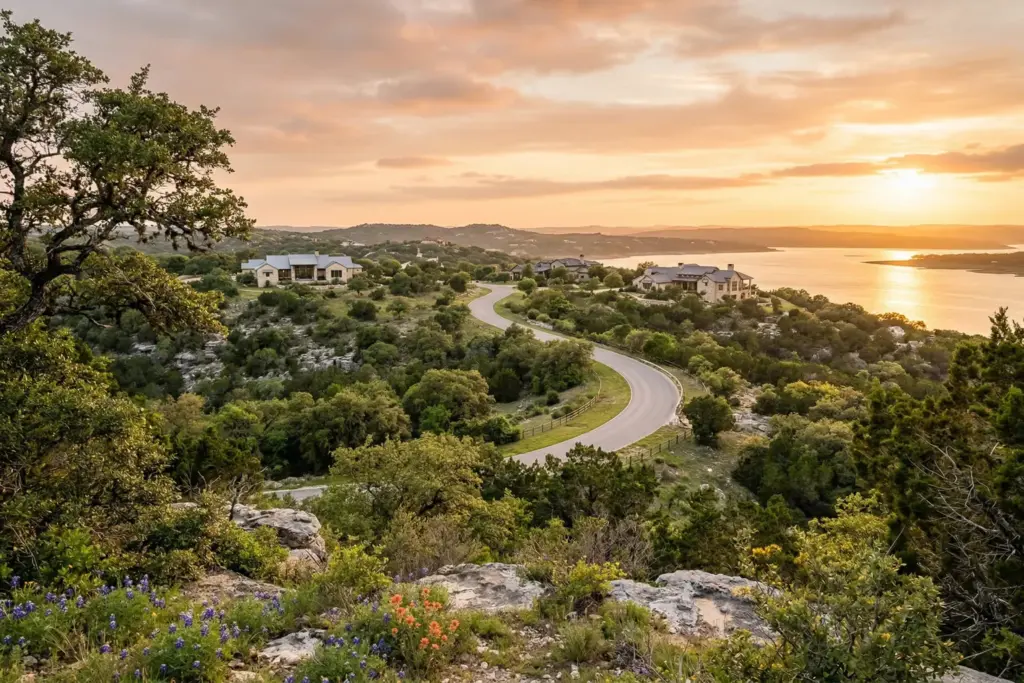
Retirees moving to the Austin Hill Country in 2026 can shield up to $200,000 of their home’s value from school district property taxes, pay zero state income tax, and find homes in active communities starting around $405,000 in Georgetown. According to the Texas Comptroller’s office, the combined homestead ($140,000) and over-65 ($60,000) exemptions are the largest they’ve ever been. That’s a big deal right. And it’s one of the reasons I keep getting calls from people in their late 50s and early 60s asking me the same question: where exactly in the Hill Country should I be looking?
Lets walk through it. I’ve helped dozens of buyers make this exact move over the last 19 years, and the answer really depends on what your version of retirement looks like. Some people want a golf cart community with organized pickleball. Others want 10 acres and a view. Both exist out here, sometimes 15 minutes apart.
Why the Hill Country Specifically (and Not Just “Texas”)
I get asked this a lot. People know Texas has no state income tax. They know it’s warm. But why the Hill Country instead of, say, the coast or DFW?
The honest answer is that this part of Texas hits a very specific sweet spot. You get the outdoor lifestyle (Lake Travis, hiking at Pace Bend, cycling on ranch roads) without the humidity of Houston or the flatness of North Texas. The Hill Country has actual topography. Rolling hills, live oaks, creeks that run through limestone. It feels like you’re somewhere, not just in a suburb that could be anywhere.
And then there’s the practical stuff. Austin’s healthcare infrastructure is legitimately world-class now. You’re within 30 minutes of multiple major hospital systems from almost anywhere in the Hill Country. The Austin-Bergstrom airport has direct flights to most major cities. And the cultural scene (live music, restaurants, galleries) means retirement doesn’t have to mean isolation.
Benjamin Graham wrote that the intelligent investor is one who is “realistic about the present.” That applies to retiring in Austin TX just as much as it applies to picking stocks. The present reality is that the Hill Country offers a combination of tax advantages, healthcare access, lifestyle, and property values that’s genuinely hard to find anywhere else in the country.
Where to Live: Four Communities Worth Your Attention
I’m going to break this down by what I actually see people choosing when they make this move. Not every 55+ community brochure, just the places that keep coming up in real conversations with real buyers.
Georgetown and Sun City: The Full-Service Retirement Community
If you want the turnkey retirement experience, Sun City Texas in Georgetown is the obvious starting point. Three golf courses, three fitness centers, resort-style pools, art studios, miles of walking trails, and more organized social activities than you could possibly attend. The median home price in Georgetown sits around $405,000 as of February 2026, which makes it the most affordable option on this list by a wide margin.
Georgetown itself has been landing on “best places to retire” lists for years (it ranked 15th in Texas for 2026 according to Niche.com), and the downtown square is genuinely charming. Good restaurants, small-town feel, but still only about 35 minutes to downtown Austin on a good traffic day.
The trade-off? You’re further from the lake lifestyle and the more dramatic Hill Country scenery. Georgetown is beautiful but it’s more rolling prairie than rugged hill country. For some retirees that’s perfect. For others it’s a dealbreaker.
Lakeway: Lake Life and Golf Without the Full 55+ Model
Lakeway is where retirees land when they want the active outdoor lifestyle but don’t necessarily want to live in a gated age-restricted community. The median home price is running about $725,000 to $778,000, and you get Lake Travis access, multiple golf courses (Flintrock Falls is gorgeous), marinas, and a resort-style atmosphere that’s baked into the whole town, not just one subdivision.
There is actually a 55+ option here too. Tuscan Village offers Italian-inspired townhomes and villas, nearly 200 units, for people who want the low-maintenance lifestyle. But most retirees I work with in Lakeway are buying regular single-family homes and loving the fact that they can walk to a restaurant, take the boat out in the morning, and play golf in the afternoon without ever leaving town.
I wrote a deeper dive on the area if you want the full picture: Lake Travis and Lakeway Real Estate 2026.
Bee Cave: Convenient, Low Taxes, and the Hill Country Galleria
Bee Cave is interesting for retirees because it has the lowest property tax rate in the area (no city ad valorem tax) and it’s the closest Hill Country community to central Austin. If you still want to pop into the city for dinner, a show at the Long Center, or to see the grandkids, Bee Cave puts you 20 minutes away instead of 40.
The price of admission is higher though. Median home prices run $850,000 to $925,000 in Bee Cave. You’re paying for location, the Hill Country Galleria shopping and dining complex, and neighborhoods like Falconhead and Spanish Oaks that are legitimately beautiful.
For a retiree selling a paid-off home in California or the Northeast and moving equity into Texas, Bee Cave often makes perfect financial sense even at higher price points. No state income tax on your retirement distributions plus lower property taxes than what you were paying? The math works.
Dripping Springs: Space, Quiet, and the Wine Country Vibe
Dripping Springs is where you go when your retirement vision involves more land, more quiet, and maybe a few goats (I’m only half kidding). This is the “Gateway to the Hill Country” and it has become the epicenter of the Texas wine and distillery scene. Dripping Springs real estate ranges from $550,000 to $650,000 at the median, with properties on acreage going well above that.
The pace of life here is noticeably slower than Lakeway or Bee Cave. That’s the whole point. Saturday morning at a winery, Sunday afternoon on your porch watching the sunset over the hills. But you’re still only 25 minutes from a Costco and 35 from Austin. It’s not remote. It just feels like it.
If you’re choosing between these communities, I wrote a head-to-head comparison that might help: Dripping Springs vs Bee Cave vs Lakeway.
What It Actually Costs to Retire Here
Lets talk real numbers. I put together a detailed cost-of-living breakdown for West Austin and the Hill Country, so I won’t repeat every line item here. But the retirement-specific numbers are worth highlighting.
Property Taxes (The Number Everyone Asks About)
Texas property taxes are higher than the national average. There’s no getting around that. The state average rate is about 1.58% compared to the national average of 1.02%. On a $600,000 home, you might be looking at $9,500 to $13,200 annually depending on which taxing jurisdictions you fall into.
But here’s where it gets interesting for retirees. Once you turn 65:
Your general homestead exemption is now $140,000 (up from $100,000). You get an additional $60,000 over-65 exemption for school district taxes. That means $200,000 of your home’s value is shielded from school taxes. And your school district tax amount FREEZES. It will not go up as long as you own that home and don’t add major improvements (like building a pool or adding a garage).
On a $600,000 home, the over-65 exemptions and freeze can realistically save you $2,000 to $3,000 per year compared to what a younger homeowner would pay on the same property. Over a 20-year retirement that adds up to serious money.
And remember, there’s no state income tax here. If you’re pulling from a 401(k), IRA, or pension, Texas doesn’t take a cut. For retirees coming from states with 5% to 10% income tax rates, that’s often worth more than the property tax difference. Way more.
Monthly Living Costs
Budget around $150 to $250 per month for electricity (averaged annually, less in winter), $300 to $450 total for utilities in a typical 2,500 square foot home, and grocery costs that track pretty close to national averages. Healthcare costs depend entirely on your insurance situation, but having multiple major hospital systems in the area means you have options and competition, which generally keeps costs more reasonable than rural areas.
The thing that catches some retirees off guard is HOA fees. In communities like Lakeway or Sun City, you might pay $200 to $500 per month for access to amenities. Factor that in when comparing total costs.
Healthcare: Better Than You’d Expect
This is the question I get from every retiree who’s seriously considering the move, and it’s the right question to ask. Healthcare access can make or break a retirement location.
The good news is Austin’s healthcare infrastructure has grown dramatically. Three major hospital systems serve the Hill Country area:
St. David’s HealthCare operates multiple hospitals across the Austin metro, including St. David’s South Austin Medical Center and the Round Rock campus. It’s the largest healthcare system in Central Texas.
Baylor Scott & White opened their Austin medical center in January 2020 on West 290 near MoPac, which is right at the gateway to Hill Country communities. They now have eight hospitals and more than 70 care sites in the Austin-Round Rock area. For retirees in Bee Cave or Lakeway, this location is incredibly convenient.
Ascension Seton rounds out the big three with Dell Seton Medical Center at UT (the region’s only Level 1 trauma center) and multiple specialty locations.
I’m not a doctor and I’m not going to pretend to evaluate hospital quality (that’s what U.S. News hospital rankings are for). But I can tell you from 19 years of helping people relocate here that healthcare access has never been a reason someone decided NOT to move to the Hill Country. Twenty years ago, maybe. Not anymore.
The Lifestyle: What Retirees Actually Do Out Here
Ok so I might be a little biased because I live out here and I love it. But the lifestyle is genuinely what sells most retirees on the Hill Country once they’ve checked the financial boxes.
Golf. There are more courses per capita in this part of Texas than almost anywhere. Flintrock Falls, Falconhead, Crystal Falls, Avery Ranch, Sun City’s three courses. You could play a different course every week for months.
Lake Travis. If you’ve never been on Lake Travis on a Tuesday morning in October when everybody else is at work, you’re missing out. Boating, kayaking, fishing, or just sitting at a waterfront restaurant watching the water. This is where the “income independent of time” philosophy really pays off for retirees right.
Hiking and Nature. Pace Bend Park, Hamilton Pool (well, the wait for reservations is a thing), Reimers Ranch, the Violet Crown Trail system. The Hill Country is genuinely one of the most beautiful parts of Texas and you can be on a trail in 10 minutes from most of these communities.
Food and Wine. The Dripping Springs wine trail has blown up. Same with the distillery scene. And Austin’s restaurant culture needs no introduction. You won’t run out of new places to try. Not possible.
Ryan Holiday wrote about how the Stoics believed retirement should be the most active phase of your life, not the least. The Hill Country kind of forces that. It’s hard to sit around when there’s this much to do right outside your door.
What to Watch Out For (The Honest Version)
I wouldn’t be doing my job if I didn’t mention the stuff that trips people up.
Traffic on 620 and 71. If you live in Lakeway or Bee Cave and need to get into Austin during rush hour, budget extra time. The 620/2222 corridor has gotten worse over the last 5 years. It’s not Houston-level terrible, but it’s not the “easy 20-minute drive” it was in 2015 either.
Property taxes ARE higher than most states. The exemptions help a lot at 65, and no income tax offsets it for most people. But if you’re coming from a state with both low property taxes AND no income tax (looking at you, Wyoming and Nevada), the math is different. Run your own numbers.
Summer heat is real. June through September, you’re looking at 95 to 105 degrees regularly. If you’re from the upper Midwest or Pacific Northwest, this will be an adjustment. Most people adapt within a year or two. (Well, they adapt or they move to Colorado. No judgment either way.)
It’s growing fast. The Hill Country is not the sleepy rural area it was 15 years ago. Dripping Springs still has that feel but it’s changing. If you want truly rural, you need to go further west toward Wimberley or Johnson City. Which honestly, for the right person, those are great options too.
Frequently Asked Questions
Thinking About Retiring to the Hill Country?
Look, I could write another 5,000 words about retiring in the Hill Country but at some point you just need to come see it. Drive through Lakeway on a fall afternoon. Walk around the Georgetown square. Sit on a patio in Dripping Springs and drink local wine while the sun goes down behind the hills.
If you’re thinking about making the move, or even just starting to explore, lets grab coffee and talk through what makes sense for your situation. I’ve been doing this for 19 years and I know these communities inside and out. At Neuhaus Realty Group, we specialize in Hill Country real estate for a reason. Reach out to me directly and we’ll figure out the right fit.
Be safe, be good, and be nice to people.


