 Ed Neuhaus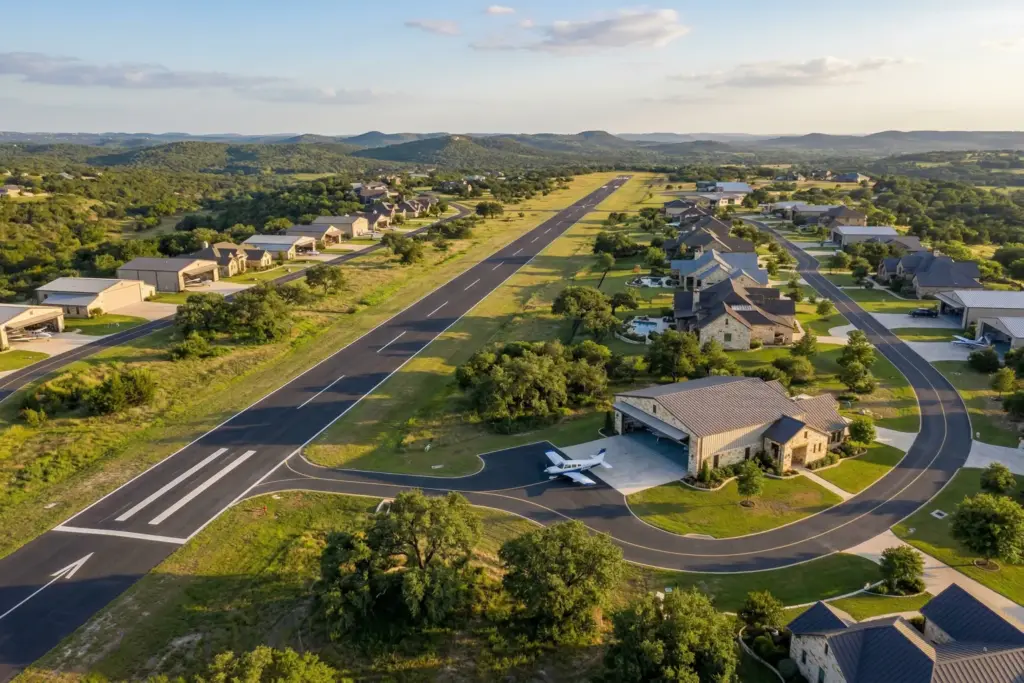
Boerne Stage Airfield (5C1) has a 5,006 foot paved runway, published RNAV GPS approaches to both ends, Jet-A on the field, and an AWOS-III. And there are houses right next to it. That combination makes Threshold Ranch in Boerne, TX the most capable residential airpark in the Austin/San Antonio corridor, and honestly one of the most capable in all of Texas. If you have been shopping airpark communities and keep running into grass strips with no instrument approaches (sound familiar right), this is the one that changes the conversation.
According to AirNav, the field sits at 1,384 feet MSL with Runway 17/35 in excellent condition. But the spec sheet only tells part of the story. Lets talk about what actually matters here, from one pilot to another.
Why Instrument Approaches Change Everything for Airpark Living
So here is the thing most people get wrong about residential airparks. They look at the runway length, maybe the lot sizes, and call it done. But if you are an IFR-rated pilot (and if you are shopping airparks at this price point, you probably are), the single most important question is: can I get home when the weather goes to garbage?
At Threshold Ranch, the answer is yes.
The field has published RNAV GPS approaches to both Runway 17 and Runway 35. That means when a cold front rolls through and the ceiling drops to 800 feet, you are not diverting to San Antonio International and calling an Uber. You are shooting the approach, breaking out, and taxiing to your own hangar. Lets be honest, that is the whole point of living on an airfield right.
Most residential airparks in Texas are VFR-only. Lakeway Airpark (3R9) near Austin, for example, has a 3,978 foot runway with no published approaches. Kestrel Airpark between Bulverde and Spring Branch, same deal. Comfort Falls Aviation Estates out near the Guadalupe River, beautiful property but no instrument capability. So you buy a gorgeous hangar home, and then three times a month between October and March you are stuck somewhere else because the ceiling is too low to get in VFR. That gets old real fast.
Benjamin Graham wrote about margin of safety being the central concept of investment. Instrument approaches at your home airfield are the aviation equivalent. You are not buying the approach for sunny days. You are buying it for the 15% of the time when weather makes VFR pilots sit and wait. That 15% is when you really, really want to be home.
The Airfield: What You Are Actually Getting
Lets walk through the specs because they matter.
Runway 17/35 is 5,006 feet long and 60 feet wide, paved asphalt, in excellent condition per the FAA. There are displaced thresholds on both ends (629 feet on 17, 1,086 feet on 35), so your effective takeoff roll varies by direction. Right traffic for 17, left traffic for 35. Low intensity edge lighting means you can fly at night.
Fuel. Both 100LL and Jet-A are available self-serve. As of early 2026, you are looking at roughly $6.44 for avgas and $6.82 for Jet-A per gallon. That Jet-A availability is a bigger deal than most people realize. It means turbine aircraft are welcome here. If you are flying a King Air, a TBM, or even a light jet, you can base it at Threshold Ranch. Try doing that at most residential airparks.
AWOS-III on 118.725 gives you real-time weather before you even leave your departure airport. Wind, altimeter, temperature, dewpoint, ceiling, visibility. You know exactly what you are coming home to. Combined with San Antonio Approach on 125.1, you have full ATC services for your instrument approach.
Maintenance. Major airframe and powerplant service is available on the field. I cannot overstate how convenient this is. Your annual inspection, oil changes, squawk repairs, all happening right where your airplane sleeps. No ferry flights to maintenance shops.
No touch-and-goes, no stop-and-goes, no low approaches. This is a community restriction and I actually like it. It keeps the pattern work and flight training noise out of the neighborhood. This is a place people live, not a practice field.
Density Altitude: The Hill Country Factor Pilots Need to Plan For
Ok so here is where I put on my “lets talk about the thing nobody wants to talk about” hat. The field elevation is 1,384 feet. That is not terrible. But on a July afternoon in the Hill Country when it is 102 degrees and humid, your density altitude is going to push north of 4,000 feet. Maybe higher.
What does that mean practically? Your takeoff roll is going to be longer. Your climb rate is going to be anemic. Your engine is making less power because the air is thinner. If you are flying a naturally aspirated Bonanza or Cirrus, you need to plan for it. Run your performance numbers for hot days, not standard day sea level.
The good news is that 5,006 feet of runway gives you margin that shorter strips do not. At a 3,500 foot grass strip at 1,400 feet elevation on a hot day, things get sporty. At Threshold Ranch, you have room. Not unlimited room (this is not Runway 28R at DFW right), but real margin for real airplanes doing real operations.
My recommendation: fly your heaviest, hottest takeoff numbers before you buy. If you are comfortable with the performance at 4,500 feet density altitude in your airplane, you will be fine here. And plan your summer departures for early morning when you can. The difference between a 7 AM takeoff and a 2 PM takeoff in August is not subtle.
The Community: What Threshold Ranch Looks Like on the Ground
Threshold Ranch was built in 2010 as a private, gated, master-planned community. It is not a neighborhood that happens to have a runway. It was designed from scratch for pilots.
The lots range from half an acre to over an acre, with each lot having its own private taxiway connecting directly to the airfield. So the morning commute is literally: walk out your back door, open the hangar, pull the airplane out, taxi to the runway. That never gets old. I promise.
Building covenants are real but reasonable. Stone or masonry exterior, tile or metal roof, hangar exterior has to be consistent with your house design (so no corrugated metal barn next to a stone house), and minimal fencing. The result is a community that actually looks good, not the “collection of metal buildings” vibe you get at some airparks.
Runway frontage lots require a hangar, which makes sense. If you are on the runway, your lot IS part of the airport infrastructure. Interior lots still have taxiway access but more flexibility on the hangar requirement.
Pricing is premium Hill Country territory. Expect lots starting around $500,000 and built homes north of $1 million. That is real money. But compare it to what you would pay for a nice home in Bee Cave or Lakeway PLUS a hangar at a separate airport PLUS fuel PLUS maintenance PLUS the commute between your house and your airplane. Suddenly the premium for having it all in one place does not look so crazy.
Boerne: More Than Just a Runway
I should mention that Boerne itself is a genuinely great town. Not that I am biased toward the Hill Country or anything (ok I am definitely biased).
The Hill Country Mile along Main Street has over 80 shops, galleries, and restaurants. The Texas German heritage shows up everywhere, from the architecture to the festivals to the food. There are legit wineries nearby, Sister Creek Vineyards and Saint Tryphon Farm being the standouts. And the craft brewery scene is surprisingly good for a town this size. Cibolo Creek Brewing and Free Roam are both worth your time.
Outdoor stuff is everywhere. Cibolo Trail runs through downtown, and the Guadalupe River is close for kayaking and fishing. Kreutzberg Canyon Natural Area has 117 acres of trails and river access.
It is about 30 minutes from San Antonio and roughly 1.5 hours from downtown Austin. I will be honest, that puts it outside my primary market in West Austin and the Hill Country west of Austin. But for a pilot who flies into Austin regularly anyway, 1.5 hours is what, 25 minutes in a Bonanza? The geography changes when you have wings.
Who This Is Actually For
Lets be real about who should be looking at Threshold Ranch. This is not for the weekend VFR-only pilot who putters around in a 152. Nothing wrong with that (I love a good 152 day), but you do not need published instrument approaches and Jet-A for that.
This is for the serious IFR pilot who:
- Flies 150+ hours a year, including in actual IMC
- Owns or plans to own a high-performance single, twin, or turboprop
- Travels for business and needs to get home reliably regardless of weather
- Wants maintenance, fuel, and hangar all in one place
- Values the Hill Country lifestyle but needs real airport capability
If you are comparing airpark communities and your airplane needs Jet-A, the conversation basically starts and ends here. There is nothing else in this part of Texas that checks all the boxes.
And for the pilot who flies a Cirrus or Bonanza on 100LL but values the instrument approaches, Threshold Ranch is still the strongest option in the corridor. The runway length, the GPS approaches, the AWOS, the on-field maintenance. No other residential airpark near Austin or San Antonio has this combination.
How It Compares to Other Central Texas Airparks
I wrote a full guide to fly-in communities in Central Texas that covers the broader landscape. But here is the quick comparison for the ones pilots ask about most:
Lakeway Airpark (3R9): Closer to Austin (huge advantage if Austin is your world), but the runway is 3,978 feet with no instrument approaches and no Jet-A. Great for VFR piston pilots. Not in the same category for IFR or turbine operations.
Kestrel Airpark: Nice Hill Country setting between Bulverde and Spring Branch. Shorter runway, no published approaches. More of a lifestyle community that happens to have a strip.
Comfort Falls Aviation Estates: Beautiful property on the Guadalupe River northwest of San Antonio. If scenery is your primary driver and you are VFR only, it is hard to beat. But again, no instrument approaches.
See the pattern? Threshold Ranch is the only one playing in the “real airport” category. The others are lovely communities with airstrips. This is a community with an airport. The distinction matters when the weather goes IFR and you need to get home.
Frequently Asked Questions
Thinking About Airpark Living?
If you are a pilot exploring fly-in communities in Central Texas, I get it. I am a pilot and a broker, which is a combination that does not come along that often. I can talk crosswind components AND comparable sales in the same conversation, and that is probably what you need right now.
Threshold Ranch sits just outside my primary coverage area, but if you are exploring the broader Hill Country or looking at airpark communities closer to Austin, lets talk. At Neuhaus Realty Group, we specialize in the Hill Country market and I have helped buyers navigate everything from standard subdivisions to properties with hangars and taxiways.
Reach out to Ed Neuhaus and lets figure out where you belong. Be safe, be good, and keep the shiny side up.


