 Ed
Ed 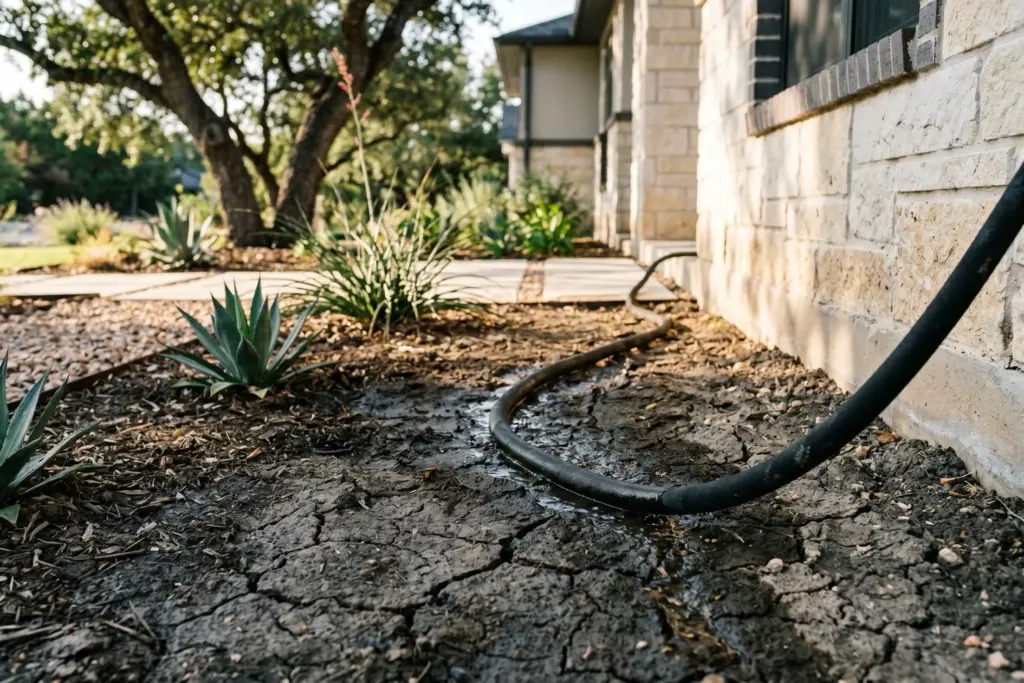
If your house sits on the black and gray clay that runs under most of Central Texas, you should be watering your foundation in the summer, not just your lawn. A soaker hose run about a foot off the slab for 30 minutes every two or three days during a dry July does more to protect your house than almost anything else you can do for the price of a garden hose. Sounds a little crazy right, watering dirt to save concrete. But the foundation pro I sat down with for this one said it without blinking, and once you understand what the soil under your slab is actually doing all summer, it stops sounding crazy and starts sounding cheap.
So I did the thing I keep doing for this series. I am a real estate broker, not a structural engineer. I have sold a lot of houses in Central Texas over the last 19 years and I have read more than a few foundation reports that killed deals, but I do not crawl under slabs for a living. So I sat down with a foundation guy who does, and asked him the questions my clients actually ask me at the kitchen table. What follows is his answer in plain English, with my real estate brain adding a few notes where it matters for your house and your resale value.
If you want the big-picture version of when every part of your house needs attention, this fits inside our year-round Austin home maintenance calendar. This post is just the foundation, because in this town the dirt moves, and the dirt moving is what cracks slabs.
Why the ground under your Austin house never sits still
Here is the thing most people do not think about. The soil under a lot of Central Texas homes is not really dirt the way you picture dirt. It is expansive clay, and expansive clay behaves more like a sponge than like sand. When it gets wet it swells up and pushes. When it dries out it shrinks and pulls away. Engineers call it shrink-swell, and our clay is some of the worst-behaved in the country for it.
Texas A&M’s Travis County extension office has a great plain-English write-up called The Real Dirt on Austin Area Soils, and the short version is this. The deep black and reddish clays of Central Texas pack into a heavy, dense mass, they absorb water slowly, and they shrink and swell so hard they will open wide cracks in the ground and heave fence posts and patios right out of place. These are called Vertisols, and they cover something like a million and a half acres in Texas, running roughly from north of Dallas down through San Antonio. You are sitting on a big ribbon of the stuff.
So picture what that means for your slab. In a wet spring the clay swells up evenly and holds your foundation in a nice supported cradle. Then July hits, it stops raining, and the sun starts cooking moisture out of the ground. But it does not cook it out evenly. The dirt under the open edges of your slab, the parts exposed to sun and wind, dries out and shrinks first. The dirt deep under the middle of your house stays damp longer because your slab is shading it. Now half your foundation is sitting on shrunken ground and half is still supported. That difference is what bends concrete.
What watering actually does (and what it does not)
The whole point of watering your foundation is not to make the soil wet. It is to keep the soil the SAME. The foundation pro put it this way, and I thought it was the cleanest way to say it. Your slab does not care if the dirt is wet or dry. It cares if one side is different from the other side. Consistency is the whole game.
When you run a soaker hose around the perimeter of your house during a drought, you are replacing the moisture the sun is pulling out of the edges, so the soil around the outside of your slab stays close to the moisture level of the soil under the middle. Even support all the way around. The clay does not get a chance to shrink away and leave part of your foundation hanging.
Now let me be honest about what it does not do, because I am not going to sell you a miracle. Watering will not lift a foundation that has already dropped. It will not fix existing damage. And it is not a substitute for fixing a drainage problem, where water pools against one side of the house and that side stays soaked while the other side bakes (that is its own post, and it is the cheapest foundation insurance there is, which is why my buddy who does gutters and I both keep harping on it). Watering is maintenance. It keeps a healthy foundation healthy through a brutal summer. That is the job, and it does that job really well.
How to actually do it without overthinking it
You do not need a fancy system. A regular soaker hose from the hardware store works fine. Here is the setup the pro walked me through, and none of it is complicated.
Lay the soaker hose about 12 to 18 inches out from the edge of your slab, all the way around the perimeter. Not jammed up against the foundation. You want the water to soak down and in, and a little gap lets it spread evenly instead of just running down the side of the slab. If you have flower beds along the house, the hose can hide right in the mulch, no big deal. The corners of your house matter the most, because corners dry out from two directions at once, so make sure the hose actually wraps the corners and does not cut across them.
Then you water consistently. During a dry stretch where it is over 95 most days and you have had no rain, run it for about 20 to 30 minutes every two or three days. You are not trying to flood it. You are trying to keep the soil evenly damp, like a wrung-out sponge, not soupy. If you can stick a long screwdriver into the soil near the foundation without much of a fight, you are in good shape. If it stops you cold like you are stabbing concrete, your dirt has gone dry and tight and it is past time to start.
A cheap hose timer makes this whole thing automatic, and honestly that is what I would do, because if it depends on you remembering to drag a hose around in 102 degree heat, it is not going to happen in late July (ask me how I know). Set it, forget it, check the soil with a screwdriver every couple weeks. The reality is the people who keep their foundations happy are the ones who took the human out of the equation.
One more thing, and it is a Texas thing. Watch your water restrictions. A lot of Central Texas towns go to stage drought rules in the summer and limit which days you can run irrigation. Foundation watering with a soaker hose usually falls under different rules than sprinklers, but check your city, because the schedule that protects your slab has to live inside the schedule your utility allows.
How to read the signs your foundation is already moving
Even with good watering, you want to know what foundation distress looks like, because catching it early is the difference between a monitoring plan and a five-figure repair. These are the signs the pro told me to watch for, and they are the same ones I have seen flag problems on inspection reports for years.
Doors are your early warning system. A door that suddenly sticks, drags on the frame, or will not latch the way it used to is often the house telling you the frame has pulled out of square because the slab under it moved. One sticky door in one season can just be humidity. Several doors going stiff at once, especially after a hot dry stretch, is worth paying attention to.
Then look for cracks, but look for the right ones. Hairline cracks in drywall happen in every house and mostly mean nothing. The ones that matter run on a diagonal, usually starting from the upper corner of a door or window frame, because that is where stress concentrates when a slab bends. Stair-step cracks in exterior brick or mortar are the outdoor version of the same thing. A crack that is getting visibly wider month over month is the one that should get you on the phone.
Floors talk too. A floor that feels like it slopes, a spot where the tile has cracked in a long line across the room, a gap opening up between the floor and the baseboard, all of that can be the slab moving underneath. None of these by itself is a death sentence. But two or three of them showing up together, in the same season, is a pattern, and patterns on a slab are worth a professional look.
When to stop watering and call a pro
Here is where my real estate brain takes over from the watering advice, because this is the part that costs people money. If you are seeing real movement, the multiple sticking doors, the widening diagonal cracks, the sloping floor, do not just water harder and hope. Watering keeps a healthy foundation healthy. It does not reverse damage, and trying to fix a moving foundation by drowning one side can actually make the movement worse by swelling the soil unevenly the other direction.
That is the moment to bring in a structural engineer or a reputable foundation company to take elevation readings. And I want to be clear about who you call first, because most people get this backwards. A structural engineer works for you and gives you an unbiased read on whether you actually have a problem and how bad it is. A foundation repair company sells repairs (which is fine, that is their business), but they are not the neutral party. For a few hundred dollars an engineer’s report can save you from a five-figure repair you did not need, or confirm you need one before it gets worse. Should you spend a few hundred dollars to know the truth before someone quotes you twenty grand in piers? Absolutely.
And if you are buying a house in Central Texas, this is exactly the kind of thing a good inspection should be flagging. Our Austin home inspection checklist walks through what to watch for, and foundation movement on our soils is near the top of the list. The other half of the equation is keeping water away from the slab in the first place, which is why drainage and gutters matter so much around here. When our post on gutter drainage and protecting your Austin foundation goes up, read it next to this one, because watering in the drought and draining in the rain are the same project from two directions.
Frequently Asked Questions
The short version
Watering your foundation sounds like the kind of thing your slightly eccentric neighbor does, right up until you understand the clay under your house and then it just sounds smart. Keep the soil moisture even around your slab during a drought, watch your doors and your cracks for the early warning signs, and call an engineer (not a salesman) the moment you see real movement. A garden hose and a $20 timer is some of the cheapest insurance you will ever buy on a house in Central Texas.
And if you are buying or selling in this market and a foundation question is sitting between you and a deal, that is exactly the kind of thing I help clients sort through every week. Have questions about a specific house or a report that has you nervous? Reach out to our team or connect with Ed Neuhaus and lets talk it through before it costs you a deal or a repair you did not need.


