 Ed
Ed 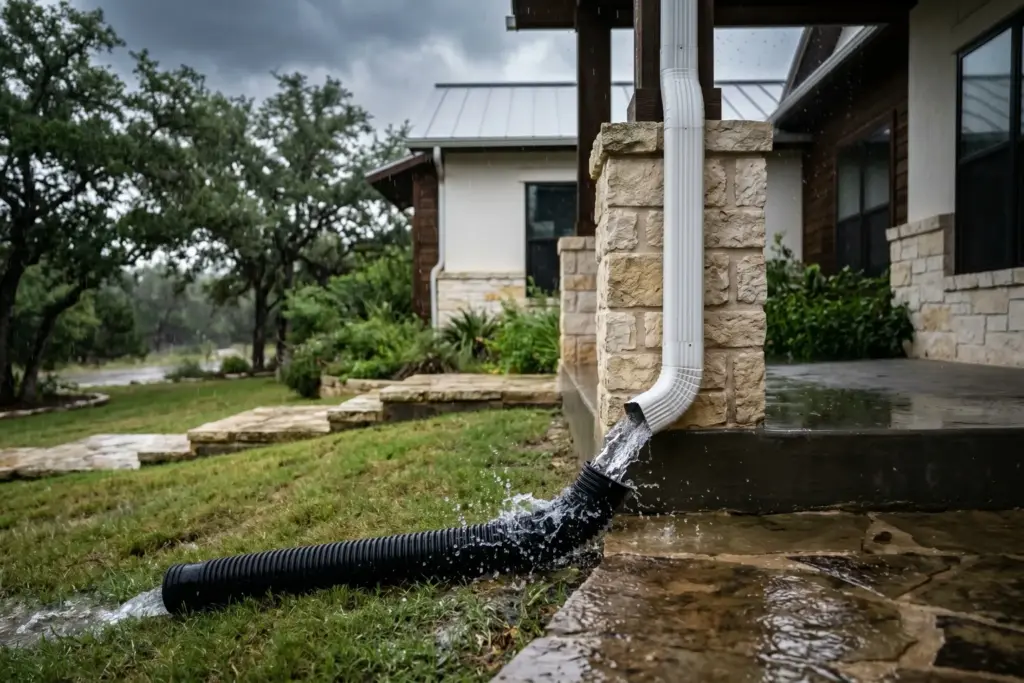
The cheapest foundation repair in Austin is the one you never need, and the way you avoid needing it costs about $1,200 in gutters and an afternoon of moving downspouts. Foundation repair on a slab in our clay runs five figures, sometimes well into them. Gutters that actually carry water 6 feet away from the house, ground that slopes away instead of toward the slab, that is the whole game. Sounds too simple right. It mostly is, and almost nobody does it until the drywall cracks.
I’m Ed Neuhaus. I’ve been selling homes in Austin and the Hill Country for 19 years, and I am not a gutter installer or a foundation engineer. So for this one I did what I keep doing in this series, I asked somebody who does it for a living. A gutter and drainage guy I trust walked me through why water management is the most underrated thing a Central Texas homeowner can do, and why he sees the same five mistakes on house after house. I’m relaying what he told me, in plain English, because it’s the kind of thing that saves people real money and almost nobody explains it.
If you want the bird’s-eye view of how this fits with everything else on the house, I put it in the year-round Austin home maintenance calendar. This post is the drainage chapter, expanded.
Why Drainage Cracks Slabs in the First Place
Here is the part most people never connect. The thing that wrecks foundations in Central Texas isn’t water, exactly. It’s water that comes and goes.
We sit on expansive clay. When it rains, that clay soaks up water and swells, and it pushes up on your slab. When it dries out in an Austin summer, the same clay shrinks and pulls away, leaving a void the slab can settle into. That swell-and-shrink cycle, over and over, is what cracks foundations. Foundation repair companies across Texas will tell you the same thing, the soil moving is the problem, and inconsistent moisture is what makes it move.
Now think about where water concentrates around a house with no gutters. It sheets off the roof and lands in a line right at the perimeter, soaking the soil hard in the exact spot you least want it. One corner under a roof valley gets a firehose, the other side stays dry. So one part of your foundation is sitting in swollen clay and another part is sitting in shrunken clay, at the same time. That uneven movement is the worst case. That’s the differential settlement that shows up as a crack stair-stepping up your sheetrock and a door that won’t latch anymore.
This is also why watering your slab in the summer is a real thing and not Austin folklore. I wrote that up with a foundation guy in why you water your slab in a Texas summer. Drainage and slab watering are two halves of the same idea, keep the moisture around your foundation as even as you can, all year. Gutters handle the too-wet half. Soaker hoses handle the too-dry half. Same goal.
The First Mistake: No Gutters, or Gutters That Dump at the Foundation
The number one thing my drainage guy sees is gutters that technically exist but do nothing useful, because the downspout just empties onto a splash block 18 inches from the slab. Congratulations, you collected all the water off a 2,000 square foot roof and delivered it to one concentrated spot right against your foundation. That’s worse than no gutters at all.
The fix is not complicated and this is the part I want you to remember if you remember nothing else. Get the water away from the house. The building codes say move roof water at least 5 feet from the foundation. The drainage guys who deal with clay say go further, 6 to 10 feet, and in clay-heavy soil push toward the 10. The reason is that the dirt right next to your foundation is backfill from when the house was built, and it’s looser and more porous than the soil further out, so water dumped near the house finds its way straight down along the slab edge. Exactly where you don’t want it.
So you extend the downspouts. Buried drain lines that pop up out in the yard, or at minimum those rigid extensions that carry water past the flower bed. Not the flimsy accordion ones that fold up and never get put back, the real ones. It’s a cheap fix and it’s the single highest-value thing on this whole list.
The Second Mistake: Grading That Slopes the Wrong Way
Gutters move the roof water. Grading moves everything else, the rain that hits the yard, the runoff from the neighbor uphill, all of it. And grading is where I see the most expensive houses get it wrong, because over the years landscaping beds get built up, mulch piles against the slab, and slowly the ground starts tilting back toward the house.
The standard, straight out of the residential code, is that the ground should fall 6 inches over the first 10 feet away from the foundation. That works out to about a 5 percent slope. You can barely see it, you can mow right over it, but it’s enough to make water run away from the house instead of toward it. When a barrier like a fence or a property line makes that impossible, the rule drops to a minimum 5 percent slope with the water steered into a swale or a drain.
Here is a thirty-second test anybody can do. Go out during the next real downpour (or just run a hose) and watch where the water goes along your foundation. If it sheets away, good. If it pools against the slab or runs along the wall looking for a low spot, you’ve got a grading problem, and that is the kind of thing that quietly feeds the wet side of the clay cycle for years. Re-grading or adding a swale isn’t glamorous but it’s a lot cheaper than piers.
The Third Mistake: Undersizing for the Way It Actually Rains Here
People think of gutters as one-size-fits-all. They’re not, and Texas is exactly the place where the size matters, because we don’t get gentle rain. We get 2 to 3 inches an hour coming down sideways for twenty minutes and then nothing for three weeks.
A standard 5-inch K-style gutter is what’s on most houses and it’s fine for a lot of the country. But for our storms, the move my guy pushes is bumping the downspouts up to 3×4 inch instead of the little 2×3 ones, because a 3×4 carries close to double the water and gives you margin when the sky opens up. He also runs more downspouts than the minimum. The rule of thumb is one downspout per 40 feet of gutter, and in a place that rains like Austin he treats it as one per 30 feet. More outlets means the gutter actually empties fast enough to keep up, instead of overflowing the front edge and dumping right back down at the foundation, which puts you right back at mistake number one.
If you’ve got a big roof or deep valleys that funnel a lot of square footage into one run, 6-inch gutters are worth the upgrade. A 6-inch K-style handles a meaningfully bigger roof area than a 5-inch. For most homes 5-inch with 3×4 downspouts is the sweet spot. The point is, don’t let somebody put the smallest legal gutter on a house in a region that gets some of the most intense downpours in the country.
The Fourth Mistake: Letting Them Clog (and the Gutter Guard Question)
A gutter full of leaves and live oak tassels is just a long planter box. Water goes over the side, hits the foundation, and you’re paying for gutters that actively hurt you. In Austin, between the live oaks dropping in spring and everything else through the fall, gutters need cleaning at least twice a year, more if you’re under heavy tree cover.
So everybody asks about gutter guards. Here’s the honest version. Good gutter guards genuinely cut down how often you’re up on a ladder, and if you’ve got mature trees they can be worth it. But “no more cleaning ever” is marketing, not reality. Fine debris, live oak pollen, shingle grit, it still gets through and builds up, guards just slow it down. Cheap guards can actually make things worse by letting water sheet right over the top in a hard rain. If you go this route, spend on decent ones and still check them once a year. I’m not going to oversell you something I wouldn’t pay for myself.
The Fifth Mistake: Ignoring the Spots Gutters Can’t Reach
Sometimes the water problem isn’t the roof at all. It’s a low corner of the yard that holds water, or a slope that sends the whole back forty toward your slab every time it storms. That’s where a French drain comes in, and this is the one job on the list I’d genuinely call a pro.
A French drain is a gravel-filled trench with a perforated pipe in it that collects water out of the soil and carries it somewhere harmless, downhill, to the street, away from the house. Done right it’s the answer for chronic wet spots and for moving subsurface water away from a foundation that keeps getting fed. Done wrong, with the pipe sloped backward or the fabric clogged, it’s a buried trench full of mud that does nothing. The grade has to be right and the discharge has to actually go somewhere, which is why this is the part where I tell people to hire the drainage company instead of renting a trencher on Saturday.
What This Means If You’re Buying
Since this is what I actually do for a living, here’s how drainage plays into a purchase. When I walk a house with a buyer, the foundation conversation and the drainage conversation are the same conversation. You can’t see the slab, but you can absolutely see how the water is managed around it, and that tells you a lot about how the home’s been cared for.
Things I look at, and things you should have your inspector look at hard. Does the house even have gutters, and do the downspouts carry water away or just dump at the corner? Does the ground slope toward the house anywhere? Are there flower beds and mulch piled up over the slab edge holding moisture against the foundation? Any cracks stair-stepping through brick or sheetrock, doors and windows that stick, gaps opening at the top of door frames? Those are the tells. A good Central Texas home inspection covers all of this, and drainage is one of the few foundation-related things a buyer can often fix cheaply after closing instead of walking away.
And honestly, that’s the encouraging part. A house with iffy grading and no downspout extensions isn’t a deal-killer the way a house with active foundation failure is. It’s frequently a few hundred to a couple thousand dollars of drainage work, which beats a foundation bill by a wide margin. You just have to know to look, and to do the work before the clay does its thing for a few summers.
Frequently Asked Questions
The Bottom Line
Drainage is the cheapest insurance policy on your house. A few hundred dollars of downspout extensions and a weekend fixing your grade can stand between you and a foundation bill that buys a used car. It’s not exciting work and nobody compliments your gutters at a dinner party, but in our clay it’s the smartest money you’ll spend on a home you plan to keep.
If you’re buying or selling around Austin and the Hill Country and you want a second set of eyes on the drainage and foundation picture before you commit, that’s exactly the kind of thing I like to help with. Reach out through the contact page or learn more about working with me, and lets walk a house together before the clay gets a vote.
Talk Drainage and Foundations with Neuhaus Realty Group | (512) 366-3270


