 Ed
Ed 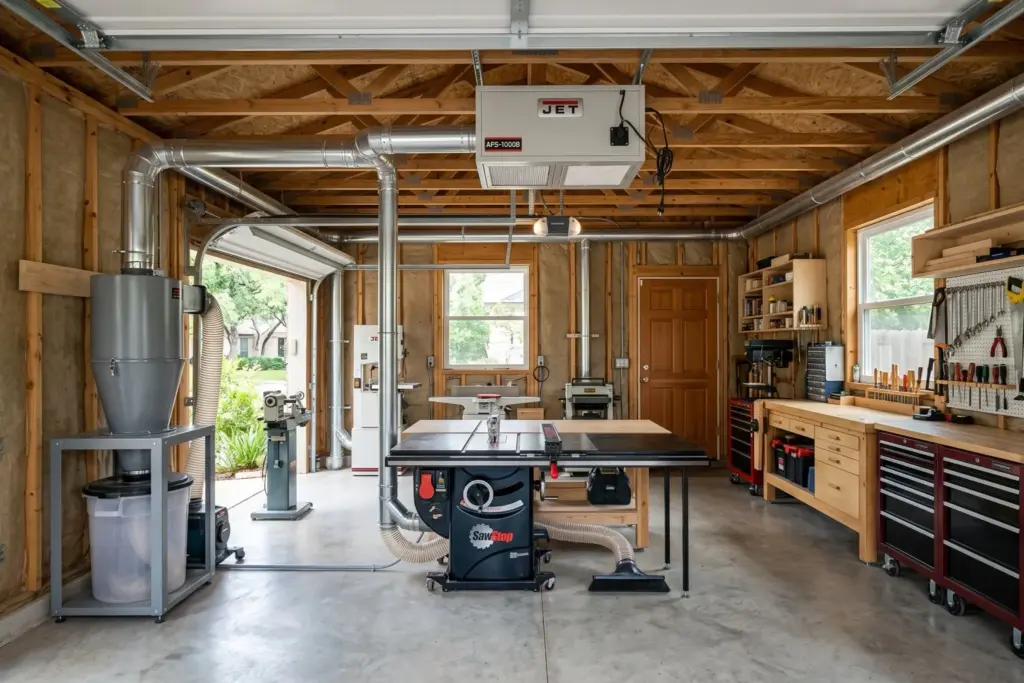
The fine dust that matters in a wood shop, the particles small enough to hang in the air and get deep into your lungs, is invisible, and in a garage shop attached to your house it travels straight into the HVAC and the bedrooms unless you stop it at the source. That is the whole case for garage dust collection, and it is not just a health issue, it is a family-and-neighbor issue. A shop that fills the house with fine dust or runs a screaming collector at 7am is how you end up sleeping on the couch or getting an HOA letter.
I think about dust collection as two systems doing two jobs: capturing the chips and dust at the tool, and cleaning the fine stuff out of the air. And in a shared-wall, close-neighbor situation like most Austin garages, there is a third job nobody talks about, which is being a considerate human about noise and timing. Lets cover all three, because getting this right is what keeps woodworking a hobby everyone in the house tolerates.
This is the dust chapter of the Woodworkers Home-Buying Guide for Austin. It connects to the power planning in the electrical reality check, because a dust collector wants its own circuit, and to the HOA and deed rules, because noise clauses are real.
Why a Garage Shop Is a Dust Problem
A detached shop contains its dust in a separate building. A garage shop does not. The garage shares a wall, a ceiling, and very often a section of HVAC ductwork or at least the same air with the house. Fine dust does not respect that wall. It drifts under the door, rides air currents, and gets pulled into the return if the air handler is in the garage, which it often is in Texas homes. Then it is in the bedrooms, on the furniture, and in everyone’s lungs.
The big chips are not the danger, your nose and a broom handle those. The danger is the fine dust, the particles you cannot see, because those are the ones that stay airborne for hours and reach the deep part of the lungs. Certain wood dusts are genuine respiratory irritants and some are classified as carcinogenic with long exposure. This is not woo, it is why serious woodworkers wear respirators and run real dust collection. In a garage attached to where your family sleeps, the stakes are simply higher.
Capture It at the Source
The first system is collection at the tool. The goal is to grab dust where it is made, before it goes airborne. For the big stationary machines, the table saw, planer, jointer, and bandsaw, that means a real dust collector, typically a 1.5 to 2 horsepower unit with a decent impeller, connected by smooth ducting to each machine. The single-stage collectors with a bag are the budget end; a cyclone separator does a better job of keeping fine dust out of the filter and the air.
For handheld tools, sanders and routers and the track saw, a shop vacuum with a good filter, ideally connected directly to the tool’s dust port, catches most of it. A small cyclone separator on top of the vacuum keeps the filter from clogging. The point is that capture-at-source is dramatically more effective than trying to clean the air after the dust is everywhere. Stop it at the blade, not in the bedroom.
Because the collector runs continuously while you work, it wants its own dedicated circuit, and a 2 horsepower unit usually wants 240 volts. That is one of the loads you plan for when you size the shop’s electrical, which is the whole point of the electrical reality check.
Clean the Air That Escapes
No capture system gets everything, so the second system is air filtration. A ceiling-hung air filtration unit moves the room’s air through fine filters and pulls the suspended dust out over time. It is the thing running after you stop cutting, scrubbing the fine particles you could not capture. In a garage attached to the house, this is not optional, because it is the layer that keeps the fine dust from migrating into the living space.
The other half of clean air is sealing the shop off from the house. Weatherstrip the door between the garage and the house, seal gaps, and if the air handler lives in the garage, be especially careful about the return pulling shop air into the system. A well-sealed, well-filtered garage shop can be kept genuinely clean. A leaky one cannot, no matter how good your collector is. This overlaps with the sealing and conditioning work in climate control for a Texas shop, which is convenient, because the same sealing helps both.
The Neighbor and Family Part
Now the part that keeps the peace. Dust collectors and shop vacs are loud, often loud enough to hear next door, and in a tight Austin neighborhood your garage may be 15 feet from someone’s bedroom window. Many HOAs have quiet hours, and even where they do not, a 2 horsepower collector roaring at 7am on a Sunday is how you make an enemy. I learned to be a clock-watcher: loud machine work happens during normal daytime hours, not early morning or late night.
Inside the house, it is about respect too. If your spouse can hear and feel the collector through the wall during dinner, or if there is a fine film of dust on the kitchen counter, the shop becomes a source of friction fast. Good capture, good filtration, good sealing, and sensible hours are what let a garage shop coexist with a happy household. Honestly, the woodworkers whose shops survive long term are the ones who treat the family and neighbor relationship as part of the setup, not an afterthought.
Sizing It Right for a Home Shop
People overspend and underspend on dust collection in equal measure, so a word on sizing. For a one-person home shop running stationary machines, a 1.5 to 2 horsepower collector with a cyclone separator is the sweet spot. Smaller than that and you do not move enough air to actually clear the fine dust from a table saw or planer; much bigger and you are buying industrial capacity and noise you do not need in an attached garage. The number that matters is airflow at the tool after duct losses, not the horsepower on the box, and long runs of flexible hose kill airflow fast, so keep ducting short, smooth, and as rigid as you can.
For the air filtration unit, match it loosely to the room volume so it can turn the air over several times an hour. And for handheld tools, do not underestimate a good shop vac with a fine filter tied directly to the tool, because a sander with no collection is one of the dustiest things in the shop. Spending on capture at the source is always a better dollar than spending on cleaning the air afterward, because the dust you never let fly is the dust you never have to filter or breathe.
One more practical note for an attached garage: where the collector and filter sit affects both noise and effectiveness. Tucked in a corner away from the shared wall, on rubber feet to kill vibration, with the exhaust thought through, a collector is a lot less intrusive to the house than one parked against the bedroom wall. Small choices, big difference in whether the household stays happy.
The Short Version
Capture dust at the source with a real collector ducted to your machines. Clean the air that escapes with a ceiling filtration unit. Seal the garage off from the house so fine dust cannot migrate. Run the loud stuff during reasonable daytime hours, especially if there is an HOA or close neighbors. Do those four things and a garage shop attached to your home is perfectly livable for everyone. Skip them and the dust will end the hobby for you, one way or another.
Frequently Asked Questions
Lets Find a Shop That Keeps the Peace
Where the garage sits, how it is sealed, and how close the neighbors are all shape whether a garage shop works for your household. As a woodworker, I think about this stuff when we walk a property. If you want that perspective on your Austin or Hill Country home search, learn how I work on my agent profile, or reach the team through our contact page or at (512) 366-3270.


