 Ed
Ed 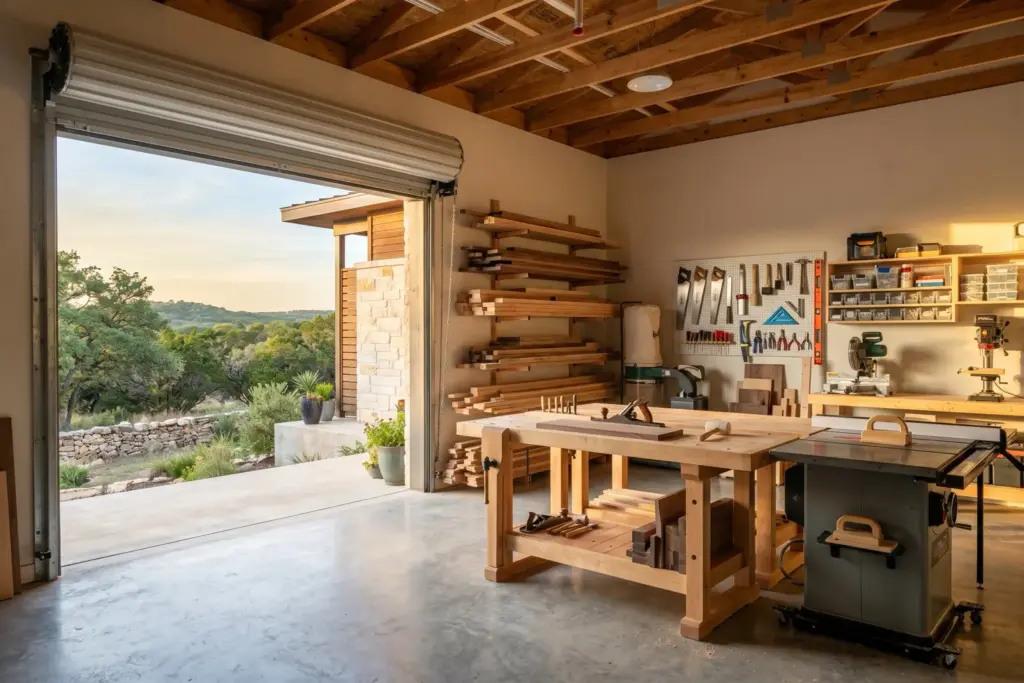
If you are a woodworker shopping for a house in Austin, the four things that decide whether a home works for you are space, power, slab, and rules, and not one of them shows up in the listing photos. A two-car garage in a typical Austin tract home gives you about 400 square feet, a 16-foot door, a 100-amp main panel feeding the whole house, and an HOA that may quietly forbid the exact thing you want to do in there. I have learned all four of those the hard way, in my own shop and walking buyers through houses they almost bought for the wrong reasons.
So this is the woodworkers home buying guide I wish someone had handed me. I have been selling homes in Austin for 19 years, and I have been making sawdust a lot longer than that. I am the guy at the open house measuring the garage ceiling with a tape while my clients look at the quartz countertops. Both matter. But the countertops you can change in a weekend with a check. The garage, the panel, the slab, and the deed restrictions are the bones of the thing, and those are expensive or impossible to change after you close.
Here is the part nobody tells you. The Austin and Texas Hill Country market is unusually good for woodworkers if you know what to look for. We have acreage lots in Dripping Springs and Wimberley where a detached shop is normal and welcome. We have older Austin neighborhoods with deep garages and no HOA at all. And we have a ton of newer master-planned stuff where the HOA will fight you on a dust collector running at 7am. The trick is matching the house to the shop you actually want, before you fall in love with the kitchen.
The Four Things That Actually Decide It
Lets walk through the framework, because every one of the eight deep-dive articles in this guide hangs off one of these. I am going to give you the short version here, then point you to the full breakdown on each.
1. Space: Garage or Detached Shop
The first fork in the road is whether your shop lives in the garage or in a separate building. This is not just a square-footage question. A garage shop means you are sharing space with cars, water heaters, and the family deep freeze, and it means the noise and dust live attached to the house where everyone breathes it. A detached shop means a separate building you can heat, cool, and make a mess in without your spouse staging an intervention.
In Austin proper, detached shops are rare on small lots and often run into setback and lot-coverage limits. Out in the Hill Country, on an acre or more, a detached metal building is so common that sellers list it as a feature. The catch is that a detached structure usually triggers more permitting, more electrical work, and sometimes more HOA scrutiny. I break the whole tradeoff down, including what it costs to add one, in Garage vs Detached Shop: What Austin Woodworkers Should Weigh Before Buying.
2. Power: Can the House Actually Run Your Tools
This is the one that breaks the most hearts. A 3 horsepower cabinet saw and a 2 horsepower dust collector both want 240 volts, and they both want to run at the same time. A typical garage in a 1990s or 2000s Austin tract home has a couple of 120-volt outlets sharing a single 20-amp circuit with the garage door opener, and the main panel feeding the whole house is 100 or 150 amps with very little headroom left.
You can almost always fix this with a subpanel, but a subpanel out to a detached shop in the Hill Country can run a few thousand dollars once you account for the trench, the wire, and the permit. Before you buy, you want to open the panel and count the spaces. I walk through exactly what to look for, what 240-volt circuits cost to add, and the red flags that mean a panel upgrade is coming, in Can That Garage Actually Run a Table Saw? An Electrical Reality Check for Austin Buyers.
3. The Physical Specs: Ceiling, Slab, Doors
Here is a number that surprises people. To safely break down a 4-foot-by-8-foot sheet of plywood on a table saw, or to stand up an 8-foot board on end at a drill press, you want more ceiling height than a standard 8-foot garage gives you. You want the slab to be flat and not cracked or heaving, because a workbench and a jointer hate an out-of-level floor. And you want a door wide and tall enough to actually get a sheet of plywood, or a finished dining table, in and out.
These are the cheap-to-check, expensive-to-fix specs that matter more than the kitchen for a woodworker. A bad slab in our expansive Central Texas clay is not a small problem, and it is exactly the kind of thing a good home inspection should flag. I cover the measurements that matter and how to read a slab, in Ceiling Height, Slab, and Door Width: The Shop Specs That Matter More Than the Kitchen.
4. The Rules: HOA and Deed Restrictions
This is the silent killer. You can find the perfect house with the perfect garage and the perfect panel, and then discover in the HOA documents that you are not allowed to run power tools before 8am, not allowed to build a detached structure, not allowed to have anything visible that looks like a workshop, and definitely not allowed to run a small woodworking side business out of it. In Texas, HOA authority comes from the recorded deed restrictions, and under Chapter 202 of the Texas Property Code those restrictions are enforceable.
You read those documents during your option period, not after. I go through the specific clauses that quietly kill a home workshop, and how to read a deed restriction before it is too late, in The HOA and Deed Rules That Quietly Kill a Home Workshop in Texas.
The Texas-Specific Stuff Most Guides Skip
If you are moving here from somewhere with a basement, you need to recalibrate. Texas houses do not have basements, so your shop is the garage or a separate building, and both of those are subject to Texas heat. In my own shop, August afternoons hit a point where the glue skins over before I can clamp, and the humidity swings make solid wood move enough to wreck a tight joint. This is not a minor inconvenience. It is the single biggest difference between woodworking up north and woodworking here.
Climate control is not a luxury in a Texas shop, it is part of keeping your lumber stable and your cast-iron tools from flashing over with rust on a humid morning. A mini-split is the usual answer, and the building you buy determines how hard that is to add. I get into what actually works, including for an uninsulated metal building in the Hill Country, in Texas Heat and Humidity vs Your Wood Shop: Climate Control That Protects Lumber and Tools.
And then there is the resale conversation, which cuts two ways. Out here, a detached building has a fork in its future. You can keep it as a shop, or you can convert it to an ADU and rent it or house family. Austin has loosened its ADU rules considerably, and a permitted ADU adds real measurable value. A shop, on the other hand, is more of a niche feature. Which one adds more to your resale, and when it makes sense to leave the building as a shop versus finishing it out, is its own analysis. I compare the two directly in Detached Workshop vs ADU: Which Adds More Resale Value in Austin, and it pairs with my full Austin ADU guide.
Living With the Shop: Dust and Neighbors
Owning the shop is one thing. Living next to it, and inside the house attached to it, is another. Fine dust is the part of woodworking that does not stay in the shop. It gets in the HVAC, it gets in the house, it gets in your lungs, and in a garage shop it is a genuine family-relations issue. A dust collector and an air filtration setup are not optional in a shared-wall situation, and a noisy collector running at the wrong hour is exactly how you end up on the bad side of a neighbor or an HOA complaint.
I learned to think about dust collection as a courtesy system as much as a health system. Where the collector lives, how loud it is, and what hours you run it all matter when the shop is 15 feet from somebody else’s bedroom window. I get practical about it in Dust Collection in a Home Garage Without Wrecking Family or Neighbor Relations.
When You Eventually Sell
Most woodworkers buying a house are not thinking about selling it. But you should, a little, because the way you finish out a shop affects who wants to buy the house later. A clean, well-lit, well-wired flex space with good power and climate control reads as a bonus room, a gym, a studio, or a workshop, and that appeals to a wide pool of buyers. A space that screams single-purpose woodshop, with a giant dust system bolted to the ceiling and a 220-volt octopus of cords, can narrow your buyer pool.
The reality is that the same investment can add value or subtract it depending on how reversible it looks. I break down what adds resale value versus what scares buyers off, in Does a Finished Workshop Add Resale Value, or Scare Off Buyers?. It also connects to how we market homes with unique features, which I cover in selling a home with a pool, acreage, or unique features in the Hill Country.
Where to Actually Look
So where do you point the search? It depends on the shop you want. If you want a detached building on real land, look at Dripping Springs and the surrounding Hill Country, where acreage lots and existing metal buildings are common and the rules are generally friendlier to a working shop. Lakeway and the lake communities tend to have more restrictive HOAs but bigger garages on bigger lots. If you want an established neighborhood with a deep garage and little or no HOA, the older parts of Austin are your friend.
The thing I tell every woodworker client is the same thing the Houston land deal my grandfather started taught my whole family. The value is in the thing nobody else is measuring. Most buyers walk past the garage. You are going to walk into it first, tape measure out, and that is exactly the edge you want. A buyer who knows what they need can find a great house that someone else overlooked, and usually for less, because the shop potential was invisible to everyone but you.
Frequently Asked Questions
Lets Find Your Shop and Your House
A house is the biggest single thing most of us ever buy, and for a woodworker the shop is half the reason you are buying. You should not have to choose between a home your family loves and a shop you can actually work in. In this market, with the right eye, you can get both. That is the kind of search I love, because I am genuinely doing the same math for my own next project.
If you are house-hunting in Austin or the Hill Country and the garage matters as much as the great room, lets talk. At Neuhaus Realty Group I work with woodworkers and makers who need a house that fits the shop, not just the family. You can learn more about how I work on my agent profile, or reach the team anytime through our contact page or at (512) 366-3270.


