 Ed
Ed 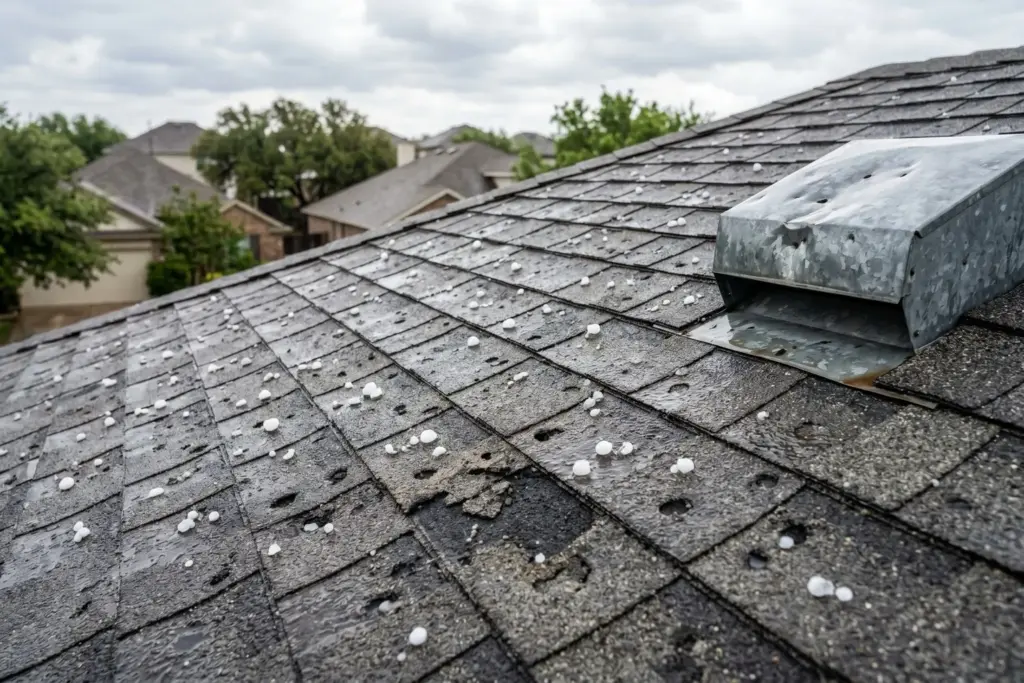
After a hard hail storm in Austin, the most expensive damage on your roof is the stuff you cannot see from the ground. A trained roofer can feel a hail bruise on a shingle with a fingertip when the surface still looks perfectly fine, and that bruise is the exact thing that fails two years later and gets your future claim denied. So yes, a post-storm inspection is worth it. Lets talk about why, and how to not get ripped off in the process (because that part matters just as much).
This one is part of my “I Asked a ___” series, where I bug the actual trades I trust and pass along what they tell me. I am a real estate broker. I am not a roofer. I have walked a lot of roofs in 19 years of selling homes around here, but I am not the guy you want crawling around up there with a chalk circle and a clipboard. So I asked one. What follows is the accepted, boots-on-the-roof version of how this works in Central Texas, minus the sales pitch.
Heres the thing about Austin. Our hail season is not a maybe, it is a calendar event. The National Weather Service climatology has our worst window running March through June, with April and May doing most of the damage, and then a quieter second round in October and November. If you have lived here more than a couple springs you already know the drill. The sky goes that weird green, your phone screams, and twenty minutes later your back patio looks like someone dumped a cooler of ice on it. No big deal right. Except your roof just took the same beating, and unlike your patio it does not dry off and move on.
What hail actually does to a roof (and why your eyes lie to you)
Lets get the physical stuff out of the way, because once you understand it the rest makes sense.
Your asphalt shingles have a layer of ceramic granules on top. Those granules are not decoration. They are sunscreen. They protect the asphalt underneath from UV, which is the thing that ages a roof out. When hail hits, two things can happen, and only one of them is obvious.
The obvious one is granule loss. The hail knocks the little granules off and you get bald spots where the dark asphalt shows through. You can sometimes see this, and you can almost always find the evidence in your gutters, a pile of what looks like coarse black sand. That is your roof, in your gutter. Not great.
The sneaky one is bruising. This is the part my roofer guy got animated about. When hail strikes hard enough, it can fracture the fiberglass mat underneath the granules without actually knocking the granules off. The top still looks fine. But press on it and it feels soft and spongy, like a bruise on a peach. That fractured spot is now a weak point that will crack, let water in, and fail, usually long after the storm that caused it. You cannot see a bruise from your driveway. You frequently cannot see it from a ladder at the edge. You have to be standing on the roof, in the right light, touching shingles. That is the whole ballgame, and it is why “well it looks fine from down here” is the most expensive sentence in Texas homeownership.
So your eyes lie to you. A roof that looks totally normal from the curb can be full of bruises that will leak next year. That gap between what looks fine and what is actually fine is the entire reason a real inspection exists.
The stuff you CAN check yourself (a 10-minute ground walk)
Before you call anybody, you can do a quick lap around your own house. You do not need to get on the roof, and please do not. I am terrible on a ladder and I assume you have better things to do than fall off your gutter line. But from the ground you can find the breadcrumbs that tell you the roof probably got hit.
Heres what to look at after a storm:
- Your gutters and downspouts. Dents and dings in the metal. Hard hail dents soft aluminum, simple as that. If the gutters got beat up, the roof got beat up.
- Granules in the gutters or at the bottom of the downspouts. That black sand. A handful after a big storm is a real signal.
- Your AC condenser unit. Walk over to the outdoor AC and look at the fins. Hail flattens those metal fins, and since the AC sits at ground level taking the same hits, it is a great little hail gauge. Dented fins mean the roof saw the same hail.
- Window screens, soft metal vents, the mailbox, the grill lid. Anything soft metal that shows fresh dents is corroborating evidence.
- Inside, your ceilings. Any new water stains over the next few weeks. That one is the bad version, because by then water is already getting in.
If you find a few of these, you almost certainly have roof damage worth a professional look. If you find none of them, you might be fine, but a borderline storm with marble-size hail can still bruise shingles while barely denting a gutter. So the ground walk tells you “probably yes,” it does not really tell you “definitely no.”
There is a Kahneman idea I think about here. His whole thing in Thinking Fast and Slow is that our brains love the easy answer, the one we can see, and we quietly ignore the one that takes effort. “Roof looks fine” is the easy answer. The bruise you would have to climb up and feel for is the effortful one. Guess which one costs you ten grand.
So is the inspection actually worth it?
Short version, yes, in two specific situations, and here is how I would think about it.
Situation one: a genuinely bad storm just rolled through your area. Quarter-size hail or bigger, wind that took down branches, the works. Get a reputable local roofer out within a few weeks. Why the hurry? Because the evidence degrades. Those granule piles wash out of your gutters in the next few rains. Fresh mat exposure weathers and starts to look like normal aging. The cleaner and fresher the evidence, the easier it is for a roofer and an adjuster to tie the damage to a specific storm date, which is exactly what your insurance claim hinges on. Wait six months and you are arguing about whether it was “the storm” or “wear and tear,” and wear and tear is not covered.
Situation two: you are buying or selling a home in Central Texas. This is my lane. If you are buying here, your general home inspector looks at the roof, but a general inspector is not a hail specialist with chalk and a soft spot for bruises. On an older roof in a hail-prone zip code, a dedicated roof inspection is cheap insurance. And if you are selling, knowing the real condition of your roof before you list is the difference between a smooth close and a renegotiation at the option period. I have watched more than one deal wobble because a buyer’s inspector flagged a roof the seller swore was fine.
Now, is it worth it after every little popcorn-hail event? Probably not. If pea-size hail tapped your roof for ninety seconds, your gutters are clean, and your AC fins are pristine, you can let that one go. Use judgment. The inspection is worth it when the storm was real or the stakes are real, not as a reflex every time it sprinkles ice.
Most reputable roofers will do the storm inspection itself for free, hoping to earn the repair work. That is fine and normal. The thing to watch is what they ask you to sign, which brings me to the part I actually care about most.
How to tell a real roofer from a storm chaser
This is the part where 19 years in this market is worth more than anything I can tell you about granules.
The morning after a big hail event in Austin, the door-knocking starts. Crews show up in trucks with out-of-state plates, clipboards, and a very friendly speech about how your whole neighborhood is getting new roofs and they can get yours covered. Some of these crews are legitimate companies chasing weather, and a few of them are flat-out predators who will be three states away by the time your roof leaks. The industry calls them storm chasers. You need to be able to tell them apart, because once you sign their paper you are stuck with whoever shows up.
Heres what should make you slam the brakes:
- “We’ll waive your deductible” or “we’ll eat your deductible.” Hard stop. In Texas this is insurance fraud, full stop, and a roofer who opens with a crime is telling you exactly who they are. A legit company will never offer it.
- Pressure to sign today. “This price is only good if you sign now,” “the crew is in your neighborhood this week only.” Real damage does not expire. Pressure is a sales tactic, not a roofing one.
- They want you to sign a contract or an assignment of benefits BEFORE the adjuster has even seen the roof. A reputable roofer is happy to inspect, document, and then talk after you and your insurer know what you are dealing with. Anybody trying to get your signature before the inspection is securing the job, not your roof.
- No local address, no local references, vague on warranty. Ask where their office is. Ask who they did in your neighborhood that you can call. A real Austin-area roofer has both and hands them over easily.
What a real one looks like is almost boring by comparison. Local address. A Texas registration you can verify. References down the street. An itemized scope of work. And a total willingness to let you call your own insurance company and your own agent before anybody signs anything. Boring is good. Boring is what you want on your roof.
I tell my buyers and sellers the same thing every spring. The roofer who knocks on your door the morning after the storm is rarely the one you want. The one you want is the one your neighbor used three years ago and still recommends. If you do not have that name, ask around before you need it, not after.
How insurance and the clock work in Texas
Lets clear up the timeline, because people panic about this and the panic is mostly misplaced.
There are really two different clocks, and folks confuse them constantly.
The first clock is your policy’s reporting deadline, the “first notice of loss.” This varies by carrier. Some want to hear from you within 90 to 180 days of the storm, some give you up to a year. These deadlines are real and legally enforceable, so do not sit on it. The practical answer is much shorter than any of those windows anyway: notify your insurer within a couple days, and aim to file within 30 to 60 days while the evidence is fresh and clearly tied to a storm date. Earlier is always cleaner.
The second clock is the legal one. Under Texas law, the statute of limitations to actually sue your insurer over a property damage claim is generally two years from the date of loss. And if it ever comes to a lawsuit, Texas Insurance Code Chapter 542A adds a step where you have to send the insurer a pre-suit notice at least 61 days before you file. You hopefully never get here. I mention it so you know there is a legal backstop, but the move is to handle it cleanly up front so you never need the backstop.
Put simply: report fast, document everything, follow up every phone call with an email summarizing what was said, and do not let a storm-chaser rush you OR let your own procrastination cost you. Both failure modes are common.
If you want the full picture on coverage, exclusions, and what Austin homeowners are actually paying, I went deep on it in our Complete Guide to Homeowners Insurance in Austin, and on the dollars specifically in how much homeowners insurance really costs here in 2026. Roof claims are where a lot of those premiums go, so it is all connected.
Where this fits in your year
Hail is a spring thing, but roof care is a year-round thing. The smart move is to add a quick post-storm ground walk to your spring routine and a real inspection to your buy-and-sell checklist. This whole post is one stop on a bigger map. If you want the month-by-month version of keeping an Austin house in one piece, I put it all in our year-round home maintenance calendar, and the deeper reference lives in our Complete Guide to Home Maintenance in Central Texas. Your roof is the single most expensive thing protecting everything else, so it earns its spot near the top of the list.
Frequently Asked Questions
The bottom line
A hail damage roof inspection in Austin is worth it when the storm was real or the stakes are real, because the damage that matters most is the damage you will never see from your driveway. Do your ten-minute ground walk, call a local roofer you actually trust, report to your insurance fast, and do not sign anything a stranger shoves at you the morning after the storm.
And if you are buying or selling a home in Central Texas and want a straight answer about whether the roof is going to be a problem at the closing table, that is exactly the kind of thing I help people sort out every week. Reach out through our contact page or call the office at (512) 366-3270, and lets make sure the most expensive part of the house is not hiding a surprise.
Be safe, be good, and be nice to people.


