 Ed
Ed 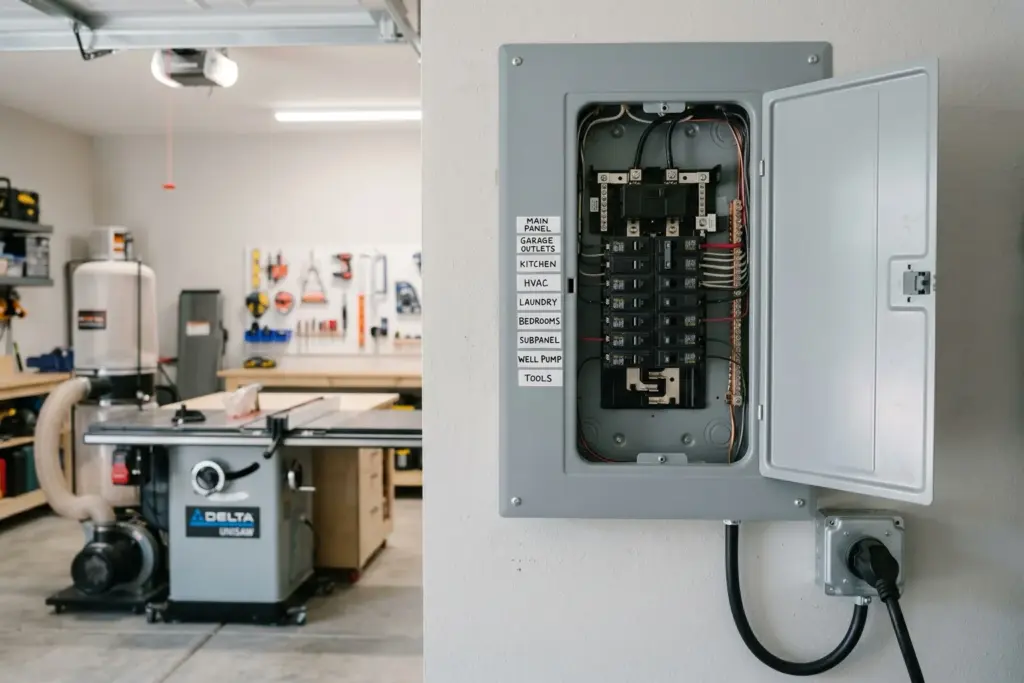
A 3 horsepower cabinet saw pulls about 13 to 17 amps at 240 volts, a 2 horsepower dust collector pulls another 12 amps or so, and they run at the same time, which means a serious garage shop wants at least two dedicated 240-volt circuits feeding it. The typical Austin tract-home garage has exactly zero. It has one or two 120-volt outlets sharing a 20-amp circuit with the garage door opener. So the honest answer to the question “can that garage actually run a table saw” is usually not yet, and that is the garage workshop electrical reality you want to understand before you buy, not after.
I am not an electrician, and the first thing I tell every buyer is to get a licensed one to do the actual work and pull the permit. But you do not need to be an electrician to walk into a garage during a showing, open the panel, and figure out whether this house can become your shop without a five-figure surprise. Lets go through exactly what to look at, because this is the single most common dream-killer I see with woodworker clients.
This is the power chapter of the bigger Woodworkers Home-Buying Guide for Austin. If you have not picked between a garage and a detached shop yet, start with that article, because the electrical answer is very different for each.
What Your Tools Actually Need
Lets get the numbers straight, because vague talk about power helps nobody. Most contractor-grade and cabinet table saws over about 1.75 horsepower are wired for 240 volts and want a dedicated circuit. A 3 horsepower saw is happy on a 20-amp 240-volt circuit. A 2 horsepower dust collector usually wants its own 240-volt circuit too, because it runs continuously while you cut. A planer, a jointer, and a big bandsaw are all in the same neighborhood.
The key insight is that you do not run every tool at once. In a one-person home shop you typically run two things at a time: the machine you are using plus the dust collector. So you do not need to add up every nameplate. But you do need at least two solid 240-volt circuits, plus a few 120-volt 20-amp circuits for sanders, routers, lights, and chargers. A common, comfortable target for a real home shop is a 60-amp subpanel out in the garage or shop, which gives you room for several 240-volt and 120-volt circuits without tripping over yourself.
Open the Panel and Count
Here is what I actually do at a showing. I find the main electrical panel and I look at three things.
First, the main breaker rating. It is the big breaker at the top, and it will say 100, 150, or 200 amps. A 200-amp service is great and means you almost certainly have room. A 100-amp service on a 2,500-square-foot all-electric house with a heat pump and an electric range is already working hard, and adding a shop subpanel may push you toward a service upgrade. That service upgrade, where the utility and an electrician bump you from 100 to 200 amps, can run a few thousand dollars on its own.
Second, open spaces in the panel. Count the empty slots where new breakers could go. A panel that is completely full means any new circuit requires either tandem breakers, a subpanel, or a panel replacement. A panel with six open slots is a much easier story.
Third, where the garage outlets land. Flip the garage outlets and the door opener off one at a time at the panel to see how they are grouped, or just note that almost universally in Austin tract homes they are one shared circuit. That tells you that you are adding everything, not modifying something.
This kind of panel inspection is exactly the sort of thing a thorough home inspection should document too, which is one more reason to read my Austin home inspection checklist before you write an offer.
What It Costs to Fix
Now for the part everyone wants. If the panel has room and the garage is attached, adding a couple of 240-volt circuits and a few 120-volt circuits is usually a manageable job, often in the hundreds to low thousands of dollars depending on the runs and whether the electrician adds a small subpanel in the garage. That is the happy path, and it is very common in Austin garages.
If the garage is detached, or worse, if the shop is a separate building out on Hill Country acreage, the cost climbs. Now you are running a feeder out to the building, which can mean trenching, conduit or direct-burial cable, a disconnect, and a subpanel in the building, plus the permit and inspection. That job commonly runs a few thousand dollars and can go higher with a long run. It is the single biggest hidden cost of a detached shop, which is why I flag it so hard in the garage-versus-detached article.
And if the main service itself is maxed out, you stack a service upgrade on top of all of that. None of this is a deal-breaker. It is just a number, and you want that number in hand before you fall in love, the same way you would want to know about a well or a septic system, which I cover in buying a home with solar panels, a well, or septic in Texas.
The Hill Country Wrinkle
Out in the rural Hill Country, you sometimes get a bonus and sometimes get a headache. The bonus is a property where the previous owner already ran a beefy subpanel out to a metal building, already wired for 240, because they were doing the same thing you want to do. When I find one of those for a maker client, it is a genuine score, because that buried feeder and subpanel is thousands of dollars already done and usually invisible to other buyers.
The headache is older rural properties with marginal service, long utility runs, or DIY wiring that never got permitted. A shop circuit that was wired by the previous owner without a permit is not just a code problem, it can be an insurance and resale problem. When the work looks homemade, you want a licensed electrician to evaluate it before you count on it.
The One-Page Version
So when you walk a house as a woodworker, do this. Open the panel, read the main breaker rating, count the open slots, and note that the garage is almost certainly on one shared circuit. If you see 200 amps and open slots, you are in great shape. If you see 100 amps and a full panel, budget for a subpanel and possibly a service upgrade. If the shop is detached, add the cost of a feeder run. Get a licensed electrician to confirm and permit whatever you do. And remember that your mini-split for climate control is one more circuit to plan for, and your dust collector wants its own dedicated circuit too, so size the panel for all of it at once.
Power is fixable. It is just money, and money you can negotiate for once you know the number. The buyers who get burned are the ones who never opened the panel and assumed the garage would just work. Do not be that buyer.
Frequently Asked Questions
Lets Read the Panel Together
I open electrical panels at showings for a living, and as a woodworker I know exactly what your tools want from one. If you are buying in Austin or the Hill Country and need someone who will actually check whether the garage can run your shop before you write the offer, learn how I work on my agent profile, or reach the team through our contact page or at (512) 366-3270.


