 Ed
Ed 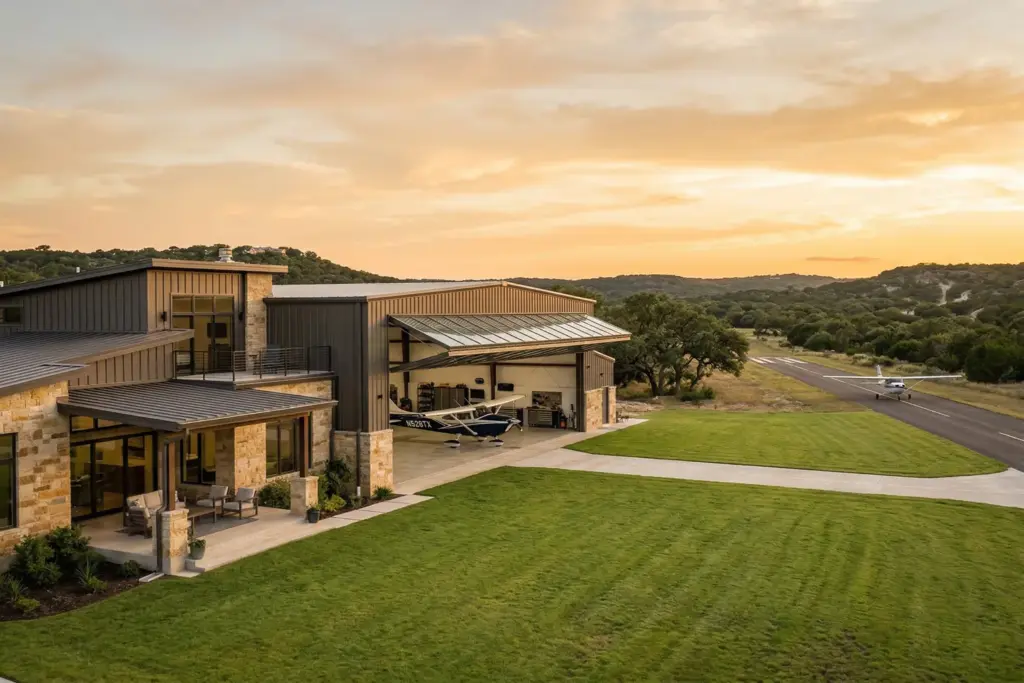
Most airpark homeowners are carrying $1,000 to $2,000 a year in hangar structure insurance on top of their standard homeowners policy, and a lot of them are still underinsured. Sounds manageable right. But here’s where it gets interesting: most pilots I talk to assume their homeowners policy covers the hangar, the plane, and any liability that comes with taxiing a Bonanza through your backyard. It doesn’t. Not even close.
I’m a licensed pilot and a real estate broker, which means I’m the guy at the hangar barbecue who ruins the fun by asking if everyone’s got adequate coverage. Real popular at parties. Someone calls about buying an airpark home in Lakeway or one of the fly-in communities around Central Texas and eventually the insurance question comes up. And honestly, there’s no good consolidated guide out there. So lets fix that.
What Your Standard Homeowners Policy Actually Covers
Before we get into the gaps, lets talk about what your regular homeowners policy does handle. Because it’s not useless, it’s just not designed for aviation.
Your standard policy covers the dwelling (the house itself), your personal property inside it, and general liability if someone trips on your front porch. Pretty standard stuff. It also typically covers detached structures like sheds, garages, and outbuildings at about 10% of your dwelling coverage amount.
And here’s where the confusion starts. Your hangar might technically qualify as an “outbuilding” under that 10% provision. Some carriers will cover it. I’ve seen policies where adding a basic hangar as an outbuilding costs almost nothing extra, maybe $25 a year in additional premium. But (and this is a big but) that coverage assumes the hangar is being used for storage. Like a glorified garage.
The second your hangar involves active aviation use, things like maintenance, fuel handling, engine runups, or regular flight operations, that basic outbuilding coverage gets shaky. Your insurer might not deny it outright on day one. They’ll deny it on the day you file a claim. And that’s when it matters.
The Five Coverage Gaps That Will Bite You
Ok so lets walk through the specific things your homeowners policy either doesn’t cover or covers so poorly that you’re basically self-insuring.
1. Hangar Used for Aviation Purposes
This is the big one. If your hangar is just storing a car and some lawn equipment, your homeowners policy probably has you covered under the outbuilding provision. But if you’re doing annuals in there, storing avgas, running up engines, or doing any kind of maintenance, that’s a different risk profile.
Insurance underwriters care about what happens inside a structure, not just what the structure looks like. A hangar with an active Cessna 182 getting oil changes is not the same risk as a tool shed. Some policies have explicit aviation exclusions. Others are just silent on it, which is almost worse because silence means the adjuster gets to decide after the fact.
2. Aircraft Inside the Hangar
This one surprises people. Your homeowners policy does not cover your airplane. Full stop. Not parked in the hangar, not taxiing on your property, not flying. Your aircraft needs its own dedicated aircraft insurance policy covering hull damage and liability.
And here’s the flip side that also trips people up. Your aircraft policy does not cover the hangar structure. So if a storm takes the roof off your hangar and totals the plane inside, you might need two separate claims to two separate insurers. The aircraft policy covers the plane. The hangar structure policy (or homeowners outbuilding rider) covers the building. Make sure both exist, because having one without the other leaves a hole. Not that complicated right. Just annoying.
3. Hangarkeeper’s Liability
Ok this one is niche but important. Hangarkeeper’s insurance covers aircraft that belong to someone else while they’re in your care, custody, or control. If your buddy parks his Piper in your hangar for the winter and a windstorm collapses the door onto his wing, guess whose problem that is.
According to Avion Insurance, hangarkeeper’s liability is typically carried by FBOs, repair shops, and commercial operators. But if you’re a private owner who lets friends or flying club members use your hangar space (even informally, even for free) you’ve got exposure.
If you only ever store your own aircraft, you probably don’t need this. But if you’re the generous type who says “yeah sure, park it in my hangar,” get the coverage first. Or stop being generous. Either way.
4. Runway and Taxiway Liability
Your Property Owners Association (and most airpark POAs are serious about this) carries insurance on the runway and shared taxiways. That’s their responsibility. But your personal liability exposure doesn’t end at the edge of your property.
Think about propwash. You start up your engine and blast dirt, gravel, or debris onto your neighbor’s hangar or car. Or someone’s kid wanders too close to your taxiway while you’re doing a runup. Your homeowners liability might cover some scenarios here, but aviation-related liability is one of those areas where standard policies get nervous.
The reality is, most standard umbrella policies explicitly exclude aviation activities. AOPA has written about this extensively. Your $2 million umbrella that covers you if someone slips on your driveway? It probably has an aircraft exclusion clause sitting on page 47. I’d check that.
5. The Aviation Umbrella Gap
Speaking of umbrellas, this is the one that keeps me up at night (well, not literally, but Nassim Taleb would call this a classic hidden risk and he’s not wrong). Standard personal umbrella policies exclude aviation. Period. Almost universally.
So you’ve got a $1 million liability limit on your aircraft policy, a $500K liability limit on your homeowners, and a $2 million umbrella that covers everything EXCEPT the activity that creates your biggest liability exposure. That’s backwards.
Aviation-specific umbrella policies exist. They’re not cheap, typically starting around $10,000 a year for $5 to $20 million in coverage. But if you own an airpark home, you’re already in a world where the liability math is different from a standard subdivision.
The Five Insurance Layers You Actually Need
Lets put this together into something actionable. If you own or are buying an airpark home, here’s the stack I’d recommend.
Layer 1: Standard Homeowners Insurance. Covers the house. Talk to your insurer specifically about the hangar. Ask them point blank: “Is my hangar covered as an outbuilding, and does that coverage survive an aviation-related claim?” Get the answer in writing. If they hem and haw, that’s your answer. For what homeowners insurance typically costs in this area, check out our breakdown of Austin homeowners insurance rates.
Layer 2: Hangar Structure Insurance. If your homeowners policy doesn’t adequately cover the hangar (and for anything beyond a basic pre-fab shelter, it probably doesn’t), get dedicated hangar structure coverage. AOPA’s hangar insurance program offers premises liability of $1 million to $5 million per occurrence with deductibles as low as $1,000, starting around $42 a month. For custom hangars with living quarters, shop space, or significant improvements, this is not optional.
Layer 3: Aircraft Insurance. Covers your plane for hull damage and liability. This is non-negotiable and most pilots already have it. But review your policy limits. Make sure your liability coverage is high enough to matter, especially if you’re operating from a residential airpark where people and property are close to the runway.
Layer 4: Hangarkeeper’s Insurance. Only if you store other people’s aircraft. If it’s just your plane in your hangar, skip this. But if anyone else’s aircraft touches your property, even temporarily, you need care/custody/control coverage. This is cheap relative to the exposure.
Layer 5: Aviation Umbrella Policy. This is the one most airpark homeowners skip because it’s expensive. But think about it this way. You bought a house with a runway. You fly aircraft from your property in a residential community. The liability ceiling on that is higher than a standard suburban home and your standard umbrella explicitly excludes it. Should you spend an extra $10K a year to close that gap? I would argue yes, especially at the asset level most airpark homeowners are sitting on.
Practical Tips (From Someone Who Has These Conversations)
Tell your homeowners insurer everything. I know, I know, you’re afraid the premium goes up. It will. Probably not as much as you think. But don’t hide the hangar. Don’t pretend it’s a “workshop.” Don’t omit the aviation use. A denied claim because you didn’t disclose is infinitely worse than a slightly higher premium. I’ve seen this go sideways and it’s not pretty.
Don’t use your regular State Farm agent for this. No offense to State Farm (they’re fine for your Camry) but aviation insurance is specialized. Use an aviation insurance broker. AOPA has partnerships and resources specifically for this. BWI Fly and Aviation Insurance Resources (AIR) are two other brokers who specialize in hangar and aviation property coverage. Benjamin Graham put it best when he talked about margin of safety. In insurance terms, your margin of safety is having a broker who actually understands what they’re insuring.
Document your hangar improvements. If you’ve added epoxy floors, insulation, radiant heating, a parts room, or a mezzanine office, those improvements need to be reflected in your replacement cost. Standard outbuilding coverage based on a basic metal structure will leave you way short if you’ve turned your hangar into a $200,000 shop.
Read your POA requirements. Some airpark POAs require minimum liability coverage amounts as a condition of membership. Others carry shared runway insurance but expect you to carry your own premises liability. At places like Aero Country East, annual POA dues run $4,500 to $6,500 and include runway operations insurance, but that doesn’t cover your individual property.
Review annually. Aircraft values change. Hangar improvements happen. Your neighbor builds a $300K hangar and suddenly the wind load on your structure matters more. Insurance isn’t set-it-and-forget-it, especially in aviation.
What This Means If You’re Buying an Airpark Home
If you’re looking at airpark properties (and I get those calls more than you’d expect for a Central Texas broker) factor insurance into your total cost of ownership from day one. Don’t just look at the mortgage payment, the HOA or POA dues, and the property taxes. The true cost of homeownership for an airpark home includes three to five separate insurance policies that a standard subdivision home doesn’t need.
And for what it’s worth, that extra cost is worth it. Living on an airfield is one of those lifestyle decisions that either makes total sense to you or sounds completely insane. If you’re reading this article, you’re probably in the first camp. But don’t let the excitement of taxi-to-takeoff from your backyard blind you to the liability exposure that comes with it.
At Neuhaus Realty Group, I work with airpark buyers and sellers across the Hill Country. Being a pilot helps me understand what matters in these transactions beyond the standard bedroom and bathroom count. If you’re considering a fly-in community in Central Texas and want someone who actually speaks both languages (real estate and aviation), lets talk.
Be safe out there. And get insured.
Frequently Asked Questions
Ready to Explore Airpark Living?
If you’re a pilot looking at airpark homes in Central Texas, I’d love to help. I’ve been selling real estate in this market for 17 years and I happen to fly too, so I get why taxiway access matters more than a three-car garage. Reach out and lets grab coffee. I’ll bring the sectional chart.


