 Ed
Ed 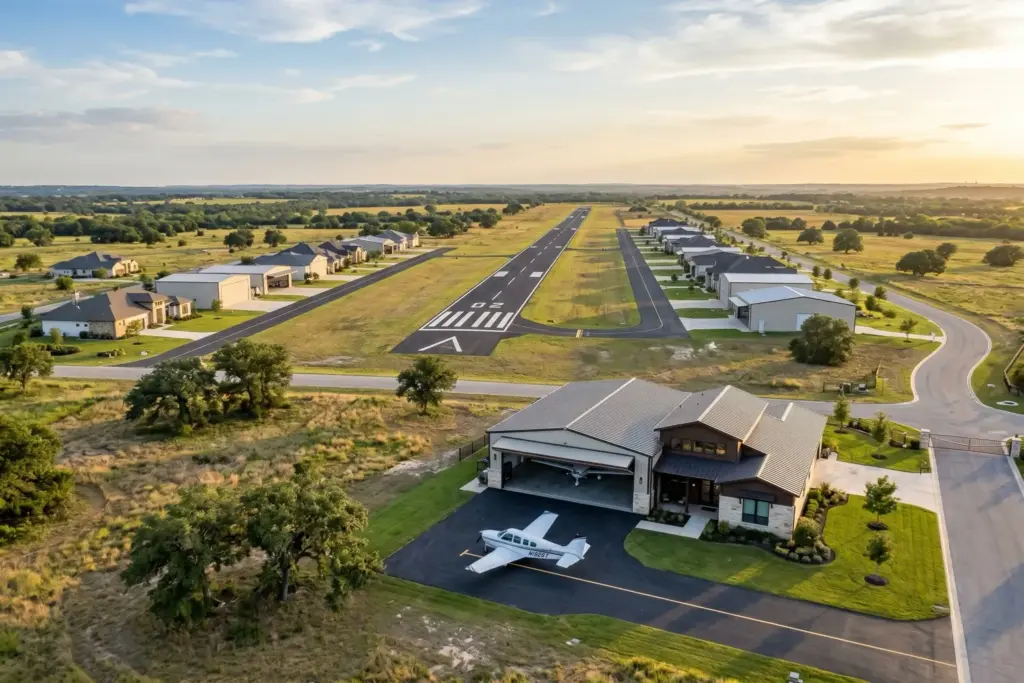
Georgetown Airpark is a brand-new gated fly-in community about 8 miles east of Georgetown, Texas, and unlike almost every other airpark within an hour of Austin, you can still buy a vacant lot here and build your own hangar home. Lots have been listed around $275,000 (as of mid-2026, verify current), and there’s a completed 2024 hangar home on Airpark Drive that’s been listed around $599,999. The community activated in July 2021, which in airpark years makes it practically a newborn.
Now here’s the first thing I have to clear up, because there are about six different “Georgetown” aviation places and people mix them up constantly. The community markets itself as Georgetown Airpark, but the FAA registers it as Randys Airpark, identifier TA68. Same place. Lets just get that straight up front so nobody books a flight to the wrong field.
I’m a pilot and a broker, which is a weirdly specific combination that comes in handy for exactly this kind of search. I’ve written about a bunch of these communities in my complete guide to airpark living, and I covered the older Georgetown fly-in community, Cross Country Estates, in its own post. Georgetown Airpark (TA68) is a different animal entirely, and the difference matters a lot depending on what kind of pilot you are. So lets walk through it.
What Georgetown Airpark Actually Is
Georgetown Airpark sits about 8 miles east of Georgetown, Texas, in Williamson County, ZIP 78626, at coordinates 30.6420N, 97.5200W and a field elevation of roughly 602 feet. You’re about 30 minutes from Austin, out on the quieter east side of Georgetown where it still feels rural even though the metro keeps creeping closer every year.
It’s privately owned, registered to EWMW, LLC, with Randall H. Brown listed as the manager (according to the FAA airport record on AirNav). The field is private use, prior permission required before landing, and it activated in July 2021. That activation date is the whole story here. Most of the airparks I cover have been around for 20 or 30 years and are completely built out. This one is still filling in. There are lots for sale. That alone makes it rare.
And no, this is not the city’s public airport. Not to be confused with Georgetown Executive Airport (KGTU), also called Johnny Gantt Field, which is the public-use city airport with two long asphalt runways (4,100 and 5,000 feet), a control tower, and a full FBO operation serving corporate jets. That’s a totally different place on the other side of town. Georgetown Airpark is a small private residential strip. You live there. You don’t just fly in for fuel.
The Runway: What the FAA Says vs What the Brochure Says
Ok lets talk about the strip, because for any pilot reading this, the runway is the whole ballgame.
The FAA record is the number I trust, and the FAA lists Runway 16/34 at 3,200 by 75 feet, asphalt, no tower, unattended. That’s the hard number. Write that one down.
The developer’s marketing tells a slightly different story, and this is worth flagging so you’re not confused when you read the listings. The community advertises a “3,300 by 50 foot” paved runway, a separate “1,000 by 50 foot” hard-surface RCA strip, and a “2,300 foot turf runway currently being completed.” Notice that the marketed paved runway (3,300 by 50) doesn’t quite match the FAA record (3,200 by 75). The official record says 3,200 by 75 asphalt. That’s not a scandal, airpark developers and the FAA database drift apart all the time, but it’s exactly the kind of thing I want a buyer to walk in and verify with their own eyes and tape measure before they close. The turf strip and the RCA strip are developer-stated and at least partly still in progress, so treat them as “planned” not “guaranteed” until you see them finished.
Either way, an asphalt runway in the 3,200-foot range is a meaningful upgrade over a 2,773-foot grass strip. At 602 feet field elevation on a hot Texas July afternoon, your density altitude can climb past 3,000 feet, which stretches out every ground roll you’ve got. On pavement with 3,200 feet to work with, a typical single-engine piston has comfortable margins even in summer. A well-flown light twin can make sense here too if you actually run your takeoff numbers every time, which you should be doing anyway. This is still not a jet field. If you’re flying a Citation, go use Georgetown Executive or look at one of the longer paved strips in my Central Texas fly-in communities guide.
One more thing. Asphalt changes the all-weather equation in a real way. Grass strips like Cross Country Estates have a rain rule, no operations within 24 hours of measurable rainfall, and in a wet Central Texas spring that can ground you for days at a time. A paved runway doesn’t care nearly as much about a Tuesday thunderstorm. If reliable access matters to you, that pavement is worth real money.
The Homes and the Lots: You Can Still Build Here
This is where Georgetown Airpark separates itself from almost everything else around Austin.
At most established airparks, the only way in is to wait for somebody to want out, and in a tight community of aviation households, that doesn’t happen often. Here, you’ve still got a blank canvas. As of mid-2026 (and please verify current status, these things move), vacant lots of an acre or more have been listed around $275,000, cleared and ready for you to build your own hangar home. Multiple lots have been on the market on Airpark Drive.
If you’d rather skip the build and move in, there’s been a completed example to look at. A 2-bed, 2-bath hangar home at 140 Airpark Drive, roughly 2,475 square feet, built in 2024, sitting on 1.16 acres, listed around $599,999. Gated community, covered parking, and a proper hangar bay attached to the house. That’s the turnkey version of the dream, somebody else dealt with the builder and the permits and the survey, and you just pull your airplane in.
If you’re going to build, understand the hangar piece before you fall in love with a lot. The hangar is what makes an airpark home an airpark home, and it’s also the part that confuses appraisers and lenders the most. I broke down what that construction actually runs in my post on hangar build costs and permits, and it’s worth reading before you sign anything. The short version: budget more than you think, and find people who’ve built on an airpark before.
For context, the broader Georgetown housing market had a median sale price of around $467,500 in May 2026 (based on data from our own database). A buildable airpark lot at $275,000 plus a custom hangar home is going to land well above that median, and it should, because you’re not buying a subdivision house with a two-car garage. You’re buying the ability to taxi out your back door. Maybe a hundred communities in the entire country can offer that.
Who Georgetown Airpark Is Actually For
So who buys here? In my experience it’s a specific kind of person, and it’s a little different from the grass-strip crowd.
The build-your-own option attracts pilots who want things their way. They want the hangar sized for the airplane they actually own (and the next one they’re already thinking about), the shop space laid out the way they like it, the house and the hangar designed together instead of bolted together. These are people who’ve maybe owned an airpark home before, know exactly what annoyed them about it, and want to fix all of that the second time around. The newer, gated, paved setup also pulls in folks who love aviation but don’t necessarily want to commit to grass-strip life with all its rain rules and soft-field landings.
It’s also a good fit for someone relocating to the Austin area who’s flying in from somewhere with real airpark inventory and is surprised to find there’s almost nothing for sale here. That’s the constant story I hear. Somebody moves to Central Texas, wants to keep their airplane at home like they did back in Florida or the Midwest, and discovers the established communities are full. Georgetown Airpark being new, with lots still available, is genuinely one of the only “yes you can still get in” answers I can give them.
The amenities lean modern, which fits the build-from-scratch vibe. The developer lists a gated entry, an equipped pavilion, a covered mail station, underground utilities, public water, high-speed fiber internet (a bigger deal out here than city people realize, rural Williamson County internet can be rough), and about five RV parking spaces with electric for guests. Verify what’s actually finished when you visit, same as the runway.
Georgetown Airpark vs Cross Country Estates: Two Very Different Runways
Here’s the comparison everybody in this exact search wants, because both communities sit east of Georgetown, both share the 78626 ZIP, and people constantly mash them together. They are not the same place, and I’d hate for you to drive to the wrong gate.
Cross Country Estates (07TS) is the old soul. It’s a 2,773-foot turf strip, 29 fully-built homes, every lot already developed, and zero vacancies. Tight-knit, grassroots, taildragger energy, the kind of place where the guy two doors down rebuilt his RV-7 in the garage. The catch is you can’t buy in unless someone decides to sell, and they rarely do. It’s the established club.
Georgetown Airpark (TA68) is the new build. Asphalt instead of grass, activated in 2021 instead of decades ago, gated with modern infrastructure, and most importantly, lots still for sale so you can build your own. It’s the blank canvas. Less history, more flexibility. No big deal right, just two completely different philosophies of airpark living sitting a few miles apart in the same county.
Neither one is better. They’re answers to different questions. If you want a finished community with character and you’re willing to wait years for a door to open, Cross Country Estates is your spot. If you want pavement, a gate, and the freedom to build it your way starting now, Georgetown Airpark is the one. (I’m a little jealous of anyone getting to design a hangar from scratch, honestly. That’s the fun part.)
What to Watch Before You Buy
A few things I’d want any buyer to think hard about before writing an offer here.
Verify the runway and amenities in person. The FAA says 3,200 by 75 asphalt. The brochure says 3,300 by 50 plus a turf strip and an RCA strip still being finished. Go see what’s actually built, measured, and usable today. Don’t buy on a rendering.
It’s a new community, so it’s still proving itself. A 2021 airpark doesn’t have 30 years of resale history to tell you how values hold up. That can cut both ways. Early can mean opportunity, and early can also mean you’re helping the place find its footing. Benjamin Graham’s whole thing about the margin of safety wasn’t just about stocks, the same logic applies to a young airpark with a thin resale record. Go in with eyes open and don’t overpay for a story.
Financing airpark homes is its own headache. Banks don’t really know what to do with hangars, and appraisers tend to give them minimal credit as outbuildings, which can leave your appraised value short of your purchase price. The buyer pool is small, so comps are thin. I see this on basically every airpark deal I touch. Read my guide to financing an airpark home before you assume a normal mortgage will work, and line up a lender who’s done this before.
Read the covenants and the PPR rules. It’s a private, gated field with prior-permission-required access. Understand who controls the runway, what the assessments are, and what you can and can’t build before you commit. You’re not just buying a lot, you’re joining a community with rules.
Frequently Asked Questions
Is Georgetown Airpark Right for You?
Either the idea of designing your own hangar home behind a gate on a fresh asphalt strip near Austin lights you up, or it doesn’t. If it does, Georgetown Airpark is one of the very few places in the entire Central Texas market where you can actually still do it, instead of waiting years for someone to sell. That’s the whole pitch, and it’s a real one.
If a brand-new community feels too unproven and you’d rather buy into something established, go read my Cross Country Estates writeup or the full Central Texas fly-in communities guide for the paved and grass alternatives across the region.
Want to talk through airpark properties or aviation real estate around Austin? I’m a pilot and a broker, so this is the exact kind of search I actually enjoy. Reach out to me and lets figure out which runway fits your life. Or call the office at (512) 366-3270.


