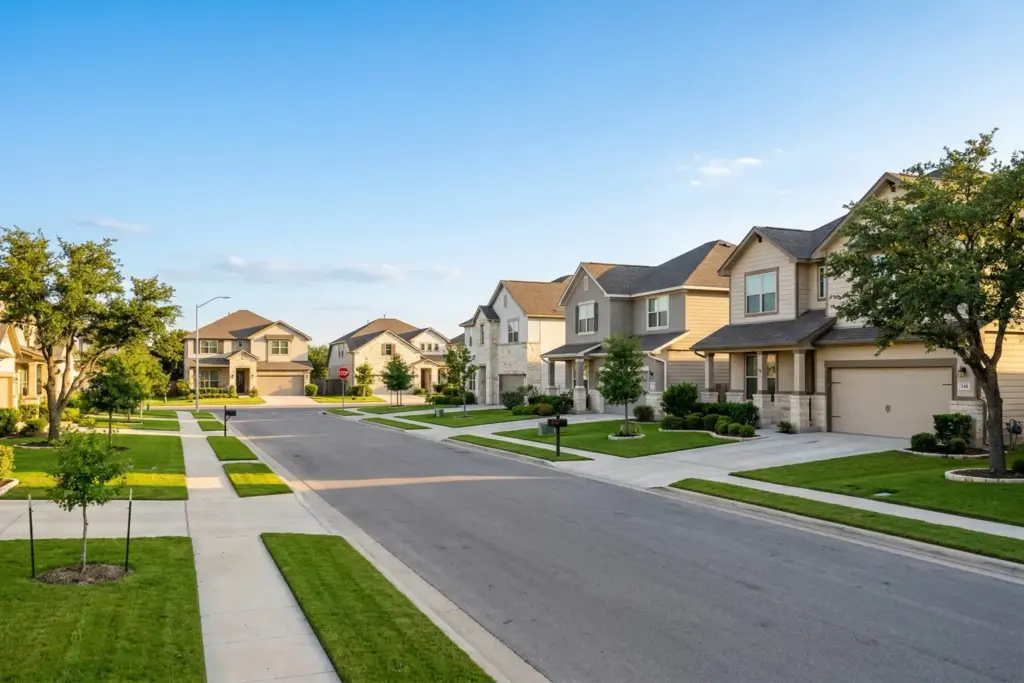
Austin’s median investment property purchase price sits at $399,000 for single-family homes in the $200,000 to $500,000 range, with 7,752 active residential listings across the metro as of March 2026. That combination of elevated inventory and softened prices has created what many investors consider the best entry window since 2019. Rental vacancy hit 9.92% in early 2025 (the highest in over a decade), but absorption is accelerating, and the market is projected to reach equilibrium by late 2026.
According to the Austin Board of Realtors and MLS data tracked by Neuhaus Realty Group, over 8,500 single-family homes closed in the $200,000 to $500,000 range across the Austin metro in just the last nine months. That volume tells you something: investors are active, and they are buying in specific pockets where the math works.
This guide covers every angle of buying investment property in Austin TX in 2026. Whether you are looking at long-term rentals, short-term vacation rentals, or a house hack to get started, the sections below walk through real numbers, financing options, tax strategy, legal requirements, and the neighborhoods where cash flow is actually achievable.
Why Austin for Investment Property in 2026
Austin has added roughly 180,000 residents since 2020. The tech sector (Tesla, Apple, Google, Oracle, Samsung) created a permanent demand floor for housing that did not exist a decade ago. But the investment case in 2026 is not about speculation or runaway appreciation. It is about buying at corrected prices with strong long-term fundamentals.
Three factors make Austin compelling for investors right now:
Price correction. The Austin metro saw a 15-20% decline from peak values in many submarkets between 2022 and 2025. A home that sold for $475,000 at the peak might trade for $399,000 today. That reset creates a margin of safety that did not exist two years ago.
Population growth. The Austin-Round Rock MSA continues to rank among the fastest-growing metros in the country, according to the U.S. Census Bureau. More people means more renters, more demand, and a floor under property values.
No state income tax. Texas has no state income tax on rental income. A rental property generating $24,000 per year in net income keeps all of that at the state level. Compare that to California (13.3%), New York (10.9%), or even Colorado (4.4%). The tax advantage alone is worth tens of thousands of dollars over a hold period.
The risk factors are real too. Property taxes in Texas run 1.7% to 2.1% of assessed value depending on your county and district. Insurance costs are climbing. And the rental market is still absorbing a wave of new apartment construction that pushed vacancy rates higher. None of those are deal-breakers, but they need to be in your underwriting.
Investment Strategy: Long-Term Rental vs. Short-Term Rental vs. House Hack
Before you shop for properties, you need to know which investment strategy you are running. The property type, location, financing, and tax treatment all change depending on your approach.
Long-Term Rentals (12-Month Leases)
This is the bread and butter of Austin real estate investing. You buy a single-family home or small multifamily, lease it to a tenant on a 12-month lease, and collect monthly rent. Cash flow is more predictable, management is simpler, and financing is straightforward.
Median single-family rents in the Austin metro range from $1,400 per month in Kyle and Manor to $2,200 or more in Cedar Park and Round Rock. The sweet spot for cash flow is a 3-bedroom, 2-bathroom home in the $300,000 to $400,000 range in a suburb with good schools and low crime.
The downside: long-term rental yields in Austin proper are thin. You are often looking at 4-6% gross yields, and after property taxes, insurance, maintenance, and vacancy, the cash-on-cash return can drop to 2-4%. The play here is appreciation plus principal paydown plus tax benefits, not pure cash flow.
Short-Term Rentals (Airbnb/Vrbo)
STRs can generate 30-80% more gross revenue than a long-term rental on the same property. A home that rents for $1,800 per month on a lease might generate $3,000 to $4,500 per month as a well-managed Airbnb in a desirable location. But the regulatory landscape in Austin is complicated (more on that in the STR regulations section below), and operational costs are significantly higher.
The best STR markets in the Austin metro are outside the city limits, where regulations are lighter. Dripping Springs, Wimberley, and Lakeway all offer strong STR potential with fewer licensing hurdles than Austin proper. For a deep dive on STR-specific investing, see our guide to finding high-ROI STR investments in Austin.
House Hacking
House hacking means buying a property, living in part of it, and renting out the rest. This could be a duplex (live in one unit, rent the other), a home with an ADU (accessory dwelling unit), or simply renting out spare bedrooms.
The advantage is financing. Owner-occupied loans (FHA, VA, conventional with 5% down) carry significantly lower rates and down payment requirements than investment property loans. You might put 3.5% down on an FHA loan versus 20-25% on an investment property loan. That difference on a $400,000 property is $14,000 versus $80,000 to $100,000 in cash.
Austin’s ADU rules in 2026 are relatively friendly. You can build a detached unit up to 1,100 square feet on most residential lots, which creates a genuine income-producing unit within an owner-occupied property. The catch: if you use the ADU as an STR, you trigger different licensing and tax requirements.
Austin Rental Market Data (2026)
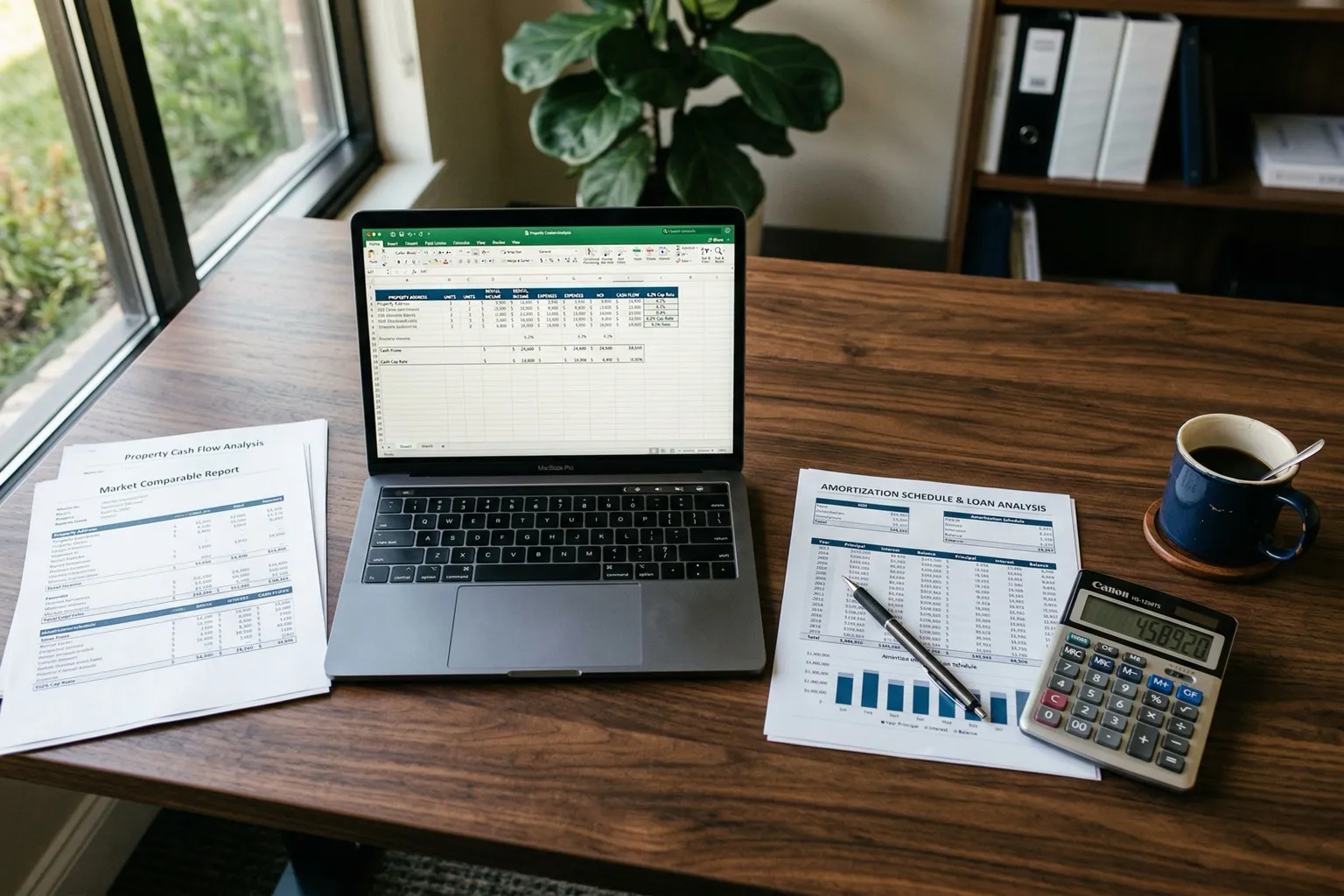
Understanding the rental market is the foundation of any investment property analysis. Here is what the data says in March 2026.
Apartment Market
According to data tracked by the Austin Apartment Association, the median apartment asking rent fell to approximately $1,357 across the metro, down from a peak of $1,659 in September 2022. That is an 18.2% decline from the top. Vacancy reached 9.92% in April 2025, the highest level in over a decade, driven by a surge in new construction (over 30,000 new apartment units delivered between 2023 and 2025).
Apartment vacancy is projected to retreat to the 6-7% range by late 2026 as new construction slows and population growth absorbs the excess supply. Many apartment operators are offering 6-12 weeks of free rent on new leases to fill units. That concession activity is a sign the bottom is close.
Single-Family Rental Market
Single-family rentals (SFR) have held up better than apartments. SFR vacancy in the Austin metro sits closer to 5-6%, and rents have been stickier because single-family tenants tend to stay longer and there is no direct competition from new apartment construction in suburban markets.
Here is what rents look like by area for a typical 3-bed/2-bath single-family home:
| City/Area | Median SFR Rent (3BR/2BA) | Median Purchase Price | Gross Yield Estimate |
|---|---|---|---|
| Kyle | $1,400 – $1,600 | $325,000 | 5.2% – 5.9% |
| Manor | $1,450 – $1,650 | $348,000 | 5.0% – 5.7% |
| Hutto | $1,500 – $1,700 | $345,000 | 5.2% – 5.9% |
| Taylor | $1,350 – $1,550 | $308,000 | 5.3% – 6.0% |
| Buda | $1,550 – $1,750 | $350,000 | 5.3% – 6.0% |
| Pflugerville | $1,650 – $1,850 | $385,000 | 5.1% – 5.8% |
| Round Rock | $1,700 – $1,900 | $385,000 | 5.3% – 5.9% |
| Georgetown | $1,700 – $1,900 | $388,000 | 5.3% – 5.9% |
| Austin (all) | $1,800 – $2,200 | $399,000 | 5.4% – 6.6% |
| Cedar Park | $1,800 – $2,100 | $400,000 | 5.4% – 6.3% |
These gross yields are before property taxes, insurance, maintenance, property management, and vacancy reserves. Net yields typically run 1.5-2.5% lower than gross, which is why many investors in Austin are playing for the combination of modest cash flow, long-term appreciation, and tax benefits rather than pure income.
Cap Rates and Where the Numbers Work
Cap rate (net operating income divided by purchase price) is the most common metric for comparing investment properties. Austin’s metro-wide cap rate averaged 3.23% in early 2025, according to analysis by Team Price Real Estate. That number sounds low, and it is, but it is a blended average that includes luxury properties and appreciation-play neighborhoods where nobody expects cash flow.
The actual cap rates investors are achieving vary dramatically by zip code and property type.
Best Cap Rate Zip Codes in the Austin Metro
| Zip Code | Area | Estimated Cap Rate | Why It Works |
|---|---|---|---|
| 78725 | East Austin / Del Valle | 5.8% – 6.5% | Low purchase price, strong tenant demand from airport/logistics workers |
| 78619 | Driftwood | 5.5% – 5.9% | Moderate prices, STR potential, Hill Country appeal |
| 78640 | Kyle | 5.2% – 6.0% | Lowest median price in metro, strong renter demand, new construction |
| 78660 | Pflugerville | 5.0% – 5.8% | Tech corridor, good schools, strong tenant pool |
| 78626 | Georgetown (west) | 5.0% – 5.7% | Retiree demand, Sun City proximity, stable rents |
| 78653 | Manor | 5.0% – 5.8% | Samsung fab proximity, affordable housing stock |
| 78634 | Hutto | 5.0% – 5.8% | New construction, growing school district, affordability |
| 78681 | Round Rock | 4.8% – 5.5% | Dell/Apple corridor, strong schools, stable tenant demand |
A “good” cap rate for a single-family rental in Austin is generally 5-7%. Getting above 7% usually means you are in a C-class neighborhood, accepting higher maintenance costs and tenant turnover. Below 4% means you are paying for appreciation potential and accepting negative or break-even cash flow in the short term.
For a deeper analysis with specific deal breakdowns, see How to Buy Investment Property in Austin 2026 and our Hill Country investment property analysis.
Running the Numbers: A Sample Deal
Theory is nice. Numbers are better. Here is what an actual investment property deal looks like in the Austin metro in 2026.
The property: 3-bedroom, 2-bathroom single-family home in Kyle, TX 78640. Built 2018, 1,650 square feet, purchased for $335,000.
| Line Item | Monthly | Annual |
|---|---|---|
| Gross Rent | $1,550 | $18,600 |
| Vacancy (6%) | ($93) | ($1,116) |
| Effective Gross Income | $1,457 | $17,484 |
| Property Taxes (1.9%) | ($530) | ($6,365) |
| Insurance | ($175) | ($2,100) |
| Property Management (8%) | ($117) | ($1,399) |
| Maintenance Reserve (5%) | ($78) | ($930) |
| HOA (if applicable) | ($35) | ($420) |
| Net Operating Income (NOI) | $522 | $6,270 |
| Mortgage (7%, 30yr, 25% down) | ($1,671) | N/A |
| Pre-Tax Cash Flow | ($1,149) | N/A |
Wait. Negative cash flow?
Yes. At 7% interest rates with 25% down on a conventional investment property loan, many Austin deals are cash-flow negative on paper. This is the reality of investing in a high-growth metro in a higher-rate environment.
But the full picture includes three other return sources:
- Principal paydown: Approximately $2,552 in year one goes toward principal, building equity.
- Depreciation tax benefit: The $335,000 property (minus land value of roughly $70,000) gives you approximately $9,636 in annual depreciation, which offsets rental income and potentially other income. At a 32% marginal tax rate, that is worth $3,084 in tax savings.
- Appreciation: Even conservative 3% annual appreciation on a $335,000 property adds $10,050 in equity per year.
Total return picture: the monthly negative cash flow of roughly $1,149 works out to $13,788 per year in losses. But principal paydown ($2,552) plus tax savings ($3,084) plus appreciation ($10,050) totals $15,686 in wealth building. The net result is roughly $1,898 in positive total return despite the negative cash flow. And when rates drop (or you refinance with a DSCR loan at 6%), the cash flow picture improves immediately.
That math is why Austin investors keep buying. The cash flow alone does not justify the purchase, but the total return does.
Financing Investment Property in Austin
How you finance an investment property changes everything: the down payment, the rate, the cash flow, and even the tax treatment. Here are the main options for Austin investors in 2026.
Conventional Investment Property Loans
The most common path. You qualify based on your personal income, credit score, and existing debt. Rates for investment properties typically run 0.5-0.75% higher than primary residence rates.
| Requirement | Details |
|---|---|
| Down payment | 15-25% (most lenders require 20-25% for SFR, 25% for 2-4 unit) |
| Credit score | 680+ preferred (some accept 620 at higher rates) |
| Reserves | 6 months PITI per financed property |
| DTI ratio | 45% max (rental income counted at 75%) |
| Current rates | 6.75% – 7.25% (March 2026) |
| Property limit | Up to 10 financed properties (with Fannie Mae) |
The advantage: lowest available rates. The disadvantage: your personal income and DTI must support the loan, which creates a ceiling on how many properties you can acquire. For a detailed breakdown of mortgage options, see our Complete Guide to Getting a Mortgage in Austin.
DSCR Loans (Debt Service Coverage Ratio)
DSCR loans are the game-changer for investors scaling a portfolio. Instead of qualifying based on your personal income, DSCR loans qualify based on the property’s rental income relative to the debt service (mortgage payment + taxes + insurance).
A DSCR of 1.0 means the property’s rent exactly covers the debt service. A DSCR of 1.25 means the property generates 25% more income than needed to cover the payments. Most lenders require a minimum DSCR of 1.0 to 1.2.
| Requirement | Details |
|---|---|
| Down payment | 20-25% |
| Credit score | 660+ minimum |
| Income verification | None required (no W-2s, no tax returns) |
| DSCR minimum | 1.0 – 1.2 |
| Reserves | 3-6 months PITI |
| Current rates | 5.875% – 6.625% (March 2026) |
| Property limit | No limit on number of properties |
DSCR loan rates have dropped significantly from 8-9% in 2024 to the 6% range in 2026. At these rates, many Austin suburban properties now qualify with a DSCR above 1.0. The no-income-verification feature is particularly valuable for self-employed investors, those with complex tax returns, or investors scaling past the 10-property Fannie Mae limit.
Portfolio and Commercial Loans
Local banks and credit unions offer portfolio loans (held on their own books rather than sold to Fannie/Freddie) with more flexible underwriting. These are useful for non-standard properties (commercial, mixed-use, large multifamily) or borrowers who do not fit conventional or DSCR boxes.
Rates are typically 0.5-1.5% higher than conventional, with shorter terms (5-10 year balloon periods are common). The benefit is flexibility: many portfolio lenders will finance properties that do not meet agency guidelines.
FHA and VA for House Hackers
If you plan to live in the property, FHA (3.5% down, 580+ credit) and VA (0% down for eligible veterans) loans are available for 1-4 unit properties. This is the most capital-efficient way to acquire investment property, but you must occupy one unit as your primary residence for at least 12 months.
A duplex in Austin purchased with an FHA loan for $375,000 requires just $13,125 down. If the other unit rents for $1,400 per month, you have effectively reduced your housing cost to near zero while building equity in a two-unit property. After 12 months, you can move out and rent both units. For more on VA financing specifically, see our VA loan guide for Austin.
Austin Short-Term Rental Regulations (2026)
If you are considering an STR investment in Austin, you need to understand the regulatory framework before you buy. Austin has a reputation for being closed to STR investors that the current rules do not support. The city rewrote its framework in 2025, and the direction was toward simpler licensing, not tighter limits.
STR License Types
The City of Austin recognizes three types of short-term rental licenses, according to Austin Development Services:
- Type 1: Owner-occupied. You live in the home and rent out part of it (a room, a casita, an ADU) while you are present. Available in all residential zones. Easiest to obtain.
- Type 2: Non-owner-occupied, whole-home rental. The classic Airbnb investment property model. Since February 2025 these are allowed as an accessory use in every residential zoning district. There is no citywide cap. The limits are two STRs per site, and a 1,000-foot separation between the separate sites a single operator runs, which does not apply between different owners.
- Type 3: Non-owner-occupied STR in a multifamily building or condo. An operator may run the greater of one unit or 10% of the units that operator owns or leases at the site, rising to 25% where the site includes a commercial use.
What Changed in 2025-2026
Since July 1, 2026, online platforms like Airbnb and Vrbo must display a valid license number on every Austin listing, must remove unlicensed listings within 10 days of a city notice, and cannot collect fees on unlicensed bookings. Enforcement is phased rather than immediate: the city paused delist notices for six months following its May 18, 2026 licensing system launch and is phasing requests in groups, starting with properties that have generated nuisance complaints. Additionally, as of October 2025, all STR licenses are valid for two years instead of one.
Hotel Occupancy Tax (HOT) applies to all STRs at 17% total (11% city + 6% state) (Source). This is collected and remitted by the platforms for most hosts, but you are responsible for verifying compliance.
For a comprehensive breakdown of STR regulations and how they affect your investment, see what investors need to know about Austin STR changes and our legal guide to protecting your STR investment.
The Alternative: Invest Outside Austin City Limits
Plenty of investors buying STR properties in the Austin area purchase outside the city limits, where regulations are lighter or nonexistent. That is a preference for less paperwork, not a necessity. Dripping Springs, Wimberley, Canyon Lake, and parts of unincorporated Travis and Hays counties have far fewer restrictions. Some areas require a basic permit; many require nothing at all beyond standard property ownership and tax remittance.
Our analysis of Hill Country investment properties covers the specific areas where STR numbers work best.
Property Taxes and How They Affect Your Returns
Texas property taxes are among the highest in the nation, and they are the single biggest expense for Austin investment property owners. There is no getting around this, so you need to account for it accurately in every deal analysis.
Effective Tax Rates by County
| County | Effective Tax Rate (2026) | Annual Tax on $350,000 Home |
|---|---|---|
| Travis County (Austin, Bee Cave, Lakeway) | 1.65% – 2.10% | $5,775 – $7,350 |
| Williamson County (Round Rock, Cedar Park, Georgetown) | 1.68% – 2.00% | $5,880 – $7,000 |
| Hays County (Kyle, Buda, Dripping Springs) | 1.75% – 2.05% | $6,125 – $7,175 |
Those ranges reflect the variation within each county. Your exact rate depends on which school district, MUD (Municipal Utility District), PID (Public Improvement District), and other taxing entities overlay your property. MUD rates alone can add $0.25 to $1.50 per $100 of assessed value, which translates to $875 to $5,250 per year on a $350,000 property. For a detailed explanation of how MUDs and PIDs affect your tax bill, see how MUD and PID districts affect your property tax.
Investment Properties Do Not Get the Homestead Exemption
This is a critical distinction. Owner-occupied homes in Texas qualify for a $140,000 homestead exemption on the school district portion of property taxes, plus additional exemptions from the county and city (Source). Investment properties do not. That means your investment property will be taxed on the full assessed value with no exemptions, no 10% annual appraisal cap, and no protections from large valuation increases.
Protesting your property tax appraisal every year is not optional for investors. It is a required part of the business. Most Austin investors either file their own protests (free, time-consuming) or hire a property tax consultant (typically 30-40% of any savings achieved, no savings means no fee).
Tax Benefits and Depreciation Strategy
The tax advantages of owning rental property are substantial, and in 2026, they are better than they have been in years thanks to the restoration of 100% bonus depreciation.
Standard Depreciation (27.5 Years)
The IRS allows you to depreciate the value of residential rental property (excluding land) over 27.5 years. On a $350,000 property with $75,000 in land value, that is $275,000 divided by 27.5, equaling $10,000 per year in depreciation. This is a “paper loss” that offsets your rental income without any actual cash outflow.
If your rental property generates $6,000 in net operating income but $10,000 in depreciation, you show a $4,000 loss on your taxes. If you qualify as a real estate professional (750+ hours per year in real estate activities), that loss can offset your W-2 or other active income. If you do not qualify, passive losses carry forward and offset future rental income or are used when you sell.
100% Bonus Depreciation and Cost Segregation
The One Big Beautiful Bill Act, signed into law on July 4, 2025, permanently reinstated 100% bonus depreciation for qualifying property acquired after January 19, 2025. This is a major win for real estate investors.
A cost segregation study breaks a property into component categories: 5-year property (appliances, carpeting, certain fixtures), 7-year property (office furniture, equipment), and 15-year property (landscaping, driveways, sidewalks). Instead of depreciating these components over 27.5 years, you can deduct 100% of their value in the year the property is placed in service.
On a $350,000 purchase, a cost segregation study might reclassify $60,000 to $90,000 worth of components into accelerated categories. That means a first-year depreciation deduction of $60,000 to $90,000 (versus just $10,000 under standard depreciation). At a 32% marginal tax rate, that is $19,200 to $28,800 in tax savings in year one.
Cost segregation studies typically cost $3,000 to $7,000 and pay for themselves many times over. For a real-world example of how an Austin investor used this strategy, see the $50,000 tax play with a Wimberley STR. For more on bonus depreciation for STR investors specifically, see our bonus depreciation guide.
1031 Exchange
When you sell an investment property, you can defer capital gains taxes by reinvesting the proceeds into a “like-kind” property through a 1031 exchange. The rules are strict (45 days to identify replacement property, 180 days to close), but this strategy allows investors to compound wealth across properties without triggering tax events. Many long-term Austin investors roll from one property to the next over decades, deferring millions in capital gains.
Entity Structure: LLC, Series LLC, and Asset Protection
Should you hold investment property in an LLC? For most Austin investors, the answer is yes, eventually. But the timing and structure matter.
Why Use an LLC
- Liability protection. If a tenant or visitor is injured on your property and sues, an LLC limits their claim to the assets within that entity. Your personal home, bank accounts, and other investments are protected (assuming you maintain the LLC properly).
- Tax flexibility. LLCs are pass-through entities by default, meaning income and losses flow to your personal return. No double taxation.
- Estate planning. Transferring ownership interests in an LLC is simpler than deeding real property. This matters when you want to bring in partners, gift ownership to heirs, or restructure your portfolio.
Series LLC (Texas Advantage)
Texas allows Series LLCs, which are extremely useful for investors with multiple properties. A Series LLC has a “parent” entity with individual “series” underneath. Each series operates as a separate liability compartment, according to Texas Business Organizations Code Section 101.602. A lawsuit involving Property A in Series 1 cannot reach the assets of Property B in Series 2 or Property C in Series 3.
The cost savings are significant. Instead of forming and maintaining a separate LLC for each property ($300 filing fee per entity, plus annual franchise tax only on entities above the no-tax-due revenue threshold), you form one Series LLC ($300 filing fee) and create individual series as you acquire properties. Annual maintenance costs drop from potentially thousands of dollars (for 5-10 separate LLCs) to a few hundred dollars for one Series LLC.
The Financing Complication
Most conventional and DSCR lenders require the property to be in your personal name at closing. You can transfer to an LLC afterward, but this technically triggers the “due on sale” clause in your mortgage. In practice, lenders rarely enforce this on transfers to your own LLC, but the risk exists. Some investors use a land trust with the LLC as beneficiary to add a layer of separation. Others use portfolio or commercial lenders who lend directly to the LLC.
Consult a Texas real estate attorney before structuring your entities. The wrong setup can leave gaps in your protection or create unnecessary tax complications.
Texas Landlord-Tenant Law: What Investors Need to Know
Texas is generally considered landlord-friendly compared to states like California or New York, according to the Texas Attorney General’s office. Here are the key provisions investors should understand.
Security Deposits
There is no statutory limit on security deposit amounts in Texas. Most landlords collect one month’s rent. You must return the deposit (minus itemized deductions for damages beyond normal wear and tear) within 30 days of the tenant vacating and providing a forwarding address.
Eviction Process
Senate Bill 38 (SB 38), effective January 1, 2026, restructured the Texas eviction process to be faster and more uniform statewide. The basic timeline:
- 3-day notice to vacate for non-payment of rent (or as specified in the lease)
- File eviction suit in Justice of the Peace court
- Court hearing scheduled within 10-21 days of filing
- Judgment issued, tenant has 5 days to appeal
- Writ of possession issued if no appeal, tenant removed by constable
Total timeline from notice to possession: typically 3-6 weeks. This is significantly faster than most states. Self-help evictions (changing locks, shutting off utilities, removing belongings) are illegal in Texas and will result in liability.
Lease Requirements
Texas does not mandate a specific lease form, but the Texas Real Estate Commission (TREC) and Texas Apartment Association (TAA) provide widely used templates. Your lease should include: authorized agent contact, late fee provisions (Texas allows them after a grace period), pet policies, maintenance responsibilities, and early termination clauses.
No Rent Control
Texas preempts local rent control ordinances. No city in Texas can impose rent control, cap rent increases, or limit how much you charge. You can raise rent at lease renewal to whatever the market will bear. This is a significant advantage for long-term investors in a growing market.
Property Management: Self-Manage or Hire Out
Property management is the operational decision that most affects your experience as an investor. Both self-management and professional management have clear advantages and trade-offs.
Self-Management
If you live in the Austin area and own 1-3 properties, self-management is viable. The work includes tenant screening, lease execution, rent collection, maintenance coordination, and occasional emergencies. Budget 5-10 hours per month per property for a well-maintained home with good tenants.
The financial benefit: saving 8-10% of gross rent. On a property renting for $1,700 per month, that is $136 to $170 per month, or $1,632 to $2,040 per year. If you are just barely cash-flow positive, that savings can be the difference between positive and negative returns.
Professional Property Management
Austin property management companies typically charge 8-10% of collected rent plus a leasing fee of 50-100% of one month’s rent for placing a new tenant. Some also charge maintenance markups (10-20% on top of vendor invoices) and lease renewal fees ($150-$300).
Professional management makes sense when you have 4+ properties, live out of state, or simply value your time more than the management fee. The key is finding a manager with a strong tenant screening process (credit, income verification, rental history), transparent accounting, and responsive maintenance coordination.
For strategies on maximizing your returns with or without a property manager, see our guide to maximizing rental income from your investment property.
Insurance for Investment Property
Homeowners insurance does not cover investment properties. You need a landlord policy (also called a dwelling fire policy or DP-3 policy) that covers the structure, liability, and loss of rental income.
What Landlord Insurance Covers
- Structure coverage: Damage to the building from fire, storms, hail, and other covered perils
- Liability: If someone is injured on the property, coverage for legal defense and settlements
- Loss of rental income: If the property becomes uninhabitable due to a covered event, the policy reimburses lost rent during repairs
What It Does Not Cover
- Tenant belongings (that is renter’s insurance, which you should require in your lease)
- Flood damage (requires a separate flood policy, even if you are not in a FEMA flood zone)
- Mold, in most policies
- Intentional damage by tenants
Cost Expectations
Landlord insurance in the Austin area runs approximately $1,800 to $2,400 per year for a $350,000 single-family rental, depending on the age of the property, roof condition, claims history, and proximity to fire hydrants. Properties with pools, trampolines, or aggressive dog breeds may face higher premiums or exclusions. Adding an umbrella policy ($1 million to $2 million in additional liability coverage) costs roughly $200 to $400 per year and is strongly recommended for landlords.
Best Neighborhoods for Investment Property in Austin (2026)
Not all neighborhoods are created equal for investment purposes. Ed Neuhaus, broker of Neuhaus Realty Group, notes that the strongest cash-flow neighborhoods in the Austin metro share three characteristics: low purchase price relative to rent, strong tenant demand from nearby employers, and limited new rental construction that would dilute occupancy.
Here is where the numbers are most compelling in 2026:
For Cash Flow
Kyle remains the strongest cash-flow market in the Austin metro. Median closed prices of $325,000 combined with rents of $1,400 to $1,600 produce the highest gross yields in the area. Kyle is 20 minutes south of downtown Austin on I-35, with growing retail, new schools, and strong tenant demand from commuters and Samsung factory workers.
Hutto is similar to Kyle but on the northeast side. Median prices around $345,000, strong new construction pipeline, and proximity to the Samsung semiconductor campus in Taylor. Hutto ISD is growing rapidly, which supports tenant demand from relocating workers.
Manor sits east of Austin with median prices around $348,000. The Tesla Gigafactory and Austin-Bergstrom International Airport are both within 20-30 minutes, creating a stable blue-collar and logistics-sector tenant base. Yields here are among the highest in the metro.
For Appreciation
Cedar Park and Leander offer a blend of moderate cash flow and strong appreciation potential. The Apple campus, Leander ISD (consistently rated among the best in the metro), and the toll road network make this corridor attractive to higher-income renters. Prices in the $375,000 to $400,000 range are still accessible, but rent growth potential is higher than cheaper markets.
Georgetown is one of the fastest-growing cities in Texas and has been for several years. Sun City (the 55+ Del Webb community) creates consistent demand for both home purchases and rentals. Georgetown’s charming downtown square, strong job growth, and Williamson County schools make it a solid long-term appreciation play.
For STR Investment
Dripping Springs is the wine country of Austin, with dozens of wineries, event venues, and a growing restaurant scene. Properties here can generate strong weekend and event-season STR revenue. Median prices are higher ($664,000), so the numbers only work if you hit high occupancy rates. For investors targeting STR specifically in the Hill Country, our Wimberley STR investment guide covers another strong market.
Common Mistakes Austin Investment Property Buyers Make
After nearly two decades working with investors in the Austin market, Neuhaus Realty Group has seen the same mistakes repeatedly. Here are the ones that cost real money.
1. Underestimating Property Taxes
New investors from California, Florida, or other low-property-tax states are frequently shocked by Texas tax bills. A $400,000 investment property in a MUD district can easily face $8,000 to $10,000 per year in property taxes. That is $667 to $833 per month, often the largest single expense after the mortgage. Always verify the exact tax rate and MUD/PID overlay for any property before making an offer.
2. Buying for Appreciation Only
Austin appreciated wildly from 2020 to 2022, and some investors bought expecting that trajectory to continue indefinitely. When prices corrected 15-20%, those investors were stuck with negative cash flow and declining equity. Buy properties that at least break even on cash flow (or close to it), and treat appreciation as a bonus, not the investment thesis.
3. Ignoring the Insurance Spike
Texas homeowners insurance premiums have risen 30-50% since 2022. A property that penciled out with $150 per month in insurance may now cost $200 or more. Always get a current insurance quote before closing, and budget for 5-10% annual increases.
4. Not Accounting for Vacancy
The Austin rental market has more supply than it did two years ago. Budget 6-8% vacancy for long-term rentals (roughly 3-4 weeks per year of turnover between tenants). For STRs, budget 25-35% vacancy depending on the market and season.
5. Skipping the Professional Inspection
Investment properties in Texas face the same structural and mechanical issues as any other property: foundation settling on expansive clay soils, HVAC systems stressed by 105-degree summers, plumbing issues in older homes. A $400-$600 professional inspection can save you $10,000 or more in surprise repairs.
6. Overleveraging in a High-Rate Environment
Buying five properties at 7% with 25% down each is a path to cash-flow crisis if vacancy or maintenance costs spike. Scale gradually. Make sure each property can survive a bad quarter without jeopardizing your personal finances.
Building a Portfolio: Scaling from 1 to 10 Properties
Most Austin real estate investors start with one property and grow over time. Here is a realistic scaling path.
Property 1 (Year 1): House hack. Buy a duplex or home with ADU using owner-occupied financing (FHA or conventional with 5% down). Live in one unit, rent the other. Build equity and learn the landlord business with minimal capital outlay.
Property 2 (Year 2-3): Move out of the first property and convert it to a full rental. Buy your next primary residence (again with low-down-payment financing). You now have two rentals.
Properties 3-4 (Year 3-5): Use conventional investment property financing (20-25% down) for the next two. Cash flow from the first two properties plus your savings funds the down payments. You are now at four units with two conventional investment loans.
Properties 5-10 (Year 5-10): Transition to DSCR financing. As your portfolio grows, conventional lenders tighten (higher reserves, more scrutiny past 4 financed properties). DSCR loans let you qualify based on property income alone, removing the personal income ceiling. Use equity from appreciating properties (cash-out refinance or HELOC on your primary residence) to fund down payments.
At 10 properties with an average value of $375,000, you control $3.75 million in real estate with roughly $750,000 to $937,500 in equity (assuming 20-25% down payments). Annual depreciation alone could exceed $100,000, sheltering significant income from taxes.
This is not a get-rich-quick plan. It is a decade-long wealth-building strategy that requires patience, discipline, and the willingness to manage risk. For more on the long-term wealth-building approach, see our article on building wealth through multifamily homes.
Frequently Asked Questions
Related: For a deep dive into short-term rental investing specifically, including Austin licensing, revenue projections, and the STR tax loophole, read our Complete Guide to Airbnb and Short-Term Rental Investing in Austin (2026).
Related: Before purchasing your next investment property, review our Complete Guide to Real Estate Entity Structure in Texas (2026) to understand LLC formation, Series LLCs, DSCR financing in an LLC, and multi-property structuring strategies.
Getting Started: Your Next Steps
Investment property in Austin is not a passive activity. It requires research, accurate underwriting, solid financing, and ongoing management. But the long-term wealth-building potential is real: appreciation in a growing metro, tax advantages that shelter income, and a landlord-friendly legal environment that protects your investment.
If you are ready to explore investment property in the Austin area, start by defining your strategy (long-term rental, STR, or house hack), getting pre-approved with a lender who understands investment property financing, and identifying neighborhoods where the rental math works for your goals.
Contact Neuhaus Realty Group for a personalized investment property analysis. The team specializes in Austin and the Texas Hill Country, with MLS data access and local market knowledge to help you identify properties where the numbers actually work.