 Ed Neuhaus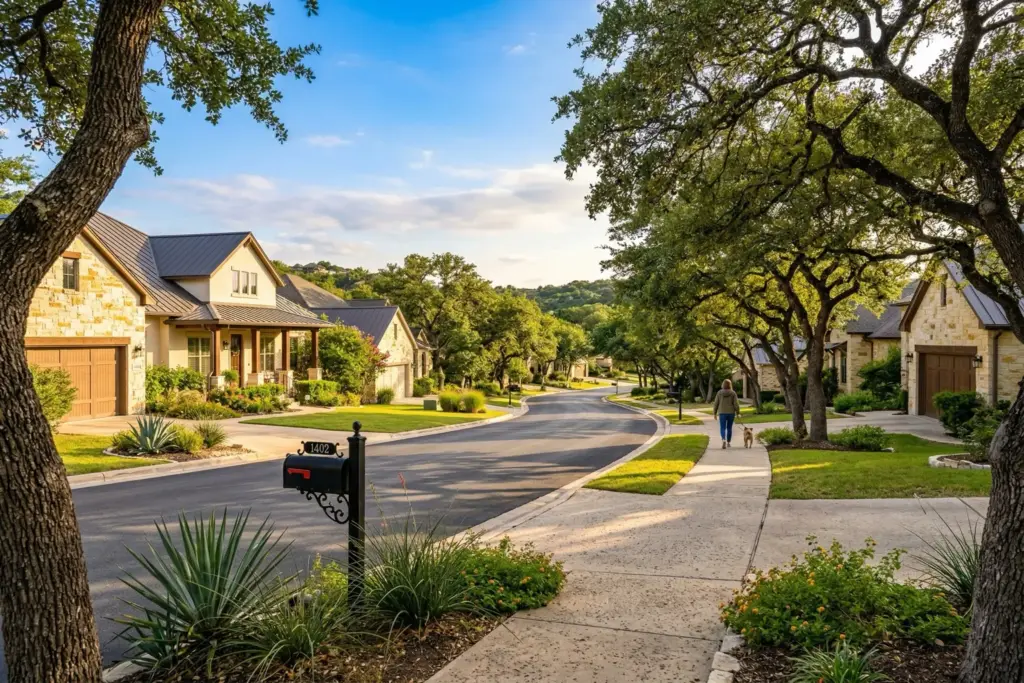
59% of homebuyers say neighborhood quality is the single biggest factor in their purchase decision, according to NAR’s 2025 Generational Trends Report. Not the kitchen. Not the backyard. The neighborhood. And if you’re relocating to a city you’ve never lived in, that’s a problem, because you have zero frame of reference for what “good neighborhood” actually means in that market.
I get this call probably twice a week. Someone from California or Colorado or Chicago says “Ed, we’re moving to Austin, where should we look?” And my honest answer is always the same: I can’t tell you where to live until we figure out how you live. But I CAN give you a research framework that will cut months off the learning curve. So lets walk through it.
This is the exact process I walk buyers through on that first phone call. Eight steps, in order, and the order matters.
Start with Commute Mapping (Not Zip Codes)
Most people start their neighborhood search by Googling “best neighborhoods in [city]” and reading listicles. That’s backwards. Start with where you need to be five days a week.
Open Google Maps, type in your workplace address, and set the arrival time for 8:00 AM on a Tuesday. Not a Saturday. Not “leave now.” Tuesday at 8 AM. Google Maps uses historical traffic data to predict drive times at specific hours, and the difference between a Sunday afternoon and a Tuesday morning is often 60% or more. I’ve seen buyers fall in love with a neighborhood that’s “only 20 minutes from downtown” based on a weekend visit, and then discover it’s 55 minutes during rush hour. That’s a deal breaker for most people right.
Here’s the framework: draw a 30-minute rush hour commute radius from your workplace. Everything inside that circle is in play. Everything outside it needs a really compelling reason.
For Austin specifically, this exercise is revealing. If you work downtown, Bee Cave and Lakeway look close on a map but can be 40-50 minutes at 8 AM on 360 or MoPac. If you work in the Domain area, Cedar Park and Round Rock are suddenly 15-minute drives. Geography lies. Traffic tells the truth.
And if you’re remote, congratulations. Skip this step and start with step two. But even remote workers should think about the commute to the places they’ll actually go three times a week: gym, grocery store, kids’ school. That adds up faster than you think. (We wrote a whole guide for remote workers relocating to Austin if that’s you.)
School Ratings Matter Even If You Don’t Have Kids
I know, I know. You don’t have kids, you’re not planning to have kids, so why would you care about schools. Because your future buyer does.
Homes near top-rated schools (a 9 or 10 on GreatSchools) sell for 78% more than comparable homes in surrounding areas, according to Opendoor’s 2025 market analysis. The National Bureau of Economic Research found that every dollar spent on public schools raises nearby home values by $20. That’s not a lifestyle preference. That’s a math equation.
So even if you’ll never set foot in the local elementary school, the quality of that school is directly connected to your home’s resale value. Check the TEA (Texas Education Agency) ratings if you’re buying in Texas. A school’s letter grade (A through F) is public information and takes about 30 seconds to look up.
Here in the Austin area, this creates some interesting dynamics. Eanes ISD (Westlake) and Lake Travis ISD are consistently top-rated, which is a big part of why home prices in those districts hold up even in soft markets. Meanwhile some Austin ISD zones have incredible homes at lower price points but D and F rated schools, which limits your buyer pool when you sell. It’s worth understanding that tradeoff before you buy, not after.
And yeah, I send my own kids to Lake Travis ISD. So I’m not just reading about this, I’m living it. If you want the deep dive, we’ve written a full breakdown of how school districts affect home values.
Walkability and the 10-Minute Test
Walk Score gets thrown around a lot, and it’s a decent starting point. But here’s what I actually tell my buyers to do: open Google Maps in satellite view, drop a pin on the house you’re considering, and draw a mental 10-minute drive radius. What’s inside that circle?
Grocery store? Coffee shop? A restaurant you’d actually eat at on a Tuesday night? A park? If the answer to most of those is no, you’re going to spend a LOT of time in your car. And the novelty of a big lot and quiet street wears off fast when you’re driving 25 minutes to buy milk.
This matters more than people think. I’ve helped buyers relocate to Dripping Springs who loved the property but underestimated how far they’d be from basic amenities. Two years later they’re listing and moving closer in. And I’ve helped people move to Bee Cave who thought it’d feel too suburban and discovered the Hill Country Galleria and 620 corridor had everything they needed within 10 minutes. You can read our Dripping Springs vs Bee Cave vs Lakeway comparison for the full picture.
The walkability question is really about trajectory too. Is the area adding restaurants and retail, or losing them? A neighborhood with three new restaurants under construction is a totally different bet than one where storefronts are going dark.
The Vibe Check: Saturday Morning AND Tuesday at 6 PM
Ok so this is where the internet can’t help you. You need boots on the ground.
Every neighborhood has two personalities. The Saturday morning version where people are walking dogs, kids are on bikes, someone’s mowing the lawn. And the weekday evening version where the commuters are home, the street parking fills up, and you hear what the noise level actually is.
Visit both.
Drive the neighborhood at 8 AM on a Saturday. Are people outside? Is there activity? Does it feel alive or does it feel like everyone’s somewhere else? Then come back on a Tuesday at 6 PM. How’s the parking? Is the traffic from the main road bleeding into the neighborhood? Are the kids playing in yards or is everyone locked inside?
I’ll be honest, most buyers skip this step. They see a house they love on a Saturday afternoon showing and make an offer by Sunday. And sometimes that works out. But I’ve had clients discover after closing that the house backs up to a busy road that sounds like a highway after 5 PM. Or that the neighbor runs a home business with client traffic all day. A second visit at a different time would’ve caught both of those.
Benjamin Graham’s whole thing was “margin of safety.” You don’t just want something that looks good, you want enough evidence that it’ll STILL look good when conditions change. Same principle here. A neighborhood that passes the vibe check at two different times on two different days has a margin of safety. One that only passes when you happen to visit? Not so much.
The Weekend Test Drive
If you’re seriously considering a neighborhood, spend a full day there before you make an offer. Not “drive through on the way to a showing.” A full day.
Here’s what I mean. Go to the coffee shop at 8 AM. Walk the neighborhood. Eat lunch at the nearest restaurant. Go to the grocery store. Drive the commute to your workplace at rush hour. Come back and take a walk at dusk.
Sounds like a lot right. But you’re about to spend $400,000 or more on a piece of real estate in this neighborhood. Eight hours of due diligence is… not that much actually.
What you’re looking for isn’t on any website. You’re looking for the feeling. Can you picture yourself making that morning coffee run three times a week? Does the grocery store carry the stuff you actually buy? (That last one sounds silly but I’ve had buyers from the Northeast discover the nearest Trader Joe’s was 30 minutes away and it genuinely mattered to them. No judgment.)
If you’re relocating from out of state and can’t easily do this, even a single dedicated day during your house-hunting trip makes a difference. Don’t spend the entire trip looking at houses. Spend half of it looking at neighborhoods. You can always find another house. The neighborhood is what you’re really buying.
Talk to Actual Residents (Not Your Agent’s Curated List)
This is going to sound weird coming from a real estate agent, but don’t ONLY listen to the agent when evaluating a neighborhood. I have an incentive right. I’m trying to help you buy a house. Even the good agents (and I’d like to think I’m one of the good ones) have blind spots about the areas we specialize in.
Go to the neighborhood coffee shop or park and strike up a conversation. Ask people what they like about living here. Ask what surprised them. Ask what they’d change. You will get a more honest answer from a random person at a Saturday farmers market than from any agent’s neighborhood guide.
Nextdoor is surprisingly useful for this. You can usually browse neighborhood discussions by address even before you live there. Scroll back a few months. What are people complaining about? Construction noise? Package theft? HOA drama? What are they celebrating? Block parties? New restaurants?
The complaints tell you way more than the celebrations. Every neighborhood has issues. The question is whether THOSE specific issues are ones you can live with. I tell my buyers all the time: the house is something you can change (well, mostly). The neighborhood is what you’re stuck with.
Check the Development Pipeline
This is the step almost nobody does, and it might be the one that matters most for your investment.
What’s being built within a mile of the house you’re considering? What’s been permitted but not started? Is there a 500-unit apartment complex approved for the vacant lot across the street? A new highway interchange that’ll dump traffic onto your quiet road? Or maybe a mixed-use development that’ll finally bring restaurants and shops to a part of town that desperately needs them?
For Austin, the City of Austin Capital Projects Explorer is a free interactive map showing every city-funded project with timelines and budgets. The city’s Open Data portal lists every construction permit by address. The Downtown Austin Alliance tracks emerging projects with an interactive map showing what’s in the application stage, what’s approved, and what’s already under construction.
Here’s where local knowledge really earns its keep. A permit for a mixed-use development might look scary on paper. But if you know the area, you might know that development will finally bring a grocery store to a neighborhood that’s been waiting years for one. That’s actually great for property values. Or a highway expansion might look like progress on paper, but locals know it’ll route 20,000 more cars past your front door.
I spend a lot of time tracking development in the Bee Cave, Lakeway, and Dripping Springs corridors because that’s where most of my buyers are looking. The growth out here in the Hill Country has been something to watch. But not all growth is equal, and the difference between a neighborhood that benefits from development and one that suffers from it? That often comes down to details only a local would know.
Get a Local Agent (But the Right Kind of Local)
And here’s where I’ll be transparent about my bias, since I am a local agent who would very much like to help you.
An agent who actually lives in the area saves you months of research. Not because we’re smarter than you. Because we already did the research by living here. I live in Lake Pointe in Bee Cave. I know which streets in my neighborhood get pooling after heavy rain. I know which HOAs are easy to work with and which ones will send you a letter for leaving your trash can out 12 hours too long. I know that certain parts of Lakeway feel like resort living and other parts feel like a standard suburb. None of that shows up on any listing site.
But not all agents are local. Some agents cover five counties and couldn’t tell you the name of the nearest elementary school. When you’re relocating to a city you don’t know, your agent IS your local knowledge. So choose carefully.
Questions to ask: How long have you lived in this area? Which neighborhoods do your own buyers tend to choose, and why? Have you personally bought or sold a home in this market recently? Do you invest here yourself?
That last one matters more than people realize. An agent who owns investment property thinks about neighborhoods differently than one who only sells. We’re looking at appreciation trends, property tax trajectories, development patterns, school rating momentum. It’s a different lens. (And if you’re curious about Austin property taxes, we have a full guide for that too.)
At Neuhaus Realty Group, I’ve been working the Austin market since 2007. I own STR and long-term investment property out here. I send my kids to Lake Travis ISD schools. When I tell a buyer “this neighborhood holds its value” or “that development is going to change things,” it’s because I’ve watched it play out over 19 years. Not because I read it somewhere.
Frequently Asked Questions
Putting It All Together
How to choose a neighborhood when you don’t know the area comes down to a simple framework: commute first, schools second, amenities third, vibe check fourth. Then test drive it, talk to people who live there, check what’s being built, and get a local agent who can fill in the gaps you can’t Google.
Most people do step one and skip to making an offer. The ones who follow the whole framework? They end up in neighborhoods they love five years later. Not just five months later.
If you’re moving to Austin (or moving from California specifically) and want someone who’ll be straight with you about which neighborhoods actually fit your life, lets talk. I do this literally every week and I’m not going to lie, I enjoy it.
Be safe, be good, and be nice to people.


