 Ed
Ed 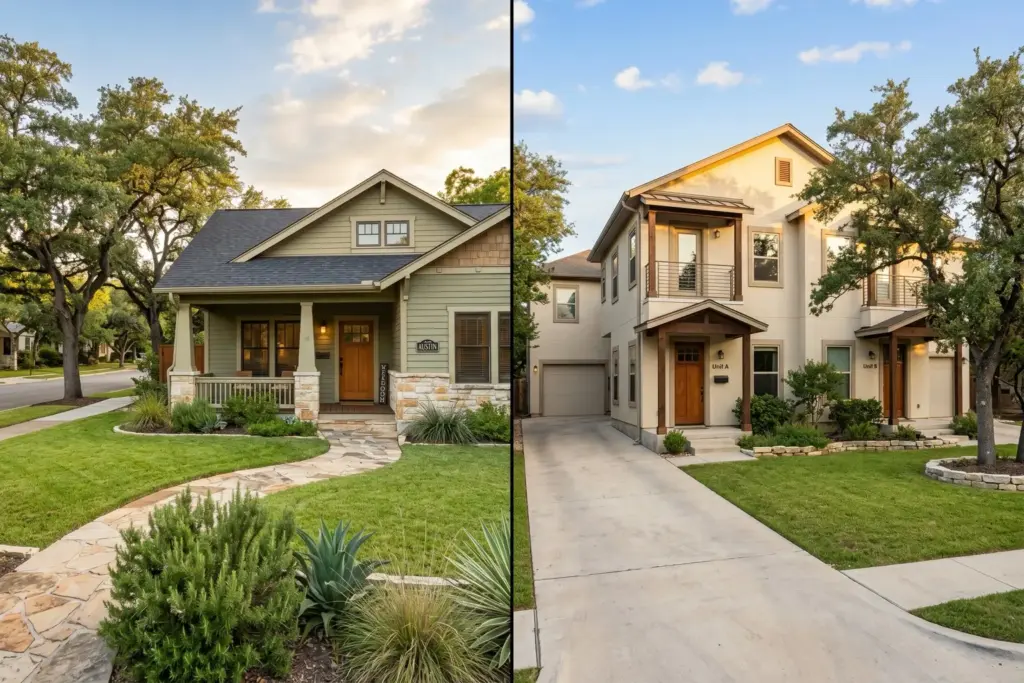
Austin’s median multifamily property sold for $557,500 in March 2026, up nearly 14% year over year according to Austin Board of Realtors data. A comparable single-family rental in the same zip code? Probably $425,000 to $475,000. So the duplex costs more upfront but puts two rent checks in your mailbox instead of one. That math changes everything about how your portfolio grows.
I get this question constantly. Someone will call me up and say Ed, I have $120,000 saved, should I buy a duplex or a single-family rental. And the honest answer is it depends on what you’re optimizing for. But not in a wishy-washy “it depends” way. I mean there are specific, measurable tradeoffs between the two strategies and once you understand them the right answer for YOUR situation usually becomes obvious. Lets walk through all of it.
What Counts as “Small Multifamily”
Before we get into the comparison, lets define terms. When I say small multifamily I’m talking about 2-4 unit properties. Duplexes, triplexes, and fourplexes. This matters because anything with four units or fewer qualifies for residential financing. Same loan products you’d use for a single-family home. Same Fannie Mae guidelines, same DSCR loan options, same FHA programs if you’re willing to live in one unit.
The second you hit five units you’re in commercial lending territory. Different underwriting, different down payments, different everything. Not that hard to understand right. So when investors talk about “multifamily vs single family” they’re really comparing two different flavors of residential investing. The fundamentals are the same. The returns are not.
Acquisition Costs and Financing
Here’s where the multifamily vs single family investment decision starts getting real. In Austin right now, a decent single-family rental in a B-class neighborhood (think Pflugerville, Manor, Del Valle) runs $350,000 to $425,000. A duplex in a similar area? $500,000 to $650,000 depending on condition and location.
More money up front. No way around that.
But here’s what most people miss. The financing is almost identical for 2-4 units. Put 20-25% down on either one with a conventional loan. Or if you’re house hacking (living in one unit, renting the others) you can go FHA at 3.5% down on a duplex. Try getting 3.5% down on a pure investment property. You can’t.
So yes the duplex costs more. But your actual out-of-pocket might be less if you’re willing to live in it for a year. I wrote about DSCR loans and portfolio loans in detail if you want the full financing breakdown for scaling past your first property.
The old Will Rogers line is “don’t wait to buy real estate, buy real estate and wait.” That applies to both strategies. But the house-hack path into multifamily is genuinely one of the lowest-friction entry points I’ve seen in 19 years of doing this.
Cash Flow: Where Multifamily Usually Wins
Lets talk about the numbers that actually matter to your bank account every month.
Take a real example from Austin. A single-family home in southeast Austin, purchased at $400,000. Market rent around $2,100 per month. After your mortgage payment (let’s say $2,450 at 6.5% with 20% down), property taxes, insurance, and a maintenance reserve, you’re probably negative $500 to $600 a month on cash flow. Not unusual for Austin SFRs right now. You’re buying for appreciation and equity build, not cash flow.
Now take a duplex in the same general area at $575,000. Each unit rents for $1,800 per month, so $3,600 total gross rent. Your mortgage is higher (maybe $3,500 with the same terms on a bigger loan) but your revenue is 71% higher than the single family. After taxes, insurance, and reserves you might be close to break-even or slightly positive. Two income streams from one closing, one appraisal, one insurance policy.
The reason multifamily usually wins on cash flow is simple math. You’re spreading your fixed costs (the roof, the foundation, the property taxes on the land) across multiple revenue streams. Benjamin Graham would call that margin of safety. I just call it having more money come in than goes out.
At Neuhaus Realty Group, I run these numbers for clients almost every week. And the pattern is consistent, multifamily properties in Austin are generating 15-25% more gross yield per dollar invested than comparable single-family rentals. Not always. But usually.
Appreciation: Where Single-Family Usually Wins
Ok so if multifamily wins on cash flow, why does anyone buy single-family rentals?
Because appreciation in desirable Austin neighborhoods tends to favor single-family homes. And it’s not close.
Here’s why. When you sell a single-family home, your buyer pool is enormous. First-time homebuyers, move-up buyers, relocators from California, retirees, investors. Everyone. That broad demand pushes prices up over time, especially in areas with good schools and limited inventory.
When you sell a duplex, your buyer pool shrinks dramatically. Owner-occupant buyers mostly don’t want to share walls with a tenant. So you’re selling primarily to other investors. And investors buy based on the numbers (cap rate, cash on cash return, DSCR ratio) not emotion. That keeps prices more rational and, frankly, lower.
I’ve seen this play out dozens of times. A $400,000 single-family home in Bee Cave appreciates to $500,000 over five years. A $575,000 duplex in the same timeframe appreciates to maybe $625,000 to $650,000. The SFR gained 25%. The duplex gained 9-13%. Both good. But if appreciation is your primary strategy, the single-family home wins.
This is one of those things where your time horizon matters a lot. If you’re holding for 20 years, the appreciation gap compounds. If you’re holding for 3-5 years and optimizing for monthly cash flow right now, the duplex might still be the better play.
The Vacancy Problem Nobody Talks About
This is the one that keeps me up at night when I think about single-family investing. If your single-family rental is vacant, your income drops to zero. 100% vacancy. You’re covering the full mortgage, property taxes, insurance, and maintenance out of pocket. Every month that tenant takes to find costs you $2,000 or more.
With a duplex, if one unit goes vacant you still have the other unit paying rent. You’re hurt but you’re not drowning. National multifamily vacancy rates sit around 4.8% right now according to CBRE’s Q1 2026 market figures (Source). For a duplex, that translates to maybe one month of single-unit vacancy per year. Painful but survivable.
For a single-family rental, even one month of full vacancy is devastating to your annual returns. I’ve seen investors lose their entire year of profit to a two-month vacancy between tenants. And in Austin right now, with all the new apartment supply that’s been delivered, finding quality tenants is taking longer than it did in 2021-2022. Average days on market for Austin rentals has pushed past 30 days in many neighborhoods.
This is a legitimate reason to consider multifamily even if you’re primarily a single-family investor. Diversifying your vacancy risk across units is kind of a big deal right.
Management Complexity
I’m not going to sugarcoat this one. Managing a duplex or triplex is harder than managing a single-family rental. Not dramatically harder, but harder. And I say this as someone who manages his own properties and sometimes wonders why I do that to myself.
With a single-family home you have one tenant, one lease, one set of maintenance requests. Simple.
With a duplex you have two tenants, two leases, and the added complexity of shared systems. Who pays for the water bill when there’s one meter? What happens when the tenant upstairs is too loud for the tenant downstairs? Who’s responsible for the shared driveway? These aren’t deal-breakers but they’re real.
A triplex or fourplex multiplies all of this. Three or four separate tenant relationships, three or four move-in/move-out cycles, and the inevitable dispute about who left the trash cans out (I wish I was kidding but this is a real thing that takes up actual time).
For investors who want truly passive income, a single-family rental with a good property manager is about as simple as it gets in real estate. If you want to self-manage, multifamily is doable but you should actually enjoy the work. Or at least not hate it.
If you’re scaling past 3-4 properties regardless of type, you probably need a property manager anyway. At that point the management complexity difference between SFR and small multifamily starts to even out. I wrote about how many properties you can realistically manage if you want to go deeper on that question.
Tenant Quality and Turnover
There’s a perception that single-family tenants are “better” than multifamily tenants. And honestly, there’s some truth to it, at least statistically.
Single-family tenants tend to stay longer. National average is about 3 years for SFR tenants vs 18-24 months for apartment/multifamily tenants. They also tend to treat the property more like their own home because, well, it kind of is. They mow the lawn, they hang pictures, they care about the neighborhood.
Multifamily tenants, especially in smaller units, tend to be more transient. Higher turnover means more make-ready costs between tenants (painting, cleaning, minor repairs) and more months of vacancy over the life of your investment.
But here’s the thing. Turnover in a duplex isn’t the same as turnover in a 200-unit apartment complex. You have two units. Screen well, price fairly, maintain the property, and you’ll find good tenants who stay. I’ve had duplex tenants stay 5+ years. It’s about the landlord as much as the property type.
Insurance and Operating Costs
Insurance on multifamily properties runs 15-25% higher than comparable single-family homes. More units, more liability exposure, more things that can go wrong. That’s just the reality.
Property taxes in Texas are based on appraised value, so a $575,000 duplex will have a higher tax bill than a $400,000 SFR. But on a per-unit basis, the duplex is actually cheaper. You’re taxed on one parcel, not two.
Maintenance costs tend to be lower per unit for multifamily too. One roof covers two units. One foundation, one water heater (sometimes), one HVAC system per unit but shared exterior maintenance. When you look at total operating expenses per dollar of rent collected, multifamily usually comes out ahead.
This is where you start to see the economies of scale that make multifamily attractive even at smaller sizes.
Exit Strategy: The Flexibility Factor
This one matters more than people think. And it usually favors single-family.
When it’s time to sell a single-family rental, you have options. Sell to an owner-occupant (biggest buyer pool, highest price). Sell to another investor. Do a 1031 exchange into something bigger. Even sell with the tenant in place if the lease terms are right.
When you sell a duplex, your buyer pool is mostly investors. Owner-occupants who want to house-hack exist, but they’re a much smaller group. In Austin right now, multifamily properties are sitting on the market an average of 68 days, and sellers are accepting 92% of their asking price. Single-family homes in good areas? Closer to 45 days and 96-98% of asking.
That exit flexibility is worth something, especially if you need liquidity fast or if the market turns and you need to unload a property.
The exception is if you’re in a 1031 exchange and buying multifamily to increase your unit count. In that case, the buyer pool issue doesn’t matter because you’re acquiring, not disposing.
Scalability: Building a Portfolio
If your goal is to build a meaningful real estate portfolio (and if you’re reading this it probably is) you need to think about which strategy scales better.
Single-family homes scale linearly. Each property is its own transaction, its own closing, its own financing event. Buy ten single-family rentals and you have ten properties with ten mortgages, ten insurance policies, ten tax bills. After your fourth conventional mortgage, Fannie Mae starts making things harder. After ten, traditional lending basically dries up and you’re looking at portfolio loans or DSCR financing.
Multifamily lets you scale faster per transaction. One closing on a fourplex gives you four units. Two fourplexes and you have eight units with only two mortgages to manage. Same Fannie Mae limits apply but you’re getting more doors per loan. That’s pretty compelling right.
The portfolio loan strategy I wrote about works for both, but it’s especially powerful for investors who’ve maxed out conventional financing and want to keep growing.
Market Availability: Good Luck Finding One
Here’s the part that most “multifamily vs single family” articles ignore. In many desirable markets, including Austin, small multifamily inventory is brutally thin.
Right now there are about 155 multifamily properties for sale across the entire Austin metro. Compare that to thousands of single-family listings. The supply simply isn’t there, especially for well-maintained duplexes in good school districts (which is what everyone wants right now).
When a good duplex hits the market in Bee Cave or Lakeway, it goes fast. And the ones that sit? Usually there’s a reason. Deferred maintenance, bad floor plan, or the numbers just don’t work at the asking price.
So even if you decide multifamily is the right strategy, you might spend 6-12 months waiting for the right property. Versus single-family where you can find a viable rental property in most Austin neighborhoods within 30-60 days.
This is where working with a broker who actually invests (hi, that’s me) makes a real difference. I track multifamily inventory daily because I’m looking for deals for my own portfolio and for clients. The ones that work don’t sit on the MLS for 68 days. They get snapped up in the first two weeks.
Frequently Asked Questions
The Best of Both Worlds: Start Multifamily, Transition to SFR
Here’s what I actually recommend to most investors who ask me about the multifamily vs single family investment question.
Start with a house-hack duplex. Live in one side, rent the other. Use FHA at 3.5% down. Learn landlording with training wheels. Live there for a year (the FHA occupancy requirement) then move out and rent both sides. Now you have a cash-flowing duplex that you got into for less than $25,000 out of pocket.
Then use the equity and experience to buy single-family rentals in neighborhoods with strong appreciation. Bee Cave, Lakeway, Dripping Springs. Homes that will be worth significantly more in 10 years.
You end up with a blended portfolio. The multifamily covers your monthly cash flow. The SFRs build your long-term wealth. The combination is more resilient than either strategy alone because you’re diversified across property types, tenant profiles, and exit strategies.
I wrote about the power of buying one property per year back when I first started blogging (and I’ve done an entire video on why I only invest in single-family homes which is worth watching if you want my historical take). That thesis hasn’t changed. What’s evolved is my understanding that mixing property types within that annual acquisition makes the portfolio stronger.
And look, there’s no perfect answer here. Your goals, your capital, your risk tolerance, your willingness to deal with tenant drama all factor in. But the investors I work with who build the most durable portfolios almost always end up owning both.
Ready to Run the Numbers on Your First (or Next) Investment Property?
If you’re weighing the multifamily vs single family investment decision for Austin and the Hill Country, lets talk. I’m an investor myself (nine properties, four STRs) so I don’t just run the numbers for clients, I run them for my own portfolio. Reach out to me directly and lets dig into what makes sense for your situation. No pitch. Just math.


