 Ed
Ed 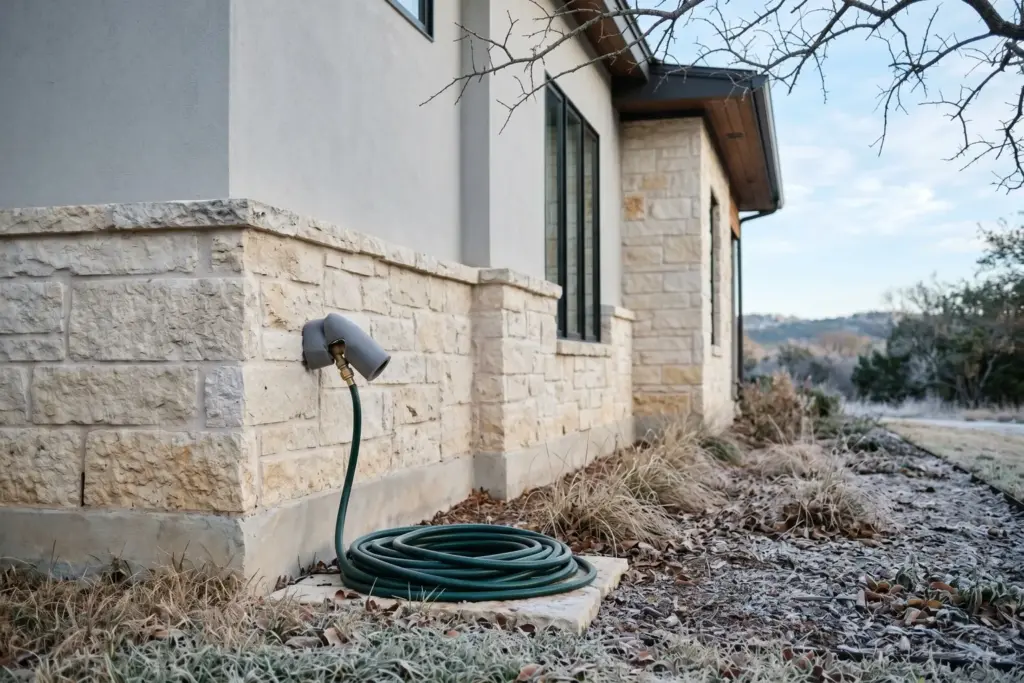
Austin lost more than 325 million gallons of water to burst pipes in a single week during Winter Storm Uri, according to the city’s own numbers from February 2021. A frozen-pipe cleanup can run into the tens of thousands of dollars per house. So when a plumber I trust told me the cheapest insurance policy in Texas is a foam faucet cover that costs about four bucks, I believed him.
Here is the problem though. It is May. Nobody in Austin is thinking about a hard freeze right now, and that is exactly why I am writing this. Because the day the freeze warning actually shows up on your phone, the hardware store is already sold out of pipe insulation and every plumber in town is booked solid (ask me how I know). The work that saves your house gets done in the boring months, not the scary ones.
So I asked a local plumber to walk me through what really matters. Not the Midwest stuff. Texas stuff. And I want to pass it along now, while it is 95 degrees and none of us care, so it is sitting in your head when it counts.
Why Texas Homes Fail in a Freeze (and Minnesota Homes Do Not)
This was the first thing the plumber said that stuck with me. Texas houses are not built for cold, and that is not a knock, it is just true. Up north they bury the water lines deep and run pipe through the heated middle of the house. Down here? Builders ran pipe through the attic, along exterior walls, through the garage, wherever it was cheapest and easiest. For 360 days a year that is totally fine. It is the other handful of days that get expensive.
And here is the part people miss. The damage from a Texas freeze usually is not the freeze itself. It is the thaw. Water expands when it freezes, the pipe cracks while it is frozen solid, but you do not find out until everything warms back up and that crack starts spraying water into your attic at two in the morning. By the time you notice the ceiling stain, you have got a real problem.
That is the whole lesson of Uri, right. According to NOAA, that storm caused $26.5 billion in damage, and the Texas Department of State Health Services put the final Texas death toll at 246. More than 4.5 million homes and businesses lost power. It was a genuine disaster. But a huge chunk of the property damage came down to one boring thing nobody had done, which was getting water out of the pipes that were going to freeze. We cannot control the grid. We can absolutely control our own plumbing.
The Four Things That Actually Break
When I asked what fails first, the answer was not complicated. It is almost always the same four spots, every single time.
Outdoor faucets and hose bibs. This is number one with a bullet. That spigot on the side of your house is exposed metal connected straight to your indoor plumbing. Leave a hose attached and you have basically built a little ice trap, because the water cannot drain out and it freezes right there at the connection. The plumber told me he could fill half his freeze calls just on hose bibs alone.
Exposed pipe in the attic, garage, and exterior walls. Remember, Texas builders love running pipe through unconditioned space. Any pipe in your attic or garage, or along an outside wall, is sitting in air that gets just as cold as the air outside. Those are the lines that crack and then dump into your living space when they thaw.
The irrigation backflow preventer. If you have a sprinkler system, walk outside and find the brass contraption sticking up out of the ground near your foundation. That is your backflow preventer, and it is full of water and totally exposed. It is one of the most common freeze failures in Central Texas, and replacing one is not cheap.
Pool equipment. If you have a pool, your pump and all that exposed PVC are vulnerable too. Cracked pool plumbing is a special kind of headache because you often do not catch it until you fire the system back up in spring and water is going somewhere it should not.
Notice what these four have in common. They are all outside, or in spaces that may as well be outside. The inside of your house is usually fine because you are heating it. It is the stuff at the edges that gets you.
What to Do Before the First Freeze Warning
Ok so here is the actual list. The good news is that most of this is a one-time setup you do on a calm Saturday, not a panic drill the night of. Lets walk through it.
Disconnect every hose, now. Honestly you can do this today and just leave them off through the winter. Pull the hose off the spigot, drain it, coil it up. That one move kills the single most common freeze failure in Texas. No big deal right, but it matters more than almost anything else on this list.
Buy the faucet covers while they exist. Those little foam domes that snap over an outdoor faucet cost a few dollars each and they sell out the instant a freeze gets forecast. Buy them in the off season. If you cannot find them in a pinch, the plumber said a towel wrapped around the faucet and taped down works as a backup. Not pretty, but it works.
Know where your shutoffs are. This is the one most people skip and then deeply regret. Find your main water shutoff at the meter. Find the shutoff for your irrigation system. Walk out there and physically locate them today, while it is light out and nobody is panicking, because the night of a freeze in the dark with a flashlight is the worst possible time to be hunting for a valve you have never touched.
Deal with the irrigation system. Before the first hard freeze, shut your sprinkler system off and drain the exposed lines, and wrap or insulate that backflow preventer. The plumber was clear that the most reliable fix is draining it, not just covering it. A cover slows the cold down, but an empty pipe cannot crack.
Insulate the pipe you can reach. Foam pipe insulation is cheap and it slides right on. Hit the obvious exposed runs in the garage and attic, especially anything near the eaves where cold air sneaks in. You do not have to insulate your whole house, just the lines sitting out in the cold.
That is most of the battle right there, and almost none of it has to happen during an actual emergency. It is the kind of thing that lives perfectly on a year-round home maintenance calendar so it just gets handled every fall without you having to remember.
The Drip Question (It Changed After Uri)
Everybody in Texas grew up hearing leave your faucets dripping. And the rules on that actually shifted, so let me give you the current version.
Austin Water now steers people away from cranking on every faucet in the house during a freeze, because when a whole city does that at once it strains the water system. The updated guidance is more targeted. If you want to drip, drip the indoor faucet that is farthest from your water meter, and a slow drip is plenty. It does not need to be a running stream. Just enough to keep water moving through the line.
The bigger move they recommend is opening the cabinet doors under your sinks, especially on exterior walls, so the warm air in your house can reach those pipes. That is free and it actually helps. I do it every freeze.
And if you are going to be out of town when a freeze hits? This is the big one. Shut your water off at the meter and keep your thermostat at 65 or higher. A house with the water shut off cannot flood, full stop. I have seen the difference between the family who flipped that valve before they left for the holidays and the family who came home to a waterfall coming through the dining room ceiling. Same freeze. Very different January.
What You Can DIY and When to Call a Plumber
I asked the plumber to be straight with me about where the line is, because I am a real estate broker, not a tradesman, and I know my limits. Here is roughly how he drew it.
Hoses, faucet covers, open cabinets, knowing your shutoffs, basic foam pipe insulation on stuff you can easily reach. That is all you. None of it is hard and none of it requires a license. If you can wrap a towel and turn a valve, you can do the bulk of Texas freeze prep yourself.
Where you call a pro is anything involving actually draining a system you do not understand, sketchy attic pipe you cannot safely get to, or a sprinkler and backflow setup you are not confident about. And obviously the second something is already leaking or you hear water where there should not be water, that is a phone call, not a YouTube video. The plumber put it the way I would put it about my own business. The cheap fix is the one you do before anything breaks. The expensive fix is the one you do at 2am while standing in an inch of water.
If you want the bigger picture on keeping a Central Texas home running, we pulled the whole thing together in our complete guide to home maintenance in Central Texas. And if a running toilet is driving you nuts in the meantime, the same plumber helped me write up how to fix a running toilet too.
Frequently Asked Questions
Get It Done While It Is Boring
Here is the honest truth. The reason Uri did so much damage was not that Texans are careless. It is that a freeze that bad is rare enough that nobody had the habit. The fix is turning a few of these into a habit you do every fall without thinking about it, so the next big one is a non-event at your house.
None of this is hard. Disconnect the hoses, learn your shutoffs, drain the sprinklers, cover the faucets. Do it on a calm afternoon and forget about it. And if you are buying or selling a home in the Austin area and you want a second set of eyes on what a place actually needs to survive a Texas winter, that is the kind of thing we live for. Reach out through our contact page or give the office a call at (512) 366-3270 and lets talk it through.
Be safe, be good, and be nice to people. And go disconnect your hose.


