 Ed Neuhaus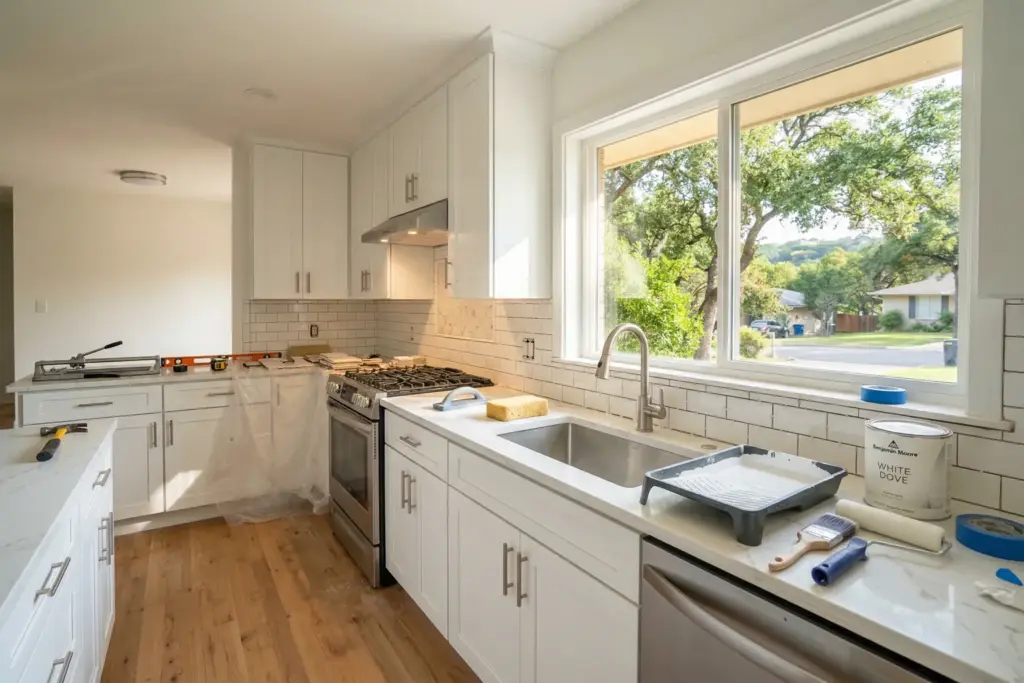
A $150 steel front door recoups 100% of its cost at resale. A $90,000 kitchen gut job? You’re looking at maybe 40 cents on the dollar. According to the NAR 2025 Remodeling Impact Report, the gap between renovations that actually add value and renovations that just burn cash has never been wider. And in Austin specifically, where our market has shifted into buyer territory with 4+ months of inventory, getting this wrong can cost you tens of thousands of dollars.
Sounds dramatic right. But I see it constantly. A seller spends $85,000 on a dream kitchen, lists the house, and the appraiser gives them maybe $35,000 in credit. That’s $50,000 gone. So lets walk through what actually works, what doesn’t, and where Austin’s unique market makes the national data irrelevant.
The Renovations That Actually Pay You Back in Austin
The 2025 Cost vs. Value Report from Zonda tracks this stuff religiously, and the West South-Central region (that’s us) consistently posts the strongest returns in the country. So we have that going for us.
But here’s what most people get wrong. The highest-ROI projects aren’t the sexy ones. They’re boring. They’re the projects your neighbor wouldn’t even notice you did.
Garage door replacement came in at 268% ROI nationally in 2025. Two hundred and sixty-eight percent. You spend $4,500 on a new garage door and your home value goes up roughly $12,000. I know that sounds crazy but think about it from the buyer’s perspective. A garage door is the single largest visual element on most homes. It’s literally the first thing people see. And a beat-up garage door screams deferred maintenance even if the rest of the house is perfect.
Steel entry door replacement returns over 200% and the NAR data shows 100% cost recovery. We’re talking about a $200-$400 project that pays for itself completely. No brainer right.
Manufactured stone veneer on a portion of the exterior also clears 200%. You don’t need to stone the whole house (please don’t do that in a $350,000 neighborhood). A tasteful accent section near the entry does the job.
And then there’s the minor kitchen remodel. This one is important because the word “minor” is doing a lot of heavy lifting. A minor kitchen remodel in the Cost vs. Value data means refacing cabinets, new hardware, updated countertops, modern appliances, and a fresh coat of paint. Not ripping everything out. Not custom cabinetry. Not the $90,000 HGTV fantasy. The minor version costs $19,000 to $27,000 and returns 96-113% of that investment. The major version at $85,000+ returns 38-50%.
Let that sink in. You get a better return spending less money.
The “Lipstick Renovation” Strategy (My Favorite Play for Sellers)
Ok so here’s where I get excited because this is the strategy that consistently makes my sellers the most money relative to what they spend. I call it lipstick renovation and if you’re thinking about listing your Austin home in 2026, pay attention.
The idea is simple. You’re not trying to make the house new. You’re trying to remove every reason a buyer might use to negotiate your price down.
Paint. Interior paint is the single highest-impact, lowest-cost improvement you can make. A full interior repaint in Austin runs $3,000 to $6,000 for a typical 2,000 square foot home. Go neutral. I don’t care that your kid loves the purple bedroom. Buyers can’t see past color. Benjamin Moore Revere Pewter, Sherwin-Williams Agreeable Gray. Pick one and do the whole house. The number of times I’ve watched a buyer mentally subtract $20,000 because they “have to repaint everything” is… well, it’s a lot.
Light fixtures and hardware. Swap out every brass fixture from 1997 for brushed nickel or matte black. Budget maybe $500-$1,000 for the whole house. Sounds trivial but updated fixtures are one of those subconscious signals that tells a buyer the home has been maintained. Robert Cialdini’s whole thing about influence is that people make decisions based on signals they can’t even articulate. A modern light fixture is one of those signals.
Landscaping and curb appeal. Fresh mulch, trimmed hedges, a few seasonal plants near the front door. Maybe $500-$1,500. Remember that garage door ROI we talked about? Same principle. The first 10 seconds of a buyer pulling into the driveway sets the emotional tone for the entire showing.
Deep clean and minor repairs. Professional deep cleaning ($300-$500), caulk the bathrooms, fix that one cabinet door that’s been hanging crooked for three years. You know the one.
Total cost of a lipstick renovation? Usually $5,000 to $10,000. Impact on sale price? I’ve seen it add $15,000 to $30,000 because you’re not adding value so much as you’re preventing value destruction. A house that shows well sells faster and closer to asking. A house that shows tired sits and gets lowballed. In a buyer’s market like we have now, that difference is everything.
What Austin’s Climate Makes Worth More (and Less)
National data is helpful but Austin is not a national market. We have specific factors that shift the ROI calculation.
Outdoor living spaces are worth significantly more here than the national average suggests. We use our patios and decks 9 to 10 months a year (well, unless you count August when the patio is basically a convection oven). Covered patios, outdoor kitchens, and well-designed deck spaces are not luxury add-ons in Central Texas. They’re expected. A $15,000 to $25,000 covered patio addition can easily return 80-100% here because buyers from out of state (and we get a lot of them) specifically look for outdoor living when they’re relocating to Austin.
Energy efficiency upgrades hit different in Texas. Our summer electricity bills are no joke. I’ve seen July bills north of $400 in older homes. So when a buyer sees a house with new windows, upgraded insulation, or a newer HVAC system, they’re not just thinking “that’s nice.” They’re doing mental math on monthly savings. New windows run $15,000 to $25,000 for a whole house and you won’t recoup all of that at resale. But combined with lower insurance premiums and lower utility bills, the total value proposition is strong.
Solar panels are complicated now. The federal 30% solar tax credit expired at the end of 2025. Austin Energy still offers a local rebate and solar adds roughly 4.1% to home value in Texas (about $16,400 on a $400,000 home). Texas law also exempts solar from property tax increases which is nice. But without that federal credit, the math changed significantly. Average Austin installation runs $25,000 to $30,000. Payback period jumped from around 5 years to closer to 9-10 without the credit. Solar is still a good long-term investment if you plan to stay 10+ years. But as a pre-sale improvement? Skip it. The ROI timeline is too long.
Pools. I know, I know. Everyone wants a pool. And I get it. But lets be honest about the numbers. A pool in Austin costs $50,000 to $80,000 minimum. Maybe it adds $15,000 to $25,000 in value depending on the neighborhood. If you’re in Bee Cave or Lakeway where $700K+ homes without pools are the odd ones out, sure, it makes sense for living. But in a $350,000 neighborhood in Pflugerville? You just spent $60,000 to add maybe $10,000 in value. And some buyers actively avoid pools (maintenance, liability, kids). I wrote about this in my guide to selling homes with pools and unique features.
The Renovations That Are Almost Always a Waste
This is the part where I save you from yourself. Because the urge to over-improve is real, especially when you’ve watched too much HGTV (not going to lie I’ve been guilty of this too).
Over-improving for the neighborhood. This is the number one renovation mistake I see in Austin. You have a $400,000 house in a $375,000 to $425,000 neighborhood and you put $150,000 into it. Guess what your house is worth now? About $425,000. Maybe $440,000 on a good day. The neighborhood sets a ceiling that no amount of Carrara marble can break through. Benjamin Graham (the father of value investing) had this concept of “margin of safety” which basically means never pay more than something is worth even if it seems like a great deal. Same principle applies to renovations. Your margin of safety is the neighborhood comp ceiling.
Luxury finishes in starter home neighborhoods. Quartz countertops in a $250,000 house? The buyer who can afford $250,000 doesn’t care about quartz. They care about the monthly payment. Spend that money on things that remove objections (paint, fixtures, curb appeal) not things that exceed expectations for the price point.
Converting the garage. Please don’t. Especially in Austin where we actually use our garages (for cars, for storage, for escaping the heat when you’re working on a project at 2pm in July). I see converted garages on MLS listings all the time and they almost always hurt the sale. Most buyers look at a converted garage and see an expensive problem to reverse, not additional living space.
Overly personal design choices. That built-in wine cellar. The custom meditation room with the waterfall wall. The all-black bathroom. These are things YOU love, and that’s great if you’re staying. But when you sell, you need to think about what the broadest possible buyer pool wants. And the broadest possible buyer pool wants clean, neutral, and functional.
When a Full Remodel Actually Makes Sense
I don’t want to leave you thinking all renovations are bad. They’re not. There are specific scenarios where spending real money is the right move.
When the house won’t sell as-is. If your home has significant deferred maintenance, functional obsolescence (one bathroom in a 4 bedroom house, for example), or systems that are visibly failing, you might not have a choice. A house that doesn’t sell costs you money every month it sits. Sometimes spending $30,000 to make a house marketable saves you $50,000 in price reductions and carrying costs.
When you’re buying a fixer-upper to live in. If you’re buying a house below market because it needs work and you plan to live there 5+ years, go for it. The fixer-upper strategy absolutely works when your timeline is long enough. Just budget 20% more than your contractor quotes because Austin contractors in 2026 are busy and materials aren’t getting cheaper.
When you’re converting to an investment property. If you’re planning to rent the house (short or long term), the renovation calculus is completely different. Now you’re thinking about durability, tenant appeal, and rental income lift, not resale value. Thats a whole different analysis and one I’m happy to walk through with you.
Austin Permits: The Timeline Nobody Talks About
Lets talk about something that catches people off guard. Austin’s permitting process.
If your renovation requires a permit (and in Austin, more things require permits than you’d think), you need to factor the timeline into your plans. The City of Austin processes residential permits in anywhere from 2 to 37 days depending on the project type and complexity. Simple permits like water heater replacements or reroof can be same-day. Structural modifications, electrical upgrades, or anything that changes the footprint of the house? Budget 3-5 weeks minimum.
The City does offer expedited review for 2x the plan review fee if you’re in a rush. And they just launched an AI pre-check tool in 2026 for standard residential plans which should help.
But here’s the practical advice. If you’re planning to list in April or May (prime selling season in Austin), and your renovation needs a permit, you should be starting that process now. Not next month. Not when you “feel ready.” Now. I’ve watched sellers miss their ideal listing window because they didn’t account for permit timelines, and in a seasonal market like Austin that can mean real money left on the table.
What to Spend by Price Point
Let me give you some actual numbers to work with. These are rough guidelines based on what I’ve seen work in the Austin market, not universal rules.
Homes under $350,000 (Cedar Park, Pflugerville, Kyle, Buda)
Budget $3,000 to $7,000 in pre-sale improvements. Focus entirely on lipstick. Paint, fixtures, landscaping, deep clean. Do not spend $25,000 on a kitchen remodel at this price point. The buyer pool is payment-sensitive and they’re comparing your house to 15 other options on their phone.
Homes $350,000 to $600,000 (Most of Austin, Dripping Springs, Round Rock)
Budget $7,000 to $15,000. Lipstick plus one targeted upgrade. Maybe it’s the kitchen countertops and backsplash ($5,000-$8,000). Maybe it’s the master bathroom vanity and fixtures ($3,000-$5,000). Pick the one room that will photograph best and invest there. This is the price range where staging also makes the biggest difference.
Homes $600,000 to $1M+ (Bee Cave, Lakeway, Westlake, Dripping Springs custom)
Budget $15,000 to $40,000. At this level buyers expect a certain finish quality. Dated kitchens and bathrooms will cost you here. A targeted kitchen refresh (not gut job) with updated appliances, counters, and paint can return 80-100%. Outdoor living investment also pays off heavily because buyers at this price expect outdoor entertaining space.
Frequently Asked Questions
Thinking About Selling?
The first step is knowing what your home is actually worth. Our free tool uses real MLS comps — not Zestimate guesswork.
The Bottom Line
Americans spent $603 billion on remodeling in 2024 and a good chunk of that was wasted on upgrades that didn’t move the needle at resale. Don’t be that homeowner.
The formula is actually pretty simple. Remove objections first (lipstick renovation). Then, if budget allows, make one targeted investment in the room that will photograph best and that buyers in your price range care about most. And for the love of all things holy, check your neighborhood comps before you start knocking down walls. No renovation in the world can overcome the ceiling your neighborhood sets.
Not sure which upgrades are worth it before listing? Lets grab coffee and I’ll walk through your specific home. I do this all the time and the answer is always different depending on the house, the neighborhood, and the buyer pool you’re targeting. Reach out to me directly and we’ll figure out exactly where to spend and where to save. At Neuhaus Realty Group, this is one of our favorite conversations to have because it’s where strategy and data actually save people real money.
Explore all of our seller resources, guides, and tools.


