 Ed
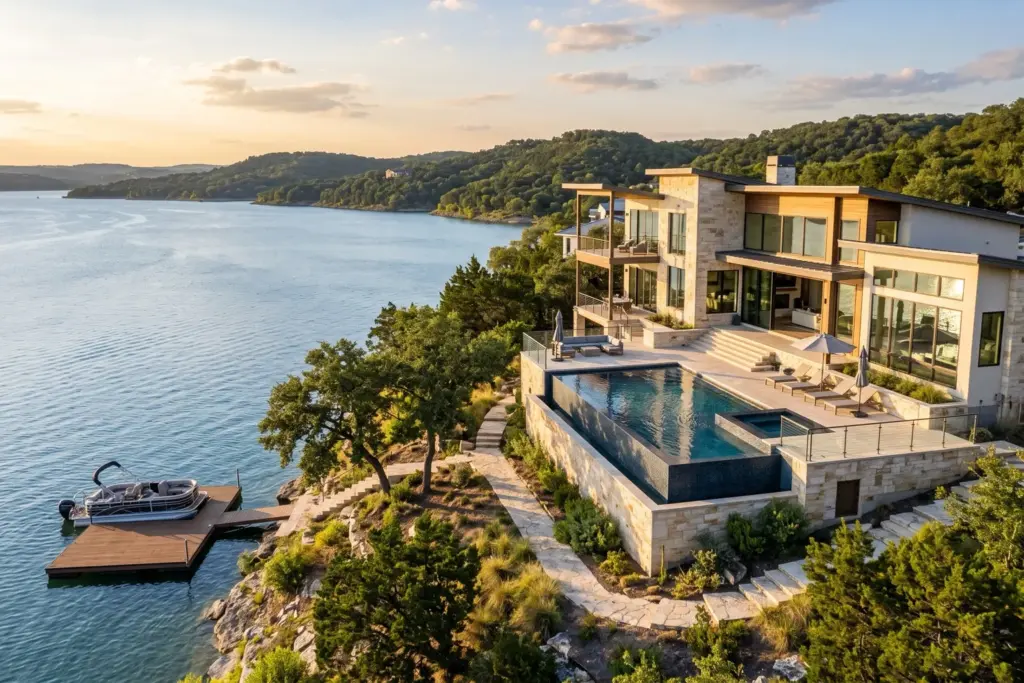
Lakeway only lets 25 single-family homes hold a short-term rental permit at one time, and right now there is a waitlist. That one sentence tells you more about buying a Lake Travis Airbnb in 2026 than any revenue projection you will ever see. Because here is the thing nobody puts in the glossy pro forma: the number that makes or breaks a lake STR is not the nightly rate, it is whether the city, the county, or your own HOA will even let you rent it.
So lets do this the honest way. I own short-term rentals myself (a few in Texas, one in South Carolina), and I have walked buyers through Lake Travis deals that looked amazing on paper and were dead on arrival because of one line in a deed. This is the regulatory map, the current inventory by price band, and the risks I actually worry about. The revenue math I am going to hand off, and I will tell you exactly why.
Why Lake Travis is the Austin area’s STR heartland
Water sells. That is the whole pitch, and it is not complicated. Lake Travis is a 65-mile reservoir 20 minutes west of downtown Austin, and the towns wrapped around it (Lakeway, Lago Vista, Jonestown, Point Venture, Briarcliff, Spicewood, and a bunch of unincorporated Travis County in between) make up the densest cluster of vacation-rental demand in Central Texas. People book these places for bachelor parties, family reunions, wedding weekends at the wineries, and “we just need to sit on a dock” trips.
Which school district you are in depends on which shore you buy on, and it matters more than a weekend guest will ever notice. The south shore (Lakeway, Briarcliff, and part of Spicewood) sits in Lake Travis ISD. The north shore (Lago Vista, Jonestown, Point Venture) is Lago Vista ISD. Either way, a solid school zone means your STR always has a second buyer waiting: the household that wants to actually live there. That optionality is worth real money, and it is why I like the lake towns better than a one-trick vacation market three hours from anywhere.
But (and you knew there was a but) the lake is carved up into a dozen little jurisdictions, and each one wrote its own STR rules. A house on one side of a road can be legal to rent and the identical house across the street can be illegal. So before you fall in love with a listing, you check the map.
The regulatory map (read this before you make an offer)
This is the load-bearing section. Every city around Lake Travis treats short-term rentals differently, and the rules change more often than the listing photos would suggest. Here is where things stand in 2026. For the full statewide picture, we keep an updated guide to short-term rental regulations in Texas cities, but here is the lake-specific version.
Unincorporated Travis County is the loosest. The county has no STR permit or registration process at all, so a home outside any city limit generally has no local government telling it who it can host. You still owe state and local hotel occupancy tax, and (this is the big one) your HOA and deed restrictions still bind you. No permit does not mean no rules, right. It just means the rules live somewhere other than city hall.
Lakeway is the tight one. The city caps single-family STR permits at 25 total, and when they are gone, you wait. There is no cap on condo permits, which quietly makes Lakeway condos the more reliable STR play if you want to be in the city proper. A permit runs a $250 initial application fee, there is a two-night minimum stay, and the current ordinance was tightened up in February 2024. If you buy a single-family house in Lakeway assuming you will Airbnb it, and you have not confirmed a permit is available, you are gambling.
Lago Vista is the friendly one, and it is not close. Lago Vista allows STRs in several residential zoning districts with a short-term occupancy permit that costs about $175 a year. That is it. Given that Lago Vista also has the most active inventory and the lowest entry prices on the lake, it is where a lot of first-time lake STR buyers actually land.
Jonestown allows short-term rentals, but only inside a designated overlay district, with a license, a two-night minimum, occupancy caps, and a hard no on parties and weddings. And Jonestown will not issue a permit at all if your HOA or deed restrictions prohibit STR use. So Jonestown does the deed-restriction check for you, which is either helpful or heartbreaking depending on your property.
Point Venture adopted a short-term rental registration process back in September 2021. You register, you follow the village’s conduct standards, you pay hotel occupancy tax. Straightforward, but you have to actually do it.
Spicewood and Briarcliff are mostly unincorporated or very small, so the county’s hands-off posture applies to a lot of it. Which, again, throws the whole question back onto the HOA and the deed. Spicewood in particular is heavy deed-restriction country.
The deed can override everything (yes, even where the city says yes)
Here is where people get hurt. In 2018 the Texas Supreme Court decided Tarr v. Timberwood Park Owners Association, and the ruling was basically this: a generic “residential purposes” covenant does not, by itself, ban short-term rentals. Guests who sleep and eat and live in a house, even for two nights, are still using it residentially. Good news for STR owners, right?
Sort of. Because since Tarr, a lot of HOAs went back and amended their covenants to explicitly ban or cap short-term rentals, and an explicit ban is very much enforceable. So the case did not throw the doors open. It just told everyone to read the actual language. An old deed with vague “residential use” wording might be fine. A deed amended in 2021 with a clause that says “no rentals under 30 days” is a wall, and no city permit gets you over it.
This is not the kind of thing you eyeball. You pull the recorded restrictions, you read every amendment (not just the original), and you check whether the HOA has a rental policy sitting outside the deed. We wrote a whole guide to Texas deed restrictions because this exact mistake costs buyers deals every year. If you skip one step in the STR due diligence process, do not let it be this one.
The numbers: what’s actually for sale around the lake
Lets talk inventory. As of mid-2026, here is the active single-family listing picture around Lake Travis, straight from our MLS data, broken into the three bands I think in.
The entry band (roughly $200K to $450K). This is Lago Vista and Point Venture territory, plus the occasional smaller Jonestown property. Lago Vista alone has around 178 active single-family listings with a median list price of about $532,000, and the floor drops to $229,000. Point Venture has fewer than 20 active listings but starts around $230,000. If you want to get into a lake-area STR without writing a seven-figure check, this is the shelf you are shopping.
The mid band (roughly $500K to $900K). This is the meat of the lake. Lakeway’s active single-family inventory sits around 98 listings with a median list of about $849,000, and Lakeway homes that sold in June 2026 moved at a median of $729,000 in about 39 days on market. Jonestown runs a median list around $836,000. This is where you get a real house with a pool and maybe a view without going full trophy property.
The luxury band ($1M and up). Spicewood is the big one here, with around 271 active single-family listings and a median list near $935,000, running all the way up past $15 million for true waterfront estates. This is where the marquee “sleeps 16, private dock, infinity pool” rentals live. Big revenue potential, big carrying costs, and (worth noting) Spicewood homes that sold in June 2026 sat a median of 106 days on market. The high end of the lake moves slowly, so you have negotiating room.
You can browse current listings on our Lakeway homes for sale and Lago Vista homes for sale pages. And if you want the deep version of how to evaluate a waterfront purchase, we have a complete guide to buying waterfront on Lake Travis.
The revenue side: why I won’t hand you an ADR number
Notice I have given you permit costs, list prices, days on market, and lake levels, but not one word about what a Lake Travis Airbnb “makes.” That is on purpose. Nightly rate and occupancy swing wildly by street, by view, by whether the house sleeps 8 or 16, and by whether it has a pool. Any blanket “Lake Travis STRs earn $X” number is either marketing or a guess, and I am not going to be either. Honestly, I am not smart enough to eyeball what a specific house on a specific street will earn, so I do not pretend to.
What I actually do (for my own deals and for buyers) is run the specific address through the StaySTRA analyzer, our sister platform that pulls address-level revenue projections off real comparable rentals. Then I do the thing most people skip: I discount it. When a projection says a property will do great, I plug in a conservative occupancy just to be safe and see if it still works. Benjamin Graham’s whole margin-of-safety idea applies here perfectly, you want the deal to survive being wrong, not just survive being right.
I wrote a full walkthrough on how to know if an Austin-area Airbnb will actually cash flow before you buy it, and everything in it applies double on the lake, where seasonality is brutal. Which brings me to the honest part.
What makes a Lake Travis STR actually work
After enough of these, a pattern shows up. The lake rentals that print money tend to share a few things. They sleep a lot of people, because groups are the whole market out here, so bedroom count and a smart bunk-room layout matter more than square footage. They have real water access or a genuine lake view, not a “you can see a sliver of blue if you stand on the roof” view. They have a pool (in a Texas summer, the pool is not a luxury, it is the product). And they sit within an easy drive of a marina and a couple of the Hill Country wineries, because that is the itinerary guests actually book around.
The seasonality is the part people underestimate. Lake Travis is a summer machine. May through Labor Day, a good property can stay booked solid. January, you are staring at a calendar full of open dates and a mortgage that did not get the memo. So when you underwrite a lake STR, you cannot annualize the July number. You blend the fat summer with the thin winter, and the deal has to work on the blend.
The risks I actually worry about
Ok, the part where I talk you out of it, or at least make you go in with your eyes open.
Ordinance changes. Every rule I described above can change at the next city council meeting. Lakeway tightened its ordinance in 2024. Any of these towns could add a cap, raise a fee, or shrink an overlay district. You are buying into a regulatory environment that is still being written, and you do not get a vote until after you close.
HOA and deed restrictions. Covered this above, but it earns a second mention because it is the number one deal-killer I see. The city can say yes and your neighborhood can still say no.
Lake level. This one is real and people forget it. Lake Travis is a flood-control reservoir, so it swings hard. Full pool is 681 feet above sea level, and in mid-2026 the lake is essentially full. But back on September 19, 2023, it bottomed out at 629.69 feet, one of the lowest readings in its history. That is roughly a 50-foot swing. When the lake drops, docks end up sitting on dry dirt and your “waterfront” listing photos stop matching reality, and bookings follow the water down. You are buying a lake asset on a lake that does not stay one size.
Insurance and carrying costs. Waterfront, Hill Country wildfire exposure, and short-term rental use all push insurance premiums up, and those costs have been climbing across Texas. Budget for it honestly, and put it in the pro forma before you fall in love, not after.
None of this means don’t buy. I own these things, I believe in them, and the lake is not making more shoreline. It means buy the right one, in the right jurisdiction, with the deed read cover to cover, underwritten conservatively. That is not that hard, it just takes discipline that most buyers skip because the listing photos are really pretty.
Frequently Asked Questions
Want to run the numbers on a specific property?
Here is how I like to work it. I find the property (on-market or off), read the deed and confirm the STR rules for that exact jurisdiction, and then we run the address through the StaySTRA analyzer to get a real revenue projection instead of a fantasy. You get a house that is actually legal to rent and numbers you can trust. That is the whole job.
If you are thinking about a Lake Travis Airbnb, reach out to me, Ed Neuhaus. I have been buying and selling around this lake for 19 years, I own short-term rentals myself, and I would rather tell you a deal does not work before you close than after. Lets find the one that does.


