 Ed
Ed 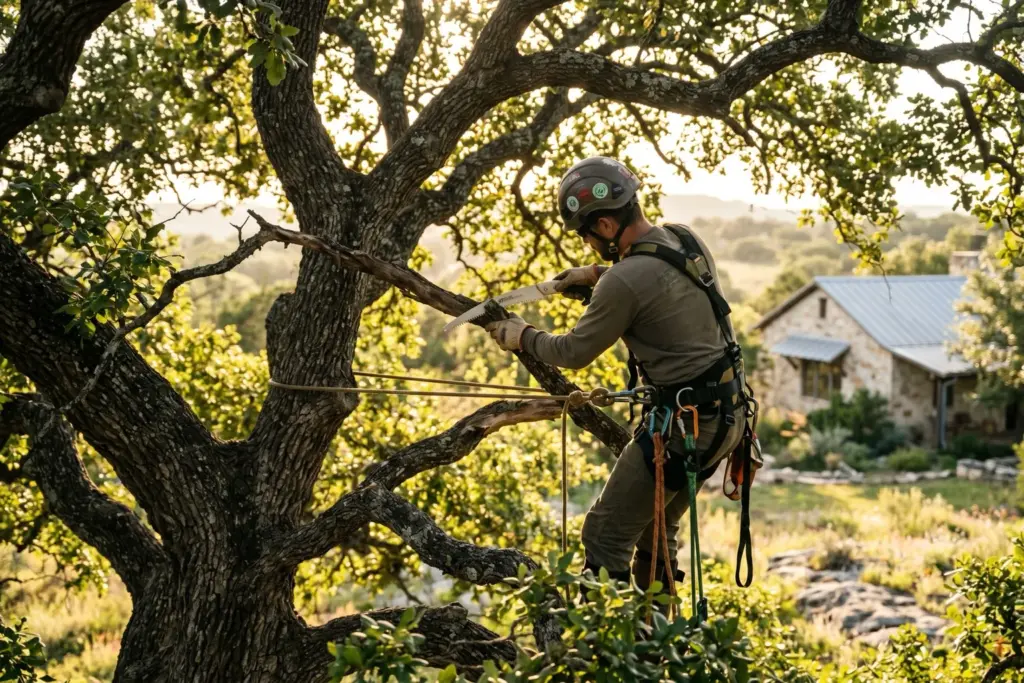
If you prune your live oaks between February and June in Central Texas, you can hand them a death sentence called oak wilt, and most people doing it have no idea. The Texas A&M Forest Service is blunt about it: avoid pruning or wounding oaks from February through June, because that’s exactly when the fungus is moving. Oak wilt spreads through connected root systems at an average of about 75 feet a year, and once it gets into a stand of live oaks it kills 70% or more of them when nobody treats it. Sounds dramatic right. It is. I have watched it take out whole streets of trees in neighborhoods I sell in.
I’m Ed Neuhaus. I’m a broker here, I’ve been selling Austin and Hill Country homes for 19 years, and I am not an arborist. So for this one I did what I always do, I asked somebody who actually knows. A certified arborist who has spent years climbing and treating oaks all over Travis and Hays County. (I am terrible with a chainsaw and I have the scar to prove it, so trust me, this is not me pretending to be the tree guy.) What he told me changed how I look at every property with mature oaks on it, and that’s basically all of them out here.
This one is part of my ongoing year-round Austin home maintenance series, where I keep bugging the trades for the stuff they wish homeowners knew. Trees are the one I see people get most wrong, and the mistakes are expensive. So lets get into it.
Why You Never Prune Oaks in an Austin Summer (or Spring)
Here is the short version, and then I will explain why. Do not prune your oaks from February through June. The single best time to prune is the dead of winter, roughly December and January, when it is coldest. July through January is generally fine, but mid-winter is the gold standard.
The reason comes down to a fungus and a beetle. Oak wilt is a fungal disease, and it spreads two ways. The first way is above ground. When a red oak dies of oak wilt, it can grow fungal spore mats under its bark in the spring. Those mats smell sweet, and tiny sap-feeding beetles (nitidulid beetles, if you want the fancy name) come crawl all over them, get covered in spores, and then fly off looking for the next thing that smells like fresh tree sap. You know what smells exactly like fresh tree sap? A pruning cut you made on a healthy oak last weekend. That’s the whole mechanism. You wound the tree during beetle season, a spore-covered beetle finds the wound, and now your healthy tree has oak wilt.
The beetles are most active in late winter and spring. That is the entire reason for the February to June rule. Outside that window the beetle pressure drops way off and the spore mats are not forming, so a fresh cut is much less likely to get infected. So when somebody tells me they had their oaks “cleaned up” in April because that’s when the tree service had an opening, I wince a little. April is the worst possible month.
And here’s the part that catches people. It does not matter if your tree looks perfectly healthy. The danger is not your tree being sick, it’s your tree getting wounded while sick trees nearby are throwing spores into the air. A storm-broken limb in May is a problem for the same reason a pruning cut is, the tree can’t tell the difference right. Which brings us to the rule that applies all year.
Paint Every Oak Wound, Every Time, No Matter the Season
This is the one almost nobody does, and it costs about four dollars. Any time an oak gets cut or wounded, paint the wound. Immediately. Within minutes, not hours. My arborist said the same thing the Forest Service says: all oak wounds should be painted right away, year round, on any cut bigger than about half an inch.
Pruning paint, latex paint, the cheap black spray stuff from the hardware store, it all works. The point is just to cover the open wood so a beetle landing on it does not find a buffet of exposed sap. People skip this because the internet spent two decades telling everyone that wound paint is bad for trees. And for most species, in most of the country, that is true, the tree heals better uncovered. But Central Texas oaks are the exception because of oak wilt, and it is not close. Paint the oaks. Leave everything else alone.
So if a limb comes down in a summer storm (and they do, every single year), you do two things. You cut it clean and you paint the cut that same hour. Keep a can in the garage. That is the cheapest tree insurance you will ever buy.
How Oak Wilt Actually Spreads Tree to Tree
The beetle thing is how a brand new pocket of oak wilt starts. But the way it eats a whole neighborhood is underground, and this is the part that surprised me.
Live oaks do something unusual. Their roots fuse together underground. Two live oaks growing fifty feet apart are very often physically connected, root to root, sharing one plumbing system. Arborists call them root grafts. It is honestly kind of beautiful until you realize what it means for disease. Once oak wilt is in one tree’s vascular system, it moves straight through those grafted roots into the next tree, and the next, marching outward at roughly 75 feet a year. That’s why you see oak wilt kill in a spreading circle, a dead zone that gets a little wider every season.
This is also the connection to something I wrote about with a totally different trade. When I talked to a foundation pro about watering your slab in a Texas summer, the whole conversation was about how our clay soil and tree roots and water all fight over the same ground. Big thirsty oaks pull enormous amounts of moisture out of the soil near a foundation, the clay shrinks, and the slab moves. Trees are not just curb appeal out here, they are an active player in the dirt under your house. Worth understanding both sides of that.
Red oaks (Spanish oak, Texas red oak, blackjack) play a different and nastier role. They are the most susceptible of all, they can die in as little as a month, and critically they are the only oaks that form those spore mats. So a red oak is usually where a fresh outbreak comes from, and a live oak grove is how it spreads far and wide. Different jobs, same disease.
If You Already Have Oak Wilt: What Actually Works
Say the worst happens and an arborist confirms oak wilt on your property. It is not automatically a total loss, but you have to move and you have to call a professional. This is not a YouTube-it weekend project. There are two real tools.
The first is a fungicide called propiconazole, sold as Alamo, injected directly into the tree’s vascular system. It is the only fungicide that is actually scientifically proven for this. It works best as prevention, on healthy trees that are near an infection but not showing symptoms yet, sort of like vaccinating the trees standing next to the sick one. Done right on the right candidates, survival rates run around 85% or better, versus the 70%-plus of untreated trees that die. Big difference. But it has to be done by someone who knows the dosing, and it usually has to be repeated.
The second tool is trenching. Because the disease travels through those grafted roots, you can sever the connection by digging a trench several feet deep between the infected trees and the healthy ones you want to protect. It is exactly what it sounds like, you cut the underground plumbing. It does nothing for a tree that’s already infected, but it can stop the spread cold before it reaches the trees you care about most.
One more thing my arborist hammered on: firewood. If a red oak dies of oak wilt, do not stack that wood by the back porch to season for next winter. Unseasoned infected red oak can grow spore mats right there in your woodpile and start the cycle over. Burn it, chip it, or cover it tight with plastic and bury the edges. And clean your pruning tools between trees so you’re not the one moving it around.
What Buyers Miss About the Trees on a Property
Now the real estate part, because this is where I live. When buyers walk a property with big mature oaks, they see shade and beauty and a higher price they’re happy to pay. What they don’t see is what an arborist sees. Here’s the stuff I tell my clients to actually look at.
Is there oak wilt nearby? A gorgeous live oak canopy is a liability, not just an asset, if the lot two doors down has a spreading dead zone. Remember, 75 feet a year through the roots. I have had buyers fall in love with the trees on a lot and not notice the dying grove right behind the fence. Look past the property line.
Are there hazard trees? A big oak leaning over the roof, with a major dead limb (arborists call it a widowmaker, which tells you everything), or a split crotch where two trunks meet, is a real cost. Removing a large oak near a house is not a few hundred bucks, it can run into the thousands, and an emergency removal after it lands on the roof costs a lot more than that. I’d rather know before we write the offer.
How stressed are the trees? Our droughts are brutal, and a stressed tree is a vulnerable tree. Thin canopy, lots of dead wood, bark splitting, leaves dropping early in summer. Sometimes that’s drought, sometimes it’s the start of something worse. An established oak that has gone years without supplemental water during the worst stretches is not as bulletproof as it looks.
And the boring expensive one, roots and the foundation. A massive oak ten feet off the slab is wonderful right up until the clay soil dries out, the tree drinks the moisture, the ground shrinks, and the foundation cracks. That does not mean cut the tree down. It means understand the relationship and water consistently, which loops right back to the foundation conversation. Out here in Dripping Springs, Spicewood, and the rest of the Hill Country, the trees and the dirt are doing a slow negotiation under every house, all the time.
Selling? Your Trees Are Worth Real Money, Treat Them Like It
Flip it around. If you’re selling, mature healthy oaks are one of the few things you cannot fake and a buyer cannot replicate for twenty years. They are genuine curb appeal and they move offers. I have watched two nearly identical houses get very different attention because one had a canopy of healthy live oaks over the front yard and the other had two sad young trees staked to the ground.
So before you list, do the cheap stuff. Have an arborist look at the oaks (in the right season, July through January, never spring). Address obvious hazard limbs so the trees read as cared-for, not neglected. If anything got pruned, make sure it was done right and painted. And if you’ve got oak wilt, get ahead of it honestly, because a sharp buyer’s inspector or a buyer who reads a post like this one is going to spot a dead grove and start doing math. Healthy trees are an asset on the MLS. A tree problem you ignored becomes a negotiation chip the buyer uses against you. Same trees, very different outcome depending on whether you got in front of it.
This is the same logic as everything else in selling a unique Hill Country property. I went deep on it in my piece on selling a home with a pool, acreage, and unique features, and trees belong right at the top of that list. The land is the product out here as much as the house is.
Frequently Asked Questions
The Bottom Line
Trees are not background scenery out here, they are part of the property, part of the dirt under your foundation, and a real line item when you buy or sell. The big mistakes are avoidable and cheap to avoid. Do not prune your oaks February through June. Paint every cut, every time. Keep an eye on your neighbor’s trees, not just your own. And when something looks off, call a certified arborist before you call a guy with a chainsaw and a truck.
If you’re buying or selling somewhere with mature oaks (so, most of the Hill Country), and you want a second set of eyes that’s seen what trees do to a deal, that’s literally my job. Reach out through my agent profile or the contact page and lets talk it through. No pressure, I just like getting this stuff right before it becomes a five figure surprise.
Thinking About Selling?
The first step is knowing what your home is actually worth. Our free tool uses real MLS comps — not Zestimate guesswork.
Be safe, be good, and go paint your tree wounds. At Neuhaus Realty Group we pay attention to the whole property, dirt and roots included.


