 Ed
Ed 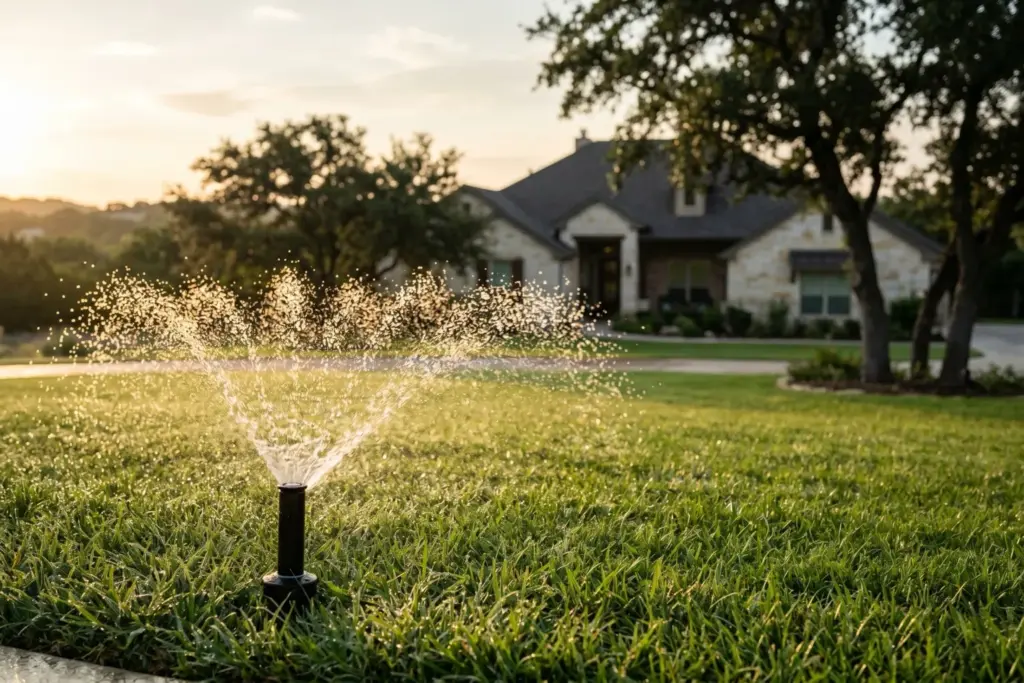
The cheapest way to cut your Austin summer water bill is to move your sprinkler clock to before 10 a.m. or after 7 p.m. and never run it in the middle of a 102-degree afternoon, when half of what you spray evaporates before it hits the roots. Austin Water already requires watering inside those windows, on limited days, and they will fine you up to $1,000 a violation if you ignore it. So you are paying for water that never reaches your grass and risking a ticket on top of it. That is a bad trade right. Lets fix it.
I have been selling and owning homes in Central Texas for 19 years, and I own a handful of properties, which means I have stood in a lot of yards at 6 a.m. wondering why a system was running while it was raining. But I am not an irrigation guy. I do not design zones or repair backflow preventers. So like I did for our year-round Austin home maintenance calendar, I called someone who does this every day, an irrigation tech who installs and services systems all over the Austin area, and I asked him the same plain question I ask all of them. What is the thing homeowners here get wrong that quietly costs them the most money? Here is what he told me, in his words and mine.
First, Know Your Watering Day (and Stop Guessing)
Austin Water runs a year-round Conservation Stage, which is a polite way of saying the watering rules never fully go away here, even in a wet year. Automatic in-ground irrigation systems are generally limited to one day a week. Hose-end sprinklers and drip get a little more room, usually two days a week. And all of it has to happen in the cool windows, before 10 a.m. or after 7 p.m., because watering at noon in August is basically setting money on fire.
Here is the part I want to be careful about, because rules change and they are not the same from town to town. Your specific watering day depends on your address and your utility, and I am not going to print a day here and have you build a schedule around something that shifts. If you are inside the city, Austin Water has a “Find Your Watering Day” tool that gives you the exact day for your address. If you are out in Lakeway, Bee Cave, Dripping Springs, or one of the MUDs, you are on a different utility with its own schedule, sometimes stricter than the city. The tech told me this is the number one thing he gets called about. Somebody sets their controller to the wrong day, gets a notice, and assumes the system is broken. It is not broken. It is just on the wrong day.
So before you touch anything else, look up your own watering day with whoever sends your water bill. Five minutes. Do not guess, and do not copy your neighbor, because if you are on opposite sides of an even-odd address split you could be on different days entirely.
The Setup Mistakes That Waste the Most Water
When my tech walks up to a system, he says he can usually spot the wasted money before he even turns it on. A few things show up over and over.
Spray heads watering the sidewalk and the street. You have seen it, that dark wet stripe running down the curb. “Half my service calls, the system works fine, it is just aimed wrong,” he told me. A head that throws water onto concrete is watering concrete, and concrete does not grow. A few minutes adjusting arcs and nozzles pays for itself fast. Cheap fix, real money saved, no big deal right.
Mixed heads on the same zone. If a zone has both big rotor heads and little fixed spray heads, they put out water at totally different rates, so by the time the rotors have done their job the spray areas are a swamp, or the other way around. That is a design problem, and it is worth having someone split the zone.
And the big one for us, runoff on clay. Most of Central Texas sits on expansive clay (the same shrink-swell clay I am always going on about with foundations), and clay does not drink fast. You blast a zone for 15 straight minutes and the back half of that just runs off down the yard because the soil cannot absorb it that quickly. The fix is something the pros call cycle and soak. Instead of one long run, you split it into two or three short runs with a soak break in between, so the water actually has time to sink in. Same total minutes, far less waste. Most modern controllers can do this automatically once it is set up. The reality is, a lot of expensive water in this town just runs into the gutter because nobody told the homeowner their soil cannot keep up.
Drip vs Spray: Where Each One Actually Belongs
This is the question I get asked at parties by people who just found out I sell houses and apparently think I install sprinklers too. Drip or spray? The honest answer is both, in different places.
Spray heads are for turf, the open lawn. That is what they are built for, covering a broad area of grass. Drip is for everything that is not lawn, your beds, your shrubs, the foundation plantings, the trees. And on clay soil drip is genuinely the smarter tool, because it dribbles water out slowly right at the root instead of throwing it into the air where the Texas sun and wind take a cut before it ever lands.
The numbers back it up. The EPA puts drip irrigation at roughly 20 to 50 percent less water than conventional spray sprinklers for the same plants, because almost nothing is lost to evaporation or runoff. On clay especially, that slow drip matches how fast the soil can actually absorb, which is the whole problem with spray on clay in the first place. So if you are redoing beds or putting in new landscaping, converting those zones to drip is one of the few upgrades that genuinely pays you back on the water bill. (Your grass still wants spray. Do not try to drip-irrigate a lawn, that is a different headache.)
Smart Controllers: Worth It or Gimmick?
I asked the tech straight up if the WiFi controllers are worth the money or just another gadget. His answer was the most useful thing he said all day. “A smart controller is worth it if it does one specific thing. Skips the watering when it has rained or is about to. Everything else is nice. That one thing is the money.”
And he is right, because the most expensive water in Austin is the water you spray on a lawn the morning after a thunderstorm. A weather-based controller pulls the local forecast and rainfall and just skips that cycle. Over a wet spring that adds up to real dollars and a lot of gallons you never needed. Kahneman’s whole point is that we run on autopilot and rarely stop to question the dumb default, and a sprinkler watering a soaked lawn is about as dumb a default as there is. The EPA actually certifies these under its WaterSense label specifically because they cut outdoor waste. A plain rain sensor (the little puck that tells the system to skip when it is wet) is the budget version of the same idea, and it is better than nothing. But a true weather-based smart controller is the upgrade I would actually spend on, because it solves the dumbest waste, watering when nature already did it for you.
One catch. A smart controller still has to obey your watering day. It does not get you out of the city restrictions, it just makes sure you are not wasting your allowed day on a wet lawn. Set the legal days, let the smart part decide whether to skip.
The Foundation Connection Nobody Tells New Texans About
Here is where this stops being about a green lawn and starts being about your single most expensive piece of the house. I wrote a whole post with a foundation specialist on why you water your slab in a Texas summer, and if you are new here it is the one to read, but the short version belongs in any irrigation conversation.
Your slab sits on that same expansive clay. When the clay dries out in an August drought, it shrinks and pulls away from the edge of your foundation, the slab loses support, and that is how you get sticking doors, stair-step cracks in the brick, and a repair bill that can run into five figures. The fix is consistent moisture around the perimeter. So your irrigation system is not just keeping the grass alive, it is, if you set it up right, also protecting your foundation.
But, and this is important, your regular sprinkler zones usually are not enough on their own during a real drought, and they are stuck on a one-day-a-week leash anyway. That is why most people here run a separate soaker hose around the foundation on a cheap timer for that job specifically. Think of your lawn irrigation and your foundation watering as two related but separate chores. The lawn keeps it looking alive. The foundation soaker keeps the house from moving. You want both, and you do not want to rely on the first one to do the second one’s job.
Check the Sprinkler System Before You Buy the House
This is the realtor part, and it is the one that costs my buyers the most when they skip it. An irrigation system almost never shows up on a standard home inspection in any real detail. Inspectors will note that one exists, but most will not run every zone, test every head, and check the controller and backflow preventer the way you would actually want. So a buyer closes, summer hits, they turn the system on for the first time, and discover three dead zones, a cracked valve, and a backflow device that needs replacing. Now it is their problem and their check to write.
So when I have a buyer on a house with a sprinkler system, I tell them to run it during the option period. Have the seller or your agent turn on every zone while you watch. You are looking for heads that do not pop up, geysers from a cracked line, dry spots, water running into the street, and whether the controller even works. If it is a bigger or older system, paying an irrigation tech 75 or 100 bucks to walk it during your option period is some of the cheapest peace of mind in the whole transaction. A full system repair can run well into four figures, and it is a lot easier to make that the seller’s problem before you close than your problem after.
It is the same logic as everything else I tell buyers in this climate. The expensive surprises in a Texas house are almost never bad luck. They are the thing nobody checked.
Frequently Asked Questions
One Last Thing
I am a real estate broker, not your irrigation tech, but I care about this stuff for the same reason I care about roofs and foundations. The water you waste every summer is real money, the foundation your irrigation quietly protects is the most expensive thing you own, and the sprinkler system you forgot to check before closing has a way of becoming a nasty first-summer surprise. None of it is hard. It is mostly just knowing your watering day, aiming your heads, and watering when the sun is not out to steal it.
If you are buying or selling in Austin or the Hill Country and you want a straight read on what a house actually needs, or what yours is worth in this market, that is the part I am good at. You can reach out to me here anytime. I have spent 19 years watching Austin homes (and their yards) deal with this climate, and I am happy to share what I have learned. Be safe, be good, and water before 10.


