 Ed Neuhaus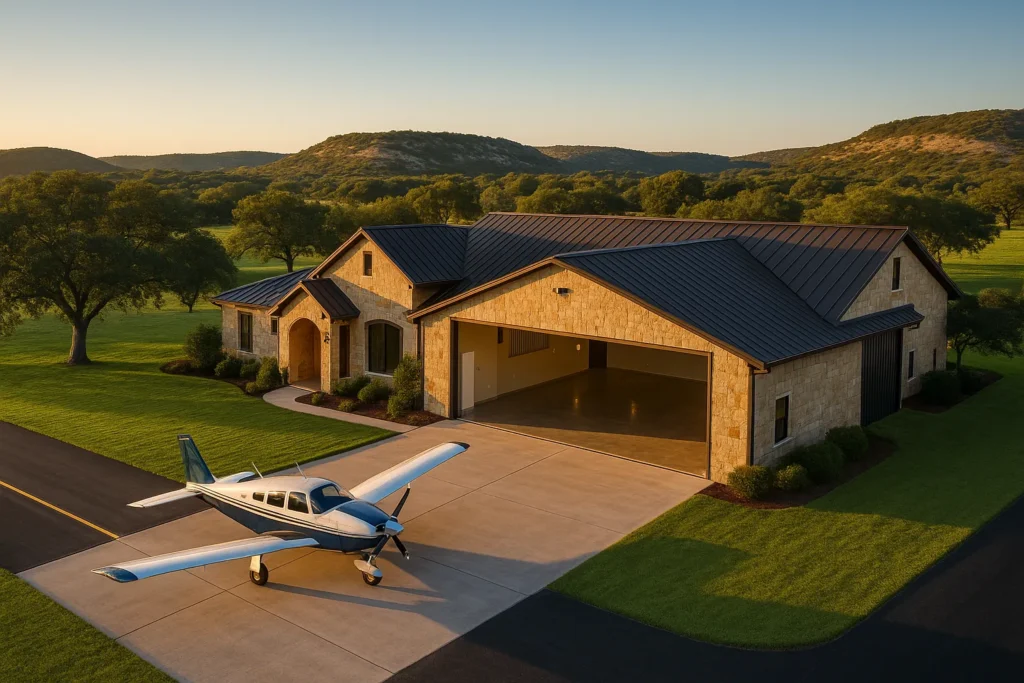
Texas has 84 residential airparks, more than any other state, and seven of the best are within 90 minutes of downtown Austin. That is not a random stat. It means if you are a pilot looking for a hangar home, Central Texas gives you more options in one metro than most people get in their entire state.
I am a pilot. I have been around aviation my entire adult life. And I can tell you that the fly-in communities in Central Texas are one of the most interesting corners of this market that almost nobody talks about. Not because people are keeping it a secret. Its just that the universe of buyers who need a taxiway connected to their garage is.. small. And that is exactly what makes these properties interesting.
So lets talk about what fly-in communities actually are, which ones exist in the Hill Country and greater Austin area, and why the barriers to owning one of these properties might be the best thing about them.
What Is a Fly-In Community
A fly-in community, sometimes called a residential airpark, is a neighborhood built around a private or public-use runway. The homes have direct taxiway access, meaning you can literally taxi your aircraft from the runway to your own hangar, which is usually attached to or part of your house.
Think of it like a lake house with a boat dock. Except the dock is a taxiway and the lake is the sky.
These communities are not apartment complexes with a landing strip. They are typically low-density neighborhoods on large lots, often an acre or more, with serious infrastructure. Paved runways, fuel availability, terminal buildings, and in some cases instrument approaches for bad weather days. The homes themselves range from modest ranch-style builds to full custom estates with 2,000+ square foot hangars attached.
The lifestyle is exactly what you would expect. You wake up on a Saturday morning, walk through your house to your hangar, pull the plane out, and you are wheels up in minutes. No driving to an FBO. No ramp fees. No waiting for your aircraft to get pulled out of a shared hangar. Your airplane lives where you live.
The Central Texas Airpark Map
Central Texas has a surprising number of these communities. Some have been here for decades. Others are brand new. Here are the ones worth knowing about, starting with the four that are closest to Austin and then working outward.
Lakeway Airpark (3R9)
This is the one I know best, and for my money it is the most compelling airpark in the region. Lakeway Airpark sits on 39 acres just 17 miles northwest of downtown Austin, right in the heart of Lakeway. The runway is 3,930 feet of asphalt, 70 feet wide, designated 16/34 at 909 feet elevation.
The history here is great. The runway started as a ranch strip back in 1962 on the Clifton George ranch. The Lakeway Company paved it in 1964 and it became a key part of the growing Lakeway community. In the late 1970s, the first hangar homes were built alongside the runway with attached taxiways. That is when it became a true airpark. The runway was lengthened to nearly 4,000 feet in 1986, and in 2003 they added an RNAV GPS approach to runway 16.
Today there are 32 residences surrounding the airpark. 30 of them have attached taxiways and hangars on the property. There are also six freestanding condo-style hangar buildings that each house four small aircraft. The airpark is owned and operated by Lakeway Airpark, Inc., a not-for-profit formed in 1995 when a group of homeowners purchased the property from Ross Perot’s Hillwood Corporation. No public funds involved. Its supported entirely by membership fees and fuel sales.
Operations run sunrise to sunset by city ordinance, and aircraft are limited to 12,500 lbs. So we are talking single and twin engine aircraft for 95% of the traffic.
The real estate here is serious. Recent listings have included a 5,800 square foot, 5 bedroom, 5 bath home with a 2,000 square foot aircraft hangar and direct runway access. There is also active new construction through Lakeway Airpark Estates, a luxury development by Zbranek & Holt Custom Homes where seven of eight home sites include an attached airplane hangar with taxiway access.
And because it is Lakeway, you get the full resort lifestyle on top of the aviation. Golf courses, Lake Travis marinas, private clubs, dining, and an award-winning medical center. Its not just an airpark. Its an airpark in one of the best communities in the Hill Country.
If you want the deep dive on this community, I wrote a full guide to Lakeway Airpark that covers everything from the runway history to what the neighborhood actually feels like day to day. And if you are browsing homes for sale in Lakeway, the airpark estates are a category of their own.
Breakaway Park and Hank Sasser Airport (40XS)
Here is the one that surprises people. There is a fly-in community in Cedar Park. Right in the Austin suburbs. Breakaway Park is the only residential airpark inside the Austin metro’s suburban ring, and it has been here since 1977 when a USMC veteran named Walter Yates built the subdivision with a 3,000 foot grass runway running through the center of it.
That runway got paved with asphalt in 2005. Today Hank Sasser Airport (named in 2014 for a beloved local pilot) is a privately owned, private use facility covering 25 acres. Hangars line both sides of the runway, many of them attached directly to the homes. You pull your plane out of your hangar, taxi to the runway, and you are airborne. The lots run 1 to 3 acres, which gives you genuine breathing room even though you are technically in Cedar Park city limits.
The real estate runs roughly $800K to $1.7M based on recent sales and current listings. That is serious money, but consider what you are getting. A 1 to 3 acre lot with a private hangar in a community 20 minutes from downtown Austin. You are in Leander ISD (which parents absolutely fight to get into). You have H-E-B, Costco, restaurants, everything you need within 10 minutes. And then you walk out back and there is a runway.
Only Breakaway Park residents (and recently, residents of the adjacent Three Points neighborhood) can use the airport. So this is a gated aviation community without the gated community vibe. The people here are pilots who happen to live in the suburbs. Its got a “hangar barbecue on Saturday” culture that is hard to replicate.
For a pilot who works in Austin or the tech corridor and wants the shortest possible commute between their job and their airplane, Breakaway Park is it. Nothing else comes close on location.
Cross Country Estates and Marshall Field (07TS)
Cross Country Estates is about 6 miles east of Georgetown, and it has a completely different feel from the other Austin-area airparks. This is a tight-knit community of 29 properties on lots ranging from one acre to five acres, centered around a 2,500 foot turf runway designated 35/17 with VASI navigation aids and runway lighting.
The turf runway is important to understand. At 2,500 feet on grass, this is a VFR taildragger community. If you fly a Cub, a Citabria, a Maule, or a light experimental, this is paradise. If you fly a Bonanza or a twin, you are probably looking at one of the paved options. The POA owns and maintains the runway, and the rule is simple: no operations within 24 hours of measurable rainfall. Coastal bermuda grass needs time to dry.
The infrastructure is better than you might expect for a small airpark. City water through Jonah Water, septic systems, underground utilities including phone and electric, fire hydrants within 500 feet of runway-side homes, and high-speed internet through AGL Wireless. Every property has direct taxiway access to the runway. The community is served by Hutto ISD and sits roughly equidistant from Georgetown, Round Rock, Hutto, and Taylor.
Here is what I like about Cross Country. All 29 lots are developed. When one comes up for sale, it moves by word of mouth through the aviation community before it ever hits the MLS. That tells you something about how the residents feel about living there right. Nobody is trying to leave. And the location puts you within 30 miles of Lake Travis, Georgetown’s growing retail and restaurant scene, and all of Round Rock.
If you are the kind of pilot who just wants to pull the tarp off your Cessna 180 on a clear morning and go fly, no complexity, no bureaucracy, just grass and sky, Cross Country is the place. I wrote a detailed profile of Cross Country Estates if you want the full picture.
Lago Vista and Rusty Allen Airport (KRYW)
Lago Vista sits on the north shore of Lake Travis and has its own airport. Rusty Allen Airport, designated KRYW, has a 3,808 foot asphalt runway (15/33) at 1,230 feet elevation, about 2 miles northeast of town.
Lago Vista is not technically a fly-in community in the taxiway-to-your-hangar sense. It is a town that happens to have a great airport. But that distinction matters less than you might think. Several properties near the airport have easy access, and the airport itself is an AOPA recommended destination with 83 based aircraft. The pilot community here is active and welcoming.
The real advantage of Lago Vista is price. Homes range from the high $200s to over $1M, which makes it the most affordable Lake Travis option by a wide margin compared to Lakeway or Bee Cave. You get the lake lifestyle, a legitimate airport with 83 based aircraft, and you still have money left over to keep your hangar stocked with avgas. For a pilot on a budget who wants Lake Travis and aviation in the same zip code, this is the play.
Spicewood Airport (88R) and Windermere Oaks
Here is one that flies under the radar (I know, I know). Spicewood Airport, designated 88R, is a privately owned public-use airport with a 4,185 foot asphalt runway. It is managed by pilots, which tells you something about the culture.
What makes this one interesting for buyers is its proximity to Windermere Oaks, a large gated community on the south shore of Lake Travis in unincorporated Spicewood. Windermere Oaks sits right next to the airport, and residents have access to a private marina, boat ramp, swimming pool, and tennis courts. The community dates back to 1979 and homes currently range from around $269K to $975K.
There are also taxiway-access lots available near the airport with water and sewer already in place. For someone who wants the Lake Travis lifestyle, aviation access, and does not want to pay Lakeway prices, this is worth a hard look. The airport is just a mile from the neighborhood.
Georgetown Airpark (TA68)
Georgetown Airpark is the newest player in the Central Texas airpark market and it shows. This is a gated community about 30 minutes north of Austin with a brand new 3,300 foot paved runway, plus a 1,000 foot hard surface RCA strip, and a 2,300 foot turf runway currently being completed.
Lots start at $275,000 and every one of them is over an acre, cleared, level, and ready to build. The infrastructure is modern: underground utilities, public water, high-speed fiber optic internet, a fully equipped pavilion, covered mail station, and even five RV parking spaces with electric hookups for guests. And the tax rate is low.
For pilots who want to build exactly what they want from scratch, this is hard to beat. You are designing your hangar home on a clean lot with brand new everything underneath it. They already have hangar homes built in 2024 with direct runway access, so the community is established and growing.
Horseshoe Bay Jet Center (KDZB)
If you want the biggest runway and the most luxury, Horseshoe Bay is it. The Horseshoe Bay Resort Jet Center has a 6,000 foot by 100 foot paved, lighted runway with full-service FBO operations including Jet A and Avgas.
This is the only airpark in the region that can comfortably handle larger aircraft, and the resort setting is hard to argue with. Lake LBJ waterfront, multiple championship golf courses, fine dining, and a community that caters to the luxury segment. Its about 50 miles from Austin and 60 from Austin-Bergstrom International.
Properties here with hangar access are rare and priced accordingly. One past listing featured a fully remodeled airpark home with a 2,700 square foot hangar adjacent to the Jet Center. This is the top of the market for aviation real estate in Central Texas.
Threshold Ranch and Boerne Stage Airfield (5C1)
Ok this one is a stretch geographically (about 90 minutes from Austin, 25 miles northwest of San Antonio) but I am including it because the runway alone justifies the drive. Boerne Stage Airfield has a 5,005 foot paved runway with full RNAV GPS instrument approaches on both runway ends, an AWOS-III weather system on 118.725, and self-serve Jet-A and 100LL fuel. That is an IFR-capable field with jet fuel right. For serious cross-country pilots, this changes everything.
Threshold Ranch is the gated residential airpark built around the field, developed in 2010. Homesites range from a half acre to over an acre, each with a private taxiway leading directly to the runway. The homes run 3,300 to 5,200+ square feet, and the whole community has that Hill Country luxury feel. Comal ISD schools, easy access to Boerne’s growing downtown, and San Antonio is 25 minutes south.
The operational profile here is a cut above most residential airparks. Stage 3 or better noise compliance is required for all turbine aircraft. There are published arrival procedures. On-field maintenance is available. This is not a weekend VFR strip. If you fly for business, if you own a turboprop or a light jet, if you need instrument approaches for reliable scheduling, Threshold Ranch is the only residential airpark in the greater Central Texas region that checks all those boxes.
The tradeoff is obvious: you are 90 minutes from Austin. If your life is centered in Austin, that is a real commute. But if you split time between Austin and San Antonio, or if your airplane IS your commute (not a crazy idea for a pilot right), then the runway capabilities at Boerne Stage make Threshold Ranch worth serious consideration. I covered this community in detail in my Threshold Ranch guide.
Austin-Area Airpark Comparison
Here is the side-by-side so you can see how these communities stack up. I left Threshold Ranch in the table even though its further out because it competes for the same buyers.
| Community | FAA ID | Runway | Surface | Homes | Price Range | Miles to Downtown Austin | School District | Best For |
|---|---|---|---|---|---|---|---|---|
| Lakeway Airpark | 3R9 | 3,930 ft | Asphalt | 32 | $800K – $2M+ | 17 | Lake Travis ISD | Luxury lake lifestyle + aviation |
| Breakaway Park | 40XS | 3,000 ft | Asphalt | ~40 | $800K – $1.7M | 20 | Leander ISD | Suburban convenience, short commute |
| Cross Country Estates | 07TS | 2,500 ft | Turf | 29 | $500K – $1M+ | 35 | Hutto ISD | VFR taildragger pilots, tight-knit community |
| Lago Vista / Rusty Allen | KRYW | 3,808 ft | Asphalt | N/A (town) | $280K – $1M+ | 35 | Lago Vista ISD | Budget-friendly Lake Travis + aviation |
| Spicewood / Windermere | 88R | 4,185 ft | Asphalt | N/A (adjacent) | $269K – $975K | 40 | Marble Falls ISD | Lake Travis at lower price point |
| Georgetown Airpark | TA68 | 3,300 ft | Asphalt | Growing | Lots from $275K | 30 | Georgetown ISD | New build, custom hangar home |
| Horseshoe Bay | KDZB | 6,000 ft | Asphalt | Limited | $1M+ | 50 | Marble Falls ISD | Larger aircraft, resort living |
| Threshold Ranch | 5C1 | 5,005 ft | Asphalt | ~30 | $800K – $1.5M+ | 90 | Comal ISD | IFR pilots, turboprops, Jet-A fuel |
The Complexity Moat: Why Supply Stays Small
Ok here is where it gets interesting from an investment perspective. Benjamin Graham wrote about buying assets that have a “margin of safety” built in. Airpark homes have something similar, except the margin is not in the price. Its in the supply.
You cannot just build a new fly-in community. The barriers to creating one are enormous, and that is exactly why the ones that exist hold their value so well.
Zoning and local regulations are the biggest wall. Texas Local Government Code Chapter 241 establishes controlled compatible land use areas within 1.5 statute miles of runway centerlines and up to five statute miles from runway ends. Local ordinances can prohibit aircraft operations from private property entirely. Many airpark developers have learned to work at the county level outside city limits to avoid the extra layers of bureaucracy, but even then the process is long and uncertain.
FAA requirements add another layer. Part 77 restricts the height of structures near runways. Any new airstrip requires Form 7480-1 registration and an FAA study to confirm it will not conflict with operations at nearby airports. Getting through that process takes time and expertise.
Financing is harder than you would expect. Banks do not assign any value to runway proximity. A hangar is classified as an “outbuilding” and often gets minimal appraisal credit. Lenders sometimes require higher down payments than conventional home loans because the buyer pool is so specialized. An identical home on the same amount of land in a regular neighborhood might sell for 30 to 50 percent less simply because it does not have taxiway access. If you want to understand how appraisers actually value these properties, I wrote about how airpark homes get appraised separately.
So what does all of this mean? It means that the supply of fly-in community properties is effectively capped. Nobody is building new runways inside the Austin metro. The communities that exist are the communities you get. And that scarcity is structural, not cyclical.
The Investment Case for Airpark Homes
I want to be honest about this because I have seen the data go both ways.
On the positive side, limited supply and growing demand have kept airpark values holding strong. In hot aviation markets like Texas, Florida, and Arizona, airpark homes are seeing shorter time on market and in some cases appreciating faster than the broader housing market. The built-in scarcity I just described is real and it is not going away.
On the realistic side, the buyer pool for these properties is small. Over half of airpark homes are second homes, and the owners have well-above-average incomes because, well, owning and maintaining a private aircraft is not cheap. When it comes time to sell, your pool of qualified buyers is a fraction of what it would be for a conventional home in the same price range.
So here is how I think about it. If you are a pilot and you are going to live in the home, the lifestyle premium pays for itself every time you skip the drive to the FBO. The investment upside is a bonus. If you are purely an investor with no aviation interest, you need to understand that you are buying a specialty asset with a thin resale market. The scarcity supports the value, but liquidity is limited.
For the right buyer, though, these properties are the definition of a complexity moat. The barriers to entry are high enough that competition stays low, and the people who want them really want them. If you are curious about how airpark home prices compare across the country, that context helps frame what you are getting in Texas.
What to Watch For Before You Buy
A few practical things I always tell buyers who are looking at airpark properties.
Operations restrictions matter. Every airpark has its own rules. Lakeway is sunrise to sunset only, no night operations, maximum 12,500 lb aircraft. Breakaway Park is residents only. Cross Country closes the runway after rain. Threshold Ranch requires Stage 3 noise compliance for turbine aircraft. Make sure the airpark’s rules match the aircraft you actually fly. I covered this topic in depth in my airpark HOA rules guide.
Insurance is different. Hangar homes need specialized coverage. Your standard homeowners policy is not going to cover an aircraft hangar and the liability that comes with taxiway operations on your property. Budget for aviation-specific insurance and talk to a broker who understands the space. I break down exactly what policies you need in my airpark home insurance guide.
HOA and airpark fees. Most of these communities have membership fees, maintenance assessments, or both. At Lakeway, the airpark is funded by member fees and fuel sales. Cross Country’s POA owns and maintains the turf runway. Georgetown has an HOA structure. Breakaway charges a $5,000 entry fee plus $500 annually with no HOA. Know what you are paying and what it covers.
Runway condition and management. A well-maintained runway is everything. Ask about the last resurface, who pays for maintenance, and what the long-term capital plan looks like. A community that is deferring runway maintenance is a community with problems coming. This is especially true for turf strips like Cross Country where drainage and grass health directly affect when you can fly.
Inspections are different too. A standard home inspection does not cover what matters in an airpark home. Hangar door mechanisms, taxiway condition, fuel system proximity, drainage patterns. I put together an airpark home inspection checklist that covers what normal inspections miss.
Resale planning. Think about your exit before you buy. These homes sell to a niche market. Work with a broker who understands aviation real estate and can market to the right buyers when the time comes. The MLS alone is not enough for these properties.
The tax angle. Your hangar may qualify for different tax treatment than a standard garage. The rules around this are nuanced and honestly kind of interesting if you are into that sort of thing (I am, Lindsey thinks that is weird). I wrote about the tax treatment of residential hangars separately because it deserves its own deep dive.
And if you are raising a family on an airpark, the school district matters just as much as the runway specs. The comparison table above includes school districts for exactly that reason.
Frequently Asked Questions
The Bottom Line
Central Texas has something that most metro areas in the country do not: eight fly-in communities and aviation airports within 90 minutes of a major city. From the established luxury of Lakeway Airpark to the suburban convenience of Breakaway Park, from the grass-strip simplicity of Cross Country Estates to the instrument-rated infrastructure at Threshold Ranch, there is an airpark for nearly every budget and every type of aircraft.
And there are dozens more across Texas if you widen the search. This state has 84 residential airparks for a reason. Lots of land, favorable regulations, and a culture that understands aviation as transportation, not just a hobby.
The complexity moat around these properties is real. Zoning, FAA regulations, financing hurdles, and the simple fact that you cannot build new runways in developed areas all combine to keep supply permanently limited. For pilots who want to live the life, the premium is worth it. For investors who understand niche assets, the scarcity story is compelling.
I have been working the Hill Country market for 19 years and I still get excited when an airpark listing comes across my desk. If you are a pilot thinking about making a move to one of these communities, or you just want to understand what is available, lets talk. I understand both sides of this transaction, the real estate and the aviation. And if you want the full step-by-step guide to buying an airpark home, I put that together too.
Be safe, be good, and be nice to people.


