How Much Austin Homeowners Can Save by Protesting Property Taxes in 2026
Between 60% and 80% of all Texas property tax protests result in a lower assessed value. When homeowners bring solid evidence to their hearing, that number jumps to 80% or higher. In Travis County alone, the appraisal district mailed notices to more than 427,000 property owners in spring 2026, and the median residential homestead market value sits at $493,449. Even a modest 5% reduction on that median value translates to roughly $450 in annual tax savings at current rates.
The Travis Central Appraisal District reported that single-family residences saw an average 1.8% decline in market value for 2026, but that county-wide average obscures wide variation. Some neighborhoods held steady. Others climbed. If your notice shows an increase that doesn’t match your block, you have a strong case to protest.
According to the Texas Comptroller’s office, every property owner in the state has the legal right to protest the appraised value of their property, and the process is designed to be accessible without hiring a professional. The Comptroller publishes Form 50-132 (Notice of Protest) and maintains detailed guidance on evidence standards, hearing procedures, and appeal rights.
For homeowners in Austin, Bee Cave, Lakeway, Dripping Springs, and surrounding Hill Country communities, a property tax protest is one of the most direct ways to lower your housing costs without refinancing or relocating. This guide walks through every step of the 2026 protest process for Travis, Williamson, and Hays counties, from reading your appraisal notice to winning an ARB hearing.

What Is a Property Tax Protest and Why Does It Matter?
A property tax protest is a formal challenge to the value your county appraisal district assigns to your property. Texas does not have a state income tax. Instead, local governments, school districts, and special districts fund operations almost entirely through property taxes. That means the appraised value on your notice directly determines your tax bill.
The effective property tax rate in Travis County hovers around 1.8% of assessed value. In Williamson County, it runs closer to 2.0%. Hays County falls somewhere in between, depending on your school district and any MUD or PID overlays. On a home appraised at $500,000, a 2% effective rate means a $10,000 annual tax bill. Reduce that appraised value by $50,000 and you save $1,000 per year, every year, until the district raises it again.
Property tax protests are not adversarial lawsuits. They are an administrative process built into the Texas Tax Code, and appraisal districts expect them. In some years, Travis County sees more than 100,000 protests filed. The system only works if property owners participate.
Key Deadlines for 2026: Travis, Williamson, and Hays Counties
The most important date is May 15, 2026. That is the statutory deadline to file a property tax protest in Texas. However, if your Notice of Appraised Value was mailed after April 15, you have 30 days from the mailing date instead of the May 15 deadline, whichever is later.
| County | Appraisal District | Notices Mailed | Protest Deadline | Informal Hearings Begin | ARB Hearings Begin |
|---|---|---|---|---|---|
| Travis | TCAD (traviscad.org) | Early April 2026 | May 15, 2026* | April 6, 2026 | June 2026 |
| Williamson | WCAD (wcad.org) | Early April 2026 | May 15, 2026* | Late April 2026 | Late May 2026 |
| Hays | Hays CAD (hayscad.com) | April 1, 2026 | May 15, 2026* | Mid-April 2026 | June-July 2026 |
*Or 30 days after your notice was mailed, whichever is later.
Missing the deadline means losing your right to protest for the entire year. There are no extensions. Mark the date now.
Step 1: Read Your Notice of Appraised Value
Your Notice of Appraised Value arrives by mail in early to mid-April (sometimes later, depending on your county). This single-page document contains several critical numbers:
Market Value: What the appraisal district believes your property would sell for on the open market as of January 1, 2026. This is the number most people protest.
Assessed Value: For homestead properties with a 10% annual cap, the assessed value may be lower than the market value. Your taxes are calculated on the assessed value, not the market value. But if the market value drops below your capped assessed value, your taxes drop too. That is why protesting still matters even with a homestead exemption.
Taxable Value: The assessed value minus any exemptions (homestead, over-65, disabled veteran, etc.). This is the number that gets multiplied by the tax rate.
Property Description: Square footage, lot size, year built, number of bedrooms and bathrooms. Errors here are common and are one of the easiest protest grounds. If your notice says 2,400 square feet and your home is actually 2,200, that alone could reduce your appraised value by $50,000 or more.
Check all of these numbers carefully. The appraisal district does not inspect every property every year. They rely on aerial photography, building permits, and mass appraisal models. Mistakes happen.
Step 2: Decide Your Grounds for Protest
Texas law allows property owners to protest on several grounds. You can select more than one when filing your Notice of Protest.
Market Value Is Too High
This is the most common reason. You believe the appraisal district overestimated what your property would sell for. To prove this, you need comparable sales data showing that similar homes in your area sold for less than your appraised value.
Unequal Appraisal
This argument says: even if my market value is technically accurate, neighboring properties that are similar to mine are appraised lower. Texas Tax Code Section 41.43 allows you to argue that your property is appraised at a higher percentage of market value than comparable properties. This is a powerful tool because it does not require you to prove the district got your value wrong, only that your neighbors got a better deal.
Property Description Errors
Wrong square footage, incorrect lot size, missing information about foundation problems, outdated condition ratings. These factual errors are the easiest to win because they are objectively verifiable.
Exemption Not Applied
If you qualified for a homestead exemption, over-65 freeze, disabled veteran exemption, or any other exemption and it was not applied, you can protest to get it corrected.
Ed Neuhaus, broker of Neuhaus Realty Group, notes that unequal appraisal is often the strongest argument for Austin-area homeowners. “Two identical homes on the same street can have appraised values $40,000 apart. The appraisal district’s own data proves the disparity, and the ARB takes that seriously.”
Step 3: How to File Your Property Tax Protest
Filing is straightforward. Every county offers multiple methods.
Travis County (TCAD)
Online (recommended): Visit traviscad.org, log in to your property owner account, and file electronically. You receive instant confirmation. The informal review process opens April 6, 2026, so you can file and begin informal negotiations almost immediately.
By mail: Send a completed Form 50-132 to Travis Central Appraisal District, PO Box 149012, Austin, TX 78714. The form must be received (not postmarked) by May 15.
In person: Visit the TCAD office at 850 East Anderson Lane, Austin, TX 78752.
Williamson County (WCAD)
Online: Visit wcad.org and use the online protest filing portal. Your appraisal notice includes an Online Passcode for authentication.
By mail: Send Form 50-132 to Williamson Central Appraisal District, 625 FM 1460, Georgetown, TX 78626.
In person: Visit the WCAD office in Georgetown.
Hays County (Hays CAD)
Online: Visit hayscad.com/protest and create an account to file electronically.
By email: Send your Notice of Protest to [email protected] with your property account number, contact information, and supporting evidence.
By mail or in person: Hays CAD, 21001 N. IH 35, Kyle, TX 78640.
When filing, check all applicable protest grounds. There is no penalty for selecting multiple reasons. Most experienced protesters check both “market value is too high” and “unequal appraisal” to give themselves the best chance at a reduction through either argument.
Step 4: Gather Your Evidence
Evidence wins protests. The homeowners who show up with organized data get reductions at dramatically higher rates than those who show up with opinions. Here is what to assemble.
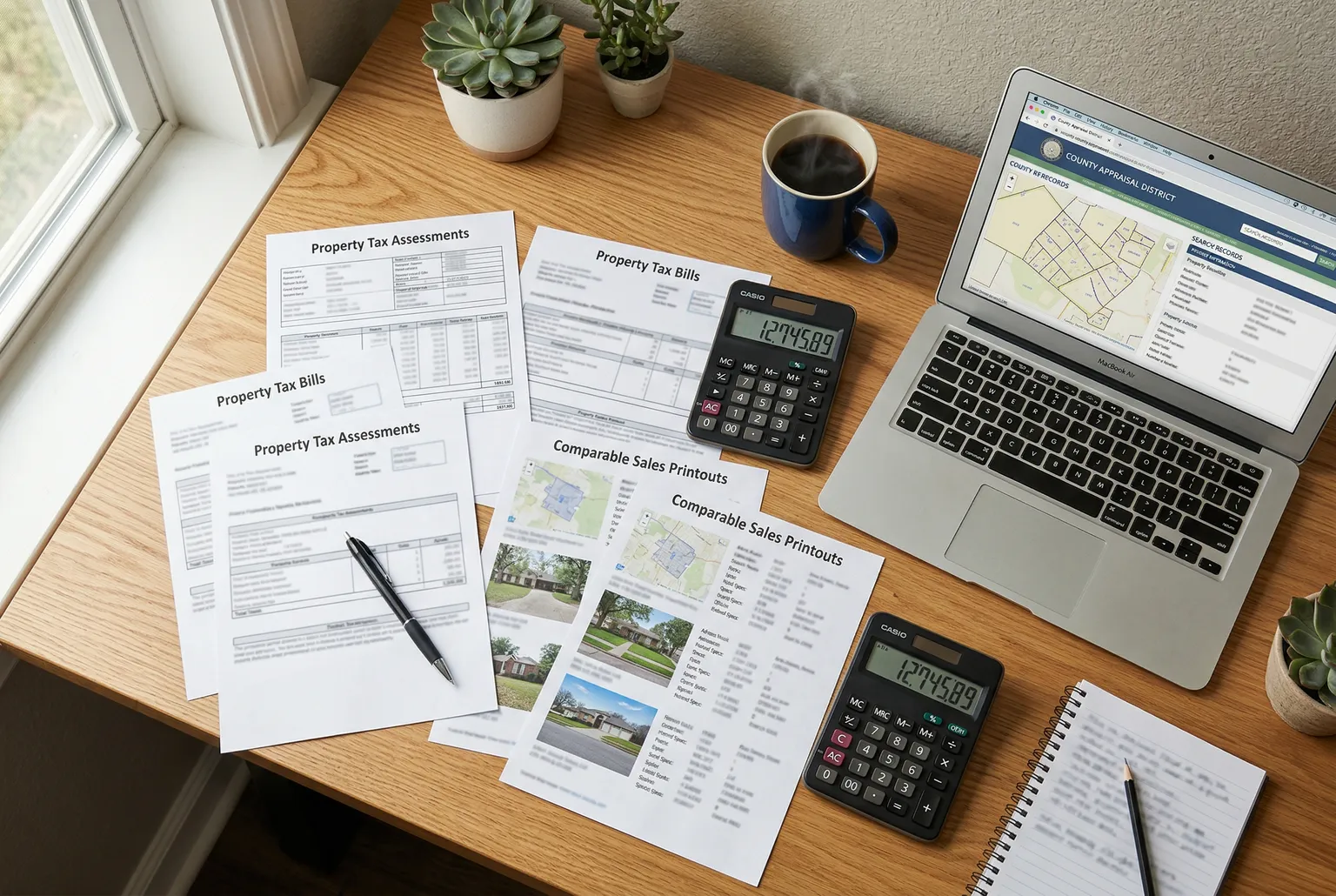
Comparable Sales (Comps)
This is the gold standard. Find 3 to 5 homes that sold within the past 12 months (ideally the past 6 months) that are similar to yours in size, age, condition, and location. Calculate the price per square foot for each comp and compare it to your appraised value per square foot.
Where to find comps:
- Your county appraisal district website (free property searches)
- The Neuhaus Realty Group guide to using comparable sales for protests
- Ask a real estate agent for MLS data (many will provide this free of charge)
- Public records from the county clerk’s office
The best comps are in the same subdivision or neighborhood code. The closer the match in square footage (within 200 sq ft), year built (within 5 years), and lot size, the stronger your argument.
Unequal Appraisal Evidence
Pull appraisal data for 5 to 10 properties similar to yours from the appraisal district website. Look for homes with the same bedroom/bathroom count, similar square footage, and nearby location that are appraised lower than yours on a price-per-square-foot basis. Create a table showing each property’s address, appraised value, square footage, and value per square foot. If the average is below your appraisal, you have a strong unequal appraisal case.
Photos and Condition Documentation
Take photos of any condition issues that might reduce your property’s value: aging roof, foundation cracks, outdated kitchen, water damage, drainage problems, or deferred maintenance. The appraisal district rates your property’s condition, and if their rating is too generous, photos prove it.
Get repair estimates in writing from contractors. A $15,000 foundation repair estimate is compelling evidence that your home should be valued lower than the district’s number.
Building Your Evidence Packet
Organize your evidence into a single packet, whether you are presenting it online, by mail, or in person:
- Cover page with your property account number, current appraised value, and your opinion of value
- Comparable sales table with prices per square foot
- Unequal appraisal table showing neighbor values
- Photos with descriptions and dates
- Repair estimates or inspection reports
- Any other supporting documentation
Keep it organized. ARB members review dozens of cases per day. A clean, concise presentation respects their time and strengthens your credibility.
The Informal Hearing: Your Best Shot at a Quick Win
Before you ever see the Appraisal Review Board, every county offers an informal hearing (sometimes called a settlement conference or informal meeting). This is where most protests get resolved.
In Travis County, the informal process begins April 6, 2026. An appraiser from the district reviews your evidence and may offer a reduced value. You can accept the offer, counter, or decline and proceed to the formal ARB hearing.
The informal hearing is a negotiation, not a trial. Be polite, prepared, and specific. Lead with your strongest evidence. If your comps show $180 per square foot and the district has you at $210, present those numbers clearly.
Tips for the informal hearing:
- Know your target number before you walk in (or log in). What value do you believe is correct?
- Let the appraiser make the first offer. Their opening number is often lower than the current appraised value.
- Do not accept the first offer unless it meets your target. You can counter once or twice.
- If the offer is reasonable but not quite where you want to be, weigh whether the difference is worth an ARB hearing (which could take months).
- You lose nothing by declining the informal offer. Your protest moves to the ARB automatically.
About 70% of protests in Travis County are resolved at the informal stage. If you have good evidence, this is the fastest path to savings.
What If Your Appraisal Went Down but Still Feels Too High?
Even in years when the appraisal district reports an overall decline, individual properties can still be overvalued. The 1.8% average decline in Travis County single-family values for 2026 is exactly that: an average. Your specific home might have increased, stayed flat, or declined more than the average. The district uses mass appraisal models that estimate values based on neighborhood trends, not individual property inspections.
If your neighborhood saw declining sales prices in late 2025 and early 2026 but your appraised value stayed the same or went up, that is worth protesting. Pull three to five recent closed sales within a half-mile of your home and compare the price per square foot. If the sold prices per square foot come in lower than your appraised value per square foot, you have the data to support a reduction.
This is especially common in areas where new construction activity has slowed. Builders may have been selling at $250 per square foot in 2024, but resale homes in the same subdivision are now trading at $220 per square foot. The appraisal district may still be using the higher builder-sale data points in its model. Your job in the protest is to show the more current market picture.
Ed Neuhaus of Neuhaus Realty Group frequently pulls MLS data for homeowners preparing protest evidence across the Hill Country. “The difference between appraised value and actual market value is often wider than people expect, especially in neighborhoods with limited recent sales. A targeted comp analysis from the MLS gives you data the appraisal district does not always have in its model.”
The Formal ARB Hearing: What to Expect
If the informal process does not produce an acceptable result, your case moves to the Appraisal Review Board (ARB). The ARB is an independent panel of citizens (not appraisal district employees) authorized to resolve disputes between property owners and the appraisal district.
Before the Hearing
You will receive written notice of your hearing date at least 15 days in advance. Thanks to HB 1533 (passed in 2025), the appraisal district must also disclose all evidence it plans to use at least 14 days before your hearing. This is a significant advantage. You can review their comparable sales, their valuation methodology, and prepare counterarguments.
Hearing Format
ARB hearings typically run 15 to 30 minutes. You can appear in person, by telephone, or by video conference (another HB 1533 provision). You can also submit a written affidavit with your evidence if you cannot attend.
The process works like this:
- The appraisal district presents its case for your property’s value
- You present your evidence and argue for a lower value
- Both sides may ask questions of the other
- Under Texas Tax Code Section 41.66(b), you always have the right to the final word
- The ARB panel deliberates and issues a decision
Presentation Strategy
Focus on your two or three strongest arguments. Do not try to cover every possible angle. ARB members appreciate concise presentations with clear data.
Start with your strongest comp. Show the sale price, the property details, and explain why it is comparable to yours. Then show your unequal appraisal data. Finish with any condition issues or errors in the property description.
Avoid emotional arguments (“my taxes are too high” or “I can’t afford this”). The ARB can only rule on whether the value is correct, not whether the taxes are fair.
Remote Hearing Tips
If you attend by phone or video:
- Submit your evidence packet in advance (upload it online or mail it before the hearing)
- Test your connection and equipment before the hearing starts
- Have your evidence in front of you so you can reference specific pages
- Speak clearly and pause between points so the panel can follow
What Happens After the ARB Decision
The ARB will mail you a written order with their determination. If they reduced your value, congratulations. The new value takes effect for the 2026 tax year.
If you are unsatisfied with the ARB’s decision, Texas law provides three appeal paths, all with strict deadlines:
| Appeal Option | Eligibility | Filing Deadline | Cost | Key Details |
|---|---|---|---|---|
| District Court | Any property | 60 days after ARB order | Court filing fees + possible attorney costs | Full trial; requires partial tax payment; can request jury |
| Binding Arbitration | Homesteads or properties valued ≤$5M | 60 days after ARB order | $450 deposit (homestead ≤$500K; $500 above) | Faster than court; limited appeal rights; decision is final |
| SOAH (State Office of Administrative Hearings) | Properties valued >$1M | 30 days after ARB order | $1,500 deposit | Administrative law judge; primarily for commercial properties |
For most residential homeowners, binding arbitration is the most practical post-ARB option. You file a request with the Texas Comptroller (Form AP-219), pay a $450 deposit for a homestead valued at $500,000 or less ($500 if above) (refundable if you win), and an independent arbitrator reviews your case. The process is faster and less expensive than district court, but the decision is final with very limited appeal rights.
Travis County vs. Williamson County vs. Hays County: Process Differences
While the Texas Tax Code sets the framework statewide, each appraisal district has its own portal, communication style, and practical nuances.
| Feature | Travis (TCAD) | Williamson (WCAD) | Hays (Hays CAD) |
|---|---|---|---|
| Online Portal | traviscad.org | wcad.org | hayscad.com |
| Email Filing | No (online or mail only) | No (online or mail only) | Yes ([email protected]) |
| Informal Start | April 6, 2026 | Late April 2026 | Mid-April 2026 |
| ARB Hearings | June 2026 | Late May-July 2026 | June-July 2026 (records approved by July 20) |
| Typical Volume | Highest in metro (100,000+ protests some years) | Moderate | Growing rapidly with county population |
| Online Experience | Well-developed portal with settlement offers | Online passcode system, straightforward | Account-based system, accepts email submissions |
If your property straddles county lines (rare but possible in areas like the Bee Cave/Dripping Springs corridor), you protest with whichever appraisal district has jurisdiction over your property. Check your notice for the appraisal district name.
Should You Hire a Property Tax Protest Firm?
You can absolutely protest on your own. The process is designed for property owners, and the filing itself takes about 15 minutes. However, professional protest firms handle thousands of cases per year and bring deep knowledge of local valuations, ARB tendencies, and evidence preparation.
Fee Structures
Contingency (most common): No upfront cost. You pay a percentage of your first-year tax savings, typically 25% to 50%. If the firm wins a $1,000 reduction in your tax bill, you pay $250 to $500. If they achieve no reduction, you owe nothing. This model aligns incentives: they only get paid if they save you money.
Flat fee: You pay a fixed amount ($49 to $200+) regardless of outcome. The risk here is paying for a protest that achieves nothing. Firms charging flat fees also have less financial incentive to fight for the largest possible reduction.
When Hiring Makes Sense
- You do not have time to research comps and attend hearings
- Your property is high-value (above $750,000) where even small percentage reductions mean significant savings
- You are uncomfortable presenting evidence or negotiating
- You are an out-of-state owner and cannot attend hearings easily
When DIY Makes Sense
- You have clear evidence (obvious comps, factual errors, condition issues)
- You are comfortable reviewing data and presenting your case
- Your potential savings are modest (under $500), making contingency fees eat into the benefit
- You want full control over the process and negotiations
If you decide to hire a firm, verify they are authorized to represent you (they will need a signed Form 50-162, Appointment of Agent), and confirm whether they attend ARB hearings in person or handle everything through written submissions. Some firms only do informal negotiations and stop before the ARB stage.
Annual Protest Strategy: Building a Multi-Year Approach
Property tax protests are not one-time events. The most effective approach is to protest every year, regardless of whether your value went up or down.
Why Protest Every Year
The appraisal district sets your value fresh each January 1. Last year’s reduction does not carry over automatically. If you won a reduction in 2025 but skip 2026, the district may ratchet your value back up. Consistent annual protests establish a pattern and keep your appraised value anchored closer to reality.
Track Your Data Year Over Year
Keep a file (physical or digital) for each tax year containing:
- Your Notice of Appraised Value
- The evidence you submitted
- The informal offer (if any)
- The ARB decision (if you went to hearing)
- Your final appraised and taxable values
This history helps you identify trends and spot anomalies. If your value jumped 15% when comps only support 5%, you have your protest argument ready.
The 10% Homestead Cap
If you have a homestead exemption, Texas law caps the annual increase in your assessed value at 10% (plus the value of any new improvements). This cap protects you from sudden spikes, but it does not replace the need to protest. Here is why: the cap applies to assessed value, but the appraised (market) value can increase without limit. If you let the market value climb unchecked for several years, and then lose your homestead exemption (by selling, renting out the property, or moving), you lose the cap protection entirely, and your taxes would jump to the full market value.
Protesting keeps the underlying market value in check, which protects you both now and in the future.
Common Mistakes That Sink Property Tax Protests
Missing the Deadline
May 15 (or 30 days after your notice) is absolute. There are no grace periods, no exceptions, and no appeals for late filings. Set a calendar reminder the day you receive your notice.
Using the Wrong Comps
A 1,200-square-foot bungalow in East Austin is not a valid comp for a 3,000-square-foot home in Lakeway. Comps must be similar in size, age, condition, and location. The more precise the match, the stronger your argument. Weak comps actually hurt your case because the ARB may dismiss your evidence entirely.
Arguing About Taxes Instead of Value
The appraisal district and the ARB have no authority over tax rates. They can only determine the value of your property. Complaining about high tax rates, government spending, or the unfairness of the system will not help. Stay focused on value.
Not Bringing Evidence
“I just feel like my value is too high” is not a protest strategy. The 20% of homeowners who bring no evidence to their hearing account for the majority of unsuccessful protests. Data wins. Opinions lose.
Accepting the First Informal Offer Too Quickly
The first offer from the informal appraiser is rarely the best the district can do. If their opening offer is a $20,000 reduction but your evidence supports a $40,000 reduction, counter. You can always accept a later offer, decline and go to the ARB, or settle somewhere in between.
Special Situations: Investment Properties, New Construction, and Recent Purchases
Investment and Rental Properties
Investment properties do not receive the homestead exemption or the 10% assessment cap. That makes protests even more important for investors, since appraisal increases hit the tax bill dollar-for-dollar with no cap protection. The protest process is identical, but your evidence may differ. Rental income and expense data (operating statements, vacancy rates, capital expenditure history) can be relevant for income-approach valuations, especially on multi-unit properties.
For a deeper look at investment property ownership in the Austin market, see the Complete Guide to Investment Property in Austin.
New Construction
New construction is tricky. The appraisal district may not have complete information about your home’s features and finishes. They sometimes overvalue new builds based on the builder’s base price without accounting for the specific lot, market conditions at the time of appraisal, or post-construction issues. Review the property description on your notice carefully. If the square footage, room count, or condition rating is wrong, protest.
Recent Purchases
If you bought your home recently, the sale price is the strongest possible evidence of market value. If your appraised value exceeds your purchase price, bring the closing statement. Appraisal districts are generally required to consider arm’s-length sales as evidence of market value. However, if you purchased through a related party, with seller concessions, or in an off-market deal, the district may scrutinize the sale more closely.
The Role of Homestead Exemptions in Your Protest Strategy
Filing a homestead exemption and protesting your property taxes are two separate actions, and you should do both. The homestead exemption reduces your taxable value. The protest reduces your appraised (market) value. Together, they compound your savings.
For 2026, the Texas homestead exemption removes $140,000 from your taxable value for school district taxes (Texas Comptroller). Many counties and cities offer additional exemptions. Travis County offers a 20% general homestead exemption. The City of Austin offers a 20% general homestead exemption for city taxes.
If you have not filed your homestead exemption, do that first. Visit your county appraisal district’s website and apply online. You can file a homestead exemption retroactively for up to two years. For the full breakdown, see the Complete Guide to Homestead Exemption in Texas.
How MUDs and PIDs Affect Your Protest
Many Austin-area neighborhoods sit within a Municipal Utility District (MUD) or Public Improvement District (PID). These districts add an extra layer of taxation on top of county, city, and school district taxes. MUD tax rates can add $0.50 to $1.50 per $100 of assessed value, which means a $500,000 home could pay an additional $2,500 to $7,500 in MUD taxes alone.
You cannot protest MUD or PID rates directly through the property tax protest process. Those rates are set by the district’s board. However, reducing your appraised value through a successful protest lowers your MUD and PID taxes proportionally, since they are calculated on the same assessed value.
If you live in a MUD or PID, the financial incentive to protest is even higher because each dollar of appraised value carries a heavier tax load. For more on how these districts work, read How Austin’s MUD and PID Districts Affect Your Property Tax Bill.
Online Tools and Resources for Your Protest
| Resource | What It Provides | Where to Find It |
|---|---|---|
| TCAD Property Search | Appraised values, property details, sales history for all Travis County properties | traviscad.org |
| WCAD Property Search | Same for Williamson County | wcad.org |
| Hays CAD Property Search | Same for Hays County | hayscad.com |
| Texas Comptroller Protest Forms | Form 50-132 (Notice of Protest), Form 50-162 (Agent Authorization) | comptroller.texas.gov |
| County Clerk Deed Records | Recorded sale prices for comp research | County clerk websites |
According to Neuhaus Realty Group‘s analysis of the Austin market, homeowners who combine appraisal district data with MLS-sourced comparable sales build the strongest protest cases. A real estate agent familiar with your neighborhood can often pull five to ten relevant comps in minutes, giving you a significant evidence advantage over using public records alone.

2026 Legislative Changes Affecting Property Tax Protests
The Texas Legislature has made several changes in recent sessions that directly impact the 2026 protest process.
HB 1533: Evidence Disclosure and Remote Hearings
This is the biggest procedural change for 2026. The appraisal district must now disclose all evidence it intends to use at least 14 days before your ARB hearing. Previously, homeowners sometimes walked into hearings blind, not knowing what data the district would present. Now you can review their comps, their methodology, and prepare specific rebuttals.
HB 1533 also codified the right to attend ARB hearings by phone or video conference. You no longer need to take time off work to sit in a government building.
Proposition 4 (2023): Expanded Homestead Exemption
The $140,000 school district homestead exemption (raised from $100,000 by Proposition 13, approved November 2025) benefits homeowners in 2026. Combined with local percentage exemptions, this removes well over $140,000 from your taxable value before any protest reduction is applied.
10% Assessment Cap for Non-Homestead Properties
A provision discussed in recent legislative sessions would extend the 10% assessment cap to commercial and investment properties. As of 2026, this cap only applies to residential homesteads. Investment property owners should watch for updates during the current legislative session.
Property Tax Protest Timeline: A Month-by-Month Calendar
| Month | Action |
|---|---|
| January | Appraisal districts set values as of January 1. No action needed yet. |
| February-March | Review previous year’s protest file. Identify new comps from recent sales. |
| April (early) | Receive Notice of Appraised Value. Review for errors. Begin gathering evidence. |
| April (mid) | File your protest online, by mail, or in person. Do not wait until May. |
| April-May | Attend informal hearing. Negotiate with appraiser. Accept or decline offer. |
| May 15 | DEADLINE to file protest (or 30 days after notice, whichever is later). |
| June-July | ARB hearings for cases not resolved informally. |
| July-August | Receive ARB decision. Evaluate appeal options if unsatisfied. |
| August-September | 60-day deadline for binding arbitration or district court appeal. |
| October-December | Tax bills mailed and due. Verify your protest reduction is reflected. |
Frequently Asked Questions
Take Action Before May 15
Property tax protests are one of the few financial tools available to Austin homeowners that cost nothing to use and have a high probability of success. The data is clear: the majority of protests result in a reduction, and homeowners who bring evidence save hundreds to thousands of dollars per year.
File your protest early. April filings get informal hearing appointments faster than last-minute May filings. Gather your comps, check your property description for errors, and photograph any condition issues.
For more on Austin property taxes, including rate breakdowns, exemption details, and payment schedules, read the Complete Austin Property Tax Guide for 2026. If you need comparable sales data for your protest, the Travis County property tax protest guide covers the step-by-step process.
Your appraisal notice is not a final answer. It is the opening of a negotiation. Treat it that way.


