 Ed
Ed 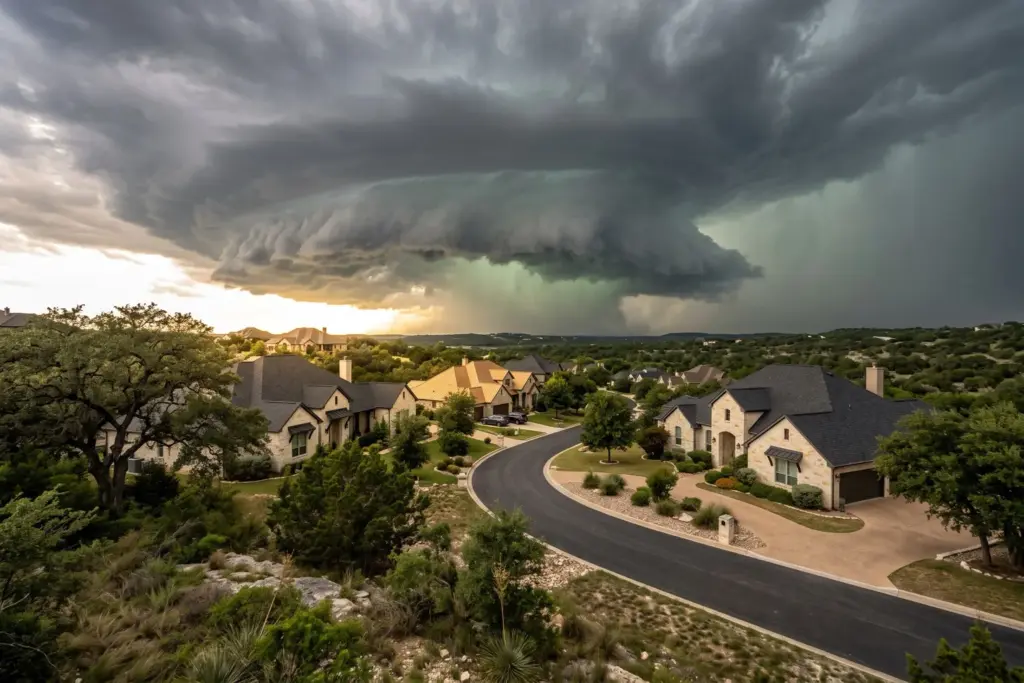
The average Texas homeowner paid $3,506 for home insurance in 2025, which is the state’s preliminary count. In 2021 that same average was $2,124, so the price went up 65 percent in four years. And it did that while the median home in Travis County got cheaper.
Those two numbers sit next to each other in my notes and I cannot unsee them. (My wife has pointed out that this is not normal dinner conversation. She is not wrong.) The premium side comes from the Texas Department of Insurance, which publishes the statewide average annual premium going back to 2015. The home price side comes from our own market database at Neuhaus Realty Group, built from the MLS data feed we license. Nobody had to guess at either one.
So no, your carrier did not pull a number out of a hat. Texas home insurance got expensive for four specific reasons and I can show you all four with receipts. Then I want to tell you the part almost nobody is saying out loud, which is that the wholesale price of this risk already peaked and has been falling for two years. Your renewal letter just has not caught up yet.
First, the receipts on Texas home insurance
Here is what TDI actually reports. Two different columns that people constantly mash together, so I am going to keep them separate.
| Year | Texas average annual premium | Change vs prior year | TDI statewide rate change |
|---|---|---|---|
| 2019 | $1,961 | +2.3% | +4.2% |
| 2020 | $1,987 | +1.3% | +3.8% |
| 2021 | $2,124 | +6.9% | +5.9% |
| 2022 | $2,374 | +11.8% | +10.8% |
| 2023 | $2,800 | +17.9% | +21.1% |
| 2024 | $3,291 | +17.5% | +18.7% |
| 2025 (preliminary) | $3,506 | +6.5% | +4.3% |
Look at 2025. The rate change was 4.3 percent but the average premium went up 6.5 percent. That gap is not an error and it is the single most useful thing on this page. A rate change is the price per unit of coverage. Your premium is the price times how much coverage you carry. Coverage amounts move on their own, TDI’s average home coverage went from about $243,000 in 2015 to about $409,000 in 2024, and a filed rate change takes a year or more to work its way through everybody’s renewal. So the two lines never match in a given year, in either direction.
So when a carrier tells you “we did not raise your rates this year,” that can be completely true and your bill can still be higher. Ok that is annoying, but at least now you know which question to ask.
Over the whole run, 2021 to 2025, that is $1,382 more per year. About $115 a month. For a lot of the buyers I work with that is the difference between the house they wanted and the house they settled for.
Your house got cheaper. The risk did not.
Here is the part no national insurance site is going to write, because they do not have Central Texas sold data and we do.
| County | Median sold price, July 2021 | July 2025 | July 2026 | Change 2021 to 2026 |
|---|---|---|---|---|
| Travis | $550,000 | $520,775 | $525,000 | -4.5% |
| Williamson | $440,000 | $419,990 | $415,000 | -5.7% |
| Hays | $403,000 | $364,000 | $372,490 | -7.6% |
Every county in this metro is worth less at the median than it was in July 2021. Hays is down almost 8 percent. Over roughly the same stretch, 2021 to 2025, which is the latest year TDI publishes, the statewide average premium climbed 65 percent.
That is the whole thesis of this article in one comparison. What you pay to insure the house has almost nothing to do with what the house is worth on the open market. It tracks two completely different things: what it costs to rebuild the structure, and how often storms around here break structures. Both of those went one direction while prices went the other. Nobody explains that to you at closing, they hand you a binder and move on.
Reason one: hail is the main event now, not a side character
TDI publishes Texas homeowners losses by peril. For 2024 it looks like this: hail $4.93 billion, wind $2.21 billion, water and freeze $1.61 billion, fire $1.09 billion, everything else $362 million. Hail alone is 48 percent of all homeowners losses in the state. Hail and wind together are about 70 percent.
Not hurricanes. Not wildfire. Ice falling out of the sky onto roofs. (Every spring I get the same text from three different clients within about an hour of a storm cell coming through, and every spring I tell them the same thing, wait for daylight before you climb anything.)
The Dallas Fed put a number on how fast this changed. In a April 2026 analysis by Mariam Yousuf, Texas went from 8 billion dollar disasters in 2017 to 20 in 2024, two and a half times as many, and Texas’ share of all US billion dollar storms went from 8 percent to 74 percent over that same period.
Now, I want to be fair about that number, because the Dallas Fed itself is fair about it. Those disaster counts are inflation adjusted, but they still reflect the fact that Texas built a lot more stuff worth a lot more money in the path of these storms, which makes it easier for a mid-sized hail event to clear a billion dollars. The Fed checked that though. Texas real GDP grew 34 percent and population grew 10 percent over the same window, and both of those are well below the growth in storm costs. Their conclusion is that more bad weather is likely the primary driver, not just more houses. I find that convincing and I would have said so either way.
Globally the same pattern shows up. Swiss Re Institute counted $51 billion in insured losses from severe convective storms in 2025, the third costliest year on record for that peril, behind only 2023 and 2024. Three of the worst hail and windstorm years ever recorded happened back to back to back.
Daniel Kahneman’s work on the availability heuristic says we judge how likely something is by how easily we can call an example to mind. If you have not personally had a hail claim, hail feels rare to you. Your carrier is not working off memory. It is working off a claims file for your zip code that goes back years, and in Central Texas that file is fat.
Reason two: the roof costs a fortune to replace and it is still climbing
Your dwelling coverage is not based on what you paid for the house. It is based on what it costs to rebuild it. So the price of building materials feeds directly into your premium, and roofing is the material that matters most in a hail state.
The Bureau of Labor Statistics tracks a producer price index for asphalt shingle and coating materials manufacturing. In January 2021 it read 261.5. In July 2026 it read 374.3. That is up 43 percent, and July 2026 is the highest reading in a series that starts in December 1975.
Lets be plain about what that means. In plain dollars, shingles have never cost more than they do right now, in fifty years of the government tracking it. Adjust for inflation and the early 1980s were actually worse, I will give you that. But nobody settles a 2026 hail claim in 1980 dollars. Every replacement cost claim your carrier pays gets settled at today’s price.
This is also why roof age has become the whole ballgame on a purchase. A 15 year old composition roof in Texas is at the end of its life, and some carriers will either decline it or move you from replacement cost coverage to actual cash value, which pays the depreciated value of a worn out roof. That is close to nothing. If you want the mechanics of replacement cost versus actual cash value, we walk through all of it in the complete guide to homeowners insurance in Austin. And if a storm already came through, my conversation with a roofer about post-storm hail inspections is worth ten minutes.
Reason three: insurance companies buy insurance, and it got expensive
This is the piece that never makes it into consumer articles, and it explains more of your premium than anything else on this list.
Your carrier does not keep all of your risk. It buys reinsurance, which is insurance for insurance companies, so that one bad hail season does not take the whole company down. That is a reasonable thing for them to do, right. But when reinsurance gets more expensive, that cost lands in your premium whether or not a single shingle on your street was damaged. (I did not understand this at all for the first decade I did this job. I just assumed premiums went up because claims went up on my street.)
Guy Carpenter tracks the price of that coverage in an index that goes back to 1990. US property catastrophe reinsurance rates hit an all time high in 2024. Not a recent high, an all time high. And even after rates started falling in 2025, the index was still sitting above any level it had reached before 2023.
So think about what that means for your 2023, 2024 and 2025 renewals. Your carrier was buying its own protection at the most expensive prices in the history of the market, at the same time shingles were setting records, in the same years Texas was setting storm loss records. Three inputs, all at record highs, all at once. The premium did what it had to do.
Reason four: Texas lets the price actually move
Texas is a file and use state. Under Sections 2251.101 and 2251.103 of the Texas Insurance Code, a carrier may use a rate on and after the day it files it, and the commissioner then has until the earlier of the effective date or 30 days to disapprove it. So the regulator reviews it after, rather than making the company wait for a blessing first.
The Dallas Fed analysis has an honest read on what that does. In heavily regulated states like California and North Carolina, homeowners tend to pay less than their actual climate risk would justify, because insurers cannot get the increase approved. In lightly regulated states, insurers raise rates even when expected losses have not really changed. Texas is in the middle of the pack, and the Fed says Texas may be subject to some of those distortionary effects.
I am not going to pretend that is good news. But it cuts both ways and that matters for what happens next. A market where prices move fast on the way up also moves faster on the way down than a market where every change needs a hearing.
Here is the part nobody is telling you
The wholesale price of this risk already turned.
Guy Carpenter’s global property catastrophe rate on line index fell 12 percent at the January 2026 renewal, and by the July 2026 renewals it was down about 16 percent across the year, which is the steepest annual drop since the late 1990s. The US version of that index is down 22 percent from its 2024 peak. Reinsurers have plenty of capital, losses have been manageable, and they are competing on price again.
The retail side is following, slowly. TDI’s statewide rate change collapsed from 18.7 percent in 2024 to 4.3 percent in 2025. And the rate requests carriers are filing have gone flat. In TDI’s July 2026 filing window, filed rate requests averaged negative 2.8 percent, and across the May to July window they averaged positive 0.4 percent. TDI rolls those numbers forward every month, so go look at the current window yourself rather than taking my word for where it sits the day you read this.
| Input | Where it is now | Direction | Source |
|---|---|---|---|
| Texas statewide rate change | +4.3% in 2025, down from +18.7% in 2024 | Cooling | TDI |
| US property cat reinsurance | Down 22% from the 2024 peak | Falling | Guy Carpenter |
| Asphalt shingle price index | 374.3 in July 2026, a record nominal high | Still rising | BLS producer price index |
| Severe convective storm losses | $51B globally in 2025, third worst on record | Still elevated | Swiss Re Institute |
So do not go expecting a refund. Two of the four inputs are still pushing up. What has changed is the speed. The years of 18 and 21 percent statewide increases look like they are behind us, and if you got quoted during 2023 or 2024 and never shopped it again, you are very likely carrying a price that the current market would not charge you.
That is the actionable part, and it is worth more than the whole rest of this article.
What you can actually do about your Texas home insurance
Five things, in the order I would do them.
- Shop it every single renewal, not every few years. Prices moved enormously between 2023 and 2026 and carriers do not volunteer to lower your rate. Worth knowing how wide the spread is: TDI puts the 2025 Texas average at $3,506, while Insurify, which prices a standardized policy off quotes and rate filings rather than measuring what in force policies actually cost, put Texas at $4,380. Both are defensible, they are measuring different things, and the gap tells you how much room there is between what one company quotes you and what another will.
- Find out what your wind and hail deductible actually is. On most Texas policies it is a percentage of your dwelling coverage, not a flat dollar amount. On a $500,000 dwelling limit, a 2 percent wind and hail deductible is $10,000 out of your pocket before the carrier pays a dime. A lot of people think they have a $2,500 deductible and they do not, not for the peril that is actually going to hit them.
- Treat roof age as a price, not a detail. Class 4 impact resistant shingles earn a premium credit from some carriers. Class 4 is the top impact resistance rating a roofing material can earn in lab testing, but TDI says plainly that the size of that discount is set by each insurance company on a company by company basis, so there is no standard number and you have to ask yours directly. A roof under 10 years old also changes which companies will even quote you.
- Get the insurance quote during the option period. Not after closing. This is the one that costs my buyers the most money when they skip it, and I will come back to it below.
- Do not solve this by dropping coverage. The Dallas Fed describes Texas homeowners responding to premium increases by cutting coverage limits, raising deductibles, and switching to actual cash value. That converts a monthly problem into a catastrophic one. Lowering your limits does not lower your risk, it just moves the bill to a worse day.
The option period thing, because this is where I actually help
When you go under contract on a house here, you have an option period. Everybody uses it for the inspection. Almost nobody uses it to get a real insurance quote, and that is a mistake I watch play out several times a year.
Insurability is a property characteristic, same as the foundation or the septic. A 17 year old roof, a prior claim history on the address, a wood shake roof, an older electrical panel, a location that a particular carrier has decided to stop writing. Any one of those can add thousands of dollars a year to the quote, and you will not find out from the seller’s disclosure. You find out from an agent running the actual address.
Getting that quote during the option period does two things. It tells you your real monthly payment before you are committed, and it gives you a reason to renegotiate. I have watched buyers get roof credits at closing purely because they had an insurance quote in hand that spelled out why the roof was a problem. Without the quote it is an opinion. With the quote it is a number, and numbers move sellers.
That is not hard to do, right. It just has to happen in the window where it still helps you.
This is the first of a few pieces we are doing on insurance. Coming up: what your policy actually covers and why “named peril” versus “open peril” is the most expensive sentence in the document, how carriers really differ from each other, and what premiums look like by specific area around Lakeway, Bee Cave, Dripping Springs and Westlake. If you want the dollar ranges right now, we already published what Austin homeowners are actually paying in 2026. And if your house is anywhere near a creek, read the flood zone guide too, because none of the above covers flood.
Frequently Asked Questions
If you want a real number before you commit
If you are under contract, or about to be, and you want to know what this house is actually going to cost you every month with insurance included, that is a conversation worth having before your option period runs out rather than after. Same goes if you already own and your renewal made you sit down.
Get in touch with our team and we will run it with you. No charge, and if the answer is that your current policy is already fine, I would rather tell you that than sell you something.
Be safe, be good, and be nice to people.


